
Quick Read
- Stanford ranks 3rd and Harvard ranks 5th in the QS World Rankings 2027.
- Harvard’s 2026-27 full cost of attendance is Rs.83.18 lakh ($86,926) a year.
- Stanford’s 2026-27 tuition alone is Rs.64.81 lakh ($67,731) a year.
- Harvard covers full cost for Indian families earning under Rs.95.69 lakh ($100,000).
- Both schools admit under 4.5% of applicants in their most recent cycles.
- Indian applicants face effective acceptance rates lower than the headline figure.
Harvard vs Stanford QS Ranking 2027: Who’s Actually Ahead?
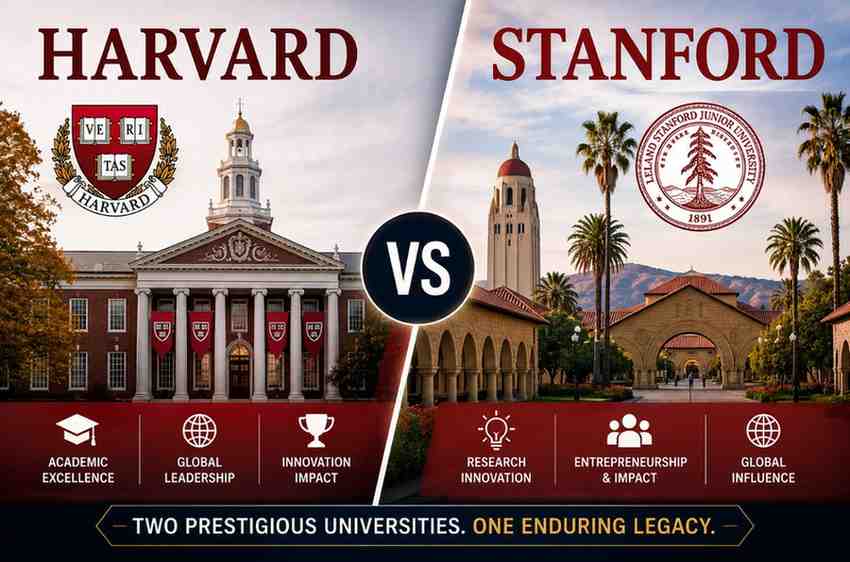
Stanford rose to third place in the QS World University Rankings 2027, moving ahead of Oxford and Harvard, which sits fifth. This is a real shift: Stanford climbed from 6th to 3rd through improvements in sustainability and international faculty numbers.
| Metric | Harvard | Stanford |
|---|---|---|
| QS World Rank 2027 | 5 | 3 |
| Known for | Liberal arts, law, policy, medicine | Engineering, CS, entrepreneurship |
| Founded | 1636 | 1885 |

Choose your dream country
 UK
UK
 USA
USA
 Germany
 Australia
 Ireland
 Canada
 UAE
UAE
 France
 Sweden
 Italy
Italy
 Other
Other
When do you want to study abroad?
What's your highest level of education?
Have you completed Class 12th?
What was your Class 12 CGPA/percentage?
Are you a student or a parent/guardian?
What do you want to study?
Select your current city
How Leap will help you

Personalised University Shortlist

Express Applications with Quicker Admits

End-to-End Application Support
Counselor insight: A three-place QS gap between two universities ranked in the global top 5 changes nothing about your outcomes. Recruiters and PhD committees do not distinguish between rank 3 and rank 5. Pick based on the sections below, not this table.
Related reading: Oxford vs Harvard comparison if you're also weighing UK options.
Harvard vs Stanford Cost of Attendance 2026-27: The Real INR Numbers
This is where most comparison guides stop at the US dollar figure. Here's what it actually means for an Indian family, at Rs.95.69 to the dollar.
| Cost component | Harvard 2026-27 | Stanford 2026-27 |
|---|---|---|
| Tuition (USD) | $59,320 | $67,731 |
| Tuition (INR) | Rs.56.76 lakh | Rs.64.81 lakh |
| Room & board (USD) | $8,598 + $13,532 | $22,944 |
| Room & board (INR) | Rs.21.16 lakh | Rs.21.96 lakh |
| Total sticker COA (USD) | $86,926 | ~$90,675 |
| Total sticker COA (INR) | Rs.83.18 lakh | Rs.86.77 lakh |
Exchange rate used: 1 USD = Rs.95.69. Verify the current rate before finalising your budget.
Financial aid changes this math completely for most Indian families:
- Harvard is tuition-free for families earning $200,000 or less (Rs.1.91 crore) and covers the full cost of tuition, fees, food, and housing for families earning $200,000 or below.
- For families with incomes below $100,000 (Rs.95.69 lakh), Harvard's expected parent contribution is zero.
- Stanford families earning under $100,000 typically pay nothing for tuition, room, and board, and families earning up to $150,000 may qualify for significant aid.
- Over 60% of Stanford undergraduates receive Stanford Scholarship grant aid that never has to be repaid.
Counselor insight: Most Indian families in the Rs.15–40 lakh annual income bracket assume elite US universities are financially out of reach. For need-blind schools like Harvard and Stanford, that assumption is usually wrong the real barrier is admission, not affordability, once you're in.
Which Harvard vs Stanford Scholarships Apply to Indian Students?
| Scholarship | Applies to | Coverage |
|---|---|---|
| J.N. Tata Endowment | Both, PG students | Loan scholarship starting from Rs.1 lakh |
| Fulbright-Nehru Fellowship | Both, Master's/PhD | Full tuition, ~$2,500/month living allowance, round-trip airfare |
| Inlaks Shivdasani Foundation | Both, grad students | Tuition, living expenses, and travel |
| Stanford Reliance Dhirubhai Fellowship | Stanford MBA only | Full cost of tuition and fees |
| Knight-Hennessy Scholars | Stanford, grad only | Up to 3 years of full funding tuition, stipend, travel |
| Need-based institutional aid | Both, all levels | Need-blind admission; up to 100% of demonstrated need met |
Full list: Scholarships for Indian students in the USA
Harvard vs Stanford: Which Wins for CS, MBA, or Humanities?
Harvard graduates dominate finance, consulting, law, and public policy, moving into firms like Goldman Sachs, McKinsey, and the World Bank. Stanford graduates are deeply embedded in technology, engineering, and entrepreneurship, sitting minutes from Google, Apple, and hundreds of active startups.
| Field | Better fit |
|---|---|
| Computer Science / Engineering | Stanford Silicon Valley proximity, recruiter density |
| Law, Public Policy, Government | Harvard Kennedy School, Law School network |
| Humanities, Social Sciences | Harvard larger liberal arts core |
| MBA (general management) | Harvard broader industry spread |
| MBA (VC, startups, tech) | Stanford GSB's Silicon Valley pipeline |
MBA specifically: Harvard Business School's median base MBA salary is $184,500, with a median signing bonus of $30,000 and a 90% offer rate within three months of graduation. Stanford GSB tends to post higher packages in tech and venture roles, though it is also harder to get into.
Explore programs: Top Tier 1 universities in the USA for MS | Harvard Business School course fees
Test requirement for MBA: More than 35,000 Indian students take the GMAT every year check GMAT exam details for current fees and dates, or GRE exam details if your target program accepts either.
Harvard vs Stanford: A Decision Framework for Indian Student Profiles
If you are a Class 12 JEE aspirant also targeting CS abroad: Apply to Stanford as your reach for CS/engineering. Your JEE prep already covers the math depth Stanford's admissions readers look for. Pair your application with a strong SAT score for Stanford (aim for 1500+) and highlight independent projects over coaching-class rankings, which don't translate on a US application.
If you are a humanities or UPSC-track student: Harvard's concentration system and Kennedy School pipeline fit a policy, law, or civil-services-adjacent career better than Stanford's engineering-heavy culture. Target the Harvard SAT score range of 1500–1580 and lead your essays with research or advocacy work, not just grades.
If you are a working professional targeting an MBA: Choose Harvard if you want optionality across consulting, finance, and general management. Choose Stanford GSB if you're set on venture capital or founding a startup its class size is smaller and its network sits inside the industry you're targeting. Either way, budget 3–4 months for GMAT prep alongside your job.
Documents and Timeline: Applying to Harvard vs Stanford from India
| Document | Harvard | Stanford | India-specific note |
|---|---|---|---|
| Class 12 marksheet + provisional certificate | Required | Required | CBSE/ISC/state board get English-medium attested copies |
| SAT or ACT | Required for 2026-27 (test-optional policy ends) | Required from fall 2026 entry | Book via SAT exam page |
| English proficiency (IELTS/TOEFL/DET) | Required for non-native speakers | Required for non-native speakers | Compare on IELTS vs TOEFL vs PTE vs Duolingo |
| Letters of recommendation | 2 teacher + 1 counselor | 2 teacher + 1 counselor | Ask teachers 6–8 weeks in advance |
| Statement of Purpose / Essays | Required | Required | India-specific: avoid generic "give back to society" framing |
| CSS Profile (for aid) | Required for financial aid | Required for financial aid | Needs parent income documents translated to USD |
| Passport | Mandatory for exams and visa | Mandatory for exams and visa | Apply early if not already held |
Month-by-month calendar (Indian academic year, Fall 2027 intake):
| Month | Action |
|---|---|
| June–July (after Class 11) | Shortlist universities, start SAT prep |
| August–September | Take SAT/ACT; request LORs |
| October (board pre-boards) | Finalise essays; submit Early Action (Nov 1 deadline) |
| November | Submit a restrictive early action to ONE of Harvard or Stanford |
| December | Class 12 board pre-boards; Early decisions released |
| January (Regular Decision deadline) | Submit remaining applications |
| February–March (board exams) | Focus on boards; universities review applications |
| April | Regular Decision results; compare aid packages |
| May–June | Accept offer, apply for F-1 visa, book SEVIS |
| August | Fly out for Fall intake |
Counselor insight: Both Harvard and Stanford use restrictive early action, which is non-binding but limits you to one private early application you must pick Harvard or Stanford for your early round, not both. Choose whichever school is genuinely your stronger fit from the framework above, not the one with a marginally better acceptance rate that cycle.
More: How to get into Harvard from India | Harvard University course fees
What to Do If You Don’t Get Into Harvard or Stanford
- Waitlisted: Send a concise letter of continued interest with any new achievement. Don't over-email the admissions office.
- Rejected at both: Apply to strong Tier 1 alternatives in the same cycle next year, or consider a gap year with research/work experience to strengthen your profile.
- Deferred decision: Both schools defer some early applicants to regular decision rather than rejecting outright this is not a rejection; keep your regular decision applications to other schools moving on schedule.
- Missed the SAT deadline: Book the next available international date immediately; both schools accept the December test date for regular decision.
- Aid package looks short: Contact the financial aid office directly. Both schools allow appeals with updated financial documentation before you decline an offer.
Counselor insight: Rejection from a sub-4% acceptance school is not a signal about your ability it reflects an applicant pool that rejects valedictorians and Olympiad medalists every year. Build your list with 2–3 realistic reach schools, not just these two.
3 Takeaways on Harvard vs Stanford
- Match your field, not just the name. Stanford wins for CS, engineering, and startups; Harvard wins for law, policy, humanities, and broad-based MBA outcomes.
- Run the real INR numbers before ruling either out. Both schools are need-blind and cover full cost for most Indian middle-income families Rs.83–87 lakh sticker price rarely reflects what you'll actually pay.
- Apply to backup Tier 1 schools regardless of which one you target. With effective acceptance rates for Indian applicants running below 2.5% at both, treat this as a reach pair, not your only plan.
Verified by: LeapScholar's USA counseling team, with hands-on experience guiding Indian students through Ivy League and Silicon Valley university applications.
Have questions about Harvard vs Stanford for your profile? Book a free session with a LeapScholar counselor.
Frequently Asked Questions About Harvard vs Stanford for Indian Students
-
What happens if I miss the SAT or application deadline for either school?
Regular Decision remains open until January even if you miss Early Action in November. If you miss both, wait for the next admissions cycle rather than submitting an incomplete application an incomplete file is rejected outright at both schools.
-
What GPA or board percentage do I need for Harvard or Stanford?
Neither school publishes a minimum. Successful Indian applicants typically rank in the top 1–2% of their board or school cohort, paired with a competitive SAT score (1500+ for Harvard, 1430+ for Stanford) and strong extracurricular depth.
-
Can Indian students get full scholarships at Harvard or Stanford?
Yes, through need-based institutional aid at either school, or through external programs like Fulbright-Nehru, Inlaks Shivdasani, and the J.N. Tata Endowment for graduate study. Undergraduate merit scholarships are not offered at either school; all aid is need-based.
-
How much does Stanford cost for Indian students in 2026-27?
Full tuition is Rs.64.81 lakh ($67,731), with room and board adding Rs.21.96 lakh ($22,944), for a total of roughly Rs.86.77 lakh a year before aid. Families earning under $100,000 typically pay nothing for tuition, room, and board.
-
How much does Harvard cost for Indian students in 2026-27?
The full sticker cost is Rs.83.18 lakh ($86,926) a year. Families earning $200,000 (Rs.1.91 crore) or less pay no tuition, and those earning $100,000 (Rs.95.69 lakh) or less have their full cost covered.
-
Which is better for an MBA, Harvard or Stanford?
Harvard MBA offers the most balanced outcomes across consulting, finance, and technology, while Stanford GSB has the strongest pipeline into venture capital and startups. Choose based on the industry you want, not the brand name.
-
Which is better for computer science, Harvard or Stanford?
Stanford, for its direct Silicon Valley proximity, recruiter density, and CS-focused research labs. Harvard's CS program is strong but smaller and less industry-embedded.
-
Is Stanford an Ivy League school?
No. Stanford is not part of the eight-member Ivy League athletic conference; Harvard is. This has no bearing on academic prestige or ranking.
-
Which is harder to get into, Harvard or Stanford?
Stanford's most recent published rate (3.6%) was marginally lower than Harvard's (4.2%), but both reject over 95% of applicants and the gap isn't meaningful for planning purposes. For Indian applicants specifically, effective odds run lower than either headline number due to the size of the applicant pool from India and China.
-
Is Stanford ranked higher than Harvard in 2027?
Yes. Stanford ranks 3rd and Harvard ranks 5th in the QS World University Rankings 2027. This is a recent shift; Stanford has historically ranked below Harvard in most global rankings.





Have Questions? Get Guidance to reach your Dream University
Connect with India's finest counsellors and biggest study abroad community.
Get Guidance