
Quick Read
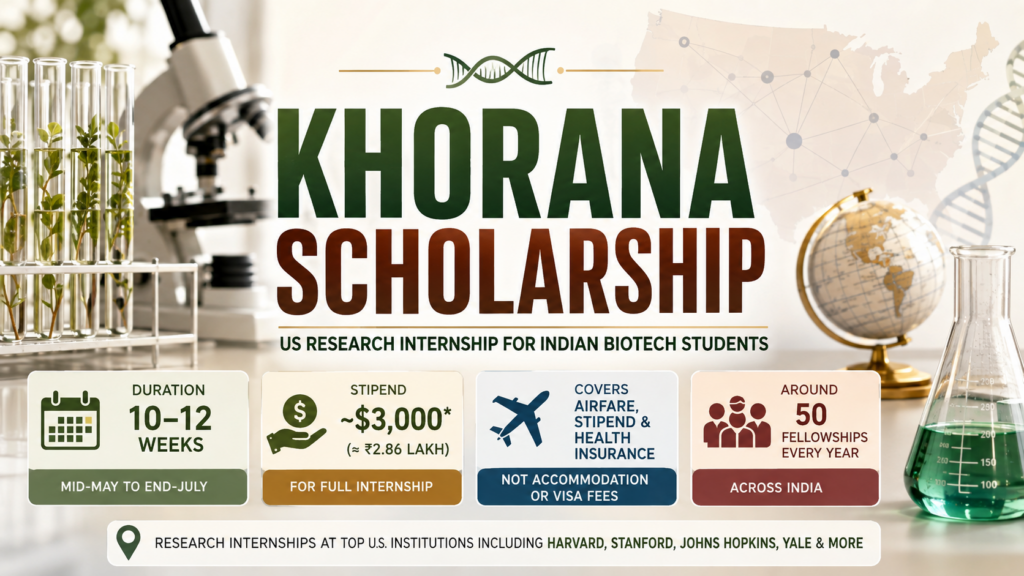
- The Khorana Scholarship funds a 10-12 week research internship in the US, not a full degree.
- Only pre-final year Indian biotech students are eligible; PhD and final-year students are not.
- It covers airfare, stipend, and health insurance, but not accommodation, visa fees, or bench fees.
- Around 50 fellowships are awarded across India every year.
What Is the Khorana Scholarship? Overview
The Khorana Scholarship, also called the Khorana Program for Scholars and sometimes referred to as the Khorana Fellowship, provides funding for a 10-12 week research internship in the U.S. for pre-final-year Indian biotechnology students during the summer. Here’s what it actually is, at a glance:
| Detail | What You Need to Know |
| Named after | Dr. Har Gobind Khorana, Indian-born Nobel laureate, won the 1968 Nobel Prize in Physiology or Medicine, for work at the University of Wisconsin-Madison |
| Run by | A tripartite arrangement: Department of Biotechnology (DBT, Govt. of India), the Indo-US Science and Technology Forum (IUSSTF), and WINStep Forward |
| What it is | A fully funded summer research internship, not a degree scholarship or university admission |
| Who it’s for | Pre-final year Indian undergraduate and postgraduate students in biotechnology and allied fields |
| Duration | 10-12 weeks, typically mid-May to end-July |
| Next cycle | Summer 2027 internship period |
| Where it happens | Not limited to the University of Wisconsin-Madison, recent scholars researched at Harvard Medical School, Stanford Medicine, Johns Hopkins, Yale, UCSF, Mayo Clinic, and dozens of other U.S. institutions, based on each student’s own research interests |
Source: USSTF’s official Khorana Program page.
Counselor insight: Students often assume Khorana works like a university admission process, where you apply, and the institution decides everything. It doesn’t. You drive the host-matching process yourself, which means your research proposal matters more than your college’s brand name.
Khorana Scholarship Eligibility for Indian Students 2026-27
| Requirement | Detail |
| Academic stage | Pre-final year only; first-year, final-year, and PhD students are not eligible |
| Eligible degrees | B.Tech, M.Tech, B.Sc., M.Sc., B.E., M.E., M.S., Integrated B.S-M.S., B.V.Sc., M.V.Sc., B.Pharm., M.Pharm., MBBS, and MMST |
| Field of study | Biotechnology and allied areas, including agricultural, food, health, and biomedical sciences, plus interdisciplinary fields like computational sciences, big data, and machine learning |
| Minimum score | CGPA 8.0 or 80%, except MBBS students need only 65% |
| Course timeline | At least one year of your course must remain after the internship |
| Nationality | Indian citizens currently enrolled at a recognized Indian institution |
| Prior experience | Preference given to students without prior international research experience |
Note: This scholarship is not for students straight out of Class 12. You must already be enrolled in one of the listed degree programs in your pre-final year, so a 12th-pass student would need to complete at least a year or two of their bachelor’s degree before the scholarship becomes relevant.
Counselor insight: The “preference for no prior international experience” clause surprises strong applicants who’ve already done a research stint abroad. Don’t assume more experience always helps here; a clear, well-matched research proposal often counts for more.
Khorana Scholarship Stipend, Amount, and What It Actually Covers
The Khorana Scholarship stipend is often cited as roughly $3,000 (₹2.86 lakh) for the full 10-12 week internship, but IUSSTF’s own guidelines don’t publish a fixed public figure for the stipend amount, so treat this as an approximate, not guaranteed, number.
| What It Covers | Covered? |
| Round-trip international airfare (economy, shortest route) | Yes, booked directly by the IUSSTF Travel Desk |
| Stipend for the internship duration | Yes, exact amount not officially published |
| Health insurance | Yes |
| Accommodation | No. Host institution may sometimes help or waive costs, but it’s not guaranteed |
| Visa fees | No |
| Tuition or bench fees | No. Host may waive these, but it isn’t guaranteed |
Exchange rate used: ₹95.22 per USD as of August 2026. Verify the current rate before finalizing your budget.
Source: IUSSTF’s official Khorana Program FAQ.
To directly answer a common point of confusion: a stipend under this program functions like a scholarship in that it doesn’t need to be repaid, but it isn’t a salary either, since you aren’t formally employed by the host lab. It’s closer to a fellowship allowance meant to cover living costs during the internship.
Counselor insight: Budget for accommodation and visa fees separately from day one. Students who assume the scholarship is “fully funded” in the literal sense are often surprised by a US summer accommodation bill that can run into thousands of dollars.
Most Khorana scholars enter the US on a J-1 exchange visitor visa, not a student F-1 visa, since this is a research exchange rather than a degree program; confirm the exact category with your host institution once placed.
How to Apply for the Khorana Scholarship for Indian Students 2026-27
There is no offline or emailed application. Everything happens through IUSSTF’s official Online Application Portal for Visitation Programs, linked from the official Khorana Program page.
- Register on the official application portal and verify your account via email.
- Complete the online application form and upload your latest marksheet, a No-Objection Certificate, and 2 Letters of Recommendation (one from a teacher, one from a research or internship supervisor).
- Submit before the deadline; the application typically opens in the fall for the following summer’s internship, with deadlines historically falling around September or October.
- If selected, you and WINStep Forward jointly identify up to three preferred U.S. host professors based on your research interests, in priority order.
- WINStep Forward then contacts these professors to arrange your placement.
Counselor insight: Step 4 is where most applicants underprepare. Start reading faculty research pages and drafting a shortlist of potential host professors before you even submit your application, not after you’re selected.
Khorana Scholarship Selection Criteria and Timeline
There is no personal interview. Selection runs through a three-tiered screening by subject experts, based on the following:
- Academic background and credentials
- Research interests, proposed project ideas, and career goals
- Research experience, technical background, and lab work
- The genuine need to conduct research specifically in the U.S.
- Publications, poster presentations, or conference participation, if any
There is no reservation category preference; selection is purely merit-based on the criteria above. The full process, from pre-screening through placement, takes approximately 4-5 months, with candidates tentatively notified around mid-March.
| Milestone | Typical Timing |
| The application window opens | Fall (varies by year) |
| Application deadline | Typically September-October |
| Selection notification | Tentatively mid-March |
| Host placement finalized | Following notification, before the internship |
| Internship period | Mid-May to end-July, 10-12 weeks |
Note: Dates shift each cycle slightly, so recheck closer to your application season.
Counselor insight: Don’t wait for a fixed “last date” announcement before preparing. Because deadlines have shifted between September and October in past cycles, have your documents ready by August so you’re not scrambling once the exact date is confirmed.
Documents Required for the Khorana Scholarship
| Document | Notes |
| Latest academic marksheet | Upload your most recent one even if not yet official; attested copies are accepted |
| No-Objection Certificate | From your current institution |
| Two Letters of Recommendation | One from a teacher/tutor and one from a research or internship supervisor can be uploaded or emailed directly by the referee |
| Passport | If you don’t have one yet, select “Applied for” on the form and apply immediately |
| Research proposal / statement of interest | Not always listed as a separate document, but your proposed research area is directly assessed in selection |
Counselor insight: If you’re a first-year Master’s student without a first-semester result yet, you can apply using your final undergraduate marks instead of waiting for a marksheet that doesn’t exist yet.
Which Situation Fits You?
- Pre-final-year B.Tech or B.Sc. student in biotechnology or an allied field, no prior international research experience: you’re in the profile IUSSTF explicitly prefers. Focus your application on a clear, specific research proposal rather than trying to compensate for a less prestigious college.
- MBBS student: you’re eligible with a lower 65% threshold instead of 80%/CGPA 8.0, and past Khorana scholars from AIIMS and other medical colleges have been placed at Harvard Medical School, Yale School of Medicine, and similar institutions. Frame your proposal around translational or clinical research where relevant.
- A student who has already completed an international research stint: you can still apply, but understand that preference goes to students without that experience. Lean harder on a distinctive, well-matched research proposal to offset this experience.
What to Do If You’re Not Selected or Miss the Deadline?
The Khorana Scholarship runs once a year with roughly 50 fellowships awarded nationally, so it’s genuinely competitive. If you’re not selected:
- Reapply the following year if you’re still pre-final year; there’s no penalty for a prior unsuccessful application.
- Approach professors directly for unpaid or self-funded research opportunities in the meantime, using the same research-proposal skills you built for your Khorana application.
- Look at parallel research fellowships run by other Indo-US or domestic science bodies if your field extends beyond core biotechnology.
Note: If you miss the deadline entirely, there’s no late window; the next opportunity is the following year’s cycle.
Counselor insight: A rejected Khorana application isn’t wasted effort. The research proposal and recommendation letters you prepare are directly reusable for university research assistantships and PhD applications later.
Many Khorana scholars later pursue master’s or PhD programs in the U.S. If that’s part of your long-term plan, explore our comprehensive Study in USA guide to understand university options, admissions, funding opportunities, and visa requirements before applying.
3 Takeaways on Khorana Scholarship for Indian Students
- The Khorana Scholarship is a research internship, not a degree fund, and it isn’t limited to the University of Wisconsin-Madison; recent scholars have researched at Harvard, Stanford, Johns Hopkins, and dozens of other U.S. institutions.
- It covers airfare, stipend, and health insurance but not accommodation, visa fees, or bench fees; budget for these separately.
- You propose your own host professors after selection rather than being assigned one, so start researching potential labs before you apply, not after.
Verified by: LeapScholar’s USA counseling team, with hands-on experience guiding Indian students through research fellowship and graduate funding applications.
Have questions about the Khorana Scholarship or planning your research profile? Book a free session with a LeapScholar counselor.
Frequently Asked Questions About Khorana Scholarship
-
What is the Khorana Scholarship?
The Khorana Scholarship, formally the Khorana Program for Scholars, funds a 10-12 week research internship during the summer at U.S. host institutions for pre-final year Indian biotechnology students. It’s run jointly by India’s Department of Biotechnology, IUSSTF, and WINStep Forward and named after Nobel laureate Dr. Har Gobind Khorana.
-
What is the Khorana Scholarship eligibility for 2026-27?
Eligibility is limited to pre-final year Indian students in specific biotech-related degrees like B.Tech, M.Tech, B.Sc., M.Sc., B.Pharm., M.Pharm., and MBBS, with a CGPA of 8.0 or 80% (65% for MBBS students). First-year, final-year, and PhD students cannot apply, and at least one year of your course must remain after the internship.
-
Is the Khorana Scholarship available for MBBS students?
MBBS students are explicitly eligible, with a lower minimum requirement of 65% compared to the 80%/CGPA 8.0 threshold for other degrees. Several past Khorana scholars from Indian medical colleges have been placed at institutions like Harvard Medical School and Yale School of Medicine.
-
What is the Khorana Scholarship stipend amount?
IUSSTF’s official guidelines list a stipend as a covered benefit without publishing an exact figure, though it’s commonly cited around $3,000 (₹2.86 lakh) for the full 10-12 week internship. This amount isn’t officially confirmed, so verify current figures through the official program guidelines before budgeting.
-
How many Khorana scholarships are given each year?
Around 50 fellowships are awarded across India each year under the Khorana Program, according to India’s Department of Biotechnology. This makes it a genuinely competitive, merit-based selection rather than a guaranteed award for every eligible applicant, so a strong, specific research proposal matters as much as your academic score.
-
Does the Khorana Scholarship involve an interview?
Selection is based entirely on a review of your application, academic record, research proposal, and recommendation letters. There is no personal interview at any stage, which makes the written research proposal and your recommendation letters the most important parts of your application.
-
What documents are required for the Khorana Scholarship application form?
You’ll need your latest academic marksheet, a No-Objection Certificate from your institution, two Letters of Recommendation, and passport details (or proof you’ve applied for one). All documents are submitted online through the official portal; hard copies and emailed applications aren’t accepted.
-
Is the Khorana Scholarship the same as the National Scholarship Portal (NSP), SSP, or SGIS scholarships?
These are unrelated programs. NSP, SSP, and SGIS are Indian government portals for domestic scholarships within India, covering things like means-cum-merit or minority education support. The Khorana Scholarship is a specific India-US research fellowship for a summer internship abroad, run through IUSSTF, not through NSP or any state scholarship portal.





Have Questions? Get Guidance to reach your Dream University
Connect with India's finest counsellors and biggest study abroad community.
Get Guidance