
Quick Read
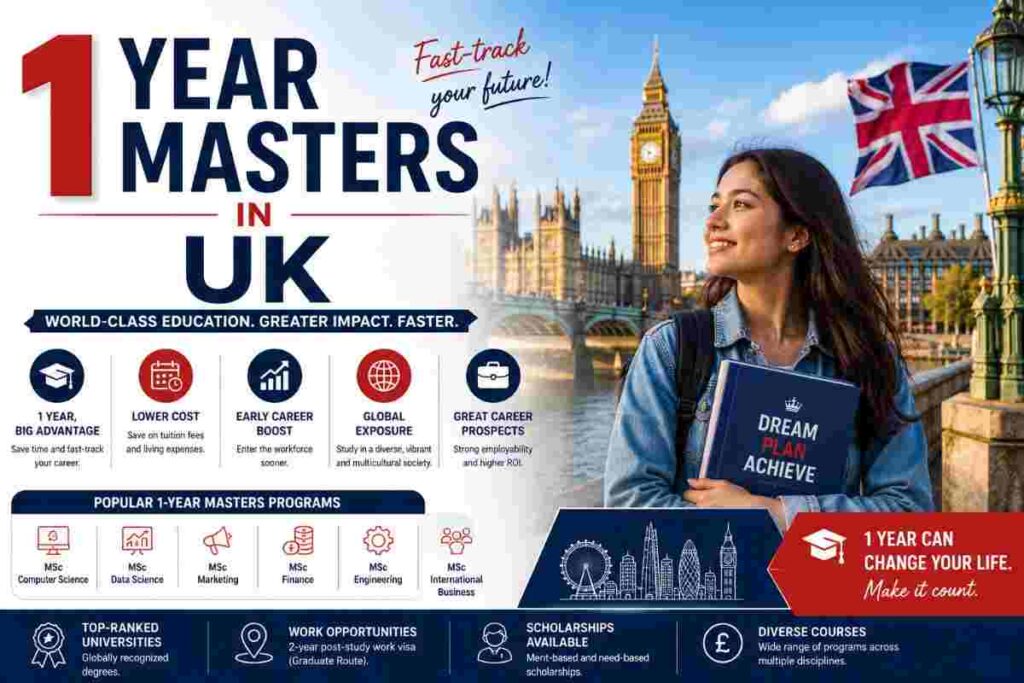
- A 1 year masters in UK runs 12 months and 180 credits.
- September 2027 starters get 18 months on the Graduate Route.
- Indian three-year bachelor’s degrees are accepted for direct entry.
- Proof of funds is Rs.13.60 lakh minimum for courses outside London.
- A levy of Rs.1.19 lakh per student per year begins August 2028.
What a 1 Year Masters in UK Actually Involves
A 1 year Masters in UK is a 180-credit postgraduate degree compressed into roughly 12 months, against the 90 to 120 credits per year that a two-year master’s elsewhere spreads across 24. The structure is usually two taught terms from September to around May, followed by a dissertation or industry project over the summer, with graduation in late autumn.
That density is the point and also the catch. There is no settling-in semester. Most Indian students find that assessment starts in week five or six, and by the time they have found a flatmate and a bank account, coursework is already due.

Choose your dream country
 UK
UK
 USA
USA
 Germany
 Australia
 Ireland
 Canada
 UAE
UAE
 France
 Sweden
 Italy
Italy
 Other
Other
When do you want to study abroad?
What's your highest level of education?
Have you completed Class 12th?
What was your Class 12 CGPA/percentage?
Are you a student or a parent/guardian?
What do you want to study?
Select your current city
How Leap will help you

Personalised University Shortlist

Express Applications with Quicker Admits

End-to-End Application Support
Two intakes matter. September is the main one and carries the widest program choice and the most scholarship activity. January exists at many universities with a narrower subject list, which pushes your dissertation into the following summer.
Counselor insight: Students who do best on a 12-month course arrive with their target sector already decided. If you are still choosing between consulting and data engineering in October, you will spend your only recruiting window deciding rather than applying. For diplomas, top-up degrees and pre-master's pathways rather than a full master's, see our guide to 1 year courses in UK.
Is a 1 Year Masters in UK still Worth it on an 18-month Graduate Route?
This is the question that changed, and most guides online have not caught up.
The Graduate Route now lasts 18 months for bachelor's and master's graduates who apply on or after 1 January 2027. PhD graduates keep 36 months. The reduction was implemented through the Statement of Changes in Immigration Rules published on 14 October 2025, confirmed in the House of Commons Library briefing on the 2025 immigration white paper. It is settled rule, not a proposal.
What matters for you: the trigger is your Graduate Route application date, not your graduation date. If you start a 1 year masters in UK in September 2027, you finish in late 2028 and apply well after the cutoff. You get 18 months. There is no earlier window to chase and no strategy that recovers the missing six months. Any article still telling you to graduate before the end of 2026 to lock in two years is describing a cohort that has already gone.
Eighteen months is still workable, but it changes the maths. You are not getting two years to explore. You are getting roughly 18 months to find a licensed sponsor, which in practice means your job search has to start in your first term, not after your dissertation.
| Feature | UK, 1 year masters | US or Canada, 2 year masters |
|---|---|---|
| Duration | 12 months, 180 credits | 24 months |
| Tuition years paid | One | Two |
| Living costs | One year | Two years |
| Time to first salary | About 12 months | About 24 months |
| Post-study work | 18 months, no job offer needed to apply | US OPT 12 months with a 90-day job-search limit, Canada PGWP up to 3 years |
| Curriculum | Specialised from week one | First year often foundational |
| Recruiting window | Compressed, overlaps coursework | Dedicated summer internship |
| Best suited to | Students with a decided sector | Students still exploring |
Counselor insight: Eighteen months is enough if you have a field and a plan to convert to a Skilled Worker visa inside the first year. It is not enough if your plan is to land and figure it out. Canada's PGWP is now the longer runway, so if optionality matters more than speed, weigh that honestly. Our UK vs USA comparison covers the trade-off in more detail.
What a 1 Year Masters in UK costs an Indian student
Tuition by subject area, for the 2027-28 cycle. Verify the exact fee on your program page, since universities publish annual increases.
| Subject area | Tuition range | Representative universities |
|---|---|---|
| Finance and Accounting | Rs.36.06 lakh to Rs.57.98 lakh (£27,954 to £44,948) | Oxford, LSE, Imperial, Warwick |
| Computer Science and AI | Rs.33.54 lakh to Rs.51.52 lakh (£26,000 to £39,935) | Cambridge, Imperial, Edinburgh, Nottingham |
| Management and MiM | Rs.34.86 lakh to Rs.54.15 lakh (£27,020 to £41,974) | LBS, UCL, Manchester, Imperial |
| Data Science and Analytics | Rs.32.22 lakh to Rs.48.99 lakh (£24,980 to £37,981) | UCL, Warwick, KCL, Birmingham |
| Marketing | Rs.28.39 lakh to Rs.45.16 lakh (£22,006 to £35,007) | Imperial, KCL, Manchester, Warwick |
Exchange rate used: Rs.129 per GBP, as of August 2026. Verify the current rate before finalising your budget.
Post-92 universities including Bedfordshire, Anglia Ruskin, East London and Hertfordshire run master's courses closer to Rs.16.13 lakh to Rs.19.03 lakh (£12,500 to £14,750), and they are QAA-accredited and Graduate Route eligible.
For the full breakdown see our guides to the cost of masters in UK and the cost of studying in UK. On funding, start with scholarships for masters in UK and fully funded scholarships in UK.
Counselor insight: The IHS is charged at the discounted student rate of £776 per year, plus £388 for any part-year of six months or less. A 12-month course on a 16-month visa comes to £1,164, paid in full upfront with your application.
Eligibility for a 1 Year Masters in UK for Indian Students
The academic bar is more accessible than most Indian applicants expect.
Your degree. UK universities accept a three-year Indian bachelor's degree for direct master's entry. A B.Com, B.Sc., B.A. or BBA is fine. You do not need a four-year degree, which is a meaningful advantage over the US.
Your grades. Most universities want a First Class, broadly 60 percent and above. Imperial, LSE and comparable programs often want 70 percent or higher, and competitive courses screen above their stated minimum.
Work experience. Not required for MSc or MA programs, which makes a 1 year masters in UK genuinely open to freshers. MBAs are the exception and usually want two to three years.
English. IELTS Academic 6.5 to 7.5 overall with no band under 6.0 is the common range, or TOEFL iBT 90 to 100 for competitive programs. Some universities will waive the test if you scored well in Class 12 English, but treat this as program-specific rather than a general rule. Check your offer conditions before skipping the test, because a waiver granted for admission does not always satisfy the visa requirement.
| Document | Purpose | India-specific detail |
|---|---|---|
| Bachelor's transcripts and degree certificate | Admission | Apply with your latest marksheet if final results are pending |
| Percentage or CGPA conversion note | Admission | Helps the university read your score correctly |
| Statement of Purpose | Admission | Programme-specific, not a generic template |
| Two LORs | Admission | Academic referees for MSc, mixed for MBA |
| IELTS or TOEFL | Admission and visa | Confirm the waiver applies to both, not just admission |
| CAS from your university | Visa | Issued after you accept and pay your deposit |
| Bank statements | Visa | Must satisfy the 28-day rule. See below |
| TB test certificate | Visa | Required from India, from an approved clinic |
| Passport | Both | Name spelling must match academic documents |
Counselor insight: Do not wait for your final semester results. UK postgraduate admissions run on rolling offers and universities issue conditional offers against your latest marksheet routinely. Waiting until your degree certificate arrives can cost you the seat entirely.
Visa Funds and the Rules tightening Around this Cohort
Your visa is assessed against specific figures, and one balance dip can sink it.
| Item | Amount |
|---|---|
| Maintenance funds, London | Rs.1,97,241 (£1,529) per month, up to 9 months |
| Maintenance funds, outside London | Rs.1,51,059 (£1,171) per month, up to 9 months |
| Nine-month total, London | Rs.17,75,169 (£13,761) plus unpaid tuition |
| Nine-month total, outside London | Rs.13,59,531 (£10,539) plus unpaid tuition |
| Immigration Health Surcharge | About Rs.1,33,515 (£1,035) for a 16-month visa |
| Student visa fee | About Rs.71,982 (£558) |
Funds must sit at or above the required total for 28 consecutive days, ending no more than 31 days before you apply. Parents' accounts are acceptable with a consent letter and proof of relationship. Property, gold, mutual funds and PPF are not acceptable evidence.
Three rule changes land inside this cohort's timeline. The Graduate Route drops to 18 months for applications from 1 January 2027. A higher English standard applies to indefinite leave to remain on various routes from 26 March 2027. And an international student levy of £925 per student per year of study, about Rs.1.19 lakh, begins in August 2028, announced in the 2025 Budget with the consultation now complete. A September 2027 cohort finishes around the point that levy starts, so ask your university directly whether it intends to pass the cost on.
Counselor insight: Build a 5 to 10 percent buffer above the minimum. Rupee balances are converted at the Bank of England rate on your application date, and a rate move on the wrong day has refused otherwise-complete files.
Deadlines and a September 2027 Planning Calendar
UK postgraduate admissions are rolling. There is no single national deadline, which sounds relaxed and is not. Competitive courses in data science, AI and finance close when they fill, often without notice, and university scholarships are frequently allocated to students holding offers early.
| Period | What you do |
|---|---|
| Aug to Oct 2026 | Shortlist programs. Check entry requirements against your transcript |
| Sep to Nov 2026 | Sit IELTS or TOEFL. Take GMAT if applying for an MBA |
| Oct to Dec 2026 | Finalise SOP and secure two LORs |
| Oct 2026 | Chevening applications typically close. Confirm the exact date |
| Dec 2026 to Mar 2027 | Submit applications. Earlier is materially better |
| Mar to Apr 2027 | GREAT Scholarship deadlines. University scholarship rounds |
| Apr to May 2027 | Accept your offer, pay the deposit, receive your CAS |
| May 2027 | Begin the 28-day fund-holding window |
| Jun to Jul 2027 | Apply for your Student visa. TB test and biometrics |
| Sep 2027 | Course begins. Start your job search in term one |
| Late 2028 | Graduate, then apply for the Graduate Route (18 months) |
Counselor insight: Treat the scholarship calendar as your real deadline. Chevening in October and GREAT in March to April sit months ahead of most university cutoffs, and missing them usually means a full-year wait or full fees.
Top Subject Areas and Universities for a 1 Year Masters in UK
Choice of institution matters less than fit with your target sector, but rankings still shape recruiter shortlists.
| UK rank | University | Global QS rank | Strengths |
|---|---|---|---|
| 1 | Imperial College London | 2 | STEM, business analytics, AI |
| 2 | University of Oxford | 4 | Law, medicine, humanities |
| 3 | University of Cambridge | 6 | Engineering, CS, mathematics |
| 4 | UCL | 9 | Management, architecture, education |
| 5 | King's College London | 31 | Health sciences, public policy, law |
| 6 | University of Edinburgh | 34 | AI, data science, informatics |
| 7 | University of Manchester | 35 | Management, engineering, biotech |
| 8 | LSE | 50 | Finance, economics, corporate law |
Indicative graduate salaries by sector, which are the other half of the ROI calculation.
| Sector | Typical roles | Starting salary |
|---|---|---|
| Finance and FinTech | Investment banking, FinTech analyst | Rs.58.05 lakh to Rs.90.30 lakh (£45k to £70k) |
| Technology and AI | AI engineer, data scientist | Rs.49.02 lakh to Rs.64.50 lakh (£38k to £50k) |
| Law | Corporate law, compliance | Rs.58.05 lakh to Rs.90.30 lakh (£45k to £70k) |
| Business and Marketing | Business analyst, digital manager | Rs.42.57 lakh to Rs.56.76 lakh (£33k to £44k) |
| Healthcare | NHS specialist roles, health data | Rs.45.15 lakh to Rs.58.05 lakh (£35k to £45k) |
Counselor insight: Oxford and Cambridge carry the brand, but Manchester, Warwick and Edinburgh often carry deeper UK employer relationships, which matters more when you have 18 months to convert to sponsorship. If your goal is a UK job rather than a return to India with a name, weight placement support above ranking. For London specifically, see our guide to MS in London.
If 1 Year Masters in UK Goes Wrong
Your percentage is below the threshold. Many post-92 universities accept 55 to 60 percent, and a pre-master's bridges a larger gap. A pre-master's year is not covered by Chevening or GREAT, so budget it separately.
Your IELTS band is short. A 0.5 gap is usually a six to eight week retake. Some universities offer pre-sessional English that satisfies the condition. Confirm your pre-sessional is Home Office recognised before paying.
Your visa is refused on financial grounds. The refusal notice names the exact rule. Most refusals are 28-day violations, which require a fresh application rather than an administrative review. Rebuild the balance, restart the 28 days, reapply.
You have no job offer by month 12. This is common and not failure. Apply for the Graduate Route immediately on course completion, take contract or adjacent work to stay in the market, and target licensed sponsors from the public register rather than applying broadly.
Your university has a weak sponsor compliance rating. The Home Office moved to a Red-Amber-Green rating system for student sponsors in 2026, and a poor rating can affect a university's ability to issue CAS letters.
Counselor insight: If a refusal or a rejection arrives, get the specific stated reason before doing anything else. Students routinely rebuild an entire application over one fixable document and lose the intake in the process.
3 Takeaways on 1 Year Masters in UK
A 1 year masters in UK remains one of the most efficient postgraduate routes available to Indian students, provided you plan for the cycle you are actually in.
- Plan for 18 months, not two years. Every September 2027 starter applies for the Graduate Route after the 1 January 2027 cutoff. Build your job search into term one rather than saving it for after your dissertation.
- Work backwards from the scholarship deadlines, not the university ones. Chevening in October 2026 and GREAT in March to April 2027 come well before most course cutoffs, and rolling admissions mean competitive courses close when they fill.
- Start the 28-day fund window in May 2027. Consolidate everything into one eligible account, add a 5 to 10 percent buffer for exchange-rate movement, and do not touch it.
Verified by: LeapScholar's UK counseling team, with hands-on experience guiding Indian students through postgraduate applications, CAS issuance, Student visa financial documentation, and Graduate Route planning.
Have questions about a one year masters in UK? Book a free session with a LeapScholar counselor.
Frequently Asked Questions About 1 Year Masters in UK
-
Which intake should I target for a 1 year masters in UK?
September 2027 offers the widest 1 year masters programs UK choice and the most scholarship activity, with applications best submitted between December 2026 and March 2027. January intakes exist at many universities with fewer programs, which pushes your dissertation into the following summer.
-
Are there fully funded scholarships for a 1 year masters in UK for Indian students?
Chevening and Commonwealth scholarships are fully funded and highly competitive, with Chevening requiring around 2,800 hours of work experience. GREAT Scholarships offer at least £10,000 to Indian citizens. Many universities also award automatic merit scholarships once your offer is confirmed.
-
Can I work while studying?
Yes, up to 20 hours per week during term time and full time during official vacations. On a 12-month course, be careful about relying on this income in your first term, when coursework is heaviest and you are still settling in.
-
Can I get a 1 year masters in UK without IELTS?
Sometimes. Several universities waive the test based on your Class 12 English marks or your medium of instruction, but this is set program by program rather than nationally. Confirm that any waiver satisfies both admission and visa requirements, because they are assessed separately.
-
How much money do I need to show for the visa?
For up to nine months of living costs, about Rs.17.75 lakh (£13,761) for a London course or Rs.13.59 lakh (£10,539) outside London, plus any unpaid tuition. The funds must be held for 28 consecutive days ending no more than 31 days before you apply.
-
How much does a 1 year masters in UK cost in total?
Tuition ranges from about Rs.16 lakh at post-92 universities to Rs.58 lakh at the most competitive programs. Add living costs, the visa fee and the immigration health surcharge, and a realistic full-year budget is Rs.30 lakh to Rs.50 lakh outside London and Rs.41 lakh to Rs.72 lakh in London.
-
Is a 1 year masters in UK recognised in India?
Yes. The Association of Indian Universities recognises accredited UK master's degrees as equivalent to Indian master's degrees for most academic and professional purposes. Confirm equivalence with AIU directly if you plan to pursue a PhD in India or apply for a government role that requires formal recognition.
-
Can I do a 1 year masters in UK with a three-year Indian degree?
Yes. UK universities accept three-year Indian bachelor's degrees for direct master's entry, which is a real advantage over the US where a four-year degree is often expected. You will usually need a First Class, broadly 60 percent and above.
-
Is a 1 year master degree in UK worth it now that the Graduate Route is 18 months?
It still works, but for a narrower profile than before. You save one full year of tuition and living costs, roughly Rs.30 lakh to Rs.47 lakh, and you start earning a year earlier. The trade-off is a shorter post-study runway, so it suits students with a decided sector and a plan to convert to Skilled Worker sponsorship inside the first year.







Have Questions? Get Guidance to reach your Dream University
Connect with India's finest counsellors and biggest study abroad community.
Get Guidance