
Quick Read
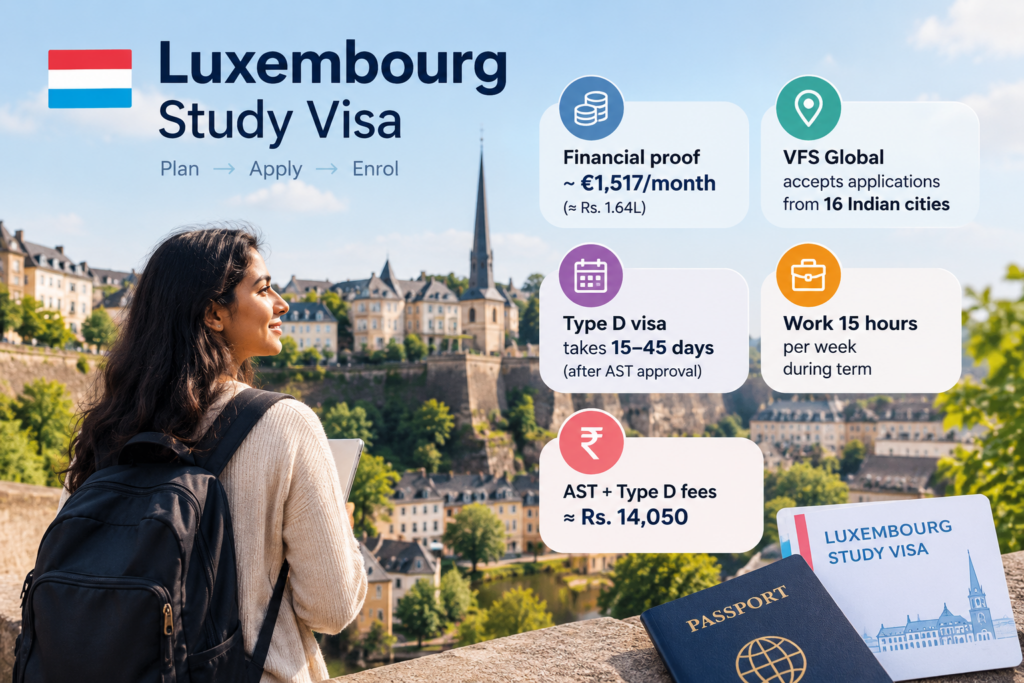
- The Luxembourg study visa involves three sequential steps before you can enroll.
- Financial proof for a Luxembourg student visa works out to roughly €1,517/month (Rs. 1.64L) a month.
- VFS Global accepts Luxembourg study visa applications from 16 Indian cities, not just Delhi.
- A Type D visa usually takes 15 to 45 days once your AST is approved.
- Students holding this visa can legally work 15 hours a week during the term.
- AST and Type D visa fees together cost around Rs.14,050 right now.
How the Luxembourg Study Visa Actually Works: Three Steps
Most people assume the Luxembourg study visa is one form and one stamp. It isn’t. It’s three separate approvals, each one sitting on top of the last, and if you’re an Indian student planning to stay past 90 days, none of them are skippable.
Step 1: Temporary Authorisation to Stay (AST). Before you touch a visa application, you need pre-approval from Luxembourg’s Directorate of Immigration. This is the AST, and it isn’t optional paperwork; it’s the gate you have to pass through first. You submit it from India, either directly to the Directorate or through a Luxembourg diplomatic mission, and applications sent after you’ve already entered Luxembourg simply aren’t accepted.

Choose your dream country
 UK
UK
 USA
USA
 Germany
 Australia
 Ireland
 Canada
 UAE
UAE
 France
 Sweden
 Italy
Italy
 Other
Other
When do you want to study abroad?
What's your highest level of education?
Have you completed Class 12th?
What was your Class 12 CGPA/percentage?
Are you a student or a parent/guardian?
What do you want to study?
Select your current city
How Leap will help you

Personalised University Shortlist

Express Applications with Quicker Admits

End-to-End Application Support
Step 2: The Long-Stay Type D Visa. Once your AST comes through, you use it to apply for the Type D visa at a VFS Global centre. This is the actual travel document that lets you enter Luxembourg.
Step 3: The Residence Permit. Your Type D visa gets you into the country, but it isn't permission to stay indefinitely. Within three months of arriving, you need to apply for your residence permit at the Directorate of Immigration, and this is what actually authorizes you to study for the full length of your program.
My insight: The single most common mistake we see with the Luxembourg study visa isn't a document error; it's sequencing. Students start looking for Type D visa appointments before their AST has cleared, or they assume the AST is a formality that runs alongside the visa application instead of before it. It doesn't. Budget the AST as its own multi-week milestone, not a footnote.
Luxembourg Study Visa vs Luxembourg Student Visa: Types Explained
People use "Luxembourg study visa" and "Luxembourg student visa" more or less interchangeably, and functionally that's fine, but there are two distinct visa categories underneath that phrase that matter for planning.
Short-stay Type C visas exist too, but they're for trips under 90 days and don't apply to anyone enrolling in a full degree program.
| Stage | What It Is | Where You Apply | Typical Processing Time | Fee (Approx.) |
|---|---|---|---|---|
| Temporary Authorisation to Stay (AST) | Pre-approval from Luxembourg's immigration authority | Directorate of Immigration or Luxembourg mission, from India | Up to 60 days (budget for longer) | Included in the residence permit fee |
| Type D Visa (Long-Stay) | Entry visa into Luxembourg | VFS Global centre in India | 15 to 45 days after AST approval | Roughly €50-100 (Rs.5,404-10,808), sometimes waived for students |
| Residence Permit | Authorization to actually live and study in Luxembourg | Directorate of Immigration, after arrival | Issued after medical check and commune registration | €80 (Rs.8,646) |
Sources: EU Immigration Portal, Guichet.lu
How to Apply for the Luxembourg Study Visa from India
Here's the actual sequence, step by step, once you're ready to apply.
1. Get your AST approved first. This has to be settled before anything else moves forward. Don't attempt to book a VFS appointment until this letter is in hand.
2. Book your appointment on the VFS Global Luxembourg portal for India. Slots are city-specific, so pick whichever of the 16 centres is nearest to you.
3. Fill out the Type D visa application form with the same details as your AST application. Inconsistencies between the two are one of the easier ways to trigger extra scrutiny.
4. Gather your documents using the checklist in the next section, and get anything not in English, French, or German translated in advance.
5. Attend your VFS appointment in person. This is where you submit your form, your documents, and your biometrics (fingerprints and a photograph). None of these steps can be done remotely.
6. Pay the visa fee at the centre, either at submission or as instructed by VFS.
7. Track your application online using the reference number VFS gives you.
8. Collect your passport and visa, either in person or via the courier option VFS offers in most cities.
My insight: Book your VFS slot the moment your AST approval letter arrives. Slots in metro cities fill up fast in the run-up to intake deadlines, so don't wait a week to "get your documents perfectly ready" before booking.
Sources: VFS Global, Guichet.lu
Documents You Need for the Luxembourg Study Visa
| Category | Documents | India-Specific Note |
|---|---|---|
| Identity | Valid passport with 2+ blank pages, 2 passport photos | The passport must be valid well beyond your intended stay |
| Academic | University acceptance letter, attested transcripts, and degree certificates | Get transcripts HRD-attested or apostilled depending on your state, this can take 3-4 weeks |
| Financial | Bank statements (last 6 months), sponsorship letter, or scholarship certificate | Joint family sponsorship is accepted with a notarized affidavit of support |
| Insurance | Travel medical insurance covering at least €30,000 (Rs.32.42 lakh) | Buy this only after admission is confirmed, insurers price it by trip length |
| Accommodation | Proof of housing (university dorm confirmation or rental agreement) | University dorm confirmations count and are usually easiest to secure early |
| Character | Police clearance certificate or sworn affidavit | Apply for PCC at least 4 weeks ahead through Passport Seva |
Documents not in English, French, or German need certified translation, and this step alone can add a week or two if you leave it for last.
Luxembourg Study Visa Financial Requirement: How Much Bank Balance You Need
This area is where a lot of outdated information is floating around, so let's be precise. The University of Luxembourg's own admissions page states that, as of 2025, you need to prove access to at least €18,211 for the academic year, which works out to a minimum of €1,517 per month. At today's rate of Rs.108.08 per euro, that's approximately Rs.1,63,957 a month, or roughly Rs.19.68 lakh for the year.
You'll see older figures online; some sources still quote €860.80 per month or €1,201, which were correct a few years back but haven't been updated. Always cross-check against the current official figure before you finalize how much to show, because immigration officers work off the current threshold, not what a blog said in 2022.
Accepted proof includes:
- Bank statements from the last six months
- A formal sponsorship letter from a parent or guardian, with their own bank statements attached
- A scholarship or education loan certificate stating the amount and duration
Sources: University of Luxembourg: Cost of Living and Financial Support, Guichet.lu: Social Inclusion Income (REVIS)
If the full amount feels steep, it's worth checking whether you qualify for one of the scholarships available for Luxembourg-bound Indian students, since even a partial award reduces what you need to show from your funds.
My insight: Don't show the exact minimum and nothing more. Immigration officers tend to view bank balances that land right at the threshold, with no buffer, as a soft red flag. A comfortable margin above €1,517/month reads as more credible.
Luxembourg Study Visa Fees: Complete Cost Breakdown in INR
The Luxembourg study visa itself isn't expensive by European standards; the residence permit and visa fees together run under Rs.20,000. Where the real cost sits is in the monthly living requirement you have to prove, not the fees themselves. Here's the full breakdown, converted at today's exchange rate.
| Item | Cost in EUR | Cost in INR |
|---|---|---|
| Residence permit fee | €80 | Rs.8,646 |
| Type D visa fee | €50-100 (often waived for students) | Rs.5,404-10,808 |
| Public university tuition | €200-400/semester | Rs.21,616-43,232/semester |
| Student housing (dorm) | €450-700/month | Rs.48,636-75,656/month |
| Health insurance premium | €50-100/month | Rs.5,404-10,808/month |
| Monthly living cost (food, transport, essentials) | Approx. €1,517 | Approx. Rs.1,63,957 |
Sources: EU Immigration Portal, University of Luxembourg
Our detailed cost of living breakdown provides a full picture of what a month in Luxembourg actually costs, including rent variations by city and typical grocery bills, beyond the visa minimum.
Who Should Plan Differently for the Luxembourg Study Visa
Not every applicant is working with the same timeline or risk profile. Here's how three common situations actually play out.
If you're a final-year student graduating in 2026 and targeting the next available intake:
Move on to your AST the moment you have your acceptance letter. Don't wait for every last document to be perfect before starting the immigration paperwork; the AST clock is the one that matters most.
If you're a working professional targeting the upcoming January/February intake for a master's program:
You have more breathing room than a September applicant, but don't waste it. Spring intakes have fewer available seats at most Luxembourg institutions, and a delayed AST can push your entire enrollment to the following semester.
If you've had a previous Schengen visa refusal from any country:
Disclose it upfront on your application rather than hoping it goes unnoticed. Immigration authorities cross-reference Immigration authorities cross-reference your Schengen visa history, and they treat an undisclosed prior refusal far more harshly than a disclosed one with a reasonable explanation.
If you're specifically eyeing a postgraduate route, our guide to pursuing an MS in Luxembourg breaks down which programs align with the spring intake.
Luxembourg Study Visa Timeline for the Upcoming Intake
Luxembourg runs two intake windows. September is the primary one, with the widest range of programs and seats. January/February is a secondary, smaller intake offered by a limited set of programs, mainly at the University of Luxembourg and a few private institutions.
As of today, the September 2026 intake window has already passed for new visa applicants; an AST started now wouldn't clear in time. The intake that's actually live and worth planning around is January/February 2027. Here's how the timeline maps out if that's your target:
| When (relative to today, mid-September 2026) | What to Do |
|---|---|
| Now through early October 2026 | Finalise admission, gather academic and financial documents |
| October 2026 | Submit your AST application from India |
| November-December 2026 | AST under review (budget up to 60 days); book your VFS appointment as soon as it's approved |
| December 2026-January 2027 | Submit Type D visa application, and complete biometrics at VFS |
| Mid-to-late January 2027 | Buy travel medical insurance, confirm accommodation, book travel |
| Within 3 days of arrival | Register with your local commune |
| Within 3 months of arrival | Apply for your residence permit, and complete the mandatory medical check (including TB screening) |
If you're reading this after October 2026 and haven't started your AST yet, treat it as urgent. The 60-day AST window alone eats most of the runway you have left before a January/February start.
What to Do If Your Luxembourg Study Visa Gets Delayed or Rejected
Most guides skip this part entirely, but it matters. If your AST or Type D visa application is refused, the Luxembourg authorities are required to give you a written reason. Under the EU Immigration Portal's own guidance, you can challenge that decision before the First Instance Administrative Court within three months of the notification. If that appeal fails, a further appeal to the Administrative Court is possible within 40 days.
The most common reasons for rejection, based on what shows up across visa refusal data for similar Schengen study visas, are:
- Insufficient funds shown, or funds that don't match the current €1,517/month threshold
- Incomplete or unattested documents, particularly academic transcripts missing the right certification
- Gaps in academic history that aren't explained with a covering letter
- Inconsistent information between the university application and the visa application
If your AST is taking longer than the typical 60-day window, don't panic immediately, but do follow up in writing with the Directorate of Immigration rather than assuming silence means rejection. And if your intake date is approaching fast, contact your university about deferring to the next intake before your visa timeline forces the decision for you.
Working in Luxembourg on a Student Visa and What Comes After
Part-Time Work Rules While You Study
Once your residence permit comes through, your Luxembourg student visa lets you work part-time:
- During term: up to 15 hours a week
- During official university holidays: full-time, up to 40 hours a week
- Exception: Bachelor's students can't work at all during their first two semesters. Master's and PhD students don't have this restriction.
After Graduation: The Stay-Back Window
Once you finish your degree, you can apply to stay in Luxembourg to look for work or start a business.
Here's something worth correcting: Luxembourg's stay-back permit for job search or business creation is valid for 12 months, genuinely more generous than the EU's own 9-month minimum baseline, which some guides mistakenly quote as Luxembourg's actual figure.
Once you land a job offer, the next move is a standard work visa or, if you qualify, an EU Blue Card.
If you're curious what employers in Luxembourg's finance and tech sectors actually look for, our guide to career opportunities in Luxembourg covers that in more depth.
3 Key Takeaways on the Luxembourg Study Visa
First, start your AST application 3-4 months before you plan to travel, since it's the step everyone underestimates.
Second, verify your financial figure against the current €1,517/month standard rather than an outdated number you found in an old blog post.
Third, remember that VFS Global's 16-city network in India means you likely don't need to travel to Delhi just to submit your paperwork.
Verified by: LeapScholar's Europe counseling team. They've walked Indian students through AST filings, VFS appointments, and residence permit paperwork for Luxembourg often enough to know where things usually go wrong.
Still working out your timeline? Book a free session with a LeapScholar counselor.
Frequently Asked Questions About Luxembourg Study Visa
-
How do I get a study visa for Luxembourg from India?
You start with the Temporary Authorisation to Stay (AST) from Luxembourg's Directorate of Immigration. Once that's approved, head to VFS Global in India for the Type D visa. Land in Luxembourg, and you've got three months from there to sort out your residence permit.
-
How much bank balance is needed for a Luxembourg study visa?
Based on the University of Luxembourg's own 2025 figures, you'll need to show at least €1,517 a month, which comes to roughly Rs.1,63,957 at today's rate. Stretched across a full year, that's about €18,211, or close to Rs.19.68 lakh.
-
Can I apply for the Luxembourg study visa online?
Only partly. You can handle appointment booking and status tracking online, but you'll still need to show up in person at a VFS Global centre for document submission and biometrics. There's no fully remote path here.
-
What is the fee for a Luxembourg study visa?
Expect €80 (Rs.8,646) for the residence permit and another €50 to €100 (Rs.5,404 to Rs.10,808) for the Type D visa, though that second fee is sometimes waived for students. It depends on your specific case.
-
What is the approval rate for a Luxembourg student visa?
Nobody officially has actually published a number. What you'll find are independent estimates, most landing somewhere in the 90-99% range for applications that are complete and well-documented. If you see a single precise figure quoted confidently anywhere online, treat it with caution, since none of it traces back to an actual government release.
-
Can international students work part-time on a Luxembourg study visa?
Yes, up to 15 hours a week while classes are on and full-time during official holidays. One exception: Bachelor's students can't take on paid work during their first two semesters.
-
Is there an interview for the Luxembourg student visa?
Usually not, specifically for Indian applicants. You will need to give biometrics (fingerprints and a photo), but a sit-down interview isn't standard practice, though the embassy can still call for one if your case needs a closer look.
-
What happens if my application for a Luxembourg study visa is rejected?
You'll get a written explanation of why. From there, you have three months to appeal before the First Instance Administrative Court, and if that doesn't go your way, a further appeal is possible within 40 days.
-
What English test scores are accepted for Luxembourg universities?
That's really a university decision, not a visa one. Most English-taught programs look for IELTS around 6.0-6.5 or TOEFL in the 87-100 range, but it varies by faculty, so check your specific program's admissions page rather than assuming.





Have Questions? Get Guidance to reach your Dream University
Connect with India's finest counsellors and biggest study abroad community.
Get Guidance