
Quick Read
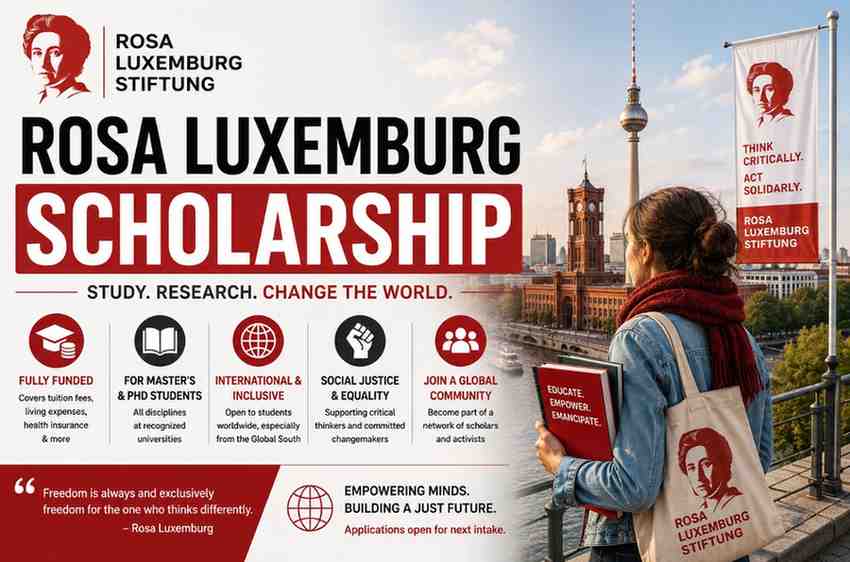
- Rosa Luxemburg scholarship funds Master’s and doctoral students in Germany.
- Applicants need German admission or enrolment before they apply.
- Doctoral candidates receive Rs.1,59,660 monthly, roughly EUR 1,450.
- German at B2 level is required even for English-taught programs.
- Applications close 1 October each year at 23:59 CET.
- Indian applicants may submit provisional certificates with university confirmation.
What the Rosa Luxemburg Scholarship Pays and What It Does Not Cover
The Rosa Luxemburg scholarship is a monthly stipend, not a tuition waiver. The Studienwerk (the scholarship department of the Rosa-Luxemburg-Stiftung, a German political foundation affiliated with Die Linke) awards it to international students with funding from the Federal Foreign Office. Two tracks are open to foreign nationals: a Master’s study scholarship and a doctoral scholarship.
| Track | Monthly stipend | Additional | Standard duration |
|---|---|---|---|
| Doctoral (international) | Rs.1,59,660 (EUR 1,450) | Rs.11,011 (EUR 100) mobility allowance, plus health insurance subsidies | Three years as a rule |
| Master’s (international) | Rs. 1,02,841 (€934) | Book allowance, insurance subsidy | Standard programme duration (Regelstudienzeit) |
Doctoral figures come from the DAAD scholarship database entry for this program, totalling roughly Rs.61,44,138 (EUR 55,800) across three years.
On the Master’s figure: the foundation publishes no rate for the international Master’s track, and secondary listings disagree, quoting either EUR 850 plus a EUR 20 lump sum or EUR 992. Confirm it at studienwerk@rosalux.de.
What it does not cover: tuition. That matters less than it sounds, since public German universities charge no tuition for consecutive Master’s degrees, only a semester contribution of roughly Rs.16,517 to Rs.44,044 (EUR 150 to EUR 400). See our breakdown of the cheapest universities in Germany.
Counselor insight: Students treat this as a tuition scholarship and get confused when nothing is waived. A two-year public Master’s costs roughly Rs.66,000 in semester fees but Rs.26,21,498 in blocked-account funds. This scholarship attacks the second figure.
Rosa Luxemburg Scholarship Eligibility: Three Rules That Decide Everything
Most listings open with the stipend. Start here instead, because each rule can disqualify you outright.
Rule 1: German admission or enrolment must already exist. Per the study scholarship page, international Master’s applicants must be enrolled at, or at minimum hold admission to, a state or state-recognised German university, and must be in Germany to study. Doctoral applicants need doctoral admission plus supervision by a German university lecturer. This is not a scholarship you win from India to decide whether to go.
Rule 2: The 15-month residence cap. You must not have been in Germany more than 15 months at the time of application. Exceptions: you completed a Bachelor’s in Germany, or began your doctorate or research stay more than 15 months ago.
Rule 3: German at B2, evidenced. Covered next, including the one workaround permitted.
Beyond those three:
- A completed Bachelor’s degree, for the Master’s track
- Above-average academic performance at school or university
- Documented engagement aligned with the foundation’s aims
- No parallel public funding. Competing scholarships are offset against each other
- No doctoral completion scholarships, and previous doctoral funding of three years or more disqualifies you
- Master’s exclusions: a second full degree, part-time study, a change of major after the fourth semester
The foundation gives stated preference to women, students from non-academic and migrant backgrounds, students facing financial hardship, and people with disabilities showing comparable achievement. That is written policy, unusual among German funders.
Counselor insight: The sequencing mistake is the expensive one. DAAD accepts applications while your admissions are open. This one does not. Order it as APS certificate at Rs.18,000, then admission, then this application. Parallel tracks cost a full 12-month cycle.
German Language Requirements for the Rosa Luxemburg Scholarship
B2 German or above is required, and it applies even if your Master’s program or dissertation is in English. The foundation states this on both scholarship pages.
The requirement is substantive. The Studienwerk’s support program runs largely in German: political education events, summer schools, writing workshops and methodology seminars, backed by over 250 academic trustees.
The workaround most pages miss. The official document list for international students states that where B2 proof is unavailable at the deadline, a current B1 certificate plus proof of enrolment in an ongoing or imminent B2 course is sufficient.
Accepted certificates include Goethe-Zertifikat B2, telc Deutsch B2, DSH and TestDaF at TDN 3 or above. German proficiency is separate from English: your university may not ask for IELTS at all, as our guide to studying in Germany without IELTS explains, but this scholarship still asks for German.
Counselor insight: Students at B1 in August read “B2 required” and skip the round. That is the most avoidable loss here. The 2026 round opened 20 August and closes 1 October, enough time to enrol in a B2 course and submit the receipt with your B1 certificate.
What Counts as Social and Political Engagement for the Rosa Luxemburg Scholarship
Engagement is the criterion Indian applicants most often under-evidence, and it decides interviews. The foundation’s stated aims are democracy, social justice and solidarity, and it selects for engagement “in the spirit of” those aims, so a strong CGPA alone will not carry an application. The foundation does not publish an exhaustive list of qualifying activities. The table below is our counseling guidance on what to document.
| What you did | Evidence to collect from India |
|---|---|
| Student union or campus committee role | Letter on institutional letterhead with dates and your role |
| NGO or community work | Letter from the organisation, project reports, event programmes |
| Trade union, labour or farmer organising | Letter from the union or collective, campaign material |
| Gender, caste or anti-discrimination work | Event programs, published pieces, letters from organisers |
| Climate or environmental campaigns | Campaign documentation, partner letters |
Collect these now. Indian institutions typically take two to three weeks to issue letters, and a letter that is vague about dates or your role carries little weight. Be honest. The interview tests whether your engagement is real, and the interview record is decisive.
Counselor insight: “I care about social justice” is worth nothing in an interview. A named collective, dated roles and a letter from the people you worked with is what counts.
Rosa Luxemburg Scholarship Documents Checklist for Indians
Every item uploads as a single PDF. No other format is accepted, files must be clearly named, and there is no postal or email route.
| Required document | What this means for an Indian applicant |
|---|---|
| Enrolment certificate for the coming winter semester, showing completed subject and university semesters plus the program | Certificates missing these details are rejected outright. Not yet enrolled? Submit your admission letter |
| Tabular CV, German or English, with dated education history | Include Class 10 and 12 boards with month and year. Account for gap years |
| Proof of social engagement | Letters on letterhead, event programs. See the mapping table above |
| One academic reference on your performance and study ability | Only one is needed, no template exists, the referee needs no doctorate. DAAD usually asks for two |
| Highest degree certificate with final grade | Provisional certificates and consolidated marksheets work. If not yet issued, submit a transcript plus university confirmation of completion including your thesis grade |
| Studienordnung extract showing standard programme duration | Download from your German university’s programme page |
| Passport or national ID | Bio page. Name spelling must match every other document |
| German residence permit or visa, for non-EU nationals | A Fiktionsbescheinigung is not accepted. If delayed at the Ausländerbehörde, submit the most recent permit held |
| German language certificate at B2 or above | Or the B1 plus enrolled B2 course substitute above |
Translations need not be certified, saving notary fees and about a week. Items 1 and 8 depend on your visa timeline, so read this with the German student visa process.
Counselor insight: Item 1 causes more silent rejections than eligibility does. German enrolment certificates carry a completed-semester count Indian ones do not, and the foundation names its absence as a disqualifier in bold. Check that line before uploading.
Rosa Luxemburg Scholarship Deadlines and Selection Timeline for 2027 and 2028
The 2026 round closed on 1 October 2026. One annual deadline applies: 1 October at 23:59 CET, for funding beginning 1 April of the following year (the start of the German summer semester). The portal opens roughly six weeks before, per the foundation’s application page. The DAAD database lists both 1 April and 1 October, while the foundation’s own pages list 1 October only. Treat 1 October as operative.
The next round: apply by 1 October 2027 for funding from 1 April 2028.
Planning calendar for the 1 October 2027 round
| When | What to do |
|---|---|
| Oct to Dec 2026 | Decide your track. Start B1/B2 German. Begin collecting engagement letters |
| Jan to Feb 2027 | Start APS for a winter 2027 intake |
| Mar to Jun 2027 | Submit university applications by spring and summer deadlines. Secure admission |
| May to Jun 2027 | Graduate. Degree certificates usually arrive July to September |
| Aug 2027 | Portal opens (approximate, late August). Have B1 and a B2 course receipt in hand |
| 1 Oct 2027 | Submit the full application from a desktop |
| Oct 2027 | Arrive and enrol for winter semester 2027-28 |
| Mid-Nov 2027 to mid-Jan 2028 | Interviews with trustees. The interview record is decisive |
| Early Feb 2028 | Doctoral committee decides |
| Early Mar 2028 | Student committee decides |
| 1 Apr 2028 | Funding begins |
Applicants without a funding recommendation hear back roughly three months after the deadline.
Counselor insight: The interview window is the underrated risk. Mid-November to mid-January overlaps Indian end-semester exams and peak wedding season, and the foundation states that individual scheduling requests cannot be accommodated. If you will be travelling, say so inside the application.
Should You Apply for the Rosa Luxemburg Scholarship? Three Indian Student Situations
If you are already enrolled at a German university for winter semester 2026-27 with B2 German: the 1 October 2026 round is yours, funding from 1 April 2027. Check the 15-month cap against your arrival date and request engagement letters from India now, since Indian institutions take two to three weeks to issue them.
If you are a final-year Indian Bachelor’s student targeting a Master’s intake in winter 2027-28: you are not eligible for the 2026 round, because admission must exist first. Your sequence: APS by February 2027, university applications by the spring or summer 2027 deadlines, admission letter in hand, B1 German by mid-2027, then apply by 1 October 2027 for funding from April 2028. Spend the intervening year on DAAD.
If you are an Indian PhD scholar registered at an Indian university planning a research stay in Germany: the doctoral track covers research stays forming part of a doctorate held abroad, provided you have doctoral admission at home and a supervising German lecturer. Funding follows the requirements of the stay, to a maximum of three years, and the 15-month cap runs from arrival. Private stays in your home country are not funded. Supervisor identification comes first, covered in our guide to PhD programs in Germany.
Counselor insight: The second situation is the largest group here and the one most misled by listing sites, which publish the 1 October deadline without the enrolment precondition. Those students email in September asking how to apply, Goethe exam already booked. That year is better spent on APS and DAAD.
If Your Rosa Luxemburg Scholarship Application Hits a Problem
| Problem | What to do |
|---|---|
| Degree certificate not issued by 1 October | Submit a transcript plus university confirmation of completion including the thesis grade. Send the certificate by the stated cut-off in early November |
| Residence permit delayed at the Ausländerbehörde | Submit the most recent permit held. A Fiktionsbescheinigung is not accepted. Supply a valid permit by the stated deferral date |
| Enrolment certificate omits completed semesters | Request a corrected one from your Studierendensekretariat. Do not upload the incomplete version, a named rejection trigger |
| Interview falls during Indian exams | Flag availability constraints inside the application. Rescheduling after invitation is not accommodated |
| Application rejected | Decisions are not justified and there is no legal entitlement to funding. Reapply next cycle with stronger documented engagement, the criterion Indian applicants most often under-evidence |
The portal has limited functionality on mobile, per DAAD’s note. Submit from a desktop.
Counselor insight: Rejection here rarely means your grades fell short. The process runs five months and turns on an interview about values and engagement. A February or March rejection still leaves the full following cycle, so reapplying is a real plan rather than a consolation.
3 Takeaways on Rosa Luxemburg Scholarship
- Settle your German admission first. Enrolment or an admission letter is a precondition, not a parallel track. Start APS at Rs.18,000 at least five months before your visa appointment.
- If you are at B1 in the application month, apply anyway. A B1 certificate plus proof of an enrolled B2 course clears the deadline.
- Confirm the Master’s stipend before budgeting. Email studienwerk@rosalux.org or call +49 30 44310-223 on Tuesdays 10:00 to 12:00 or Thursdays 14:00 to 16:00 CET.
Verified by: LeapScholar’s Germany counseling team, with hands-on experience guiding Indian students through APS certification, German university admissions, and political foundation scholarship applications.
Have questions about the Rosa Luxemburg scholarship or funding a Master’s in Germany? Book a free session with a LeapScholar counselor.
Frequently Asked Questions About Rosa Luxemburg Scholarship
-
Can I hold the Rosa Luxemburg scholarship and DAAD together?
Dual funding from public sources is not permitted and scholarships are offset against each other. Apply to both if you like, but you cannot draw both stipends. If another institution already funded your doctorate, further funding is possible only where that support ran under three years.
-
What if my Bachelor’s degree certificate is not ready by 1 October?
Submit a current transcript of records plus a confirmation from your university that you completed the Bachelor’s, including your thesis grade. The degree certificate can follow by the cut-off the foundation publishes for that round, in early November.
-
Do I have to submit all my documents in German?
Your CV and academic reference may be in German or English. Documents in other languages need a translation, and it does not have to be certified. Every item uploads as a single PDF and no other format is accepted.
-
Can I work part-time while holding the scholarship?
Secondary employment is permitted within limits. For doctoral funding it must not exceed one eighth of standard weekly working time, which is five hours, or one quarter for research and teaching roles, which is ten hours. Exceeding these limits risks your funding.
-
Is there an age limit for the Rosa Luxemburg scholarship?
No age limit is set. The foundation’s stated expectation is that you should be at an age where a doctorate offers realistic prospects of an academic career. That affects late-career applicants rather than the 22 to 30 range most Indian applicants fall into.
-
What is the Rosa Luxemburg scholarship deadline for 2027?
Applications close 1 October at 23:59 CET each year, with funding starting 1 April of the following year. Funding from April 2027 required a 1 October 2026 submission. For April 2028, apply by 1 October 2027. The portal opens roughly six weeks earlier.
-
Do I really need B2 German if my course is taught in English?
German at B2 is required even when your program or dissertation is in English, and the foundation states this on both scholarship pages. One substitute exists: where B2 proof is unavailable at the deadline, a current B1 certificate plus proof of enrolment in a B2 course is accepted.
-
How much does the Rosa Luxemburg scholarship pay per month?
Doctoral candidates receive Rs.1,59,660 (EUR 1,450) monthly plus a Rs.11,011 (EUR 100) mobility allowance and health insurance subsidies, per the DAAD scholarship database. No rate is published for the international Master’s track, so confirm that figure with the Studienwerk directly.
-
Can I apply for the Rosa Luxemburg scholarship from India?
Not before you hold German admission. International applicants must be enrolled at, or hold admission to, a state or state-recognised German university and must be in Germany to study. Doctoral applicants also need a supervising German lecturer. Documents can be prepared from India, but admission must already exist.









Have Questions? Get Guidance to reach your Dream University
Connect with India's finest counsellors and biggest study abroad community.
Get Guidance