
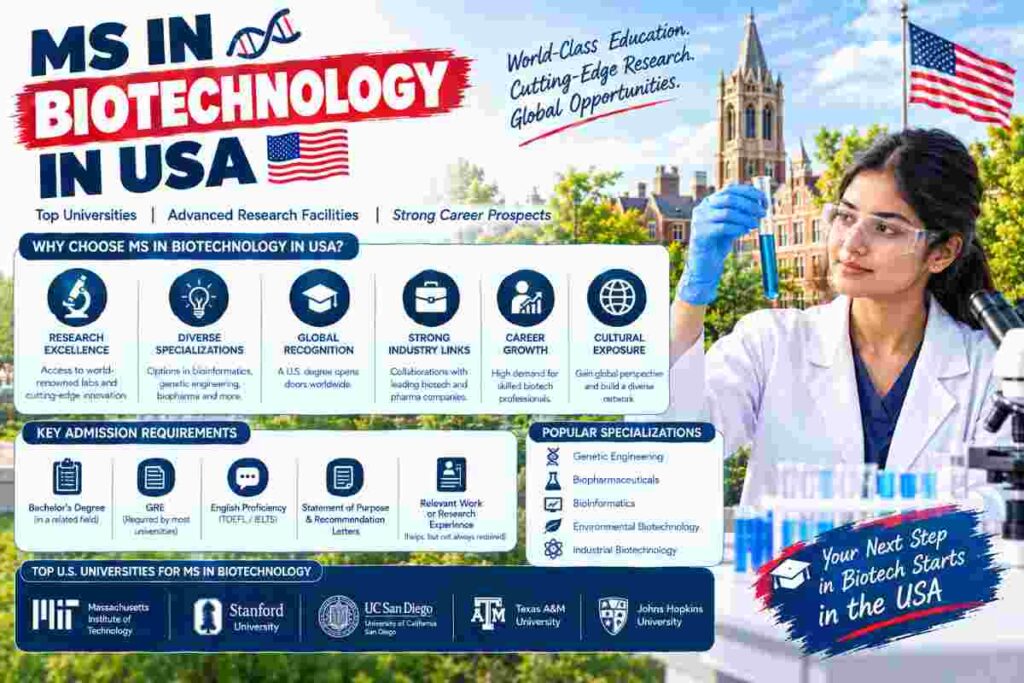
Quick Read
- Johns Hopkins charges $5,740 per course for biotechnology.
- Northwestern’s program costs about Rs.89 lakh across five quarters.
- Biotechnology degrees under CIP 26.1201 qualify for STEM OPT.
- F-1 visa government fees now total $785 per student.
- Duration of status ended for students on 15 September 2026.
- Indian students must now track a fixed I-94 date.
Is an MS in Biotechnology in USA Worth it for Indian Students in 2027-28?
Tuition for an MS in biotechnology in USA runs from roughly Rs.42 lakh to Rs.89 lakh for the full program at the three universities compared below, before living costs. That spread is the first thing to understand, because these degrees are not priced like Indian master’s programs, and the cheapest option is not always the weakest one.
The second thing to understand is the work runway. Biotechnology is a STEM-designated field in the United States, which means a graduate can hold 12 months of Optional Practical Training plus a 24-month STEM extension for up to 36 months of work authorization. For most Indian families doing the maths on a Rs.60 lakh education loan, that runway is the actual product being purchased, not the degree certificate.

Choose your dream country
 UK
UK
 USA
USA
 Germany
 Australia
 Ireland
 Canada
 UAE
UAE
 France
 Sweden
 Italy
Italy
 Other
Other
When do you want to study abroad?
What's your highest level of education?
Have you completed Class 12th?
What was your Class 12 CGPA/percentage?
Are you a student or a parent/guardian?
What do you want to study?
Select your current city
How Leap will help you

Personalised University Shortlist

Express Applications with Quicker Admits

End-to-End Application Support
American biotechnology master's programs come in three shapes. Research-track MS degrees are thesis-based and often part of a PhD feeder pipeline. Professional MS degrees combine science with business and an internship. Professional studies or applied master's degrees are shorter, course-based, and often part-time in structure. They cost different amounts and lead to different first jobs.
| Program | Structure | Official tuition | Total in INR | Entry bar |
|---|---|---|---|---|
| MS in Biotechnology, Johns Hopkins University (Advanced Academic Programs) | 10 courses, 40 credits, on-campus and online options | $5,740 per course, 2026-27 catalogue | Rs.55.06 lakh (about $57,400) | Bachelor's, minimum 3.0 GPA, named prerequisite coursework |
| Master of Biotechnology Program (MBP), Northwestern University | Five quarters, 15 to 21 months, internship included | $18,639 per quarter, 2025-26 rate | Rs.89.40 lakh (about $93,195) | Competitive GPA above 3.5, TOEFL above 100 or IELTS above 7.5, interview |
| MPS in Biotechnology, University of Maryland, Baltimore County | 30 credits, professional studies format | $1,460 per credit, non-resident | Rs.42.02 lakh (about $43,800) | Bachelor's in a relevant science field |
Counselor insight: Students fixate on the tuition line and forget that Northwestern charges no tuition during the internship quarter and that many of those internships are paid. A programme that looks 60% more expensive on paper can close part of that gap through one funded work term. Always ask the program office directly whether internship quarters are billed.
Work through the full budget in our guide to the MS cost in the USA for Indian students.
Top Universities for an MS in Biotechnology in USA
Three programs cover three realistic price points. Rankings matter less here than structure, cost and whether the program is coded as STEM.
Johns Hopkins University: MS in Biotechnology
Johns Hopkins runs its MS in Biotechnology through the Krieger School's Advanced Academic Programs. The 2026-2027 university catalogue lists the part-time AAP graduate biotechnology rate at $5,740 per course (Rs.5,50,638). The degree is 40 credits, which works out to ten courses and roughly $57,400 in tuition.
Admission requires a bachelor's degree from an accredited institution or an equivalent international credential and a minimum GPA of 3.0 on a 4.0 scale. The prerequisite list is specific and catches a lot of Indian applicants: from Summer 2026 onward it covers two semesters of general biology, two semesters of general chemistry, one semester of organic chemistry, one semester of biochemistry requiring organic chemistry proficiency, one semester of molecular biology and one semester of cell biology.
One warning that no aggregator article mentions. AAP programs are built around part-time and online delivery. F-1 regulations strictly limit how much of your course load can be online, so if you are coming on a student visa you must confirm in writing that you can enrol in an on-campus, full-time course of study before you accept an offer.
Northwestern University: Master of Biotechnology Program
Northwestern's MBP sits in the McCormick School of Engineering and runs across five quarters, or 15 to 21 months depending on your pathway. Students pay five quarters of tuition, and the 2025-26 rate was $18,639 per quarter (Rs.17,88,039), which is about $93,195 across the degree. Students who take an internship during the degree do not pay tuition during the internship quarter, and many of those placements are paid.
The program states that its admission requirements emphasise strong quantitative skills and knowledge of the molecular sciences. Competitive applications show GPAs above 3.5 and TOEFL scores above 100 or IELTS above 7.5. An interview is scheduled if your application is competitive. The MBP does not require the GRE.
University of Maryland, Baltimore County: MPS in Biotechnology
UMBC's Master of Professional Studies in Biotechnology is billed per credit, at $1,460 per credit for non-residents (Rs.1,40,058). Across the 30-credit program, that comes to roughly $43,800 in tuition, which makes it the most affordable of the three by a wide margin. The professional-studies format is designed for applied industry roles rather than a research career.
Other universities run well-regarded biotechnology master's programs, including Boston University, Rutgers, Columbia and the University of Wisconsin-Madison. Confirm the credit count, the per-credit rate and the CIP code on each program's own page before shortlisting, because professional master's fee structures change annually.
Counselor insight: Shortlist on cost per credit, not on the headline annual figure. American universities bill graduate professional programs per course or per credit, so an "annual tuition" number quoted on a comparison site is usually somebody's guess at how many courses you will take.
MS in Biotechnology in USA Fees and Total Cost in Rupees
Tuition for an MS in biotechnology in USA is Rs.42.02 lakh to Rs.89.40 lakh across the three programs above. Government visa fees add Rs.75,305, and living costs are separate again.
| Cost item | USD | INR |
|---|---|---|
| Johns Hopkins, per course | 5,740 | Rs.5,50,638 |
| Johns Hopkins, full 10-course degree | 57,400 | Rs.55,06,382 |
| Northwestern, per quarter | 18,639 | Rs.17,88,039 |
| Northwestern, five quarters | 93,195 | Rs.89,40,196 |
| UMBC, per credit (non-resident) | 1,460 | Rs.1,40,058 |
| UMBC, 30-credit degree | 43,800 | Rs.42,01,734 |
| MRV visa application fee (DS-160) | 185 | Rs.17,747 |
| SEVIS I-901 fee | 350 | Rs.33,576 |
| Visa Integrity Fee | 250 | Rs.23,983 |
| Total government visa fees | 785 | Rs.75,305 |
| Typical university application fee | 75 to 125 | Rs.7,195 to Rs.11,991 |
Exchange rate used: Rs.95.93 per US dollar. Verify the current rate before finalising your budget.
The three visa fees are paid at three different points. The SEVIS I-901 fee is paid after your I-20 arrives and before you book the interview. The MRV fee is paid when you schedule the appointment and is not refunded if you are refused. The Visa Integrity Fee, created by 2025 federal legislation and in force since 1 October 2025, is charged only when a visa is actually issued.
For living costs, use the figure printed on your own I-20 rather than an average from a blog. Every university calculates its own estimated cost of attendance, that figure appears on the I-20, and it is the number a consular officer will expect your financial documents to cover.
Funding options are covered in our guide to scholarships in the USA for Indian students.
Counselor insight: Loan sanctions are usually sized against tuition. Build the visa fees, the flight, the first month of setup costs and one semester of rent into the sanction request, because those land before your first stipend or campus job ever does.
Eligibility and Documents for an MS in Biotechnology in USA
Most programs expect a four-year bachelor's in a life science with a 3.0 GPA equivalent, English test scores, and specific prerequisite coursework in chemistry and molecular biology.
| Document | What it is | India-specific detail |
|---|---|---|
| Bachelor's degree and transcripts | Usually a four-year degree in a science field | Three-year BSc degrees are assessed case by case and are often the weakest point of an Indian application |
| GPA | Minimum 3.0 at Johns Hopkins; above 3.5 is competitive at Northwestern | Your 10-point CGPA has to be converted. Roughly 7.0 to 7.9 CGPA maps to a 3.0 to 3.4 GPA |
| Prerequisite coursework | Named courses in biology, chemistry, organic chemistry, biochemistry, molecular biology and cell biology at Johns Hopkins | Check your marksheet course titles against the list before applying. Gaps can sometimes be filled through an approved course |
| English test | TOEFL above 100 or IELTS above 7.5 for competitive applications at Northwestern | Book with time for one retake |
| GRE | Not required by Northwestern; varies elsewhere | Do not assume it is mandatory, and do not assume it is optional. Check each program page |
| SOP and LORs | Statement of purpose plus two or three recommendations | Write the university SOP and the visa statement separately. They have different readers |
| Credential evaluation | WES or similar, where required | Allow 10 to 14 working days on top of transcript issue time |
| Financial documents | Proof of funds to match the I-20 cost of attendance | Needed before the I-20 is issued, not just at the interview |
Check the wider picture in our guide to MS eligibility in the USA and decide on testing with GRE accepted universities in the USA.
Counselor insight: The prerequisite list is where strong Indian applicants lose offers. A BTech Biotechnology degree may not carry a distinct biochemistry or cell biology course even though the content was taught inside another subject. Ask the program office whether a syllabus copy can be submitted to demonstrate coverage.
STEM OPT and How long you can work after an MS in Biotechnology in USA
A STEM-designated MS in biotechnology in USA gives you up to 36 months of post-study work authorisation: 12 months of OPT plus a 24-month STEM extension.
Eligibility is decided by the six-digit CIP code printed on your Form I-20, not by the name of your degree. Biotechnology sits at CIP 26.1201 on the DHS STEM Designated Degree Program List, and DHS designates the entire Biological and Biomedical Sciences series (CIP 26) at the two-digit level, so any new code added to that series is automatically included. This matters because a program called something like "biotechnology management" or "biotech enterprise" may be coded under business rather than CIP 26, which would leave you with 12 months of work authorisation instead of 36.
Check the CIP code on your I-20 before you pay a deposit, and confirm it with the designated school official if it is not what you expected. The STEM extension carries conditions. Your employer must be enrolled in E-Verify, and you and the employer must complete a Form I-983 training plan. The extension is not automatic and it is not available to every employer.
Beyond OPT, the usual next step is the H-1B, which is capped and allocated by lottery. Both the lottery structure and a proposed six-figure supplemental fee have been through several rounds of litigation since 2025, with rules changing and being challenged repeatedly. Do not plan your finances around any specific H-1B outcome, and check the position at the time you graduate rather than relying on an article written years earlier.
Counselor insight: Employers who sponsor STEM OPT must be E-Verify enrolled, and many small biotech startups are not. When you evaluate a first job offer, ask about E-Verify enrolment in the first conversation, not after you accept.
What the New F-1 Stay Rules Mean for Your MS in Biotechnology in USA
The duration of status ended for F-1 students on 15 September 2026. DHS published the final rule on 17 July 2026 in the Federal Register as docket 2026-14439, and it replaces the old open-ended admission with a fixed date.
Under the new framework, you are admitted until the program end date on your Form I-20, not exceeding four years, plus a 30-day period to depart. The previous 60-day post-completion grace period has been reduced to 30 days. If your research or coursework runs past the I-20 end date, you must file an Extension of Stay with USCIS or leave and seek readmission with an updated I-20. Students already in the United States on duration of status when the rule took effect fall under transition provisions.
Three practical consequences for an Indian student starting in Fall 2027. First, an I-94 now carries a hard end date you need to track yourself. Second, a thesis that slips by a semester is now an immigration filing, not just an academic matter. Third, the shorter departure window means job-hunting timelines after graduation are tighter than what older guides describe.
The rule is facing a legal challenge, so confirm the current position with your designated school official before you make any decision based on it.
Prepare for the interview itself with our guide to F-1 visa interview questions, and understand the document at the centre of all of this in our explainer on Form I-20.
Counselor insight: Ask your program office for a realistic completion date before they issue the I-20, not the shortest one that looks good on paper. An I-20 end date that is tight for your program now creates an extension filing later.
Jobs and Salary after an MS in Biotechnology in USA
US Bureau of Labor Statistics data for May 2025 puts the median wage for biological technicians at $57,510 a year (Rs.55.17 lakh) and for medical scientists at $103,410 (Rs.99.20 lakh).
| What you are comparing | Biological technicians | Medical scientists |
|---|---|---|
| Median annual wage, May 2025 | $57,510 (Rs.55.17 lakh) | $103,410 (Rs.99.20 lakh) |
| Bottom 10% earned under | $40,330 (Rs.38.69 lakh) | Substantially higher than the technician floor |
| Typical entry-level education | Bachelor's degree | Doctoral or professional degree |
| Projected growth, 2025 to 2035 | 7% | 13% |
| Where a master's graduate fits | A common first destination, though a master's moves you past pure bench work faster than a bachelor's does | Usually out of reach without a PhD, so treat this as a ceiling rather than a starting point |
A master's degree places you between those two rungs. It opens regulatory affairs, quality, process development, bioprocess manufacturing, and commercial roles, but it does not on its own make you competitive for independent research positions. If independent research is the goal, a funded PhD is usually the better financial decision than a self-funded master's, and our guide to PhD scholarships in the USA covers that route.
Counselor insight: Graduates who land well almost always add one hard technical skill to the biology: Python and data handling, GMP manufacturing exposure, or regulatory documentation. Pick that skill during your first semester rather than during OPT.
Month-by-Month Plan for the Fall 2027 MS in Biotechnology in USA Intake
| Month | What to do |
|---|---|
| Jul to Sep 2026 | Shortlist 8 to 10 programs. Check the CIP code and prerequisite list for each |
| Sep to Oct 2026 | Book TOEFL or IELTS. Decide on the GRE based on your specific shortlist |
| Oct to Nov 2026 | Request transcripts, start WES if required, brief your recommenders, and draft the SOP |
| Dec 2026 to Feb 2027 | Submit applications. Most US Fall deadlines fall in this window, but confirm each program's date |
| Feb to Apr 2027 | Interviews where required. Admission decisions arrive |
| Apr to May 2027 | Accept an offer, submit financial documents, and receive the I-20. Check the program end date on it |
| May 2027 | Pay the SEVIS I-901 fee, file the DS-160, and book the visa slot early. Peak-season slots for Indian applicants fill fast |
| Jun to Jul 2027 | Visa interview. Pay the Visa Integrity Fee on issuance. Arrange forex and the education loan disbursal. |
| Jul to Aug 2027 | Book flights, arrange housing, complete pre-departure documentation |
| Aug to Sep 2027 | Arrival, SEVIS registration, orientation |
Start the visa paperwork with our walkthrough on how to fill the DS-160 form.
Counselor insight: Visa slot availability, not the interview itself, is what usually derails a June departure. The moment your I-20 arrives, pay the SEVIS fee and book a slot even if you are still deciding between offers.
What to Do if Your MS in Biotechnology in USA Plan Goes Wrong
- Your visa is refused under section 214(b). This is a finding that you did not establish non-immigrant intent or sufficient funds. Identify which one, fix the documentation or the answers, and reapply. A refusal does not bar a fresh application.
- Your funds fall short of the I-20 figure. Universities will not issue the I-20 until documents match their cost of attendance. Sanction the loan earlier, or ask the program office whether a partial first-semester figure is acceptable.
- You miss a deadline. Many US programs run a spring intake or rolling review. Ask the admissions office directly rather than assuming the cycle is closed.
- Your program turns out not to be STEM-coded. Ask the school whether an alternative concentration carries a CIP 26 code. If not, you are planning around 12 months of work authorisation, not 36, and the financial case changes.
- You need more time than your I-20 allows. Under the rules in force since 15 September 2026, that means an Extension of Stay filing with USCIS. Start it with your designated school official well before the I-94 end date, not after.
- Your visa slot lands after the program start date. Ask the university for a deferral to the next intake in writing. Arriving late without authorisation creates status problems.
Counselor insight: Every one of these is survivable if you act in the same week you discover it. What turns a fixable problem into a lost year is waiting to see whether it resolves itself.
3 Takeaways on MS in Biotechnology in USA
An MS in biotechnology in USA is a Rs.42 lakh to Rs.90 lakh decision whose value depends heavily on immigration rules that changed this year. Three things to do next:
- Check the six-digit CIP code on every program you shortlist and confirm it sits in the CIP 26 series before paying any deposit.
- Map your transcript against each program's prerequisite coursework list, and fix gaps before applications open in late 2026.
- Build a budget that includes the Rs.75,305 in government visa fees and the cost of attendance printed on your I-20, not tuition alone.
Verified by: LeapScholar's USA counseling team, with hands-on experience guiding Indian students through graduate admissions, F-1 visa applications and OPT timelines.
Have questions about applying for an MS in biotechnology in USA? Book a free session with a LeapScholar counselor.
Frequently Asked Questions on MS in Biotechnology in USA
-
My three-year BSc is being questioned. What are my options?
Get a credential evaluation done early so you know how your degree is assessed. Some universities accept a three-year degree with strong coursework; some require a fourth year or a master's. Targeting programs that publish their position on three-year degrees saves application fees you would otherwise lose.
-
Can I do this degree online or part-time on a student visa?
F-1 regulations limit how much of your course load can be completed online, so a program designed for part-time or online delivery may not support a student visa in its standard format. Confirm in writing with the admissions office that on-campus, full-time enrollment is available before accepting an offer.
-
What salary can I expect after an MS in biotechnology in USA?
BLS May 2025 data lists a median wage of $57,510 (Rs.55.17 lakh) for biological technicians and $103,410 (Rs.99.20 lakh) for medical scientists, though a doctorate is the typical entry-level education for the latter. A master's graduate usually starts between those figures, higher in regulatory, manufacturing, and commercial roles.
-
What are the total visa fees for a US student visa from India?
Government fees total $785 (Rs.75,305): the MRV application fee of $185, the SEVIS I-901 fee of $350, and the $250 Visa Integrity Fee. Each is paid at a different stage, and the MRV fee is not refunded if your application is refused.
-
Do I need the GRE for an MS in biotechnology in USA?
It depends entirely on the program. Northwestern's Master of Biotechnology Program states that it does not require the GRE. Other universities still ask for it, and some accept it optionally. Check each program page on your shortlist rather than assuming one rule applies across the country.
-
How long can I work in the US after this degree?
A STEM-designated degree allows 12 months of Optional Practical Training plus a 24-month STEM extension, up to 36 months total. The extension requires an employer enrolled in E-Verify and a completed Form I-983 training plan. It is not automatic, and not every employer can support it.
-
What changed with F-1 student visas in September 2026?
The duration of status ended on 15 September 2026. F-1 students are now admitted until the program end date on the Form I-20, capped at four years, plus 30 days to depart, down from the previous 60-day grace period. Extra time requires an Extension of Stay filing with USCIS.
-
Is an MS in biotechnology in USA a STEM degree?
Biotechnology carries CIP code 26.1201 on the DHS STEM Designated Degree Program List, and the whole CIP 26 series is designated at the two-digit level. What matters is the six-digit code printed on your Form I-20, not the program title. Management-oriented biotechnology programs coded under business will not qualify.
-
How much does an MS in biotechnology in USA cost for Indian students?
Tuition across the three programs compared here runs from about $43,800 at UMBC (Rs.42.02 lakh) to about $93,195 at Northwestern (Rs.89.40 lakh). Johns Hopkins bills $5,740 per course for ten courses, roughly $57,400 (Rs.55.06 lakh). Living costs and the $785 in government visa fees are on top of tuition.










Have Questions? Get Guidance to reach your Dream University
Connect with India's finest counsellors and biggest study abroad community.
Get Guidance