
Quick Read
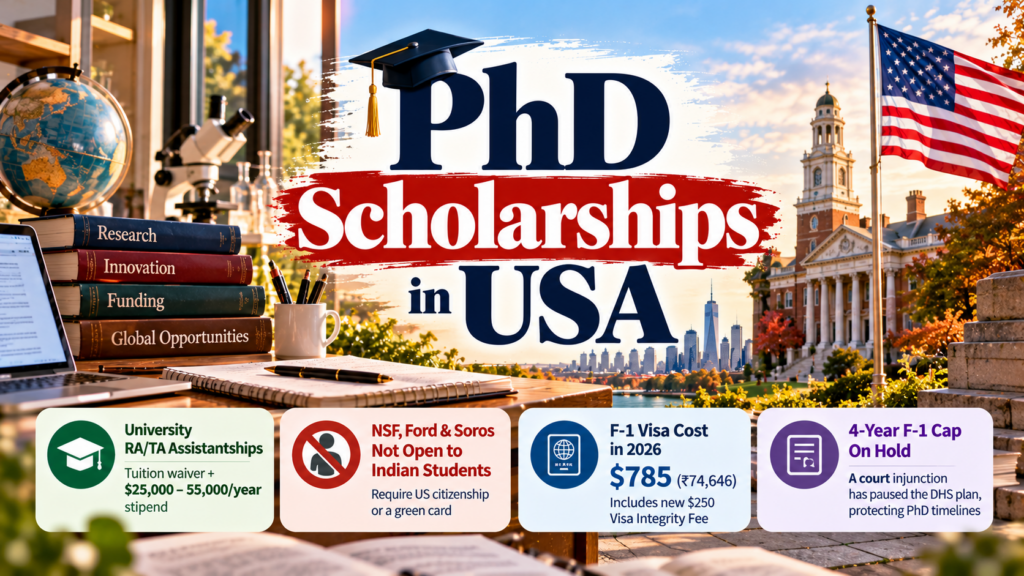
- Most fully funded PhDs come from the university itself (RA/TA assistantships), not a standalone scholarship
- NSF GRFP, Ford Foundation, and Paul & Daisy Soros fellowships require US citizenship or a green card
- F-1 visa costs now total $785 (₹74,646), including a new $250 Visa Integrity Fee from FY2026
- A court injunction has paused a DHS plan to cap F-1 status at 4 years, which would have hit PhD timelines hardest
How PhD Scholarships in USA Actually Works
Most Indian students searching for PhD scholarships in USA picture a separate application process on top of PhD admission. In practice, PhD funding in USA for international students primarily comes through the university itself, via assistantships awarded automatically when you’re admitted to a funded PhD program:
- Research Assistantships (RAs): You work on a faculty member’s funded research project. Common in STEM, where grants pay your tuition and stipend directly.
- Teaching Assistantships (TAs): You assist with teaching, grading, or leading discussion sections, funded by the department.
Both typically include a tuition waiver, an annual stipend, and health insurance, guaranteed for 4–6 years as long as you maintain academic progress. For most Indian PhD applicants, securing admission to a program that funds all its PhD students, which most reputable research universities do, matters more than chasing an external scholarship.
Counselor Insight: When you shortlist programs, ask directly: “Does this program guarantee funding for all admitted PhD students?” Many departments do; some don’t. That single answer matters more than any external fellowship you might apply for later.
Which PhD Scholarships in USA Are Actually Open to Indian Students?
Several fellowships that routinely appear on “Top 10 PhD Scholarships in USA for Indian Students” lists are not actually open to applicants from India. Each requires US citizenship, national status, or a green card:
- NSF Graduate Research Fellowship Program (GRFP): Eligibility is limited to US citizens, US nationals, and permanent residents. An Indian student applying from India, or studying in the US on an F-1 visa, is not eligible.
- Ford Foundation Fellowship: Eligibility is limited to US citizens, nationals, permanent residents, and DACA recipients. Not open to F-1 visa holders.
- Paul & Daisy Soros Fellowship for New Americans: Despite the name, this requires you to already be a naturalized US citizen or green card holder; it is not for students applying to study in the US for the first time.
If you’re applying from India on a student visa, these three are not realistic options, regardless of how often they appear on scholarship lists. The next section covers fellowships that genuinely welcome applicants in your position.
Sources: NSF GRFP; Ford Foundation Fellowships; Paul & Daisy Soros Fellowship
PhD Scholarships in USA That Indian Students Can Actually Apply For
| Scholarship/Fellowship | Funding: USD (INR) | Who It’s For |
| University RA/TA Assistantship | Tuition waiver + 25,000–55,000/year stipend (₹23.8L–₹52.3L) | Admitted PhD students; the primary funding route |
| AAUW International Fellowship | $25,000/year for doctoral fellows (₹23.8L) | Women pursuing full-time graduate study; open to non-US citizens |
| Fulbright-Nehru Doctoral Research Fellowship | Travel, stipend, and research support for 6–9 months | Indian scholars already registered for a PhD at an Indian institution (see next section) |
| IBM PhD Fellowship | ~$40,000/year (₹38.0L) | STEM and computing research, open internationally |
| Stanford Knight-Hennessy Scholars | Full tuition + living stipend (~$40,000/year; ₹38.0L) | All disciplines at Stanford, explicitly open to international students |
| University of Chicago Neubauer Fellowship | Full tuition + ~$35,000/year stipend (₹33.3L) | Humanities and Social Sciences PhD admits |
| MIT Presidential Fellowship | Full tuition + living stipend (~$40,000/year; ₹38.0L) | STEM and Engineering PhD admits |
| Harvard Graduate Fellowships | Varies; typically full tuition + stipend (~$45,000/year; ₹42.8L) | All disciplines, awarded at admission |
| Inlaks Shivdasani Scholarship | Up to $120,000 toward tuition and living costs (₹1.14Cr) | Indian citizens under 30; excludes engineering, computer science, medicine, and MBA/management |
Sources: AAUW International Fellowships; Inlaks Shivdasani Foundation
Currency Conversion Note: All amounts in this guide are listed in US Dollars (USD) with Indian Rupee (INR) equivalents in brackets. Conversion rate used throughout: 1 USD = ₹95.09. Rates fluctuate daily, so confirm the live rate before transferring funds.
Unlike the citizenship-restricted fellowships above, every option in this table either comes from the university itself (triggered by admission, not a separate application) or explicitly welcomes international and Indian applicants. If you’re comparing PhD programs in USA with scholarships for international students, prioritizing a funding guarantee does more for your finances than any single external award, which is why these fully funded PhD scholarships for Indian students in USA are the ones worth your application time.
Counselor Insight: University-tied fellowships like Knight-Hennessy or the Neubauer Fellowship are typically awarded automatically when you’re admitted and don’t need a separate application beyond your PhD application itself. Ask the admissions office directly whether you’re being considered.
What the Fulbright-Nehru Doctoral Fellowship Actually Funds
Fulbright appears on nearly every PhD scholarship list for Indian students, but the specific Fulbright-Nehru Doctoral Research Fellowship, administered by the United States-India Educational Foundation (USIEF), does not fund a full PhD at a US university. It’s a 6–9 month pre-doctoral research fellowship for Indian scholars already registered for a PhD at an Indian institution, letting them conduct research at a US university before returning to complete their degree in India.
The fellowship covers round-trip economy airfare, a monthly stipend, and J-1 visa support, and requires an undertaking to return to India afterward. The 2027–28 cycle’s application deadline was 1 July 2026; the next cycle typically opens in February of the following year.
If your goal is a complete PhD based at a US university, the university assistantship route or the fellowships in the table above are the relevant paths, not Fulbright-Nehru’s doctoral category.
Source: USIEF
What Does a “Fully Funded PhD” in the USA Really Mean?
A fully funded PhD typically bundles four components, so you can focus on research instead of tuition bills:
- Tuition waiver: Full tuition and mandatory fees covered, typically valued at 15,000–50,000/year (₹14.3L–₹47.5L) depending on the university.
- Stipend: A fixed living allowance, usually 25,000–55,000/year (₹23.8L–₹52.3L), for rent, food, and transport.
- Health insurance: Most programs include full medical and dental coverage, sometimes extending to dependents.
- Duration: Funding is generally guaranteed for 4–6 years, contingent on satisfactory academic progress.
PhD Scholarships in USA at a Glance
| Factor | Detail |
| Primary funding route | University RA/TA assistantship, awarded at admission |
| Typical tuition waiver | 15,000–50,000/year (₹14.5L–₹48.4L) |
| Typical stipend | 25,000–55,000/year (₹24.2L–₹53.2L) |
| Funding duration | 4–6 years, contingent on academic progress |
| F-1 visa total cost (2026) | $785 (₹75,971) |
| Open to Indian applicants | AAUW International, IBM PhD, Knight-Hennessy, Neubauer, MIT Presidential, Harvard Graduate, Inlaks Shivdasani |
| NOT open to Indian applicants | NSF GRFP, Ford Foundation Fellowship, Paul & Daisy Soros Fellowship |
Source: National Center for Education Statistics (NCES)
How to Apply for a PhD in the USA with Funding
- Shortlist 8–12 programs and specific faculty advisors whose research matches yours; a program’s overall funding guarantee matters as much as its ranking
- Prepare transcripts, a CV highlighting research and publications, and a Statement of Purpose with a clear research proposal
- Check each program’s standardized test policy (see below) and submit TOEFL/IELTS scores
- Secure 3 strong letters of recommendation from professors or research supervisors
- Apply 6–12 months before your intended start, indicating financial need where the application asks
- Once admitted with funding, begin your F-1 visa process
Is the GRE Still Required?
GRE policy varies sharply by field. Many humanities, social science, and biology PhD programs made the GRE optional or dropped it entirely after 2020. Engineering, physical sciences, and some computer science programs are more likely to still require it, and a few top programs reinstated it. Check each program’s current page directly rather than assuming a blanket policy; TOEFL or IELTS remains required for international applicants regardless of GRE status, with most competitive programs expecting TOEFL 100+ or IELTS 7.0+.
Counselor Insight: “GRE optional” doesn’t mean GRE-irrelevant for funded PhD seats. A strong quantitative score can still differentiate your application at research-intensive universities, even where it isn’t formally required.
PhD Requirements in USA for International Students
Beyond funding, admissions committees screen for a consistent set of academic requirements:
- Academic qualifications: A 4-year bachelor’s degree or a master’s degree from a recognized institution; a 3-year bachelor’s may require a master’s first
- Academic record: A GPA typically above 3.0 on a 4.0 scale, or its equivalent
- English proficiency: TOEFL or IELTS scores meeting each university’s threshold, independent of GRE policy
- Research fit: A Statement of Purpose and, ideally, prior research experience aligned with a specific faculty advisor’s work
- Financial readiness: Even with a funding offer, proof of resources to cover any gap is required for the F-1 visa process
These requirements apply whether or not the program you’re targeting also offers a named fellowship.
F-1 Visa Process and Costs in 2026
Once you have an I-20 and a funded offer, you’ll apply for an F-1 student visa. The biggest update for 2026: total visa costs have risen sharply with a new fee that most guides haven’t caught up to yet.
| Fee | Amount: USD (INR) | Notes |
| SEVIS I-901 fee | $350 (₹33,282) | Paid before your visa interview; non-refundable |
| MRV visa application fee | $185 (₹17,592) | Paid when scheduling your consular interview |
| Visa Integrity Fee (new, FY2026) | $250 (₹23,773) | Charged at visa issuance; refundable if you comply with visa terms and depart on time |
| Total | $785 (₹74,646) |
The Visa Integrity Fee was introduced under the One Big Beautiful Bill Act (signed 4 July 2025) and applies to most nonimmigrant visas, including F-1, starting fiscal year 2026. Unlike SEVIS and MRV, it’s collected at visa issuance rather than before your interview, and the refund process isn’t fully detailed yet, so budget for it as a real cost rather than assuming it comes back automatically.
Documents to prepare: your I-20, proof of funding or financial resources, a valid passport, the DS-160 confirmation page, and your visa interview appointment letter.
Counselor Insight: Pay the Visa Integrity Fee’s refund terms real attention before you travel. If you overstay or work without authorization at any point, you risk losing a refund you were counting on getting back.
Source: US Department of State
Post-PhD Outlook: Two 2025–2026 Policy Changes Worth Knowing
The $100,000 H-1B fee doesn’t apply to you if you’re already in the US on F-1. A September 2025 proclamation requires a $100,000 fee for new H-1B petitions, which caused real alarm among international students. USCIS guidance clarified in October 2025 that the fee applies only to consular-processed petitions for people currently outside the US; an F-1-to-H-1B change of status filed while you’re inside the US is exempt. Most PhD graduates sponsored by their US employer after graduation fall into this exempt category.
A plan to cap F-1 status at 4 years is currently blocked. In July 2026, DHS published a final rule replacing “Duration of Status” with a fixed 4-year admission period for F-1 students, which would have forced most PhD students, whose programs typically run 4–6 years, to file a discretionary Extension of Stay partway through their degree. A federal court issued a nationwide injunction on 14 September 2026, pausing the rule before its scheduled effective date. Duration of Status remains in effect for now, but the litigation is ongoing, so this is worth monitoring if your PhD timeline runs past 2026.
Sources: USCIS; Study in the States (DHS)
3 Takeaways on PhD Scholarships in USA
- The most reliable path to a fully funded PhD is the university’s own RA/TA assistantship, not an external scholarship; NSF GRFP, Ford Foundation, and Paul & Daisy Soros are not open to Indian applicants, whatever other lists say
- F-1 visa costs now total $785 due to a new $250 Visa Integrity Fee, and a court injunction is currently holding off a 4-year F-1 cap that would have disrupted PhD timelines
- Figures here are current as of October 2026 and verified against official sources, but immigration policy in this area is moving fast; confirm live details with your institution’s international student office and a counselor before you commit
Verified by: LeapScholar’s USA counseling team, drawn from F-1 visa filings, Fulbright-Nehru applications, and university assistantship offer reviews for Indian PhD applicants.
Have a specific question about PhD scholarships in the USA? Book a free session with a LeapScholar counselor.
Frequently Asked Questions About PhD Scholarships in USA
-
How to get fully funded PhD scholarships in USA?
Apply directly to programs that guarantee funding through RA or TA assistantships; this covers most fully funded PhD seats, and it’s also the most reliable answer to how you can get a full scholarship for a PhD in USA. Supplement with fellowships you’re actually eligible for, such as AAUW International or university-tied awards like Knight-Hennessy.
-
Are NSF, Ford Foundation, and Soros fellowships open to Indian students?
No. All three require US citizenship, national status, or a green card. They are not realistic options if you’re applying from India on a student visa.
-
Does Fulbright fund a full PhD for Indian students?
The Fulbright-Nehru Doctoral Research Fellowship funds a 6–9 month research visit for students already enrolled in a PhD at an Indian institution, not a complete US-based PhD.
-
Are PhDs in the USA fully funded?
Most research-intensive universities fund all admitted PhD students through assistantships, typically covering tuition, a stipend, and health insurance for 4–6 years.
-
Is a PhD free in USA for international students?
Not free, but most research-intensive universities fund admitted PhD students fully: tuition waived, plus a stipend and health insurance, so your out-of-pocket cost can be close to zero once you’re funded.
-
Is the GRE required for a PhD in the USA?
It depends on the field. Many humanities and social science programs made it optional; engineering and physical sciences are more likely to still require it. Check each program directly.
-
How much does an F-1 visa cost in 2026?
$785 total (₹75,971): $350 SEVIS fee, $185 MRV fee, and a new $250 Visa Integrity Fee introduced for fiscal year 2026.
-
Will the new $100,000 H-1B fee affect me after my PhD?
Not if your employer files a change of status while you’re inside the US on F-1 or OPT. The fee applies to new consular-processed petitions for people outside the US.
-
Can my PhD be affected by the new 4-year F-1 limit?
Not currently. A federal court blocked the rule in September 2026, so Duration of Status still applies, though the litigation is ongoing.
-
What is the average cost of a PhD in the USA?
According to NCES, the average annual cost of a doctoral program, including tuition and living expenses, is about $49,500 (₹47.9L), which is why most students rely on full funding rather than paying out of pocket.













Have Questions? Get Guidance to reach your Dream University
Connect with India's finest counsellors and biggest study abroad community.
Get Guidance