
Quick Read
- Stanford ranks #2 globally in the QS World University Rankings 2027.
- UC Berkeley sits at #20 (down from #17 in 2026), but Berkeley remains the top-ranked public university in the US
- Stanford’s MS in Computer Science does not require GRE scores for 2026-27 admissions.
- Indian students need Rs. 1.85 lakh ($1,529) per month in London shown in bank for 28 days.
- UC Berkeley, as a public university, charges a meaningfully lower non-resident tuition than Stanford.
- UC Berkeley’s official first-year admit rate for the Class of 2029 was 11.43%, roughly three times Stanford’s rate
UC Berkeley vs Stanford University: Quick Overview
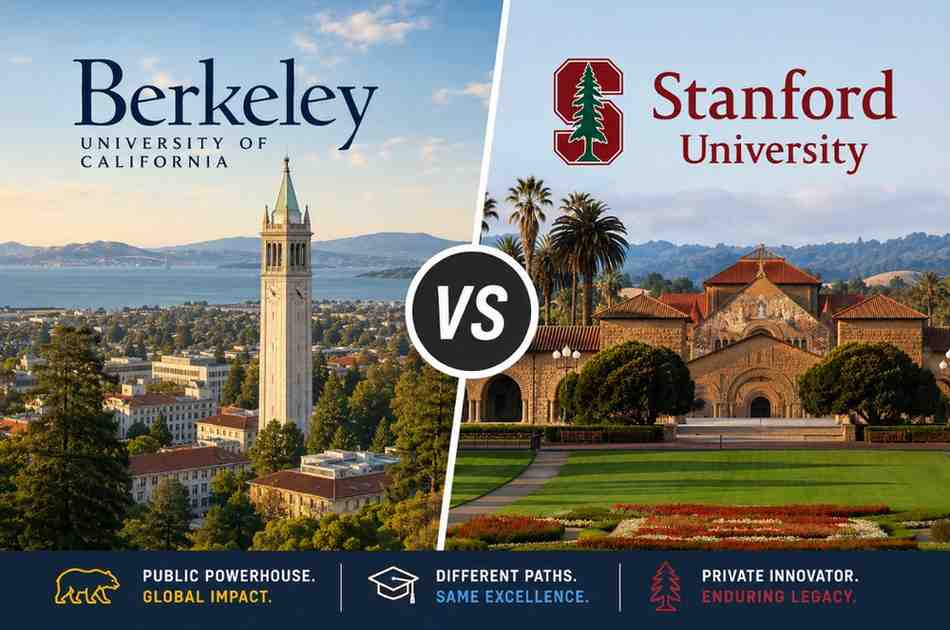
- Stanford University and UC Berkeley sit less than an hour apart on opposite sides of San Francisco Bay, and both consistently show up at the top of global ranking tables, which is why Indian students researching a US university vs Stanford University comparison usually land on this exact pairing.
- Stanford was founded in 1885 as a private research university, built around Silicon Valley proximity, entrepreneurship, and a small residential undergraduate community.
- UC Berkeley was founded in 1868 as the flagship campus of the University of California system, operating as a public university with a much larger student body, a stronger emphasis on public service and research breadth, and a lower cost structure for students who qualify for in-state-style pricing.
- For an Indian applicant, the practical difference: Stanford’s private funding model gives it flexibility on financial aid and program design, while Berkeley’s public mandate keeps its sticker price lower relative to its ranking, at the cost of larger class sizes and a more bureaucratic administrative experience.
- Both universities funnel graduates into the same Bay Area tech and finance ecosystem, so applicants typically choose based on program fit, cost, and admission odds rather than one school being categorically “better.”
UC Berkeley vs Stanford University Rankings 2027
- In the QS World University Rankings 2027, Stanford holds joint second place globally with a near-perfect overall score, continuing a run of top-three finishes.
- UC Berkeley, by contrast, dropped to joint 20th position in the same edition, a fall from 17th the previous year, even though it remains comfortably the highest-ranked public university in the United States.
- On US News and World Report’s Best Global Universities list for 2026-27, the gap narrows: Stanford sits 4th worldwide and UC Berkeley sits 7th, a much tighter spread than the QS numbers suggest.
- This split exists because QS weights academic and employer reputation surveys heavily, where Stanford’s compact, highly selective structure tends to score better, while US News gives more weight to research output and citations, categories where Berkeley’s large faculty and research volume close the gap.


When do you want to study abroad?
What's your highest level of education?
Have you completed Class 12th?
What was your Class 12 CGPA/percentage?
Are you a student or a parent/guardian?
What do you want to study?
Select your current city
How Leap will help you

Personalised University Shortlist

Express Applications with Quicker Admits

End-to-End Application Support
Counselor Insight: Don't let a ranking gap alone decide this for you. Rankings measure institutional averages, not the strength of your specific department. Berkeley's EECS program, for instance, competes with Stanford's CS department on faculty quality and research output even when the overall university ranking differs by fifteen or more places.
UC Berkeley vs Stanford Cost Comparison for Indian Students (INR)
- Stanford held undergraduate tuition flat for 2026-27 at Rs.65.24 lakh ($67,731) per year, with standard room and board adding another Rs.22.10 lakh ($22,944), taking direct costs to roughly Rs.87.34 lakh ($90,675) annually before books, travel, and personal expenses.
- Stanford charges the same rate to every undergraduate regardless of nationality, so an Indian student pays the same sticker price as a Californian; however, Stanford's need-based aid can significantly lower that amount for admitted students who qualify.
- Stanford's Graduate School of Engineering, which houses the MS in Computer Science, charges $23,239 per quarter (approximately Rs.22.39 lakh) for a full 11-18 unit courseload in 2026-27. Most students complete the 45-unit MS program over four to six quarters, putting total tuition at roughly $93,000 to $139,000 (Rs.89.55 lakh to Rs.1.34 crore), before living expenses of another Rs.9.63 lakh to Rs.24.08 lakh ($10,000 to $25,000) per year.
- Stanford's Graduate School of Business (MBA) charges $29,729 per quarter for the first year, roughly $89,187 (Rs.85.89 lakh) in annual tuition, with total cost of attendance for a single student running close to $140,940 (Rs.1.36 crore) once housing, health insurance, and personal expenses are included.
- UC Berkeley's undergraduate non-resident tuition and fee schedule is published on the Office of the Registrar's fee schedule page, and it runs meaningfully lower than Stanford's flat rate for most cohorts, though the exact figure depends on the specific year's approved schedule.
- At the MBA level, Berkeley's Haas School of Business charged 2025-26 non-resident tuition of $89,033 (approximately Rs.85.75 lakh), with total cost of attendance including housing reaching approximately $133,000 to $134,000 (approximately Rs.1.28 to Rs.1.29 crore) per year, close to Stanford GSB's tuition-only figure for the same period.
- Honest caveat: Berkeley's self-supporting professional master's programs, including several MEng and specialized MS tracks in engineering, set their own tuition These fees are separate from the standard graduate fee schedule and can vary significantly between departments. Always confirm the exact figure on the specific program's admissions page rather than relying on a university-wide average.
Indian students weighing the financial aid angle should also read our detailed breakdowns of Stanford scholarships for Indian students and UC Berkeley scholarships for Indian students, alongside a broader look at MS cost in the USA for Indian students if you are still comparing multiple universities on budget alone.
UC Berkeley vs Stanford Admission Requirements and Acceptance Rates
- Stanford's Common Data Set puts its undergraduate acceptance rate for the Class of 2029 at approximately 3.80% (2,302 admits from 60,646 applicants), continuing a multi-year trend of sub-4% admit rates.
- UC Berkeley's official first-year admit data shows an overall acceptance rate of 11.43% for the same admissions cycle, roughly three times higher.
- Within Berkeley, this rate is not uniform: its EECS program admits under 5% of applicants, the closest equivalent to Stanford's CS strength, putting it in the same selectivity tier as Stanford itself for that specific major.
- Stanford's Computer Science department has confirmed on its own admissions page that GRE scores are not required and not considered for MS applicants, a policy that has held steady for the 2026-27 cycle.
- TOEFL or IELTS remains mandatory for applicants whose first language is not English, with Stanford accepting IELTS Academic as an equivalent to TOEFL for graduate programs.
- UC Berkeley has similarly waived the GRE for many of its engineering and computer science graduate programs, though this varies by department, so confirm the exact policy on the specific program page before assuming it applies to you.
- For Indian applicants, competitive profiles at both schools usually have an undergraduate CGPA above 8.0 or a percentage above 75%, plus strong research experience, project work, and letters of recommendation that highlight specific technical or leadership contributions instead of generic praise.
If you want a step-by-step breakdown of the application itself, our guide on how Indian students can get into Stanford covers the process in detail, and our SAT-specific guides for Stanford and UC Berkeley are useful if you are applying straight out of Class 12.
Stanford vs UC Berkeley for Computer Science and Engineering
- Stanford's Computer Science department, established in 1965 as the world's first, holds a consistent top-two global position in subject rankings and offers eleven or more specialization tracks spanning artificial intelligence, security, human-computer interaction, and computational biology.
- Its location inside Silicon Valley gives students direct proximity to Google, Apple, Meta, and a dense startup ecosystem for internships and faculty consulting ties.
- Berkeley's EECS program admits under 5% of applicants, a selectivity rate that rivals Stanford's own, and counters with comparable faculty depth, a lower overall cost structure, and close ties to the same Bay Area tech employers.
- Berkeley students also point to a semester system that some find better suited to deep, sustained coursework compared to Stanford's faster-paced quarter system.
- Neither program is meaningfully weaker than the other for placement outcomes; the difference shows up more in class size, faculty accessibility, and the specific research groups active in a given year.
For a broader look at how these programs compare with other countries too, see our guide to MS in Computer Science in the USA.
My Insight: If your specific research interest maps to a named professor's lab, choose based on that fit over the general university ranking. Reach out to the professor directly months before applying; a two-hundred-word, specific email referencing their recent published work consistently outperforms a generic inquiry for both Stanford and Berkeley research-track applicants.
Stanford GSB vs Berkeley Haas: MBA Comparison
- Stanford's Graduate School of Business does not publish its acceptance rate on its own class profile, but external reporting on the MBA Class of 2027 consistently puts it around 6% to 7%, among the lowest of any MBA program globally.
- The GSB class regularly draws a meaningful share of its students from an original Ivy League undergraduate background, with the Indian Institutes of Technology among its top international feeder institutions.
- Haas runs a considerably smaller cohort, around 295 to 300 students per class, with an acceptance rate reported between 19% and 24% depending on the year, making it meaningfully more accessible than GSB while still highly competitive.
- Haas's median GMAT score sits around 726 to 738, with GRE also accepted, and its 2025-26 non-resident tuition of $89,033 (approximately Rs.85.75 lakh) runs close to GSB's tuition-only figure for the same cycle.
- International students made up 38% of Haas's most recent incoming class.
- For an Indian applicant choosing between the two, the honest trade-off is prestige and network depth at GSB against a broader admit funnel at Haas, with the actual cost gap between the two programs now narrower than it once was.
Career Outcomes, OPT, and STEM-OPT: Berkeley vs Stanford
- Both universities feed the same Silicon Valley hiring pipeline, and both qualify Indian graduates in STEM-designated programs for the same federal work authorization pathway.
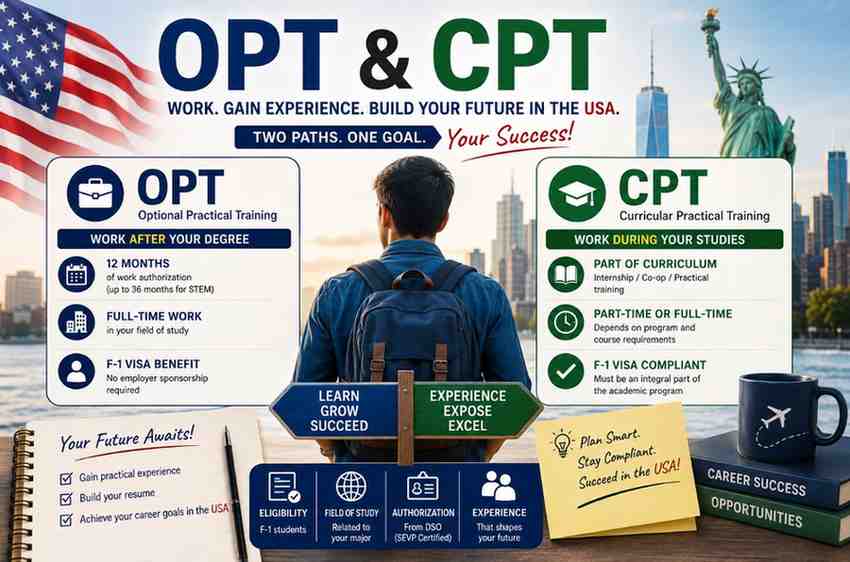
- F-1 visa holders who complete a STEM-designated degree, including Computer Science, Engineering, and most technical master's tracks at either school, can get 12 months of standard Optional Practical Training and a 24-month STEM-OPT extension, giving them up to 36 months of US work authorization before needing H-1B sponsorship.
- Stanford's MS Computer Science graduates report strong placement outcomes within six months of graduation, largely driven by proximity to Google, Apple, Amazon, Microsoft, and OpenAI recruiting pipelines.
- Berkeley's graduates report similarly strong outcomes in engineering and CS roles, with roughly two-thirds of the undergraduate cohort qualifying for some form of financial aid that reduces the effective cost against those earnings.
- Neither school offers a structural OPT or H-1B advantage over the other. The deciding factor is almost entirely which program gets you hired into the specific role and company you are targeting, since both sit inside the same 36-month STEM-OPT clock and the same annual H-1B lottery.
If you want the mechanics explained in full, read our guide on OPT vs CPT for Indian students and the note on STEM fields added for OPT eligibility.
Decision Framework: Which Should You Choose?
- Scenario 1: You're a tech-focused MS applicant prioritizing OPT and H-1B odds. Choose based on which program's specific specialization and faculty match your target role, not the overall ranking. Both schools sit on the identical STEM-OPT timeline, so factor in Berkeley's typically lower cost if your budget is tight and your target companies recruit from both campuses equally, which most large tech employers do.
- Scenario 2: You are weighing GSB prestige against the odds of being admitted to Haas for an MBA. If your post-MBA plan depends on the absolute top-tier consulting or private equity recruiting that leans on brand name, GSB's selectivity and network may justify the extra reach required. If your goal is a strong Bay Area tech or general management role and a meaningfully better shot at admission matters more than brand ceiling, Haas delivers comparable regional outcomes with a wider funnel.
- Scenario 3: You need the best return on investment and your family is budget-conscious. UC Berkeley is very likely your answer at the undergraduate and most graduate levels, given its lower non-resident tuition, public-university subsidies, and rankings that remain within striking distance of Stanford across most tables, particularly for STEM.
Documents Checklist for Indian Applicants
| Document | Stanford | UC Berkeley |
|---|---|---|
| Academic transcripts | Required, certified translation if not in English | Required, certified translation if not in English |
| Statement of Purpose | 2 pages max, research or career focused | Required, program-specific prompts |
| Letters of Recommendation | 3 required for graduate programs | 3 typically required for graduate programs |
| English proficiency | TOEFL 100+ or IELTS 7.0+ (graduate) | TOEFL 90+ or IELTS 7.0+ (graduate) |
| GRE/GMAT | Not required for CS MS; required for some departments like MS&E | Waived for several engineering and CS programs; confirm per department |
| Financial documents | Required for I-20 issuance after admission | Required for I-20 issuance after admission |
| Application fee | $125 (graduate) | $155 (graduate, international) |
Application Planning Calendar for Stanford and UC Berkeley
| Timeline | Action |
|---|---|
| 6-8 weeks before deadline | Book and take TOEFL, IELTS, GRE, or GMAT; India test slots in Delhi, Mumbai, and Bengaluru fill fast in peak season |
| 4 weeks before deadline | Finalise Statement of Purpose after at least two rounds of external review |
| 2 weeks before deadline | Complete portal forms, pay application fees, confirm recommenders have submitted |
| Around December 1 | Typical MS/PhD Engineering deadline for both Stanford and UC Berkeley for the following Autumn/Fall intake |
| After admission | Submit financial documents, receive I-20, book F-1 visa interview at the earliest available slot |
For the visa step itself, see our full F-1 visa application guide for Indian students.
Common Mistakes Indian Applicants Make
- Skipping the GRE entirely because it says "optional," without checking whether a strong score would offset a lower GPA or an average university reputation back home. For competitive departments like Computer Science or Electrical Engineering, a strong GRE Quant score still strengthens a borderline profile even when it is not required.
- Underestimating the total cost of living in the Bay Area, budgeting only for tuition and missing that housing alone can run Rs.15 lakh to Rs.20 lakh a year at either campus.
- Applying to the wrong department can lead to missing the deadline within the same university. Stanford and Berkeley both run department-specific graduate deadlines rather than one university-wide date, so a generic calendar reminder is not enough.
3 Takeaways on UC Berkeley vs Stanford
- Stanford leads on global rankings and private-university funding flexibility, while UC Berkeley leads on cost efficiency and remains within striking distance on most STEM-specific rankings.
- Neither university offers a structural advantage on OPT, STEM-OPT, or H-1B odds; both sit on the identical federal timeline, so career outcome depends more on program fit than institutional choice.
- Indian applicants should base the final decision on department-specific research fit, confirmed current-year tuition for their exact program, and official acceptance-rate data rather than overall university prestige alone.
Verified by: LeapScholar's USA counseling team, with hands-on experience guiding Indian students through UC Berkeley, Stanford, and other top US university applications.
Have questions about choosing between UC Berkeley vs Stanford? Book a free session with a LeapScholar counselor.
Frequently Asked Questions on UC Berkeley vs Stanford
-
Is UC Berkeley or Stanford better for Indian students?
Neither is categorically better. Stanford ranks higher globally and offers stronger private funding and networking in entrepreneurship-heavy fields, while UC Berkeley offers lower cost, comparable strength in specific STEM programs like EECS, and a public-university safety net on funding. The right choice depends on your program, budget, and career goal.
-
What is UC Berkeley's QS ranking compared to Stanford in 2027?
Stanford holds joint second place in the QS World University Rankings 2027, while UC Berkeley sits at joint 20th, down from 17th the previous year, though Berkeley remains the top-ranked public university in the US.
-
Is GRE required for Stanford or UC Berkeley MS programs?
Stanford's MS in Computer Science does not require or consider GRE scores for 2026-27 admissions, confirmed directly on the department's admissions page. UC Berkeley has waived GRE for many engineering and CS graduate programs, but this varies by department, so always check the specific program page.
-
What is the acceptance rate difference between Stanford and UC Berkeley?
Stanford's undergraduate acceptance rate for the Class of 2029 was approximately 3.80%, while UC Berkeley's official overall acceptance rate sits at 11.43%, roughly three times higher, though Berkeley's EECS program alone admits under 5%.
-
How much does an MS at Stanford cost compared to UC Berkeley for Indian students?
Stanford's Graduate School of Engineering tuition runs $23,239 per quarter, putting total tuition for the MS in Computer Science in the roughly $93,000 to $139,000 range depending on pace, excluding living expenses. UC Berkeley's self-supporting master's programs vary significantly by department, so confirm the current tuition on the specific program's page before budgeting.
-
Which is better for computer science, Berkeley EECS or Stanford CS?
Both are top-five globally ranked programs with comparable placement outcomes. Berkeley EECS admits under 5% of undergraduate applicants, matching Stanford's own selectivity for that specific major, so the choice usually comes down to research fit and cost rather than program quality.
-
Is Stanford GSB or Berkeley Haas better for an Indian MBA applicant?
Stanford GSB carries a lower acceptance rate around 6% to 7% and a stronger global brand, while Haas offers a smaller, still highly competitive cohort with an acceptance rate closer to 19% to 24% and tuition that has moved close to GSB's own figure in recent cycles.
-
Do both universities offer the same OPT and STEM-OPT benefits?
Graduates of STEM-designated programs at either university qualify for 12 months of standard OPT plus a 24-month STEM-OPT extension, giving up to 36 months of US work authorization regardless of which school you attend.
-
When are the application deadlines for Stanford and UC Berkeley for Indian students?
Both universities typically set MS and PhD Engineering deadlines around December 1 for the following Autumn or Fall intake, though exact dates vary by department, so confirm on the specific program's admissions page each cycle.










Have Questions? Get Guidance to reach your Dream University
Connect with India's finest counsellors and biggest study abroad community.
Get Guidance