
Quick Read
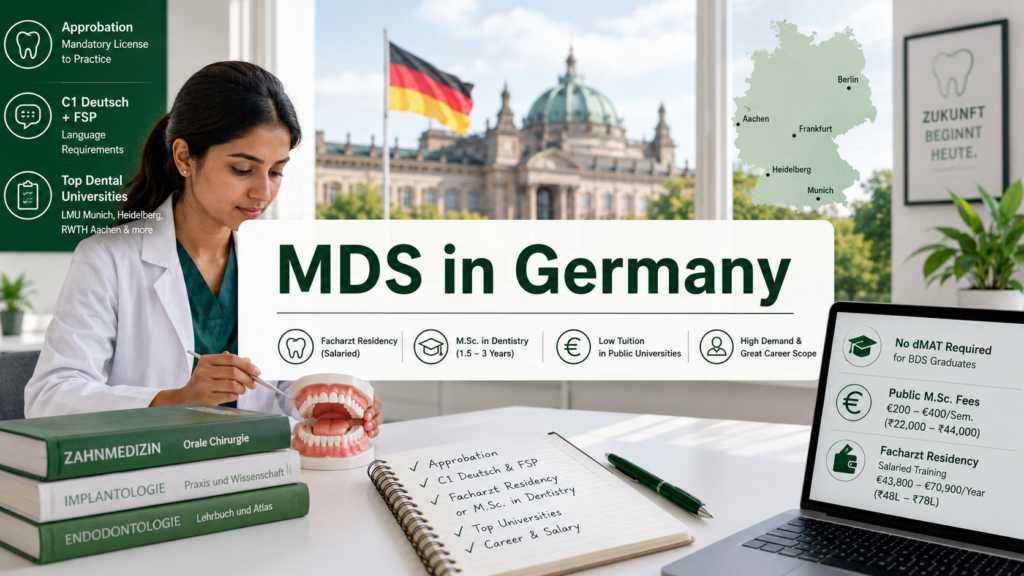
- Germany’s dental specialization has no degree literally called MDS.
- Facharzt residency pays a salary, while M.Sc. programs charge tuition.
- Public M.Sc. semester fees run about ₹22,000 to ₹44,000.
- The 2027 dMAT exam doesn’t apply to Indian BDS graduates.
MDS in Germany: The Two Real Pathways (Compared with MDS in Canada)
Germany doesn’t have a degree called “MDS.” Once you hold a dental degree, specialization happens through one of two structures: a salaried clinical residency (Facharzt) or a fee-based academic Master of Science (M.Sc.). Both terms reflect what Indian BDS graduates actually mean when they search for “MDS in Germany.” Is MDS necessary after BDS if you want to specialize internationally? For Germany specifically, yes, one of these two routes is mandatory before you can call yourself a specialist.
Here’s how the two compare against each other and against the more familiar MDS in Canada route:

Choose your dream country
 UK
UK
 USA
USA
 Germany
 Australia
 Ireland
 Canada
 UAE
UAE
 France
 Sweden
 Italy
Italy
 Other
Other
When do you want to study abroad?
What's your highest level of education?
Have you completed Class 12th?
What was your Class 12 CGPA/percentage?
Are you a student or a parent/guardian?
What do you want to study?
Select your current city
How Leap will help you

Personalised University Shortlist

Express Applications with Quicker Admits

End-to-End Application Support
| Feature | Facharzt Residency (Germany) | MSc in Dentistry in Germany | MDS in Canada |
| Type | State-regulated clinical residency | Academic postgraduate degree | Academic postgraduate degree |
| Duration | 3 to 5 years | 1.5 to 3 years | 3 to 4 years |
| Funding | Salaried (you are paid) | Fee-based (you pay tuition) | Fee-based (you pay tuition) |
| Public university fee | No tuition, semester fee only | €200 to €400/semester (₹22,064 to ₹44,128); Baden-Württemberg charges up to €1,500/semester (₹1,65,480) for non-EU students | Approx. CAD 26,000 to CAD 40,000/year (₹17.68 lakh to ₹27.2 lakh at CAD 1 = ₹68) for MSc/specialty dental programs |
| Recognised title | Protected specialist title (Facharzt/Fachzahnarzt) | Advanced academic degree, no protected title | Recognised Master's degree |
| Best suited for | BDS graduates who want to earn while specialising | BDS graduates who want research depth in a niche area (Implantology, Endodontology) | Applicants prioritising a Canadian PR pathway alongside dental study |
Source for MDS in Canada fees: University of Toronto Faculty of Dentistry, official graduate tuition and fees page.
Exchange rate used: 1 Euro equals ₹110.32 as of July 2026. Rates move daily; confirm the current rate with your bank before finalizing your budget.
Figures vary by specialty and are approved annually; confirm the current schedule directly with the university before budgeting.
Counselor insight: Students comparing MDS in Germany against MDS in Canada usually fixate on tuition. The bigger difference is funding structure. Germany's Facharzt route pays you a salary from year one; Canada's MDS is fee-based throughout, closer to the German M.Sc. than to the Facharzt residency.
Is an Indian BDS Degree Valid in Germany? Approbation Explained
Before you pick a pathway, know this: the real first hurdle isn't university admission; it's approbation, the state-issued license to practice dentistry (Zahnarzt) in Germany. Every Indian BDS holder must clear this hurdle regardless of which route you choose. This is the single biggest misunderstanding tripping up applicants: they shop for a "Master's" the way they would in India, then discover the actual gatekeeper is a licensing authority, not an admissions office.
Is an Indian BDS degree valid in Germany automatically? No. Your degree goes through an equivalence check by the state licensing authority (Approbationsbehörde) as part of your approbation application, the same process every applicant pursuing dentistry in Germany after BDS in India must complete.
| Equivalence Outcome | What Happens Next |
| Training judged fully equivalent | Approbation granted directly, once language requirements are cleared |
| Training not fully equivalent | Defizitbescheid (deficiency notice) issued; you must pass the Kenntnisprüfung (KP), a clinical knowledge exam, before Approbation is granted |
Either way, two more requirements apply before approbation is issued:
- Fachsprachprüfung (FSP): a medical-German language exam
- General C1 certificate: required before you can sit the FSP
This sequence, not a university admit letter, decides whether you can practice or specialize in Germany.
Counselor insight: Final-year BDS students often assume their degree certificate alone settles the equivalence question. It doesn't. Apply for the equivalence assessment as soon as your provisional certificate is issued so you know your KP status before you commit to either pathway.
MDS in Germany: Fees and Cost of Living for Indian Students (2027-28)
Tuition depends entirely on which pathway and which university you choose. The Facharzt residency is salaried, so tuition doesn't apply. For the M.Sc. route, fees vary by state, not just by university:
| Cost Category | Amount (EUR) | Amount (INR) | Notes |
| LMU Munich (Bavaria) | No tuition | No tuition | Only a Studierendenwerk semester contribution applies; no fixed euro figure is fixed by statute |
| RWTH Aachen (North Rhine-Westphalia) | No tuition | No tuition | The state covers international student costs; only a ~€300/semester contribution applies |
| Heidelberg University (Baden-Württemberg) | €1,500/semester tuition + €189.80 semester fee | ₹1,65,480/semester + ₹20,884 | Baden-Württemberg is the one state that charges non-EU students tuition |
| Private/executive M.Sc. programs | €10,000 to €30,000 total | ₹11,03,200 to ₹33,09,600 | Implantology and similar specialist tracks |
| Blocked account (Sperrkonto) | €11,904/year | ₹13,13,569/year | Mandatory visa financial proof, released at €992/month |
| Health insurance | €1,400/year | ₹1,54,448/year | Statutory coverage |
| C1 language course | €5,000 to €8,000 | ₹5,51,600 to ₹8,82,560 | Before Approbation eligibility |
Official sources: LMU Munich's official fees and tuition fees page confirms no tuition fees since the winter semester 2013/14. RWTH Aachen's official international applicants page confirms North Rhine-Westphalia covers tuition for international students. Heidelberg University's official tuition fees for international students page confirms the €1,500/semester non-EU fee. German Federal Foreign Office (Auswärtiges Amt) official Sperrkonto guidance confirms the blocked account requirement; the exact amount is set per mission, so verify the current figure on the Consular Services Portal before depositing funds.
Exchange rate used: 1 Euro equals ₹110.32 as of July 2026. Rates move daily; confirm the current rate with your bank before finalizing your budget.
For the full monthly living-cost breakdown, see LeapScholar's cost of living in Germany guide.
If you're weighing part-time work into your budget, see what our counselors say about part-time work rules for students in Germany, and read expert answers on Germany's Master's fee structure and payment schedule for how semester payments and blocked-account withdrawals line up.
Counselor insight: Fund your blocked account in a single wire transfer, not installments. Providers like Expatrio and Fintiba flag split payments for manual review, which can add a week when your visa clock is running.
Scholarships for MDS in Germany After BDS
Scholarships mainly help the M.Sc. route, since the Facharzt residency already pays a salary and doesn't need funding support. Here's what's realistically available:
| Scholarship | Amount | Eligibility Note |
| DAAD Study Scholarship (Master's, STEM/health-sciences-adjacent academic disciplines) | €992/month (₹1,09,437), plus travel allowance and insurance | Funds a full-time academic M.Sc. degree (e.g., Implantology, Endodontology). It does not cover the Facharzt residency, since DAAD funds degree programs, not salaried clinical training |
| Deutschlandstipendium (Germany Scholarship) | €300/month (₹33,096), for at least 2 semesters | Merit-based, open to international students at any German university, including LMU and Heidelberg. Apply directly through your university's scholarship office, typically after your first semester |
| Dental faculty-specific awards (LMU, Heidelberg) | Varies by award | LMU's Medical Faculty (covering Humanmedizin and Zahnmedizin) offers an 8-month doctoral research stipend for full-time medical and dental doctoral candidates. Heidelberg's Amirana-Stipendium, running since 2016, is reserved for Medicine and Dentistry students from Global South countries facing financial hardship, paying up to €300/month (₹33,096) for up to 2 semesters |
Sources: DAAD's official overview of scholarship programs confirms the Study Scholarship stipend structure. DAAD's official Deutschlandstipendium listing confirms the €300/month, government-and-private co-funded structure. LMU Munich's Medical Faculty funding and awards page confirms the doctoral stipend covering dentistry candidates. University of Heidelberg's official Amirana-Stipendium announcement confirms the fund's scope and monthly amount.
A confirmed DAAD scholarship covering at least €992/month (₹1,09,437) can replace the blocked account requirement entirely, provided the award letter confirms the monthly amount and duration of support. This is standard practice at German missions, consistent with the Sperrkonto guidance cited above; check with your specific consulate, since exact acceptance is at the mission's discretion.
Counselor insight: Don't wait for a scholarship decision before opening your blocked account application. If your DAAD result comes through in time, you can switch to the scholarship-letter route and skip the Sperrkonto altogether; if it doesn't, you haven't lost any time on your visa file.
Does the New 2027 dMAT Requirement Apply to MDS in Germany Applicants?
Short answer: No.
The Digital Master Test (dMAT) is a new academic aptitude test added to the APS documentation process from Summer Semester 2027 onward. Here's who it actually affects:
| Undergraduate Degree Field | Does dMAT Apply? |
| Engineering (incl. Computer Science, IT) | Yes |
| Commerce / Accounting / Finance / Economics | Yes |
| Business / Management | Yes |
| Dentistry (BDS) | No |
| Medicine, Pharmacy, and other fields not listed above | No |
Source: g.a.s.t.'s official dMAT guidance for India confirms dentistry is not one of the notified fields.
If you're applying for MDS in Germany through either the Facharzt or M.Sc. route:
- You do not need to register for or submit a dMAT certificate as part of your APS file.
- Your APS documentation still goes through the standard verification process for medical and dental degrees.
This mirrors a related question our counselors often receive about a different exam: see what they say regarding whether the GMAT is required for APS certification in Germany. The same logic applies to dMAT for dentistry applicants.
Counselor insight: We've had BDS students delay their APS submission waiting for dMAT clarity that was never going to apply to them. Proceed with your standard APS and approbation timeline without factoring in dMAT.
Documents Required for MDS in Germany After BDS
| Document | Purpose | India-Specific Detail |
| BDS degree certificate and mark sheets | Equivalence assessment | Final-year students can use a provisional certificate on official letterhead with the university seal |
| APS certificate | Mandatory verification for Indian medical/dental degree holders | Apply through APS India; processing typically takes several weeks and extends in peak season |
| Certified translations | German authorities require German or English versions of all academic documents | Use a certified translator recognised by the German mission in India |
| C1 German certificate | Required before the approbation application | Goethe-Institut or TELC C1 |
| FSP certificate | Medical-language competency | Taken after reaching C1, before final Approbation |
| Passport and visa documents | Entry and residence | Standard national visa (Type D) file for study or residency purposes |
| Proof of financial means | Visa requirement | Blocked account (Sperrkonto) confirmation |
Some university-run M.Sc. tracks also ask for a BMAT-style aptitude score alongside your APS file, similar to how GMAT is sometimes requested for business programs. Read an expert answer on APS, GMAT, and BMAT documentation requirements for Germany before assuming your program needs one.
Counselor insight: The most common delay is translation. Certified medical-document translation in India takes 2 to 3 weeks per batch. Send your BDS documents for translation the same week you start German classes, not after finishing them.
Top Universities for MDS in Germany (M.Sc. Route)
QS doesn't publish a Germany-specific Dentistry subject breakout, so this table uses each university's overall QS World University Rankings 2027 position alongside its dental specialization strength.
| University | QS World Rank 2027 | Dental Specialisation Offered |
| Ludwig Maximilian University (LMU) Munich | 61 | Strong dental faculty for research and clinical exposure |
| Heidelberg University | 86 | Highly ranked dental and medical faculties |
| RWTH Aachen University | 104 | Periodontology, Lasers in Dentistry |
| Goethe University Frankfurt | Not in global top 200; strong dental faculty regionally | Oral Implantology, Esthetic Dentistry |
| Charité, Universitätsmedizin Berlin | Ranked among Germany's most improved in Medicine 2027 | Large university hospital dental department, advanced research access |
These are the M.Sc. and Facharzt training sites most commonly used by Indian applicants pursuing MDS in Germany. Facharzt residency training happens at university dental clinics (Universitätszahnkliniken) attached to these same institutions, plus certified private practices recognized by the relevant State Dental Chamber.
Counselor insight: Don't shortlist based on overall QS rank alone. A university ranked lower globally may still have a stronger dental faculty and better approbation support network for foreign applicants. Check the dental department's own admissions page, not just the institution's overall rank, before you finalize your MDS in Germany requirements list.
Which MDS Pathway in Germany Fits You? A Decision Framework
- If you are a final-year BDS student graduating in 2027 with no clinical experience yet: Start C1 German now and target the Facharzt residency. You'll earn a salary from day one of training, and the extra 1 to 2 years of duration is offset by not paying tuition.
- If you are a working dentist with 2+ years of clinical experience wanting a research-heavy niche: The M.Sc. route in Implantology or Endodontology suits you better, especially at a public university where fees stay near €200 to €400/semester (₹22,064 to ₹44,128). If you're including your clinical years in your application, read expert answers on proof of work experience for a Germany student visa before you submit your file.
- If your Indian BDS training is likely to fall short of full equivalence: Budget extra time and money for KP preparation before committing to either pathway. A failed KP attempt pushes your entire timeline back by a full application cycle, so treat KP readiness as your actual starting gate, not university shortlisting.
Counselor insight: Students researching dentistry in Germany after BDS often try to lock in a pathway before checking their equivalence risk. Get your BDS transcripts reviewed against the German MDS requirements first; that single check will determine which of these three scenarios actually applies to you.
MDS in Germany Planning Calendar for the Indian Academic Year (2027–28)
| Month | Action |
| January 2027 | Start C1 German if not already in progress; request BDS transcripts and provisional certificate groundwork |
| February to March 2027 | Apply for APS certificate verification; begin university shortlisting for Winter Semester 2027 M.Sc. programs |
| April to May 2027 | Take FSP once C1 is confirmed; submit M.Sc. applications via Uni-Assist or direct university portals |
| June 2027 | Receive admission decisions; open blocked account once you hold an unconditional offer |
| July 2027 | Complete blocked account funding; book visa appointment via the Consular Services Portal |
| August 2027 | Attend visa interview; finalise health insurance and housing |
| September 2027 | Travel: register at your local Bürgeramt within 14 days of arrival |
| October 2027 | Winter Semester 2027-28 begins; Facharzt residency applicants register with the State Dental Chamber as Weiterbildungsassistent once employed |
Counselor insight: The Facharzt route has no fixed intake. Assistant dentist positions open year-round based on hospital vacancies, so start applications to university clinics 6 to 8 months before you plan to move, not on a semester calendar.
What to Do If Your APS, FSP, or KP Application Is Delayed
| Situation | What It Means | What to Do |
| APS delay | Processing runs past your intended semester deadline | Contact the target university's admissions office directly. Most German universities grant a documented extension when a visa or APS delay is verifiable |
| Failed FSP attempt | Does not end your Approbation path | Retakes are available. Use the gap to strengthen clinical vocabulary rather than general conversational German, since the exam tests patient-communication scenarios specifically |
| Failed KP attempt | The most common setback for Indian BDS graduates whose training is judged only partially equivalent | A second attempt is permitted. Plan for a 6 to 12 month gap before resitting, and use that time in a supervised clinical setting if your state licensing authority permits it |
Counselor insight: Students who fail KP on the first attempt often panic and abandon Germany altogether. A KP failure delays your timeline, but it does not disqualify you. Reassess your preparation resources and consider resitting rather than switching countries mid-process.
Salary and Career Scope After MDS in Germany
| Career Stage | Annual Salary (EUR) | Annual Salary (INR) |
| Assistenzzahnarzt (Facharzt trainee, entry-level) | €43,800 to €70,900 | ₹48,33,016 to ₹78,23,528 |
| Assistenzzahnarzt (7-9 years' experience) | €78,559 | ₹86,68,548 |
| Qualified Zahnarzt/Zahnärztin (general dentist, national median) | €62,400 | ₹68,83,968 |
Source: gehalt.de, Assistenzzahnarzt/-ärztin salary data, and StepStone Gehaltsplaner, Zahnarzt/ärztin salary data.
Germany does not publish a single official government salary table for this narrow specialty; these are labor-market survey platforms, not government statistics, and vary by region, employer type, and experience.
For dentist workforce and demand context, the Bundeszahnärztekammer's (Federal Dental Chamber) official statistics confirm continued strong demand, with roughly 74,000 practicing dentists nationwide as of end 2024.
These are gross figures before tax and social contributions and vary sharply by state, clinic type, and years post-approbation. MDS in Canada graduates typically enter a comparable salary band once licensed, though Canada's NDEB licensing adds its own multi-year sequence.
Counselor insight: Students weighing dentistry in Germany after BDS purely on salary often skip tax and social contribution deductions, which run 35-40% of gross income for a single filer. Budget on net income, not the gross figures above.
3 Takeaways on MDS in Germany
- Confirm which pathway, Facharzt residency or M.Sc. degree, fits your finances and timeline before starting German language preparation, since the two differ completely in funding and duration.
- The 2027 dMAT requirement does not apply to your BDS degree, so don't delay your APS process waiting for clarity that isn't coming.
- Start C1 German and your approbation equivalence check in parallel with university shortlisting, since licensing, not admission, is the actual bottleneck for MDS in Germany.
Verified by: LeapScholar's Germany counseling team, with hands-on experience guiding Indian dental and medical graduates through APS applications, approbation documentation, and German student visa filing.
Have questions about your MDS in Germany plan? Book a free session with a LeapScholar counselor.
Frequently Asked Questions About MDS in Germany
-
Can I do MDS in Germany after BDS in India?
Yes, though Germany doesn't use the term "MDS" anywhere in its system. Indian BDS graduates pursue either a salaried Facharzt residency or a fee-based M.Sc. degree, and both routes require Approbation, the state dental license, before you can start specializing. Indian BDS graduates have established both the Facharzt and M.Sc. pathways as viable routes to dental practice in Germany.
-
What is the fee for MDS in Germany for Indian students?
It depends on the state, not just the university. LMU Munich and RWTH Aachen charge no tuition at all, just a small semester contribution. Heidelberg, in Baden-Württemberg, charges non-EU students €1,500/semester (₹1,65,480) as state-mandated tuition on top of a €189.80 semester fee. The Facharzt residency carries no tuition anywhere, since it's a salaried clinical training position.
-
How long does MDS in Germany take?
The duration of an MDS in Germany depends entirely on your chosen pathway. The Facharzt residency runs 3 to 5 years full-time while you earn a training salary. The M.Sc. route takes 1.5 to 3 years depending on the specialization and university but charges tuition throughout instead of paying you.
-
Is an Indian BDS degree valid in Germany automatically?
No. Your BDS goes through a formal equivalence check as part of your approbation application. If the authority judges it fully equivalent, you proceed directly to language and licensing steps. If not, you receive a Defizitbescheid and must pass the Kenntnisprüfung before your license is granted.
-
Is the dMAT required for an MDS in Germany?
No. The dMAT, part of the APS process from Summer Semester 2027, applies only to Indian applicants whose undergraduate degrees are in Engineering, Commerce, Finance, Economics, or Business/Management. Dentistry is not a notified field, so BDS holders can proceed with standard APS documentation without registering for it.
-
Is MDS in Germany better than MDS in Canada?
It depends on what you're optimizing for. Germany's Facharzt route pays a training salary from year one, which MDS in Canada does not offer. An MDS in Canada instead suits applicants who are prioritizing a longer-term path toward Canadian permanent residency alongside their dental specialization.
-
What happens if my Kenntnisprüfung (KP) attempt fails?
A failed KP delays your approbation but does not end your plans for MDS in Germany. You can resit the exam after a preparation gap, typically 6 to 12 months, ideally while gaining supervised clinical exposure in India or Germany if your state licensing authority permits it during that window.
-
What is the salary after MDS in Germany?
As an Assistenzzahnarzt (Facharzt trainee), entry-level pay runs roughly €43,800 to €70,900 (₹48,33,016 to ₹78,23,528) annually, rising with experience. The national median for a qualified Zahnarzt is around €62,400 (₹68,83,968), per labor-market salary platforms; Germany doesn't publish one official government figure for this specialty, so treat these as indicative ranges, not guarantees.
-
Do I need C1 German before applying for an MDS in Germany?
Yes. General C1 German is required before you can sit the FSP and apply for approbation, and approbation precedes both the Facharzt and M.Sc. routes. Some M.Sc. programs are taught partly in English and accept IELTS instead of German for admission.








Have Questions? Get Guidance to reach your Dream University
Connect with India's finest counsellors and biggest study abroad community.
Get Guidance