
Quick Read
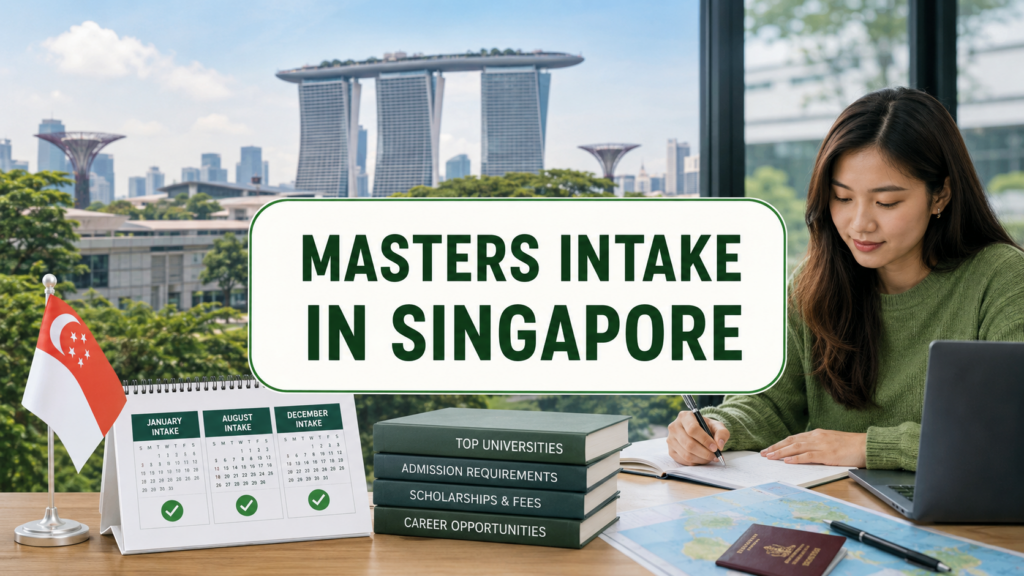
- Masters intake in Singapore runs twice yearly: August and January.
- August 2027 applications open around September 2026.
- Tuition ranges SGD 20,000 to 55,000 (Rs. 14.88-40.93 lakh) yearly.
- Indian nationals need SGD 5,000 (Rs. 3.72 lakh) security deposit.
Masters Intake in Singapore: August 2027 vs. January 2028, What Actually Differs?
If you’re wondering how to study masters in Singapore, here’s what actually differs between the two intakes, not just the calendar labels.
| Feature | August 2027 | January 2028 |
| Start month | August 2027 | January 2028 |
| Programs open | Virtually all Master’s programs at NUS, NTU, SMU, SUTD, SIT | Select programs only: NUS Business School MSc, NTU NBS MBA/MSc, SMU select MSc, James Cook University Singapore, Kaplan |
| Application window | November 2026 to March 2027 | May 2027 to September/October 2027 |
| Scholarship access | Full: all institutional and government scholarships available | Limited: most merit scholarships are tied to August intake |
| Competition | Higher (more applicants, more seats overall) | Lower (fewer programs, fewer seats) |

Choose your dream country
 UK
UK
 USA
USA
 Germany
 Australia
 Ireland
 Canada
 UAE
UAE
 France
 Sweden
 Italy
Italy
 Other
Other
When do you want to study abroad?
What's your highest level of education?
Have you completed Class 12th?
What was your Class 12 CGPA/percentage?
Are you a student or a parent/guardian?
What do you want to study?
Select your current city
How Leap will help you

Personalised University Shortlist

Express Applications with Quicker Admits

End-to-End Application Support
Application Deadlines for Masters Intake in Singapore 2027-28
| University and Program | QS Rank 2027 | Intake | Application window |
| NUS: Engineering, Computing, Sciences (most programs) | #10 | August 2027 | November 2026 to February 2027 |
| NUS MBA | #10 | August 2027 | November 2026 to March 2027 |
| NUS Business School: MSc Management, MSc Finance | #10 | January 2028 | Opens July 2027 |
| NTU: Engineering, Sciences, Humanities (most programs) | #12 | August 2027 | November 2026 to March 2027 |
| NTU Nanyang MBA | #12 | August 2027 or January 2028 | Rolling, year-round |
| SMU: MSc Business Analytics, Finance, Accountancy | #411 | August 2027 | November 2026 to March 2027 |
| SMU MBA | #411 | January 2028 | Rolling, year-round |
| SMU Computing: select MSc programs | #411 | January 2028 | 1 May 2027 to 30 September 2027 |
| James Cook University Singapore | Unranked (affiliated with JCU Australia, QS #422) | Both (rolling) | Year-round |
Note: Exchange rate used: 1 SGD = Rs. 74.41. Verify the current rate before finalizing your budget, as exchange rates fluctuate daily.
Source: QS World University Rankings 2027
Counselor insight: NUS programs in Computer Science, Data Science, and Electrical Engineering often receive decisions well before the published February deadline. The faculty review cycle can wrap as early as November. If you are targeting any of these for August 2027, submit your application in November 2026.
Masters Intake in Singapore: Indian-Focused Scenarios
Most Indian students asking is Singapore good for masters, is it worth doing masters in Singapore, or is studying in Singapore worth it fall into one of three situations when planning a Masters intake in Singapore.
- If you are a final-year BTech or BE student graduating in May 2027: Your realistic option is August 2027 if you move now, or January 2028 if your program offers a January intake. If not, August 2028 is next. Use the time well: clear your IELTS or GMAT, write a strong SOP, and if research interests you, start emailing potential supervisors now.
- If you are graduating in July or August 2027: August 2027 may already be tight depending on your specific program's deadline. January 2028 works for NUS Business School MSc programs, NTU NBS, SMU MBA, and SMU Computing. For anything else, plan for August 2028.
- If you graduated in 2025 or 2026 and are working or in a gap year: Most August 2027 deadlines are still open. If your profile could be stronger on GMAT score, work experience, or research output, use this time to strengthen it.
Month-by-Month Plan for the January 2028 Masters Intake in Singapore
| Month | What to do? |
| May 2027 | Confirm your program has a January intake. Open your SMU or NUS Business School application. |
| June 2027 | Collect documents: all semester marksheets (attested), a provisional certificate, and a CGPA-to-percentage letter from your registrar. |
| July 2027 | Sit the IELTS or TOEFL if not done yet. Target IELTS 6.5+ or TOEFL iBT 85+. Start your SOP draft. |
| August 2027 | Contact your two academic referees. They need at least four weeks. Do not leave this until September. |
| September 2027 | Submit your completed application. SMU Computing deadline is 30 September 2027. |
| October 2027 | Track application status online. Respond quickly to any document requests. |
| November 2027 | Offer letters released in batches. Accept your offer, pay the acceptance fee, wait for your SOLAR reference number. |
| December 2027 | Apply for your Student's Pass via SOLAR+. ICA's own stated processing time is one to two weeks once your application is complete; allow more overall lead time since your institution submits on your behalf. |
| January 2028 | Carry your IPA letter with you and finish the ICA paperwork. Start your program. |
Month-by-Month Plan for the August 2027 Masters Intake in Singapore
Missed August 2026 and January 2027, or your program doesn't offer a January intake? August 2027 gives you enough time to do this properly, and it's the direct answer to how to apply for masters in Singapore if you're starting your research now.
| Month | What to do? |
| November 2026 | Portals open. Apply early, not in February. Competitive NUS and NTU programs often fill up before the official deadline. |
| December 2026 to January 2027 | Retake IELTS or GMAT if your scores need work. Target IELTS 6.5+, TOEFL 85+, or GMAT 650+ for MBA programs. |
| February 2027 | Most deadlines close this month. Have your SOP, LORs, transcripts, and CGPA conversion letter ready by late January. |
| March to May 2027 | Offer letters arrive in batches. Accept quickly and pay the fee to hold your seat. |
| June to July 2027 | Apply for your Student's Pass on SOLAR as soon as you get your offer. July gets busy at ICA, so June is better. |
| July 2027 | Arrange your SGD 5,000 (Rs. 3,72,050) security deposit as liquid funds. This is required for Indian nationals before ICA issues the Student's Pass, and it isn't covered by an education loan disbursement. |
| August 2027 | Fly to Singapore on your IPA letter, complete biometrics at the ICA Building, and begin your program. |
How Much Does It Cost to Study Masters in Singapore?
Anyone researching how much does it cost to study masters in Singapore, as part of planning a masters intake in Singapore, should check the specific program category first, since the spread is large.
Annual tuition fees for international students:
| Program Type | SGD per Year | Rs. per Year |
| General MSc: Engineering, sciences | SGD 20,000–45,000 | Rs. 14.88 Lakh–33.48 Lakh |
| Tech MSc: AI, data science, cybersecurity | SGD 35,000–55,000 | Rs. 26.04 Lakh–40.93 Lakh |
| MBA at NUS, SMU, or NTU | SGD 60,000 and above | Rs. 44.65 Lakh and above |
| Private university MSc at PSB Academy, MDIS, SIM | SGD 20,000–30,000 | Rs. 14.88 Lakh–22.32 Lakh |
| Security deposit for Indian nationals (one-time, refundable) | SGD 5,000 | Rs. 3.72 Lakh |
Note: Exchange rate used: 1 SGD = Rs. 74.41. Verify the current rate before finalizing your budget, as exchange rates fluctuate daily.
Source: Numbeo cost of living data
- MOE Tuition Grant: This mainly applies to undergraduate courses. At the Master's level, subsidy is limited to specific coursework programs, such as NIE's Master of Education and Master of Teaching. The Data Science, Computing, Finance, and MBA coursework Master's most Indian applicants target generally run as self-financing programs with no subsidy option. Where it does apply, it cuts tuition by 40 to 60%.
- The condition: you must work in a Singapore-registered company for three years after graduation. If you are planning to return to India, think carefully before accepting. Full details are on the MOE Tuition Grant Scheme page.
- Monthly living costs: on average, a student spends SGD 1,500 to SGD 2,000 (Rs. 1.12 lakh to Rs. 1.49 lakh) per month on shared accommodation, food, and transport. If you are living in the heartland areas such as Woodlands or Jurong and eat at hawker centers, your cost of living will decrease by a big margin.
For a full breakdown of tuition fees, cost of accommodation, and other expenses, read our guide on the cost of studying in Singapore.
Masters Intake in Singapore: Documents Checklist for Indian Students
General Eligibility
- Bachelor's degree with at least 60 to 65 percent aggregate (NUS and NTU expect 75 percent and above for competitive programs)
- IELTS 6.5+ or TOEFL iBT 85+ for most programs
- GRE or GMAT where required. SMU waives this requirement for graduates of NUS, NTU, SUTD, and SMU.
This is also the fastest answer to what is the requirement to study masters in Singapore for a Masters intake in Singapore: a recognised bachelor's degree, an English test score, and program-specific documents that depend on your target program.
Documents Needed for Masters Intake in Singapore
| Document | India-Specific Note |
| Bachelor's degree certificate | The degree certificate should be issued by your university. If it has not been issued yet, a provisional certificate is accepted at the application stage. The actual degree certificate is required before enrollment. |
| All semester transcripts | Every individual semester marksheet must be attested by your university registrar. A consolidated transcript alone may not be sufficient. |
| CGPA-to-percentage conversion letter | An official letter from your registrar confirming the percentage equivalent of your CGPA. Indian CGPA scales vary across universities, and NUS and NTU will not accept a standard transcript instead. |
| English proficiency scorecard | IELTS, TOEFL, or PTE. Must not be older than two years at the time of application. |
| GRE or GMAT | This applies only in cases where the specific program requires it. Check the program list. |
| Statement of Purpose | 500 to 800 words for most programs. SMU Computing: maximum 600 words. Write it for the specific program, not a generic version. |
| Letters of Recommendation | Two referees, academic preferred. They receive a link directly from the portal. Give them at least four weeks. |
| CV or resume | One to two pages covering academic background and work or research experience. |
| Passport copy (biodata page) | Valid for at least six months beyond your program's end date. |
| Bank statements | Three to six months of showing sufficient funds for tuition and living expenses. Note: this is separate from the SGD 5,000 security deposit required later for the Student's Pass. |
Counselor insight: The CGPA-to-percentage conversion letter is the most frequently missed document for Indian applicants. It is not the same as your transcript, and registrar offices at Indian universities do not always issue it automatically. Request it early. Some offices take two to three weeks.
Scholarships for Masters Intake in Singapore
If you're looking into how to study in Singapore for free as part of funding your Masters intake in Singapore: the well-funded options (full tuition plus stipend) are largely reserved for research-based Master's programs and PhDs. For a taught MSc or MBA, the MOE Tuition Grant and university merit awards are the realistic options.
| Scholarship | Who it covers? | What it gives? | Application notes |
| MOE Tuition Grant | Selected coursework programs (mainly undergraduate; limited Master's coursework such as NIE's Master of Education) | 40 to 60 percent reduction in tuition at public universities. Requires a 3-year post-graduation work bond in Singapore. | Opt in during your university application |
| NUS Research Scholarship | International students admitted to research-based Master's at NUS | Full tuition plus monthly stipend (amount varies by faculty). Maximum 2-year tenure for Master's. | Indicate interest through your NUS department during application |
| NTU Research Scholarship | International students admitted to research-based Master's at NTU | Full tuition plus monthly stipend for international students. Maximum 2-year tenure. | Indicated alongside NTU application |
| NUS Commonwealth Scholarship | Citizens of Commonwealth countries (India qualifies) | Full tuition plus a monthly stipend for research Master's and PhD candidates. Renewable, subject to satisfactory progress. | Apply through NUS Graduate admissions |
| Singapore International Graduate Award (SINGA) | International students applying to research Master's or PhDs at NUS, NTU, SMU, or A*STAR | Full tuition, plus SGD 2,000 (Rs. 1.49 lakh) per month, which increases after qualifying exams, as well as airfare and a settling-in grant. | Applications for SINGA 2028 open typically in the last quarter of 2027 |
Note on the ASEAN Scholarship: This award is frequently listed in Singapore scholarship guides. It covers undergraduate programs only and is open exclusively to nationals of ASEAN member states. India is not an ASEAN member. This scholarship is not available to Indian students.
For a complete picture of funding options, see our scholarships in Singapore for Indian students guide. If you are interested in research-based programs, you should also read about the Singapore International Graduate Award (SINGA).
Curious how Singapore's costs and scholarships compare to other destinations? See what our counselors say about cost and budget criteria for a Master's in the UK, Australia, New Zealand, Ireland, and Singapore.
How to Apply for Masters in Singapore and Your Student’s Pass
Working out how to apply for masters in Singapore, or specifically how to do masters in NUS Singapore, comes down to two steps for any Masters intake in Singapore: shortlist your program, register for tests, and submit through the department's portal, then apply for the Student's Pass once admitted.
Once you have your offer letter, apply for your Student's Pass through the ICA SOLAR portal:
- Log into SOLAR with your reference number. Fill out eForm 16 with your personal, educational, and financial details.
- Pay the non-refundable SGD 45 (Rs. 3,348) processing fee.
- Submit your passport copy, proof of funds, a medical exam report if your program is six months or more, and, for Indian nationals, the SGD 5,000 security deposit arrangement.
- ICA issues an In-Principle Approval (IPA) letter, with your entry visa embedded for Indian passport holders.
- Travel to Singapore on the IPA letter and attend an in-person biometrics appointment at the ICA Building. Your digital Student's Pass follows via the Singpass app.
ICA's stated processing time is one to two weeks once your application is complete, but allow more overall, since your institution needs lead time to submit. Start the day your offer is confirmed.
Masters Intake in Singapore: What to Do When Things Go Wrong?
1. You did not meet the August 2027 deadline
Check if your program has an intake in January 2028. If the window is open, apply now. If not, target August 2028. Use the gap wisely: improve your test scores, sharpen your SOP, or gain relevant experience. For research programs, contacting potential supervisors a few months ahead can make a real difference.
2. Your SOLAR Student's Pass application was rejected
ICA rarely explains why. Common causes for Indian applicants: financial documents below the required threshold, a mismatch between university and eForm 16 details, an incomplete form, or a missing security deposit. Contact your university's international student services office; they often have a direct line to ICA and can help you identify what went wrong before you resubmit.
3. Your degree certificate or provisional certificate is delayed
Singapore universities accept a provisional certificate at application; the actual degree certificate is typically due before or shortly after enrollment. As soon as you accept an offer, contact your Indian university's registrar and request both documents in writing for your Master's intake in Singapore. If convocation falls after your program starts, your registrar can usually confirm your graduation status in an official letter.
3 Key Takeaways for Masters Intake in Singapore
- August is the entry point for most Master's programs in Singapore, and the core of any Master's intake in Singapore. If you graduated in May or June 2027, that window may already be tight. January 2028 works for a small set of business and computing programs; otherwise, August 2028 is the realistic target.
- The MOE Tuition Grant can take 40 to 60 percent off tuition where it applies, but most Computing, Data Science, Finance, and MBA Master's don't qualify, since it's mainly an undergraduate subsidy. Where it does apply, it locks you into a three-year work bond in Singapore.
- Start your Student's Pass application the day you accept your offer. ICA's processing window is one to two weeks, but total lead time is longer with institutional submission and, for Indian nationals, the SGD 5,000 security deposit. Don't leave it until the last week before your program begins.
Verified by: LeapScholar's Singapore counseling team, with hands-on experience guiding Indian students through NUS, NTU, SMU, and SUTD admissions and Student's Pass applications for their Masters intake in Singapore.
Have questions about your Masters intake in Singapore? Book a free session with a LeapScholar counselor.
Frequently Asked Questions About Masters Intake in Singapore
-
When is the Masters intake in Singapore?
There are two intakes every year. August is the big one, covering pretty much all Master's programs across NUS, NTU, SMU, SUTD, and SIT. January is a much smaller window that only applies to a handful of programs, mainly in business and computing. For the 2027-28 year, you are looking at August 2027 and January 2028.
-
Which Singapore universities offer January intake for Master's?
Not many. NUS Business School offers the MSc in Management and MSc in Finance in January. NTU Nanyang Business School has its MBA and a few MSc programs. SMU has select programs too, including MSc Computing, which closes on 30 September 2027. James Cook University Singapore and Kaplan are also options. If you are eyeing engineering, sciences, public policy, or humanities at NUS, NTU, or SUTD, January is not on the table.
-
Best programs for a Masters intake in Singapore?
Computing, Data Science, and Finance deliver the strongest return for Indian applicants. NUS and NTU's Computing and Data Science coursework masters run mainly on the August cycle. NUS Business School and SMU Finance programs have the widest January availability of any category. NUS programs in Computer Science, Data Science, and Electrical Engineering often finalise decisions well before the published deadline, so apply early if these are your target.
-
What is the application deadline for NUS and NTU Master's 2027-28?
For August 2027, NUS and NTU are expected to run application windows from November 2026 to March 2027, based on past cycles; confirm exact dates on each faculty's admissions page. For January 2028, SMU Computing shuts 30 September 2027. NUS Business School and NTU NBS open sometime in mid-2027, so check their portals for exact dates.
-
How much does a Master's in Singapore cost for Indian students?
A general MSc would cost you around SGD 20,000 to SGD 45,000 (Rs. 14.88 Lakh to Rs. 33.48 Lakh) a year. If you are entering AI, data science, or cybersecurity, you can expect SGD 35,000 to SGD 55,000 (Rs. 26.04 lakh to Rs. 40.93 lakh). The NUS and SMU MBA programs cost SGD 60,000 (Rs. 44.65 lakh) for the entire course. On top of tuition, budget SGD 1,500 to SGD 2,000 (Rs. 1.12 lakh to Rs. 1.49 lakh) per month for living costs, plus a one-time SGD 5,000 (Rs. 3.72 lakh) security deposit for the Student's Pass.
-
Does the MOE Tuition Grant apply to Indian students?
It depends on the program. The MOE Tuition Grant mainly applies to undergraduate courses. At the Master's level, only specific coursework programs qualify, mainly NIE's Master of Education. Most Computing, Data Science, Finance, and MBA Master's are self-financing with no subsidy option. Where it does apply, it brings tuition down 40 to 60 percent, with a three-year work bond in Singapore.
-
What documents do I need from India to apply for a Master's in Singapore?
You will need your bachelor's degree certificate or provisional certificate, all your semester marksheets with attestation, a CGPA-to-percentage conversion letter from your registrar, your IELTS or TOEFL scorecard, an SOP, two LORs, your CV, a passport copy, and bank statements. Your Class 12 marksheet is not something Singaporean universities typically ask for at the Master's level.
-
How do I apply for a Student's Pass after getting admission?
Your university puts your details into ICA's SOLAR system and sends you a reference number. You log in, fill out eForm 16, pay SGD 45 (Rs. 3,348), and upload your documents, including the security deposit arrangement if you're an Indian national. Once ICA approves it, you get an IPA letter, and if you hold an Indian passport, your entry visa is already in that letter. You travel to Singapore on it, then head to the ICA Building to finish your biometrics in person. ICA's own stated processing time is one to two weeks, so plan around that plus your institution's own submission lead time.
-
What if I miss the August 2027 intake deadline?
First, check if your program has a January 2028 intake. If it does not, August 2028 is your next opportunity. Instead of rushing something through, take the time to use it properly. Work on your test scores, write a sharper SOP, and build up any experience that strengthens your profile. Sending a better application a cycle later is far smarter than sending a half-ready one now.
-
Is the GRE required for Master's programs in Singapore?
It depends on where you are applying. Some programs at NUS and NTU ask for it, but plenty do not. If you already have a degree from NUS, NTU, SUTD, or SMU, SMU will waive the GRE and GMAT altogether. Go straight to your specific program's admissions page and check, rather than assuming either way.
-
How long does the Singapore Student's Pass actually take to process?
ICA's own stated processing time is one to two weeks once your application is complete, but you must apply two to three months before your course starts, and Indian nationals must also arrange a SGD 5,000 security deposit as a banker's guarantee before the pass is issued.
-
Is postgraduate medicine in Singapore part of this same Master's intake process?
No. If you're researching how to study postgraduate medicine in Singapore specifically, that follows a separate faculty-specific admissions track at NUS Yong Loo Lin School of Medicine, distinct from standard coursework Master's, with its own eligibility and licensing requirements. Check that school's graduate admissions page directly rather than applying through the general Master's process described here.







Have Questions? Get Guidance to reach your Dream University
Connect with India's finest counsellors and biggest study abroad community.
Get Guidance