
Quick Read
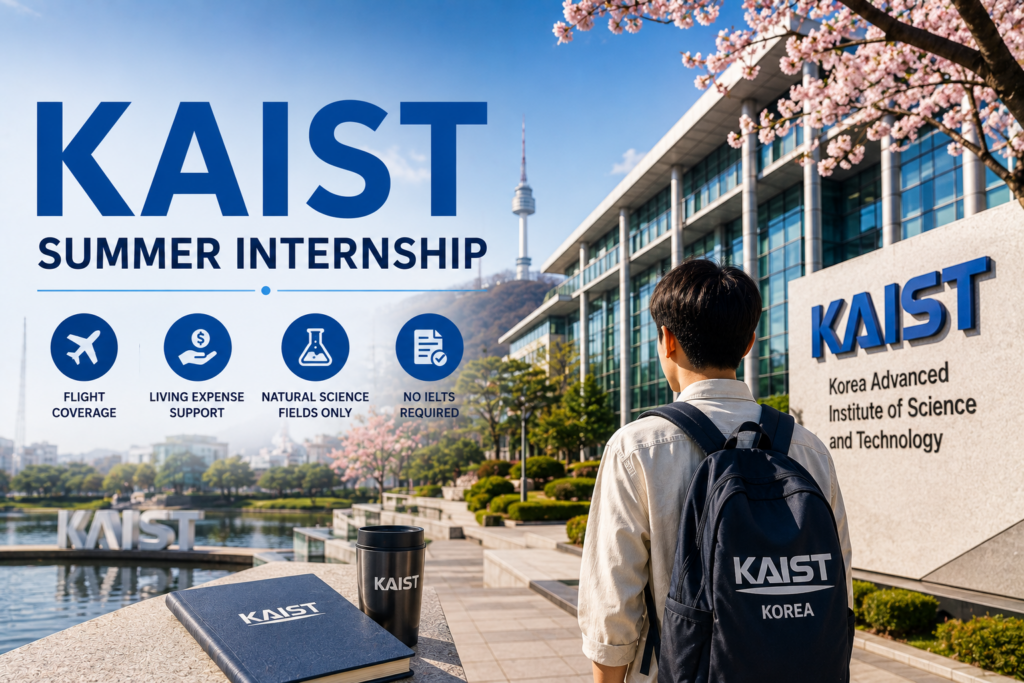
- KAIST summer internship covers round-trip airfare up to Rs.67,000.
- The 2026 cycle ran from 19 January to 15 February, with results by mid-April.
- Selected interns receive living-expense support of Rs. 40,200 for the internship.
- Only natural science fields qualify: physics, chemistry, math, biology, and two more.
- Doctoral students are explicitly not eligible for the KAI-X programme.
- IELTS or any English test score is not required to apply.
What Is the KAIST Summer Internship?
The KAIST summer internship most students mean is the KAI-X International Summer Research Internship Programme, run by the KAIST Advanced Institute for Science-X. It’s a fully funded, 7-week research placement at KAIST’s Daejeon campus, where you’re assigned to a lab, work alongside a professor and their group, and present your findings at the end.
One mix-up worth clearing up first: KAIST also runs a separate, tuition-charging International Summer School (KISS), a for-credit course program with fees starting around KRW 900,000, entirely different from KAI-X. If you want a paid research internship rather than a paid course, KAI-X is the one to apply for.

Choose your dream country
 UK
UK
 USA
USA
 Germany
 Australia
 Ireland
 Canada
 UAE
UAE
 France
 Sweden
 Italy
Italy
 Other
Other
When do you want to study abroad?
What's your highest level of education?
Have you completed Class 12th?
What was your Class 12 CGPA/percentage?
Are you a student or a parent/guardian?
What do you want to study?
Select your current city
How Leap will help you

Personalised University Shortlist

Express Applications with Quicker Admits

End-to-End Application Support
The program runs every year from around 1 July, one of the few well-known summer internships that start in July rather than June, and wraps up by mid-August.
What's the Scope of This Internship?
This is a research-exposure program, not a job offer or automatic graduate admission. You get 7 weeks inside an active lab, a professor as direct supervisor, hands-on work on a live research question, and a closing presentation. KAIST guarantees nothing beyond that; it doesn't extend into a scholarship, a work visa, or automatic entry into a KAIST graduate program. Some past interns have applied separately for KAIST's master's or PhD programs through the standard admissions process.
Who Can Apply for the KAIST Summer Internship?
| Eligibility group | Requirement | Skills or profile expected |
|---|---|---|
| Undergraduate students | 3rd or 4th year, enrolled outside Korea | Strong record in an eligible natural science field |
| Master's students | Currently enrolled in a master's program | Coursework or project experience relevant to the chosen lab |
| PhD students | Not eligible for KAI-X at all | Not applicable |
| Eligible fields | Physics, Chemistry, Mathematics, Biology, Brain & Cognitive Science, Medical Science | A major fitting one of these six fields |
| English proficiency | No test score required | Documents submitted in English |
My insight: Indian applicants sometimes assume "natural science" stretches to cover engineering or computer science. It doesn't. KAI-X's six fields are fixed each cycle, so a mechanical or CS student generally won't qualify unless their research overlaps directly with one of the six.
For wider funding options in the country, our guide to South Korean scholarships for Indian students covers degree-level funding beyond this internship.
KAIST Summer Internship Stipend and Benefits in Rupees
The role is a hands-on research placement, not an office internship. You're attached to one lab, working on an assigned or self-proposed question under a professor's supervision, alongside the lab's own graduate students.
| Benefit | In KRW | In INR |
|---|---|---|
| Round-trip airfare | Actual cost, up to 1,000,000 KRW | Up to Rs.67,000 |
| Dormitory accommodation | Support up to 500,000 KRW | Up to Rs.33,500 |
| Living-expense support | 600,000 KRW | Rs.40,200 |
| Application fee | None | None |
Source:2026 KAI-X Research Internship Program announcement (official)
This living-expense figure rose from 500,000 KRW in 2025 to 600,000 KRW for 2026. KAIST hasn't published 2027 figures, so treat 600,000 KRW as the latest confirmed baseline, not a guarantee.
For daily costs in Korea beyond this stipend, our cost of studying in South Korea breakdown is a useful reference.
My insight: Budget for the gap yourself. Even with all three benefits combined, a 7-week Daejeon stay typically costs more once food, local transport, and personal spending are added in.
KAIST Summer Internship Application Timeline for 2027
The 2026 cycle has already closed, and that cohort finished in mid-August, so the window that matters now is the next one. Exact 2027 dates aren't out yet, but the pattern has held closely for several years:
| Stage | 2026 confirmed dates | 2027 expected pattern |
|---|---|---|
| The application window opens | 19 January 2026 | Mid-to-late January 2027 |
| Deadline for summer internships (2027 cycle) | 15 February 2026 | Mid-February 2027 |
| Results announced | Mid-April 2026 | Mid-April 2027 |
| Internship period | 1 July - 14 August 2026 | Early July - mid-August 2027 |
What students need to check: Confirm exact 2027 dates on the official KAI-X FAQ page once it updates, typically in January. Applications are reviewed only after the window closes, so early submission doesn't improve your odds, but missing the deadline removes you entirely with no exceptions. If you're wondering about the latest to apply for summer internships like this one, the safest answer is the published deadline itself.
My insight: Don't wait for exact 2027 dates before starting your essay or contacting your recommender. Draft both in December regardless, since the actual window has rarely shifted by more than a few days from this pattern.
How Competitive Is the KAIST Summer Internship, Really?
Here's an honest gap worth flagging before you invest weeks in an application.
- KAI-X doesn't publish a yearly breakdown of applicants, interns selected, or countries represented.
- Any blog citing a precise acceptance rate or India-specific hire count isn't quoting an official source.
- Confirmed: Each applicant is placed in at most one lab, from up to three ranked preferences, across only six fields.
- Coverage has visibly grown online each cycle, including around the KAIST summer internship 2026 application period.
Apply as though every document matters, rather than anchoring your decision to an acceptance rate nobody, including KAIST, has published.
Source: KAI-X FAQ and 2026 announcement
How to Apply for the KAIST Summer Internship?
Everything is submitted as one combined PDF file by email, plus a separate Excel application form.
Documents Checklist
| Document | Requirement | India-specific note |
|---|---|---|
| Application form | Official Excel form, kept in its original format | Do not convert to PDF; submit as Excel separately |
| Activity plan essay | Has run up to 1,200 words in past cycles | Reference the specific lab and professor by name |
| Official transcript | Issued within the last 3 months, in English | Universities can issue an English transcript on request |
| Proof of enrollment | Issued within the last 3 months, in English | The registrar's office usually issues this within a week |
| Letter of recommendation | Must name the specific cycle and recommender's contact details | A letter from your project guide or HOD works |
Where do you find the KAIST summer internship application form? It's released as an attachment on the official KAI-X announcement page each cycle, not through a general portal, so re-check the page every January rather than reusing an old file.
My insight: Applicants often submit the Excel form as a scanned PDF because it feels more "official." Don't. KAI-X asks for it in its original format so reviewers can filter and sort applications, and converting it can flag a submission as incomplete.
Does KAIST Have an AI Summer Internship?
Not under KAI-X. None of its six eligible fields is a standalone "AI" track, so a KAIST AI summer internship in that sense doesn't exist here. What does exist is separate: individual KAIST labs working on AI, including groups like the Visual AI Group, post their own calls on their lab websites, outside KAI-X and its stipend structure. If AI research is your goal, look for the individual lab's page instead.
How to Stand Out for the KAIST Summer Internship?
A few things separate a forgettable application from a shortlisted one:
- Name the specific lab and professor in your essay, and reference a real, current project.
- Pick a less obvious field or lab for your major, since fewer applicants improve your odds.
- Ask your recommender for a letter naming the exact cycle and their contact details.
- Keep the Excel form in its original format, and combine everything else into one PDF.
- Apply in the first week the window opens, not the last few days.
My insight: Shortlisted applicants almost always show they've read the lab's actual published research. A generic "I am passionate about biology" essay loses fast against one that names a real project and the fit.
KAIST Summer Internship vs Other Research Internships
KAIST's benefits are lower in absolute terms than a 12-week program like Aalto's, simply because it runs under half the duration. Among summer internships that start in July, KAI-X is one of the shortest commitments, suiting students who can't commit three full months abroad.
| Program | Duration | Benefits (approx.) | Fields | Best for |
|---|---|---|---|---|
| KAIST summer internship (KAI-X) | 7 weeks | Rs.67,000 airfare, Rs.33,500 dormitory, Rs.40,200 living support | Six natural science fields only | Undergrads and master's students in physics, biology, chemistry |
| OIST Research Internship (Japan) | Varies by term | Stipend and housing support vary by cycle | Broader life sciences and physical sciences | Students wanting a longer or more flexible Asian research stint |
| Aalto University summer internship (Finland) | 12 weeks | Roughly Rs.2,20,000+ a month | Science and engineering, seven departments | Students who want a longer, higher-paying European alternative |
Decision Framework: What to Keep in Mind Before You Apply
If you're a 3rd or 4th year undergrad in physics, chemistry, biology, math, brain and cognitive science, or medical science: you fit squarely into KAI-X's eligibility. Pick a lab you can speak to specifically, not just the department name.
If you're a master's student mid-thesis: a 7-week gap is shorter than Aalto's 12 weeks, easier to fit around a thesis timeline. Confirm with your supervisor first, since KAI-X has no remote option.
If your field is engineering, computer science, or a related applied discipline: KAI-X likely isn't a fit unless your research sits inside one of the six listed fields. Look at individual KAIST lab calls instead, particularly for a KAIST AI summer internship specifically.
Do I Need a Visa for the KAIST Summer Internship?
Since the internship runs about 7 weeks, most Indian interns travel on a short-term visa rather than a long-stay student visa, though KAIST's guidance to selected candidates is the authoritative source for your case.
| Aspect | Detail |
|---|---|
| Typical visa category | Short-term visit visa, given the under-90-day stay |
| Remote option | None; requires physical presence in Daejeon |
| When guidance is provided | After selection, tailored to each intern's situation |
| Recommended timing | Start paperwork the week you're notified, not closer to July |
For broader logistics once accepted, our accommodation in South Korea guide covers dormitory life and off-campus options.
My insight: Start gathering visa documents the day results are announced, not after booking your flight. Visit-visa processing at Indian centres can stretch two or three weeks during the busy April-May season, which overlaps directly with KAI-X results.
Common Reasons KAIST Summer Internship Applications Get Rejected
Most of the mistakes below have nothing to do with timing, and everything to do with the documents, whatever the latest to apply for summer internships in general might be.
| Reason | Why it happens? | How to fix it? |
|---|---|---|
| Generic activity plan essay | Written around the field, not a specific lab | Name the lab and its actual published research |
| Excel form converted to PDF | Applicant assumes PDF looks more polished | Keep the Excel form in its original format |
| Transcript or enrollment proof over 3 months old | Reused from a prior cycle | Request a fresh copy right before submitting |
| Recommendation letter missing program name | Referee uses a generic template | Share the exact cycle name with your referee |
| Applying after the window closes | Assuming late submissions still count | There is no late exception whatsoever |
| Choosing a field outside the six eligible ones | Confusing "natural science" with broader STEM | Confirm your major against the listed fields |
3 Key Takeaways on the KAIST Summer Internship
Start early: The Excel form, essay, transcript, and recommendation letter all need lead time, especially since your professor's letter must name the exact cycle correctly.
Match your field precisely: KAI-X covers only six natural science fields with no AI-specific or engineering track, so confirm eligibility before writing the essay.
Budget beyond the covered benefits: Rs.67,000 in airfare, Rs.33,500 in dormitory support, and Rs.40,200 in living expenses cover the basics for 7 weeks, but plan extra spending money on top.
Verified by: LeapScholar's East Asia counselling team, with hands-on experience guiding Indian students through South Korea study and internship applications.
Have questions about the KAIST summer internship or studying in South Korea? Book a free session with a LeapScholar counsellor.
Frequently Asked Questions About KAIST Summer Internship
-
What is the KAIST summer internship (KAI-X)?
A 7-week fully funded research internship run by the KAIST Advanced Institute for Science-X, placing selected students in a KAIST Daejeon lab under a professor, working on an active project in one of six natural science fields.
-
Who can apply for the KAIST summer internship?
Overseas 3rd or 4th year undergraduates and current master's students in physics, chemistry, math, biology, brain and cognitive science, or medical science. Doctoral students are not eligible.
-
How much does the KAIST summer internship pay in rupees?
The 2026 cycle covered round-trip airfare up to Rs.67,000, dormitory support up to Rs.33,500, and living-expense support of Rs.40,200, based on 1 KRW equalling Rs.0.067, with no application fee.
-
Where do I find the KAIST summer internship application form?
Posted as a downloadable attachment on the official KAI-X announcement page each cycle, alongside the essay template. Check the page fresh each January rather than reusing a previous year's form.
-
What is the deadline for summer internships like KAI-X in 2027?
The 2026 cycle closed on 15 February 2026, so 2027's deadline is expected around mid-February, though KAIST confirms exact dates only once the new cycle opens.
-
Is there a KAIST AI summer internship?
Not as part of KAI-X, since none of its six eligible fields is a dedicated AI track. Individual KAIST labs working on AI post separate internship calls on their own lab websites, outside the KAI-X program.
-
Is IELTS required for the KAIST summer internship?
No standardized English test is required. Application documents, including the transcript and recommendation letter, need to be submitted in English.
-
Do I need a visa for a 7-week stay at KAIST?
Most Indian interns use a short-term visit visa given the stay is under 90 days, though KAIST provides visa guidance tailored to each candidate after results are announced.
-
Is it too late to apply if I missed the KAIST summer internship 2026 application?
Yes, that cycle is closed, but this is worth tracking for next year. Most funded programs publish a hard deadline with no late exceptions, so start your essay and recommendation letter request in December.







Have Questions? Get Guidance to reach your Dream University
Connect with India's finest counsellors and biggest study abroad community.
Get Guidance