
Quick Read
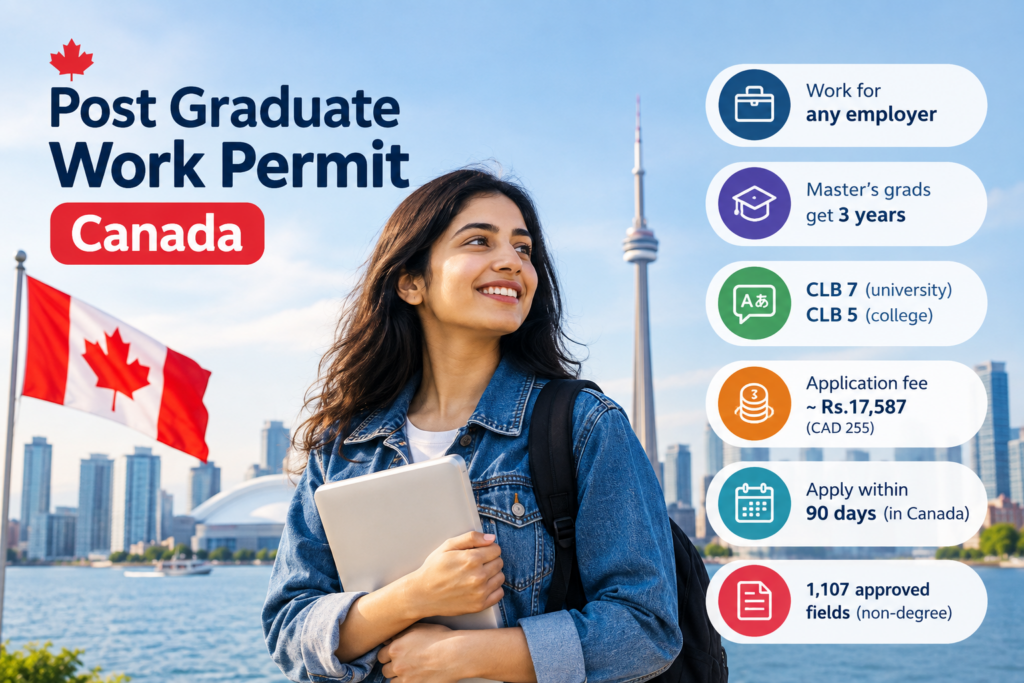
- A Post Graduate Work Permit Canada lets you work for any employer.
- Master’s graduates can get a 3-year PGWP Canada permit.
- University graduates need CLB 7; college graduates need CLB 5.
- The PGWP Canada application costs around Rs.17,587 (~CAD 255) without biometrics.
- Inside Canada, apply within 90 days of your completion letter.
- Non-degree programs must match one of 1,107 approved fields.
What Is a Post Graduate Work Permit Canada
A Post Graduate Work Permit Canada, usually shortened to PGWP, is an open work permit issued by Immigration, Refugees and Citizenship Canada (IRCC) to international students who graduate from an eligible Designated Learning Institution (DLI).
Open means no job offer, no Labour Market Impact Assessment, and no single employer tying you down. You can work for almost anyone, anywhere in Canada, once you have the permit in hand. You should start planning for your post-graduation work life in Canada before your final exams, not after.

Choose your dream country
 UK
UK
 USA
USA
 Germany
 Australia
 Ireland
 Canada
 UAE
UAE
 France
 Sweden
 Italy
Italy
 Other
Other
When do you want to study abroad?
What's your highest level of education?
Have you completed Class 12th?
What was your Class 12 CGPA/percentage?
Are you a student or a parent/guardian?
What do you want to study?
Select your current city
How Leap will help you

Personalised University Shortlist

Express Applications with Quicker Admits

End-to-End Application Support
Graduating from a DLI does not automatically make you eligible. Your study permit has to have been valid at some point in your application window, your program has to meet a minimum length, and, since November 2024, you also need to clear a language requirement. Most Indian students assume PGWP eligibility is a formality that kicks in once exams end. It isn't, and treating it that way is exactly how applications get delayed.
My insight: Students often confuse convocation with program completion. Your PGWP clock starts the day your Letter of Completion becomes available, almost always weeks before convocation. Waiting for the ceremony before preparing your application is the most common self-inflicted delay we see.
Post Graduate Work Permit Canada Eligibility Rules for 2026
| Requirement | Who It Applies To | 2026 Detail |
|---|---|---|
| Language proficiency (CLB) | All applicants | University graduates need CLB 7; college and non-degree graduates need CLB 5. IELTS, CELPIP, PTE Core, TEF Canada, and TCF Canada are all accepted, with results no older than 2 years |
| Field of study (CIP code) | Non-degree (diploma/certificate) graduates only | Must match one of 1,107 IRCC-approved fields; bachelor's, master's, and doctoral graduates are exempt |
| Minimum program length | All applicants | At least 8 months, leading to a degree, diploma, or certificate from a DLI |
| Full-time student status | All applicants | Must be maintained each academic term; part-time is allowed only in the final semester |
| Study permit validity | All applicants | Must have been valid at some point during your 90 or 180-day application window |
| Spousal open work permit | Spouses and partners | Since January 21, 2025, only spouses of students in a master's program of 16 months or longer, a doctoral program, or select professional degrees qualify |
My insight: We see far more PGWP Canada eligibility questions from diploma students than degree students, because the field-of-study rule only bites the non-degree cohort. If you're choosing between a diploma and a bachelor's program partly for PGWP reasons, weigh that before you enrol, not after.
Post Graduate Work Permit Canada Duration by Program Type
| Program Type | PGWP Duration |
|---|---|
| Non-degree, less than 8 months | Not eligible |
| Non-degree, 8 months to under 2 years | Same length as program |
| Non-degree, 2 years or more | Up to 3 years |
| Bachelor's degree | Matches program length, up to 3 years |
| Master's degree (any length of 8 months or more) | Up to 3 years |
The master's rule stands out. As of February 15, 2024, a master's graduate can get a 3-year PGWP Canada permit even if the program ran under two years, as long as every other criterion is met.
How Post Graduate Work Permit Canada Eligibility Works Across Different Courses
The rules above apply differently depending on your field of study, not just the level of your program.
| Course or Field | Degree Level | Field-of-Study Check Needed? | What to Watch For |
|---|---|---|---|
| MBA or Master's in Management | Master's | No, exempt | Gets a 3-year PGWP regardless of program length, as long as it runs 8 months or more |
| Computer Science or Data Science (PG Diploma) | Non-degree | Yes | Most tech diploma programs remain on the approved list, but confirm your specific CIP code with your DLI |
| Business or Management (PG Diploma) | Non-degree | Yes | Business diplomas were among the fields affected by the June 2025 CIP list changes, but now they are eligible as of 2026 |
| Nursing or Healthcare (Diploma or Degree) | Both | Non-degree only | Healthcare gained new eligible fields in the 2025 update, generally a safer category right now |
| Engineering (Bachelor's or Master's) | Degree | No, exempt | Exempt from the field-of-study rule regardless of specialization |
| Skilled Trades (Certificate, e.g. HVAC, Carpentry) | Non-degree | Yes | Trades expanded under the 2025 changes; most remain eligible, but confirm your CIP code |
| Hospitality or Culinary (Diploma) | Non-degree | Yes | Some hospitality-adjacent fields were affected by the June 2025 removals but are now eligible. |
In June 2025, IRCC briefly flagged these fields for removal, but it reinstated them, and they are now locked in as eligible through 2026.
My insight: Business and hospitality diploma students face more career-planning uncertainty right now than engineering or healthcare students. This isn't a comment on program quality; it's simply how IRCC's labor-shortage classification has shifted.
Which Post Graduate Work Permit Canada Situation Matches You
If you are a final-year master's student graduating in December 2026
Your program length no longer limits your PGWP. Focus on the CLB 7 requirement instead: book your language test early enough that results are back before your completion letter arrives.
If you are completing a college diploma in a field dropped from the CIP list in mid-2025
Check the date you applied for your study permit before assuming you no longer qualify. Students who applied before June 25, 2025, generally keep eligibility even if their field was later removed. If you applied after, verify your program's current CIP code directly with your institution's international office.
If your study permit is set to expire before your completion letter is issued
Apply for a study permit extension immediately. A lapsed permit before your completion letter arrives can put your entire PGWP eligibility at risk, not just delay it.
How to Get a Post Graduate Work Permit in Canada
The application happens entirely online through your IRCC secure account, whether you're still in Canada or already back in India.
- Log into your IRCC account and complete the eligibility questionnaire, which generates your document checklist.
- Fill out form IMM 5710, "Application to Change Conditions, Extend my Stay or Remain in Canada as a Worker." Download the current version from IRCC's website, since outdated forms cause delays.
- Upload every document from your checklist, pay the fee, and submit.
- Inside Canada, submit within 90 days of your Letter of Completion becoming available and before your study permit expires, whichever comes first.
- Outside Canada, or if you switch to the outside-Canada process after missing the 90-day window, you have up to 180 days from the date of your Letter of Completion.
| Fee Component | Amount (CAD) | Approx. Amount (INR) |
|---|---|---|
| PGWP application fee (includes open work permit holder fee) | CAD 255 | Rs.17,587 |
| Biometrics (if required) | CAD 85 | Rs.5,862 |
| Total, with biometrics | CAD 340 | Rs.23,450 |
Post Graduate Work Permit Canada Application Documents Checklist
| Document | Details | India-Specific Note |
|---|---|---|
| Letter of Completion | Official letter from your DLI confirm you met all program requirements | Distinct from your final marksheet, request it directly from your program office if it isn't issued automatically |
| Official transcript | Final grades for every completed term | Provisional certificates are usually not accepted as a substitute; check with your DLI |
| Passport | Bio-data page plus any pages with Canadian stamps or visas | Renew before applying if validity is under 3 years, since your PGWP cannot exceed your passport's expiry |
| Digital photograph | Passport-style, per IRCC's photo specifications | Indian passport photo studios are usually familiar with these specs but confirm dimensions before paying |
| Language test result | IELTS, CELPIP, PTE Core, TEF Canada, or TCF Canada, no older than 2 years | Book this while still studying so results are back well before your 90- or 180-day window opens |
My insight: The most avoidable rejection reason we see is a name mismatch between the passport and the Letter of Completion, usually a middle name spelled differently across documents. IRCC won't chase the issue up for you, so fix any mismatch with your DLI before submitting.
What to Do When Your Post Graduate Work Permit Canada Application Goes Wrong
Refusals and near-misses happen in post graduation Canada applications, and pretending otherwise doesn't help anyone.
You missed the 90-day inside-Canada deadline.
You can change your status to visitor and apply through the outside-Canada process instead, as long as you are still within 180 days of your Letter of Completion. You cannot work while that application is pending, so plan your finances around the gap.
Your study permit expired before you applied.
IRCC has a restoration process for expired permits, but it carries its own separate fee on top of the PGWP fee, and the amount changes periodically. Confirm the current figure on IRCC's fee page rather than trusting a number from any blog post, including this one, a year from now.
Your language score falls short of CLB 7 or CLB 5.
Retaking a test costs time you may not have inside your window. If your first attempt is borderline, book a retake immediately rather than waiting to see if it's enough.
Your passport is expiring soon.
IRCC will not issue a PGWP that outlasts your passport. Renewing an Indian passport can take several weeks through VFS Global, so start well before you plan to submit.
Post Graduate Work Permit Canada Application Timeline 2027
Your PGWP timeline depends entirely on when your program actually finishes, which in turn depends on which Canada intake you join.
| Your Intake | Program Type | Expected Completion Window | Apply by, Inside Canada (90 days) | Apply by, Outside Canada (180 days) |
|---|---|---|---|---|
| Fall 2026 (Sept 2026, currently open) | 1-year diploma | August to December 2027 | November 2027 to March 2028 | February to June 2028 |
| Winter 2027 (Jan 2027) | 1-year diploma | December 2027 to April 2028 | March to July 2028 | June to October 2028 |
| Fall 2026 (Sept 2026, currently open) | 16-24 month master's | Winter to Spring 2028 | Spring to Summer 2028 | Summer to Fall 2028 |
If you're planning to join the Fall 2026 intake or have just started it, this is the calendar to work backward from: your language test result should already be current by the time you approach your final semester, and once your Letter of Completion lands, sometime in the completion window above, your 90 or 180-day clock starts immediately, not on your convocation date.
From Post Graduate Work Permit Canada to Permanent Residency
For most Indian graduates, a Post Graduate Work Permit Canada isn't the end goal; it's the bridge to permanent residency:
- Work in a skilled role on your PGWP. Jobs in Canada classified as TEER 0, 1, 2, or 3 count toward permanent residency eligibility, such as software development, data analysis, accounting, and engineering.
- Build 12 months of qualifying experience, the minimum threshold for the Canadian Experience Class within Express Entry.
- Set up your Express Entry profile once you hit that 12-month mark. From there, you apply through the Canadian Experience Class using the work experience you've already banked.
- Don't overlook Provincial Nominee Programs while you're at it. If you studied and worked in one province the whole time, there's a decent chance that province runs a stream built almost exactly for your situation.
One more thing before you lock in a PR timeline: read through the Canada PR requirements in full. Express Entry draws and priorities move around more than people expect, and a plan built on last year's numbers can leave you short.
3 Key Takeaways on Post Graduate Work Permit in Canada
- Your Letter of Completion date is what matters, not your convocation date. That's the day your PGWP clock actually starts ticking, and treating convocation as the trigger is how students lose weeks they didn't need to lose.
- Check your CLB score and CIP field-of-study status well before your final semester. Both rules have moved since 2024, so assuming your program still qualifies without checking is a bet you don't need to take.
- Renew your passport if it has less than 3 years left on it. Your PGWP is valid only as long as your passport is, so this step protects the full duration you've earned.
Verified by: LeapScholar's Canada counseling team, who work with Indian students on PGWP applications and Express Entry planning on a daily basis.
If you're still working out where you stand on Post Graduate Work Permit Canada eligibility, book a free session with a LeapScholar who can go through your specific situation with you.
Frequently Asked Questions About Post Graduate Work Permit Canada
-
What is a Post Graduate Work Permit in Canada?
It's an open work permit for graduates of an eligible Canadian Designated Learning Institution. It lets you work for almost any employer without a job offer or LMIA, and for most Indian students it's the first real step toward permanent residency.
-
How do you get a post graduate work permit in Canada?
Apply online through your IRCC account using form IMM 5710. The questionnaire builds your document checklist, so gather your Letter of Completion, transcript, passport, a digital photo, and your language score before you start the clock.
-
What is the post graduate work permit Canada application form?
It's IMM 5710, "Application to Change Conditions, Extend my Stay or Remain in Canada as a Worker." Download the current version from IRCC's site each time. An outdated copy is a common reason applications bounce back.
-
How long is a post study work permit in Canada after a master's degree?
You can get a post-study work permit for up to 3 years, even if your master's program was less than two years, as long as you achieve CLB 7 and meet all other requirements. This rule has been in place since February 15, 2024, and it's why families increasingly lean toward the master route for the PGWP runway.
-
What is the PGWP Canada eligibility requirement for language proficiency?
If you're a university graduate, you're looking at CLB 7. College and non-degree graduates need CLB 5. IELTS, CELPIP, PTE Core, TEF Canada, and TCF Canada all count, just make sure the score isn't older than two years by the time you file.
-
How much does the PGWP Canada application cost in Indian Rupees?
Plan for roughly Rs.17,587 just for the CAD 255 application fee. If biometrics are also required, add another Rs.5,862, bringing the total to around Rs.23,450. These numbers are based on Rs.68.97 per CAD from mid-September 2026, so it's worth pulling the current rate closer to when you actually apply.
-
What happens if I miss the deadline to apply for a Post Graduate Work Permit Canada?
Missing the 90-day inside-Canada window still leaves you the outside-Canada route, as long as you're inside 180 days of your Letter of Completion overall. After that, you generally lose eligibility for that program.
-
Can I work while my PGWP Canada application is being processed?
Usually yes, if you applied before your study permit expired and within your 90-day window, you can keep working full-time under maintained status while IRCC decides. If your study permit had already lapsed, you're not authorised to work until a decision comes through.
-
How does a Post Graduate Work Permit Canada help with permanent residency?
Every month of skilled work on a PGWP, in a role classified TEER 0 through 3, builds toward Canadian Experience Class eligibility inside Express Entry. Many graduates also run a Provincial Nominee Program application alongside their PGWP, particularly if they studied and worked in one province throughout.







Have Questions? Get Guidance to reach your Dream University
Connect with India's finest counsellors and biggest study abroad community.
Get Guidance