
Quick Read
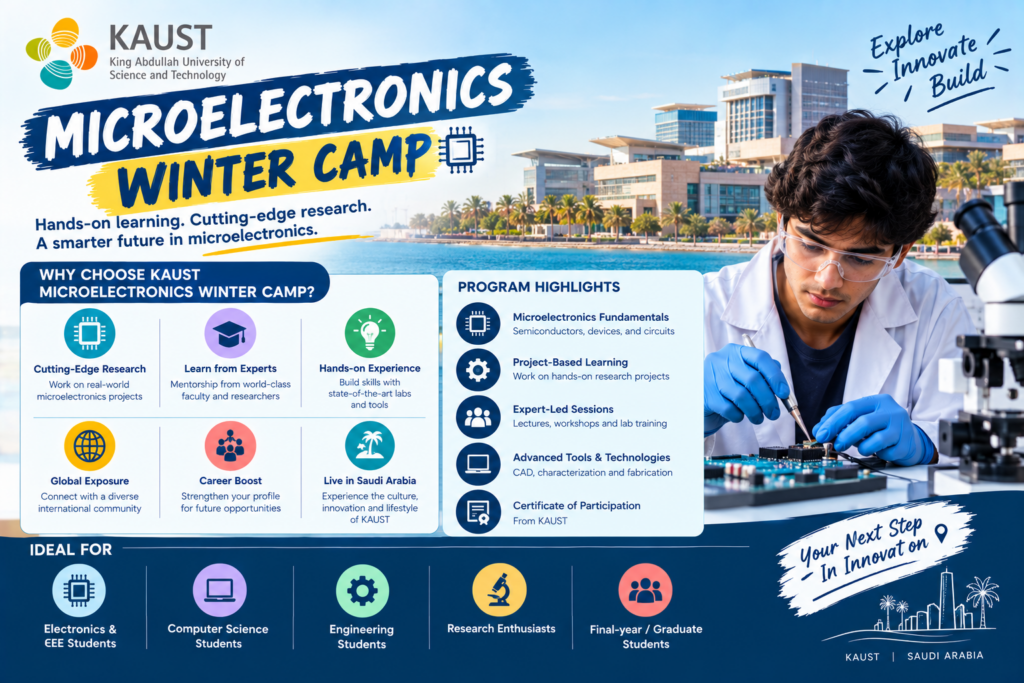
- The KAUST Microelectronics Winter Camp 2027 runs from 4 January to 11 February at KAUST, Saudi Arabia.
- Applications from Indian students close on 24 September 2026, so this year’s window is very short.
- The program is fully sponsored: stipend, free campus accommodation, and visa support, with zero application fee.
- Selection requires a GPA of 3.5/4.0 or higher (roughly 8.75/10 CGPA), strong English, and a genuine interest in research.
What Is the KAUST Microelectronics Winter Camp (MEWC)?
The KAUST Microelectronics Winter Camp, run by the Computer, Electrical and Mathematical Sciences and Engineering (CEMSE) Division at King Abdullah University of Science and Technology (KAUST), is a six-week, fully sponsored research internship in Thuwal, Saudi Arabia. It is not a lecture-based summer school. Selected students join a faculty-led research team from day one and work on an actual project in areas like integrated circuits, sensors, wearable electronics, or energy systems.
KAUST itself is a public, English-medium research university founded in 2009. It ranks first in Saudi Arabia and has a strong regional position in global research indices, which is important for Indian applicants considering whether a KAUST credential will be valued by universities and employers abroad. The KAUST Microelectronics Winter Camp is one of CEMSE’s flagship outreach programs and has run annually since at least 2019, drawing students from over a dozen countries in past cohorts.

Choose your dream country
 UK
UK
 USA
USA
 Germany
 Australia
 Ireland
 Canada
 UAE
UAE
 France
 Sweden
 Italy
Italy
 Other
Other
When do you want to study abroad?
What's your highest level of education?
Have you completed Class 12th?
What was your Class 12 CGPA/percentage?
Are you a student or a parent/guardian?
What do you want to study?
Select your current city
How Leap will help you

Personalised University Shortlist

Express Applications with Quicker Admits

End-to-End Application Support
Counselor insight: Students often assume "winter camp" means something light. It is not. Past participants describe six full weeks of faculty-mentored research, not a certificate-mill program, so applicants should genuinely enjoy hands-on lab work before applying.
KAUST Microelectronics Winter Camp 2027: Key Dates You Cannot Miss
| Milestone | Date |
| Applications open | Currently open |
| Application deadline | 24 September 2026 |
| Camp start date | 4 January 2027 |
| Camp end date | 11 February 2027 |
| Duration | 6 weeks |
The 2026 edition of the KAUST Microelectronics Winter Camp (which ran 12 January to 19 February 2026) is already over, and its application window closed in October 2025. If you are searching for the KAUST Microelectronics Winter Camp right now, the 2027 cycle above is the one that is actually open, and the deadline is days away, not months.
Eligibility for the KAUST Microelectronics Winter Camp: Can You Apply From India?
Yes. KAUST does not restrict the Microelectronics Winter Camp based on nationality. To qualify, you need to be one of the following:
- A final-year (senior) undergraduate student
- A recent graduate
- A current master's student
in electrical engineering, computer engineering, or a closely related discipline.
You also need:
- A cumulative GPA of 3.5 out of 4.00 or higher
- Strong English language proficiency
- A demonstrated motivation to work on research projects
Counselor insight: Most Indian universities grade on a 10-point CGPA scale, not a 4.0 scale, which trips up many applicants. A commonly used rule of thumb is CGPA (10-point) = GPA (4.0 scale) x 2.5, which means KAUST's 3.5/4.0 requirement is roughly 8.75/10. This is only an approximation; universities and evaluators (such as WES) use slightly different conversion tables, so check your institution's official conversion before ruling yourself out or overstating your GPA on the application.
There is no explicit IELTS or TOEFL score requirement published for the KAUST Microelectronics Winter Camp, only "strong English language proficiency," but a strong existing IELTS or TOEFL score is a reasonable way to back up that claim in your application if you have one.
What the KAUST Microelectronics Winter Camp Actually Covers
This is the part that makes the KAUST Microelectronics Winter Camp genuinely accessible for Indian students rather than just another expensive foreign internship line on a resume. Per KAUST's own program page, selected participants receive:
- A stipend to cover living expenses at KAUST
- Logistics and visa support
- Free accommodation on the KAUST campus
- Access to KAUST's research facilities and equipment
- A certificate of completion
There is no published exact stipend figure for the KAUST Microelectronics Winter Camp, so any number you see quoting a specific amount should be treated with caution.
Exchange rate note: this article uses 1 SAR = Rs. 25 for any Saudi Riyal figures mentioned. Rates move day to day, so verify the live rate before making any financial decisions around this program.
Counselor insight: "Logistics and visa support" is the phrase KAUST uses officially. Some third-party listings describe the program as covering flight bookings and airport transfers, but that level of detail is not on KAUST's own page, so confirm the exact scope (does it cover your flight from India or just the Saudi visa and airport pickup) once you are shortlisted, rather than assuming it from a blog.
Inside the Program: What You’ll Actually Do for Six Weeks
The KAUST Microelectronics Winter Camp structure includes:
- Hands-on, faculty-led research projects in areas spanning electronics, energy, health, and smart systems
- Technical training and workshops in integrated circuits (ICs), inkjet printing, 3D printing, and self-assembly
- Designing and building a gadget prototype tied to your assigned project
- Side workshops on research skills and e-poster design
- An e-poster competition at the end of the program
- Social and networking events with students from other countries
Past MEWC projects have included work on comparing wind turbine power, a smart shower water-conservation system, a 3D-printed wearable sensor, and laser-scribed graphene electrodes for dopamine detection, mentored by KAUST faculty across the CEMSE division. This information is a useful reference point if the "research summary" or interest area you write about in your application feels too vague; look at the kind of applied, hands-on projects KAUST has actually run before pitching your own.
Documents and Application Process for Indian Students
KAUST's application requirements for the Microelectronics Winter Camp are
- An up-to-date CV
- Official transcripts in English
- A copy of your passport (Indian applicants are non-Saudi, so this applies to you)
- Passing an interview with KAUST faculty and administration if shortlisted
Applications are submitted through KAUST's own application portal, not through a third-party agent or scholarship-listing website. The KAUST Microelectronics Winter Camp has no application or participation fee, so any site asking you to pay to apply is an unofficial KAUST channel.
Counselor insight: Because KAUST reviews applications on a rolling basis as the CEMSE faculty match projects to students, applying closer to the 24 September 2026 deadline (rather than on the last day) rarely helps and can hurt you if faculty slots fill up. If your CV, transcripts, and English proficiency evidence are ready, submit them now.
Cost of Attending From India (Even Though It’s “Fully Funded”)
"Fully funded" covers accommodation, a stipend, and visa support, not necessarily every rupee you will spend. Indian students should still budget for:
- A valid passport (renewal or fresh issue, if you do not already have one)
- Personal spending money for the first week or two before you settle into the KAUST campus routine
- Any domestic travel within India to reach your departure airport
- Incidentals like a local SIM card or personal toiletries once at KAUST
None of these are large costs relative to a typical study-abroad budget, but they are real, and "fully funded" should not be read as "zero cost to you."
If you want a fuller sense of what daily expenses look like in Saudi Arabia, LeapScholar's Cost of Living in Saudi Arabia guide breaks down typical monthly spending for international students.
Other Fully Funded Research Opportunities Worth Comparing
The KAUST Microelectronics Winter Camp is not the only fully funded, short-term research opportunity open to Indian STEM students. If you are building a broader shortlist, it is worth also looking at options like the CERN Internship for Indian Students and the Max Planck Internship in Germany, or LeapScholar's broader roundup of international internship opportunities for Indian students if microelectronics specifically is not your area.
If Saudi Arabia as a study destination interests you beyond this one program, Study in Saudi Arabia for International Students and Top Universities in Saudi Arabia for Indian Students cover the wider landscape, including full degree programs beyond short internships like MEWC.
3 Key Takeaways on KAUST Microelectronics Winter Camp
- Apply for the KAUST Microelectronics Winter Camp 2027 now, not later: the 24 September 2026 deadline leaves very little runway, and KAUST reviews applications as they come in.
- Convert your CGPA carefully before assuming you don't meet the 3.5/4.0 bar; the common 10-point-to-4.0 conversion puts most students with an 8.75+ CGPA in range, but verify with your university.
- Treat "fully funded" as covering the big costs, not every rupee; budget separately for personal expenses and confirm the exact scope of visa and logistics support once you're shortlisted.
Not sure if your profile is a strong fit for the KAUST Microelectronics Winter Camp, or want a second opinion on your CV before the 24 September 2026 deadline? Talk to a LeapScholar counselor and get your application reviewed before you submit.
Frequently Asked Questions About KAUST Microelectronics Winter Camp
-
Is the KAUST Microelectronics Winter Camp really free for Indian students?
Yes, in the sense that matters most: there is no application fee, and selected participants receive a stipend, free campus accommodation, and visa support. You should still budget for personal expenses and any costs before you're formally selected, but KAUST covers the core program cost.
-
What GPA do I need for KAUST MEWC if my university uses a 10-point CGPA scale?
KAUST asks for 3.5/4.0 or higher, which roughly maps to an 8.75/10 CGPA using the common x2.5 conversion. This is an approximation, not an official KAUST conversion table, so check with your university's exam cell or a WES-style conversion if your GPA is borderline.
-
Can final-year undergraduates apply, or only master's students?
Final-year (senior) undergraduates, recent graduates, and current master's students in electrical engineering, computer engineering, or related fields are all eligible for the KAUST Microelectronics Winter Camp. There is no separate track that excludes undergraduates.
-
Does KAUST MEWC 2027 require IELTS or TOEFL scores?
KAUST's published eligibility asks for "strong English language proficiency" without naming a specific test or score. A good IELTS or TOEFL score is not mandatory on paper but can help support your application if you have one.
-
What happens if I miss the 24 September 2026 deadline?
Applications submitted after the deadline are unlikely to be considered for the 2027 KAUST Microelectronics Winter Camp cohort. If you miss it, your realistic options are to prepare early for the 2028 cycle or to explore other fully funded research internships with later deadlines in the meantime.
-
Will KAUST MEWC help me get into a master's program abroad?
A completed research project, a faculty mentor reference, and hands-on lab experience from a recognized research university can meaningfully strengthen a master's or PhD application in electrical or computer engineering, particularly for programs that value research exposure. It is a strong addition to your profile, not a guarantee of admission anywhere.
-
How competitive is the KAUST Microelectronics Winter Camp selection?
KAUST does not publish official acceptance rates for the Microelectronics Winter Camp. Past cohorts have drawn students from well over a dozen countries for a limited number of faculty-mentored spots, so applicants should treat it as competitive and apply with a complete, well-prepared package rather than assuming casual interest is enough.
-
Do I need a visa to enter Saudi Arabia for the winter camp, and who arranges it?
Yes, Indian passport holders need a visa to enter Saudi Arabia, and KAUST's program benefits explicitly include visa support for selected participants. Exact processing steps and timelines should be confirmed directly with KAUST once you are shortlisted, since visa arrangements are typically finalized after selection, not at the application stage.










Have Questions? Get Guidance to reach your Dream University
Connect with India's finest counsellors and biggest study abroad community.
Get Guidance