
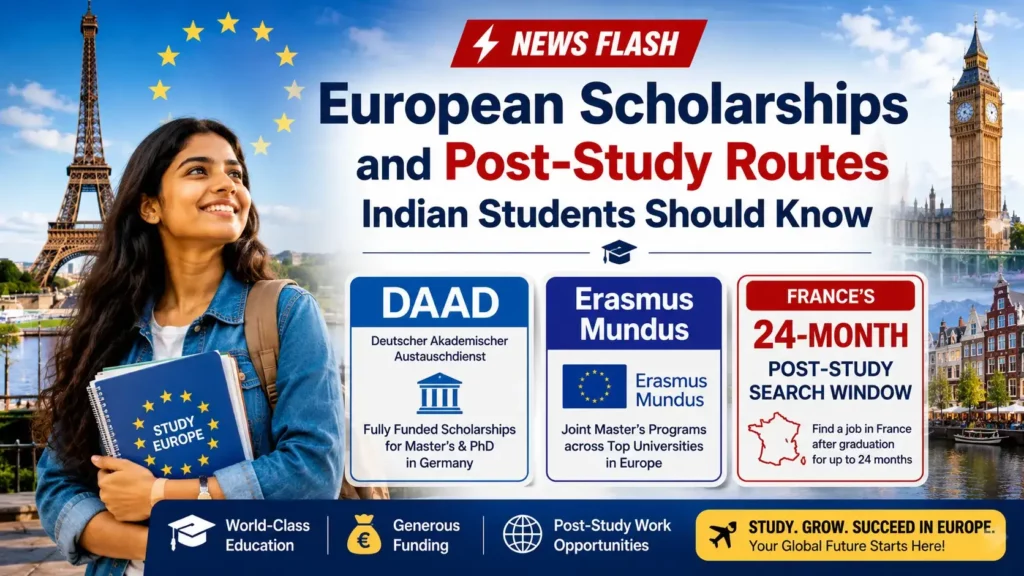
Indian students interested in artificial intelligence, advanced technology, or other specialized fields in Europe have several funded pathways to consider, including Germany’s AI-focused graduate schools, the EU’s flagship Erasmus Mundus program, and France’s above-average post-study visa window. Each offers genuine funding and post-study rights, but they also have separate rules, so the details are as important as the main figures.
Germany’s DAAD-Backed AI Schools
The Konrad Zuse Schools of Excellence in Artificial Intelligence are three graduate schools funded by Germany’s DAAD (German Academic Exchange Service) and backed by the Federal Ministry of Research, Technology, and Space as part of Germany’s national AI strategy. Between them, the three schools ELIZA (Technische Universität Darmstadt and partners), relAI (TU Munich and LMU Munich), and a third focused on AI research bring together roughly 70 partner institutions from academia and industry.
What they offer:

Choose your dream country
 UK
UK
 USA
USA
 Germany
 Australia
 Ireland
 Canada
 UAE
UAE
 France
 Sweden
 Italy
Italy
 Other
Other
When do you want to study abroad?
What's your highest level of education?
Have you completed Class 12th?
What was your Class 12 CGPA/percentage?
Are you a student or a parent/guardian?
What do you want to study?
Select your current city
How Leap will help you

Personalised University Shortlist

Express Applications with Quicker Admits

End-to-End Application Support
- Tuition-free master's programs in AI-related fields.
- Scholarships for master's students and paid research positions for doctoral candidates.
- Structured mentoring and direct links with industry partners.
- Access to Germany's wider DAAD scholarship database for other funding options, since amounts and eligibility differ by individual program.
Why the post-study picture matters here: Germany's "Job Seeker" residence permit, confirmed by the Federal Office for Migration and Refugees (BAMF), lets international graduates of German universities stay for up to 18 months to look for skilled employment, working any job to support themselves in the meantime. Once they land a job matching their qualifications, graduates can typically move to a Skilled Worker permit or an EU Blue Card Germany's main long-term work-and-settlement route for university-educated non-EU nationals.
Erasmus Mundus: EU-Funded Master’s Across Multiple Countries
The Erasmus Mundus Joint Masters (EMJM) program, funded by the European Union under Erasmus+, is one of the most recognized fully funded routes into Europe for Indian students. These are integrated master's degrees delivered jointly by at least three higher education institutions across at least two European countries. Students typically study in two or three countries during a single degree and graduate with either a joint degree or multiple degrees.
Per the European Commission's own published terms:
- Scholarships are valued at €1,400 per month, for up to 24 months (a maximum of €33,600 over the full award).
- The award also covers participation costs, including tuition and full insurance, with an optional contribution toward travel and installation costs.
- Programs run for one to two academic years (60, 90, or 120 ECTS credits).
- Students apply directly to the consortium running their chosen program, not to the EU centrally.
One caution worth repeating for anyone comparison-shopping programs online: the commonly quoted figure of "more than 200 scholarships" isn't a fixed number that resets every year; the actual number of scholarships varies by individual program and by funding cycle, so it's worth checking the specific consortium's current allocation rather than assuming a set annual total.
France’s Longer Post-Study Job-Search Window
France offers a distinct advantage for Indian graduates through a bilateral arrangement with India: per Campus France India (the official French government agency for international student mobility), Indian students completing postgraduate studies in France can obtain a 12-month post-study visa that can be renewed once, giving a total of up to 24 months to search for work or start a business after graduation. This is double the 12-month window most other nationalities receive under France's general rules.
This route isn't an automatic path to permanent residence or citizenship; graduates still need to meet the relevant conditions to convert their post-study status into a qualifying work permit, but it does provide significantly more time to find the right opportunity without the immediate pressure to leave.
What to Check Before You Commit
These three routes are genuinely different programs with different rules, and the appeal of any of them isn't just the scholarship; it's the combination of funding, the degree itself, and what happens after graduation. Before applying, it's worth confirming three things for any specific program:
- Is the course actually taught in English? Not every program at every partner university is taught in English.
- What exactly does the scholarship cover? Tuition-only and tuition-plus-stipend are completely unique financial pictures.
- What is the actual post-study immigration status once you graduate? A scholarship doesn't automatically come with a matching post-study work right. Check the specific visa or residence permit tied to that country and program, not just the country's general reputation.
Have questions about which European scholarship or post-study route fits your profile? Book a free session with a LeapScholar counselor.





Have Questions? Get Guidance to reach your Dream University
Connect with India's finest counsellors and biggest study abroad community.
Get Guidance