
Quick Read
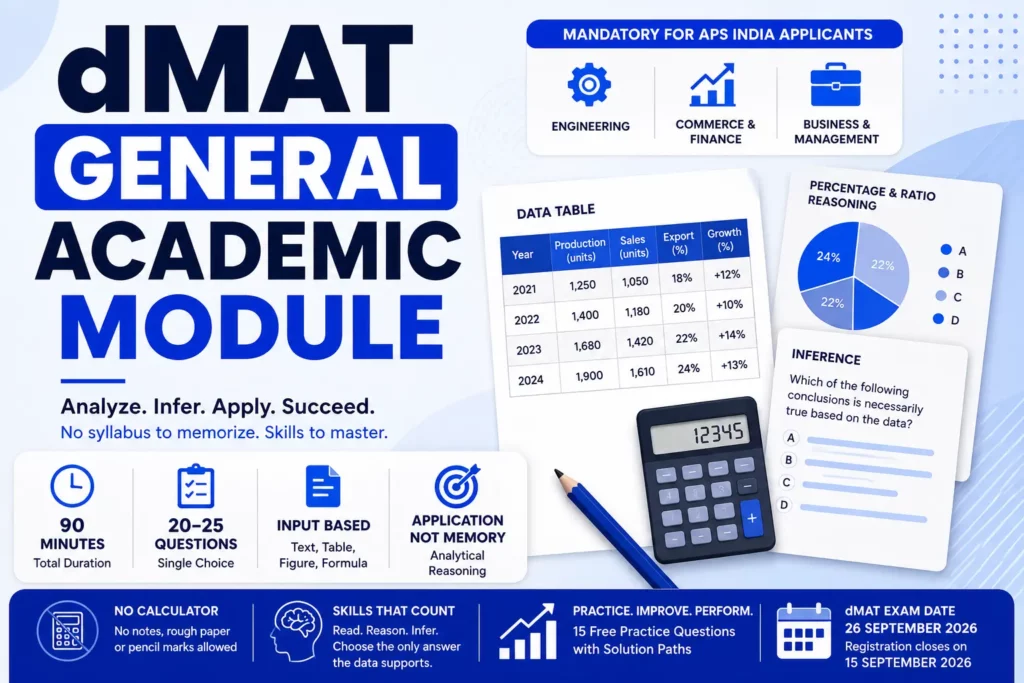
- Mandatory for APS India applicants in engineering, commerce/finance/economics, and business/management.
- Applicable for programs starting Summer Semester 2027 onwards, not the current dMAT cycle
- 90 minutes, 20-25 single-choice questions, each built from an input (text, table, figure, or formula)
- Tests application, not memorized knowledge: percentage and ratio reasoning, table reading, and inference
- Method: read the questions before the input, anchor every percentage to its base, and pick only the conclusion the data forces
- Attempt the 15 free practice questions below using this method, then check the solution path
Start the 15 Practice Questions ↓
What is the dMAT General Academic Module?
The General Academic Module is the subject half of the dMAT for APS applicants: the part that decides whether the exam requirement is met for APS certification. It runs for 90 minutes and contains 20 to 25 single-choice questions, each with four options and exactly one correct answer. Every question starts from an input, which can be a short text, a table, a figure, or a formula, and asks you to apply analytical reasoning to it.
There is no subject syllabus to memorize because the General Academic Module measures transfer and application rather than recalled knowledge. The dMAT syllabus defines it by skills: reading dense academic inputs, working with percentages, ratios, and rates, and drawing only the conclusions the data supports.
You sit it in the same session as the Core Module, so the full dMAT exam pattern is about three and a half hours, including a 30-minute break.
| Feature | Detail |
|---|---|
| Duration | 90 minutes |
| Questions | 20 to 25 single-choice (4 options, 1 correct) |
| Question style | Input (text, table, figure or formula) plus related questions |
| Syllabus | None to memorise; analytical application is tested |
| Taken with | The 75-minute Core Module, same sitting |
| Aids allowed | None. No calculator, notes or rough paper |
How to Solve General Academic Module Questions
- Read the questions before the input. Knowing what is asked tells you which numbers in the table matter and which sentences are just decoration. This alone saves 30 to 60 seconds per input set.
- Anchor every percentage to its base. Most wrong options exist because “12% of supply” was computed as 12% of consumption, or growth was divided by the new figure instead of the old one. Say the base to yourself before calculating it.
- Separate necessary from possible. Inference questions offer conclusions that could be true. Pick only the one the data forces. If you need an extra assumption, it is a distractor.
- Work in totals, mentally. Averages of averages and per-unit shortcuts create errors; totals divided by totals do not. All arithmetic in the General Academic Module is built to be manageable without a calculator if you keep the numbers whole for as long as possible.
Who Must Take the General Academic Module?
Whether the General Academic Module applies to you depends on your bachelor’s field and your intake:
| Degree background | dMAT with GAM required? |
|---|---|
| Engineering (all branches) | Yes |
| Commerce, Accounting, Finance, Economics | Yes |
| Business / Management | Yes |
| Other fields (arts, pure sciences, medicine and more) | Not currently |
The requirement applies to APS applications for programs starting in Summer Semester 2027 and later.
dMAT General Academic Module Practice Questions with Answers (Free)
There are no dMAT past papers, so format-accurate practice is the only realistic preparation. The 15 original questions below follow the official input-plus-questions format: five inputs, from data tables to rules and formulas, each with three single-choice questions. Every numeric answer has been independently verified. Attempt each question without a calculator, then open the solution path to compare your reasoning.
📄 Input 1 · Data Interpretation
A city water utility reports the following figures. Questions 1 to 3 refer to this input.
| 2020 | 2024 | |
|---|---|---|
| Total water consumption | 180 million m³ | 210 million m³ |
| Population | 3.0 million | 3.2 million |
Question 1 Medium
How did per-capita water consumption change from 2020 to 2024?
- a) It fell by about 6%
- b) It rose by about 9%
- c) It rose by about 17%
- d) It remained unchanged
✦View Solution PathHide Solution Path▼
Answer: b. 2020: 180 ÷ 3.0 = 60 m³ per person. 2024: 210 ÷ 3.2 is about 65.6 m³ per person. 65.6 ÷ 60 is about 1.09, an increase of roughly 9%.
Question 2 Medium
Which statement follows necessarily from the data?
- a) Every resident used more water in 2024 than in 2020
- b) Water prices fell between 2020 and 2024
- c) Total consumption grew faster than the population
- d) The city will exceed 220 million m³ by 2026
✦View Solution PathHide Solution Path▼
Answer: c. Consumption grew about 16.7% while population grew about 6.7%, so that comparison follows directly. The other options are possible but not necessary conclusions from this data.
Question 3 High
The utility loses 12% of supplied water to leakage, so consumption = supply × 0.88. What supply was needed in 2024?
- a) About 239 million m³
- b) About 185 million m³
- c) About 235 million m³
- d) About 246 million m³
✦View Solution PathHide Solution Path▼
Answer: a. Supply = consumption ÷ 0.88 = 210 ÷ 0.88, which is about 238.6 million m³. The trap is 210 × 1.12 = 235.2, which applies the 12% to consumption instead of supply.
📄 Input 2 · Rates and Averages
A train covers 240 km in 3 hours, then a further 120 km in 1.5 hours. Questions 4 to 6 refer to this input.
Question 4 Low
What is the average speed over the whole journey?
- a) 75 km/h
- b) 84 km/h
- c) 90 km/h
- d) 80 km/h
✦View Solution PathHide Solution Path▼
Answer: d. Total distance 360 km ÷ total time 4.5 h = 80 km/h. Always divide totals; never average two averages.
Question 5 Medium
If the whole 360 km had been covered at a constant 90 km/h, how much time would have been saved?
- a) 15 minutes
- b) 30 minutes
- c) 45 minutes
- d) 60 minutes
✦View Solution PathHide Solution Path▼
Answer: b. At 90 km/h the journey takes 360 ÷ 90 = 4 hours. The actual journey took 4.5 hours, so 30 minutes would have been saved.
Question 6 Medium
Which statement follows necessarily from the data?
- a) The average speed was identical in both parts of the journey
- b) The train was delayed in the second part
- c) The train stopped between the two parts
- d) The second part was uphill
✦View Solution PathHide Solution Path▼
Answer: a. First part: 240 ÷ 3 = 80 km/h. Second part: 120 ÷ 1.5 = 80 km/h. Both parts average exactly 80 km/h, so the statement follows. The other options add facts the data does not contain.
📄 Input 3 · Percentages and Efficiency
A machine produces 240 units per hour while running at 80% of its full capacity. Questions 7 to 9 refer to this input.
Question 7 Low
How many units per hour would the machine produce at full capacity?
- a) 288
- b) 192
- c) 300
- d) 312
✦View Solution PathHide Solution Path▼
Answer: c. 240 ÷ 0.8 = 300 units per hour. The trap answer 288 (240 × 1.2) applies the percentage to the wrong base.
Question 8 Low
How many units does the machine produce in an 8-hour shift at 80% capacity?
- a) 1,600
- b) 1,920
- c) 2,400
- d) 1,440
✦View Solution PathHide Solution Path▼
Answer: b. 240 units per hour × 8 hours = 1,920 units. The 2,400 option is what a full-capacity shift would produce.
Question 9 Medium
Maintenance reduces the machine to 60% of full capacity. How many units per hour does it produce then?
- a) 144
- b) 200
- c) 240
- d) 180
✦View Solution PathHide Solution Path▼
Answer: d. Full capacity is 300 units per hour, so 60% of it is 300 × 0.6 = 180. The trap answer 144 takes 60% of 240, which is the 80% output, not full capacity.
📄 Input 4 · Ratios and Growth
A university reports the following figures. Questions 10 to 12 refer to this input.
| 2020 | 2024 | |
|---|---|---|
| Enrolled students | 25,000 | 30,000 |
| Academic staff | 2,000 | 2,000 |
Question 10 Medium
How did the student-staff ratio change between 2020 and 2024?
- a) It rose from 12.5 to 15
- b) It fell from 15 to 12.5
- c) It stayed constant
- d) It rose from 12.5 to 20
✦View Solution PathHide Solution Path▼
Answer: a. 2020: 25,000 ÷ 2,000 = 12.5 students per staff member. 2024: 30,000 ÷ 2,000 = 15. The ratio rose from 12.5 to 15.
Question 11 Low
By what percentage did enrolment grow from 2020 to 2024?
- a) 16.7%
- b) 25%
- c) 20%
- d) 5%
✦View Solution PathHide Solution Path▼
Answer: c. Growth = 5,000 ÷ 25,000 = 20%. The trap answer 16.7% divides by the 2024 figure instead of the 2020 base.
Question 12 High
How many additional staff members would restore the 2020 ratio of 12.5 at the 2024 enrolment?
- a) 200
- b) 400
- c) 600
- d) 2,400
✦View Solution PathHide Solution Path▼
Answer: b. Staff needed = 30,000 ÷ 12.5 = 2,400. The university already has 2,000, so 400 more are needed. The option 2,400 is the total requirement, not the additional hires.
📄 Input 5 · Applying a Rule
A laboratory study finds that, within the tested range of 20°C to 60°C, a reaction rate doubles with every 10°C increase in temperature. At 20°C the rate is 5 units per minute. Questions 13 to 15 refer to this input.
Question 13 Medium
What is the reaction rate at 50°C?
- a) 15 units per minute
- b) 20 units per minute
- c) 30 units per minute
- d) 40 units per minute
✦View Solution PathHide Solution Path▼
Answer: d. From 20°C to 50°C is three steps of 10°C, so the rate doubles three times: 5, then 10, then 20, then 40 units per minute.
Question 14 High
At which temperature does the rate reach 80 units per minute?
- a) 60°C
- b) 70°C
- c) 80°C
- d) 55°C
✦View Solution PathHide Solution Path▼
Answer: a. 80 ÷ 5 = 16, which is four doublings. Four steps of 10°C above 20°C gives 60°C, which is still inside the tested range.
Question 15 High
Which is the safest conclusion from this study?
- a) The rate doubles per 10°C at any temperature whatsoever
- b) The rate is directly proportional to temperature
- c) Within the tested range, each 10°C increase doubles the rate
- d) At 0°C the reaction stops completely
✦View Solution PathHide Solution Path▼
Answer: c. The study only covers 20°C to 60°C, so conclusions outside that range are extrapolation. Doubling is also not direct proportionality. Only the range-limited statement is fully supported.
dMAT General Academic Module Study Plan Before 26 September 2026
The dMAT is on 26 September 2026, and registration closes on 15 September.
Check the dMAT exam dates and registration deadline, then work backward with this General Academic Module plan:
| Weeks before test | Focus |
|---|---|
| 6 to 5 | Watch the official instructional videos on d-mat.de and work the general sections of the official preparatory PDFs. Drill percentages and ratios mentally |
| 4 to 3 | Input-set practice at 4 minutes per question; start with data tables, then rules and formulas |
| 2 | Inference discipline: necessary versus possible; classify every error into the four traps |
| 1 | Two full-time sittings of Core plus General Academic Module together, using the 6-week dMAT study plan |
| Test week | Short daily warm-ups; revisit only your most common trap |
Remember that your sitting opens with the dMAT Core Module, so pair this plan with the three core subtests, starting with dMAT Figure Sequences practice, and keep the dMAT practice test hub bookmarked so everything is in one place.
Frequently Asked Questions About the dMAT General Academic Module
What is the dMAT General Academic Module?
It is the standardized subject module that Indian applicants take alongside the Core Module for APS certification. Over 90 minutes, it presents short academic inputs such as texts, tables, and formulas and asks 20 to 25 single-choice questions that test analytical application rather than memorized knowledge.
Who has to take it?
Applicants with bachelor’s degrees in engineering, commerce, accounting, finance, economics, business, or management who are applying through APS India for programs starting in the Summer Semester 2027 or later. Holders of a valid APS certificate and applicants from other fields are currently outside the mandate.
Is there a syllabus I can study?
There is no content syllabus, because the module measures how you handle unfamiliar academic inputs. The preparable part focuses on skills: percentage and ratio arithmetic without a calculator, reading tables quickly, and distinguishing between conclusions that the data forces and those it merely allows.
Do commerce students get different questions from engineers?
Everyone taking the General Academic Module sits the same standardized paper, whatever their degree. That is the design goal: a fair comparison of applicants across different education systems and streams, scored centrally by the TestDaF Institute.
Is a calculator allowed?
The dMAT permits no aids of any kind across the whole exam: no calculator, no notes, and no rough paper. The arithmetic is designed to be manageable mentally, which is why practicing without a calculator from your first session is essential.
Does a low score affect my APS certificate?
A weak result does not block APS certification because the dMAT is not a pass or fail exam and the certificate requires participation, not a particular mark. The score does appear on the certificate, and each university assesses it in its admission process, so a low score never means automatic rejection and a high score never guarantees admission.
How long is the module, and how many questions?
The General Academic Module runs 90 minutes with 20 to 25 questions, which is roughly 4 minutes per question. It follows the 75-minute Core Module and a 30-minute break, so plan for about three and a half hours at the test centre.
Where can I find official practice material?
The TestDaF Institute publishes free instructional videos and preparatory PDFs on d-mat.de that explains the exam format with solved examples, though there is no dedicated General Academic Module question bank. Work through the general sections, then extend your practice with format-accurate original questions like the 15 on this page.







Have Questions? Get Guidance to reach your Dream University
Connect with India's finest counsellors and biggest study abroad community.
Get Guidance