
Quick Read
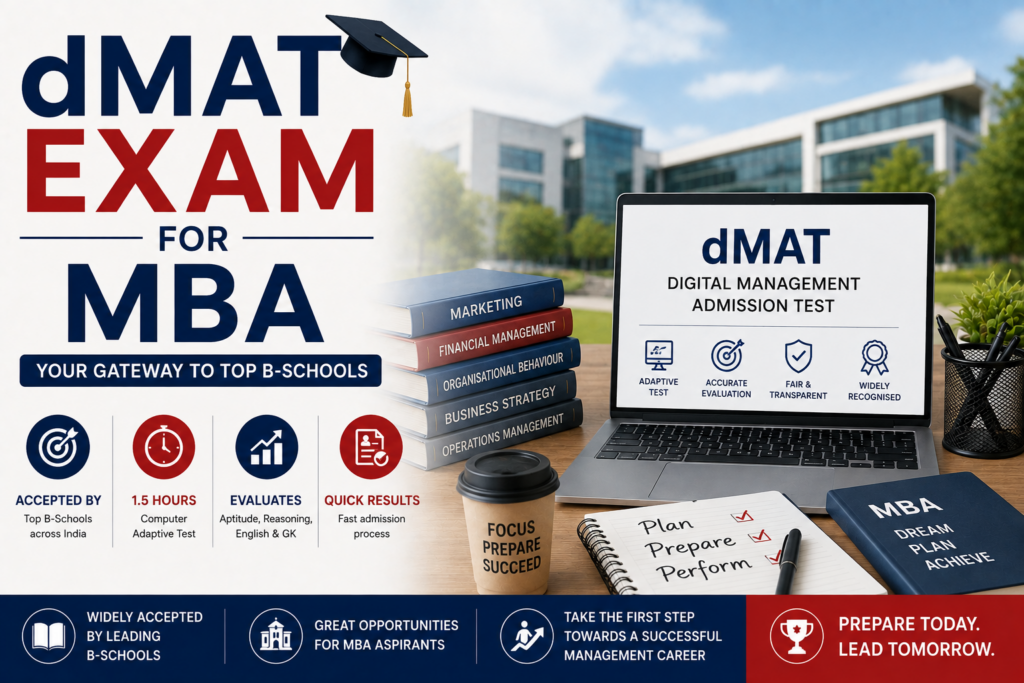
- dMAT exam for MBA applies to B.Com, BBA, and MBA graduates.
- Fee is Rs.16,350 (€150) at Rs.109/EUR, separate from your APS fee.
- Register by 15 September 2026; exam is on 26 September 2026.
- dMAT is an APS documentation requirement, not a GMAT replacement.
Does the dMAT Exam Apply to MBA Applicants?
Yes. The dMAT (Digital Master Test) affects Master’s applicants from three field groups confirmed by APS India: Engineering, Commerce/Accounting/Finance/Economics, and Business/Management. If your undergraduate degree sits in the second or third group, the dMAT exam for MBA, MSc Management, or MSc Finance is not optional once it applies to your intake.
This catches a lot of B.Com, BBA, and commerce graduates off guard, because the requirement is widely reported as an “engineering test” when it is not. Business and Commerce/Finance are firmly inside the affected fields, alongside Engineering. A search for dMAT exam for MBA Germany, dMAT for BBA, or dMAT for B.Com should all point you to the same answer: the field group, not the exact degree name, decides whether you are affected.

Choose your dream country
 UK
UK
 USA
USA
 Germany
 Australia
 Ireland
 Canada
 UAE
UAE
 France
 Sweden
 Italy
Italy
 Other
Other
When do you want to study abroad?
What's your highest level of education?
Have you completed Class 12th?
What was your Class 12 CGPA/percentage?
Are you a student or a parent/guardian?
What do you want to study?
Select your current city
How Leap will help you

Personalised University Shortlist

Express Applications with Quicker Admits

End-to-End Application Support
The requirement applies only to applications for the Summer Semester 2027 intake or later, and only if you registered for APS or shipped your documents on or after 29 June 2026. If you registered for APS or shipped your documents before that date, or if you already hold an APS certificate, you are exempt from that procedure.
Check the full dMAT exemption criteria if you think you may qualify. For the full eligibility and pattern breakdown, see the dMAT exam Germany guide.
Counselor insight: Students often assume that because their bachelor's is "Management" or "Technology" by name, the classification is automatic. It is not. APS India decides based on the exact degree title, branch, and specialization printed on your transcript, not the program's marketing name. If your degree looks borderline, such as Business Analytics or a dual B.Com/BBA, do not guess: confirm it against the official field list before you pay the fee.
Which Subject Module Do MBA and Commerce Applicants Select?
The dMAT has two parts: a Core Module (Figure Sequences, Mathematical Equations, Latin Squares), identical for every applicant, and a Subject Module. For the APS route, the Subject Module is the General Academic Module for everyone, drawing on quantitative reasoning, business and economic scenarios, and social science material applied to a general academic problem. If you were searching for a dMAT subject module for management as something distinct from the Core Module, the General Academic Module is the answer: it is the only subject module MBA and management applicants sit.
A separate set of named, field-specific modules (covering areas such as Physics, Chemistry, Computer Science and specific engineering disciplines) exists, but only for direct admission purposes at a small number of individual German universities. These are not part of the APS documentation process and do not include a business, commerce or finance option. If you are applying through the standard APS route as an MBA, B.Com, or BBA applicant, you do not need to choose between modules.
This module is the one Indian applicants targeting an MBA in Germany or a related management degree need to prepare for, alongside the shared Core Module.
If You Hold a Dual Degree
Dual-degree holders, for example, a joint B.Tech and BBA, don't choose a subject module either, since the module is the same for everyone. What the target German master's program decides instead is your field-group classification: whether the dMAT requirement applies to you at all. An engineering graduate applying to an MSc Management program is classified under the Business/Management field group based on the program they are applying to, not the bachelor's degree they hold. If your classification is unclear, check it against the official field list instead of assuming it based on your bachelor's degree.
dMAT vs GMAT for MBA: What’s the Difference?
This topic is where most MBA applicants get confused, and it is worth being direct about it. The dMAT exam for MBA and the GMAT are not the same requirement, and one does not replace the other.
| dMAT | GMAT | |
| Who requires it | APS India, for APS documentation | Individual German business schools, at their discretion |
| Applies to | Engineering, Business/Management, Commerce/Finance graduates from India | Anyone applying to a GMAT-requiring program |
| Tests | Reasoning and applied academic problem-solving | Quantitative, verbal, and data insights for business admission |
| Does a low score block you? | No, universities set their own weighting. | Often yes, against a program's cutoff |
| Replaces the other? | No | No |
If your target MBA program in Germany still asks for GMAT, clearing the dMAT does not exempt you from it. The two sit in different parts of your application: dMAT inside APS documentation and GMAT inside the business school's own admissions process.
For MBA programs that waive GMAT, see MBA in Germany without GMAT, which also flags where dMAT fits into that same timeline.
If your shortlist also includes GRE-accepting programs, dMAT vs GRE covers that comparison separately.
dMAT Exam Dates and Fee for the First India Cycle
The first India cycle runs on a compressed timeline, so MBA applicants targeting Summer Semester 2027 should treat these dates as fixed planning anchors.
| Milestone | Date |
| Registration opens | 29 June 2026 |
| Registration closes | 15 September 2026 |
| Exam date | 26 September 2026 |
| Results issued | 12 October 2026 |
| Fee | Rs.16,350 (€150) |
The Rs.16,350 figure uses a session rate of Rs.109/EUR; verify the live EUR to INR rate before you pay, since the fee is charged directly to g.a.s.t., the test administrator, via the official d-mat.de registration portal, in euros. This fee is separate from your APS certificate processing fee.
For a full fee breakdown, including what happens if you need to reschedule, see the dMAT exam fee guide.
See the dMAT exam dates guide for the full timeline against a typical Indian academic year.
Where dMAT Fits Inside Your APS Process
The dMAT certificate is one document inside your larger APS file, not a separate approval track. APS India verifies your academic documents as before; the dMAT result, once submitted, sits alongside that verification. You can generally submit your other APS documents before your dMAT certificate is ready, but APS India completes the certificate only after the dMAT result has been checked.
See exactly how APS and dMAT connect if you want the step-by-step sequencing.
For MBA applicants, this process means sequencing matters: your dMAT registration, exam, and result window should close before your APS submission deadline, not after. Read the APS Certificate Germany guide for the fees, documents, and timeline this process connects to.
Counselor insight: The tightest month on this calendar is September, because the dMAT registration deadline, the exam date, and several university application deadlines land close together. MBA applicants who wait until late August to check their eligibility often lose their preferred test centre slot, since booking is first-come, first-served.
How to Confirm Your Exact Eligibility
Do not rely on your degree's name alone. APS India's official reference is the dMAT_India_Affected_Fields_List.pdf, published on aps-india.de, and it is the final word if your degree sits in a grey area such as Business Analytics or Financial Technology. B.Com, BBA and MBA degrees fall clearly inside the Commerce/Accounting/Finance/Economics and Business/Management groups, so most commerce and management applicants will not need to dig into edge cases, but dual-major or interdisciplinary degrees should check before paying the fee.
How to Prepare for the dMAT as an MBA or Commerce Applicant
The dMAT does not have a chapter-wise syllabus to memorize. It tests applied reasoning, not recall, so preparation is about getting fast and accurate with the question formats rather than revising your degree content. The dMAT syllabus guide breaks the material down further if you want to see exactly what is and isn't tested.
- Practice the Core Module's three subtests: Figure Sequences, Mathematical Equations, and Latin Squares, all done without a calculator or notes. See the dMAT Core Module guide for scoring and practice.
- For the General Academic Module, work through applied business, economic, and general academic scenario questions, since these draw on quantitative reasoning and case-style inputs rather than memorized theory from your degree.
- Start 4 to 6 weeks before your test date and build in timed mock attempts once you understand each question type.
For a structured week-by-week plan, see how to prepare for the dMAT.
3 Takeaways on dMAT Exam for MBA
- If your degree is B.Com, BBA, or MBA and you are applying for Summer Semester 2027 or later, confirm your dMAT status against the official APS India field list before you register.
- If your degree is interdisciplinary or borderline, such as Business Analytics, Financial Technology, or a dual B.Tech/BBA, do not assume either way; check the exact classification against the official affected-fields PDF before you pay the fee.
- Register before 15 September 2026 for the 26 September 2026 exam, and remember the dMAT does not replace GMAT if your target business school still requires it.
Frequently Asked Questions About dMAT Exam for MBA
-
Is the dMAT exam mandatory for MBA applicants?
It is mandatory only if both conditions apply: your undergraduate degree falls in the Business/Management or Commerce/Accounting/Finance/Economics group, and your application targets the Summer Semester 2027 intake or later. It does not apply to Winter Semester 2026/27 applicants.
-
Is there any entrance exam for MBA, separate from dMAT?
Some German business schools set their own entrance requirements, including GMAT or an internal test, at the program's discretion. The dMAT is a separate APS documentation requirement and does not act as a university entrance exam by itself.
-
Is the entrance exam mandatory for MBAs in Germany overall?
It depends on the program, not a blanket rule. Public university MBAs usually expect GMAT, GRE, or an internal test. The dMAT is a separate, APS-level requirement layered on top of whatever entrance exam your chosen business school asks for.
-
What is the dMAT exam syllabus for MBA and commerce applicants?
There is no fixed syllabus. The Core Module tests general reasoning through the same three subtests for everyone. The General Academic Module, which every APS India applicant takes regardless of their field, tests applied business, economic, and general academic reasoning through scenario-based questions rather than memorised course content.
-
I have a dual degree. Which dMAT subject module should I choose?
You do not choose a subject module; everyone sits the same General Academic Module. What the target German master's program decides is your field-group classification, which determines whether the dMAT requirement applies to you at all. An engineering graduate applying to an MSc Management program is classified under Business/Management based on the program, not the bachelor's degree.
-
Does a low dMAT score affect my MBA admission in Germany?
A low dMAT score does not automatically block your APS certificate. Each German university independently decides how much weight, if any, to give the dMAT result in the admission process. See how dMAT scoring and results actually work if you want the full scale.
-
Where can I check if my exact degree is covered under dMAT for MBA and commerce fields?
Check the official dMAT_India_Affected_Fields_List.pdf published on aps-india.de. It lists the precise degree titles and specializations covered under each field group, and it is the authoritative source if your degree looks borderline.





Have Questions? Get Guidance to reach your Dream University
Connect with India's finest counsellors and biggest study abroad community.
Get Guidance