
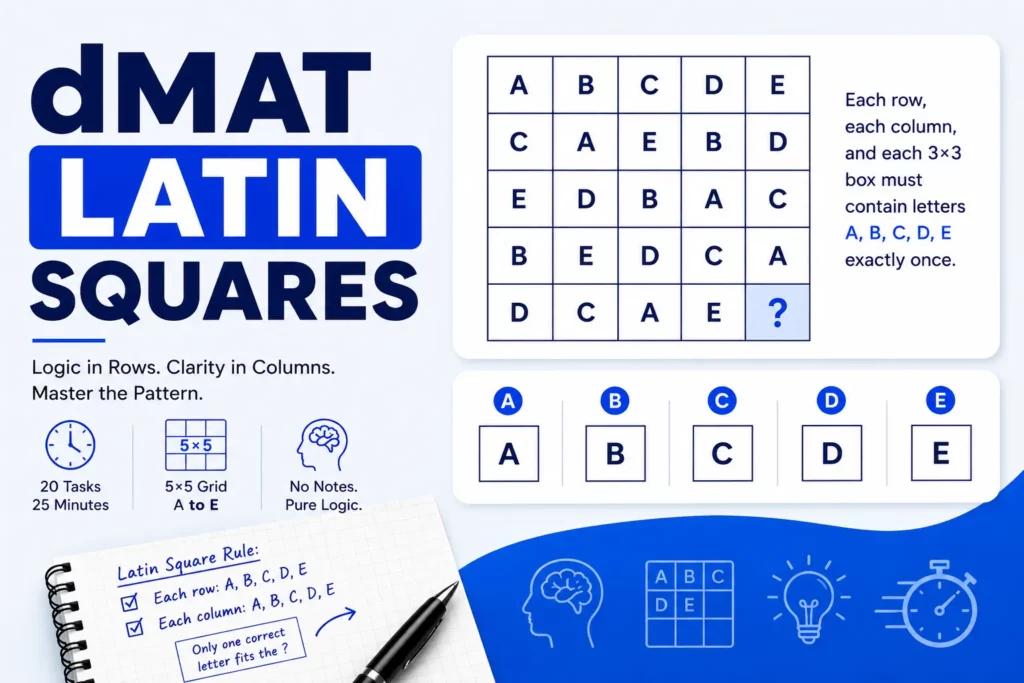
Quick Read
- 20 Latin Squares tasks, 25 minutes, 75 seconds each, no notes, rough paper, or pencil marks allowed
- 5×5 grids, letters A to E, each once per row and column, only the question-mark cell needs solving
- Every grid falls to a 2-pass method: read the cross for the fifth letter, or find the forced neighbour if two candidates remain
- Learn the method first, then attempt 15 free practice puzzles mentally before opening its solution path
Start the 15 Practice Puzzles ↓
What Are dMAT Latin Squares?
Latin Squares is the third and final subtest of the dMAT Core Module, after Figure Sequences and Mathematical Equations, and every candidate answers it, whatever their degree background. You see a 5×5 grid in which some fields already contain the letters A to E. Each letter may appear only once in every row and once in every column, and your task is to work out which letter belongs in the single field marked with a question mark. According to the official preparatory materials, you get 20 tasks in 25 minutes, which is 75 seconds per grid.
It looks like Sudoku, but the job is smaller: you never need to complete the grid, only the one marked cell.
After finishing this page, you should continue with the dMAT practice test hub, the dMAT Core Module explained guide, and the full dMAT exam pattern.
| Feature | Detail |
|---|---|
| Position in exam | The third subtest of the Core Module |
| Tasks | 20 |
| Time | 25 minutes (75 seconds per grid) |
| Grid | 5×5, letters A to E |
| What you solve | Only the question-mark field |
| Aids allowed | None. No notes, rough paper or pencil marks |
The Elimination Method for dMAT Latin Squares
Every dMAT Latin Squares grid falls to a two-pass method.
Pass 1: Read the cross. Look at the row and the column that meet at the question mark together. Count the letters already placed in both lines. If four different letters are visible across the cross, the fifth letter is your answer, and low-difficulty dMAT Latin Squares grids end here in seconds.
Pass 2: Find the forced neighbor. If the cross leaves two candidates, find the line where one of those candidates is blocked. A row or column missing only two letters, with one of them already sitting in a crossing line, forces a cell. Fill that cell mentally, return to the question mark, and the answer is now forced.
Hard grids simply chain more forced cells before the target opens, three or four hops instead of one.
The skill is holding those placements in your head, which is the same working-memory muscle you train in dMAT Mathematical Equations and the same no-notes discipline as dMAT Figure Sequences practice.
dMAT Latin Squares Practice Puzzles with Answers (Free)
There are no dMAT past papers, so format-accurate practice is the only realistic preparation. The 15 original dMAT Latin Squares puzzles below mirror the official preparatory materials: 5×5 grids, one question-mark field, and difficulty that scales with the number of inference steps. Every puzzle has been checked so that exactly one letter can legally fill the marked cell. Attempt each grid mentally, then open the solution path to compare your route.
Question 1 Low
Each letter A to E appears exactly once in every row and every column. Decide which letter belongs in the field with the question mark.
| A | B | ? | D | E |
- a) A
- b) C
- c) B
- d) D
✦View Solution PathHide Solution Path▼
Answer: b. Row 1 already contains A, B, D and E. The only letter missing from the row is C, so it must go in the question-mark field.
Question 2 Low
Each letter A to E appears exactly once in every row and every column. Decide which letter belongs in the field with the question mark.
| B | ||||
| C | ||||
| D | ||||
| ? | ||||
| A |
- a) A
- b) B
- c) E
- d) C
✦View Solution PathHide Solution Path▼
Answer: c. Column 2 already contains B, C, D and A. The only letter missing from the column is E.
Question 3 Low
Each letter A to E appears exactly once in every row and every column. Decide which letter belongs in the field with the question mark.
| E | A | B | C | ? |
- a) D
- b) A
- c) B
- d) C
✦View Solution PathHide Solution Path▼
Answer: a. Row 5 already contains E, A, B and C. The only letter missing is D.
Question 4 Low
Each letter A to E appears exactly once in every row and every column. Decide which letter belongs in the field with the question mark.
| A | ||||
| ? | ||||
| C | ||||
| D | ||||
| E |
- a) A
- b) C
- c) D
- d) B
✦View Solution PathHide Solution Path▼
Answer: d. Column 1 already contains A, C, D and E. The only letter missing from the column is B.
Question 5 Low
Each letter A to E appears exactly once in every row and every column. Decide which letter belongs in the field with the question mark.
| C | D | E | ? | B |
- a) B
- b) A
- c) C
- d) D
✦View Solution PathHide Solution Path▼
Answer: b. Row 3 already contains C, D, E and B. The only letter missing is A.
Question 6 Medium
Each letter A to E appears exactly once in every row and every column. Decide which letter belongs in the field with the question mark.
| B | ? | D | E | |
| A |
- a) C
- b) A
- c) B
- d) D
✦View Solution PathHide Solution Path▼
Answer: a. Row 2 is missing C and A, in columns 2 and 5. Column 2 already contains an A in row 5, so the question-mark field cannot be A. It must be C.
Question 7 Medium
Each letter A to E appears exactly once in every row and every column. Decide which letter belongs in the field with the question mark.
| C | ||||
| D | ||||
| ? | ||||
| E | ||||
| B |
- a) A
- b) B
- c) E
- d) C
✦View Solution PathHide Solution Path▼
Answer: c. Column 3 is missing E and A, in rows 3 and 4. Row 4 already contains an E, so row 4, column 3 must be A. That forces E into the question-mark field.
Question 8 Medium
Each letter A to E appears exactly once in every row and every column. Decide which letter belongs in the field with the question mark.
| A | B | C | ? | |
| D |
- a) A
- b) B
- c) C
- d) E
✦View Solution PathHide Solution Path▼
Answer: d. Row 1 is missing D and E, in columns 4 and 5. Column 5 already contains a D in row 5, so the question-mark field cannot be D. It must be E.
Question 9 Medium
Each letter A to E appears exactly once in every row and every column. Decide which letter belongs in the field with the question mark.
| D | ||||
| E | ||||
| A | ||||
| ? | ||||
| B |
- a) B
- b) A
- c) C
- d) D
✦View Solution PathHide Solution Path▼
Answer: a. Column 4 is missing B and C, in rows 4 and 5. Row 5 already contains a B, so row 5, column 4 must be C. That forces B into the question-mark field.
Question 10 Medium
Each letter A to E appears exactly once in every row and every column. Decide which letter belongs in the field with the question mark.
| D | ||||
| E | A | ? | C |
- a) A
- b) C
- c) B
- d) D
✦View Solution PathHide Solution Path▼
Answer: c. Row 5 is missing B and D, in columns 3 and 5. Column 3 already contains a D in row 2, so the question-mark field cannot be D. It must be B.
Question 11 High
Each letter A to E appears exactly once in every row and every column. Decide which letter belongs in the field with the question mark. You may need to fill another cell first.
| ? | B | C | ||
| C | ||||
| D | ||||
| E |
- a) B
- b) A
- c) C
- d) D
✦View Solution PathHide Solution Path▼
Answer: b. Column 1 is missing A and B, in rows 1 and 2. Row 1 already contains a B, so the question-mark field cannot be B. It must be A, and B goes to row 2.
Question 12 High
Each letter A to E appears exactly once in every row and every column. Decide which letter belongs in the field with the question mark. You may need to fill another cell first.
| E | ||||
| B | C | E | ? | |
| B | ||||
| A | C | |||
- a) B
- b) C
- c) D
- d) A
✦View Solution PathHide Solution Path▼
Answer: d. Row 2 is missing D and A, in columns 3 and 5. Column 3 already contains an A in row 4, so row 2, column 3 must be D. That forces A into the question-mark field.
Question 13 High
Each letter A to E appears exactly once in every row and every column. Decide which letter belongs in the field with the question mark. You may need to fill another cell first.
| D | ||||
| D | E | ? | C | |
| B |
- a) A
- b) B
- c) C
- d) D
✦View Solution PathHide Solution Path▼
Answer: a. Row 4 is missing A and B, in columns 3 and 4. Column 3 already contains a B in row 5, so the question-mark field cannot be B. It must be A, and B goes to column 4.
Question 14 High
Each letter A to E appears exactly once in every row and every column. Decide which letter belongs in the field with the question mark. You may need to fill another cell first.
| B | ||||
| C | ||||
| D | E | |||
| D | B | C | ||
| ? |
- a) B
- b) C
- c) A
- d) D
✦View Solution PathHide Solution Path▼
Answer: c. Column 2 is missing E and A, in rows 4 and 5. Row 4 is missing E and A too, in columns 2 and 3. Column 3 already contains an E in row 3, so row 4, column 3 must be A. Then row 4, column 2 is E, which forces A into the question-mark field.
Question 15 High
Each letter A to E appears exactly once in every row and every column. Decide which letter belongs in the field with the question mark. You may need to fill another cell first.
| D | E | |||
| E | ||||
| C | E | ? | ||
| B | ||||
| D |
- a) A
- b) B
- c) C
- d) D
✦View Solution PathHide Solution Path▼
Answer: b. Column 4 already contains D, E and B, so row 3, column 4 can only be A or C. Row 3 is missing D, A and B, so that field must be A. Row 3 is then missing D and B in columns 2 and 5, and column 5 already contains a D in row 5. The question-mark field must be B.
dMAT Latin Squares Study Plan Before 26 September 2026
The dMAT is on 26 September 2026, and registration closes on 15 September.
Check the dMAT exam dates and registration deadline, then work backwards with this dMAT Latin Squares plan:
| Weeks before test | Focus |
|---|---|
| 6 to 5 | Learn the two rules and Pass 1: low-difficulty grids untimed |
| 4 to 3 | Pass 2 drills; start 75-second pacing per grid |
| 2 | High-difficulty chained grids; name the forcing cell in every review |
| 1 | Two full-time 20-grid sets, once while tired; review stalls only |
| Test week | Five easy grids each morning; nothing new |
Frequently Asked Questions About dMAT Latin Squares
How many Latin Square tasks are in the dMAT?
The Core Module closes with 20 Latin Square tasks to be solved in 25 minutes, about 75 seconds per grid. It is the third of the three Core Module subtests, and every dMAT candidate answers it regardless of degree background or chosen subject module.
Is this the same as Sudoku?
The once-per-row-and-column logic is shared, but the format is not. dMAT grids are 5×5 with letters instead of digits; only one target cell is scored, answers are multiple choice, and no pencil marks are allowed. Speed on one marked cell matters more than completing anything.
Do I have to fill in the whole grid?
Only the question-mark field counts. Harder grids require you to work out one or more other cells mentally before the target becomes forced, but you never write them anywhere, and you never need the complete solution.
What makes a challenging grid hard?
The number of inference steps. A low-difficulty grid gives four letters in one line, so the fifth is immediate. A high-difficulty grid might need three or four forced cells resolve in sequence, all held in working memory, before the question-mark field opens.
Can I note down candidates while solving?
The dMAT permits no notes, rough paper, or annotation of any kind throughout the whole exam. Practicing with pencil marks builds a habit that fails on test day, so solve mentally from your first practice grid onwards.
What is the fastest solving method?
Read the cross first: the row and column meeting at the question mark. If four letters are visible, the fifth is the answer. If two candidates remain, find the line where one candidate is blocked, fill that forced cell mentally, and return to the target.
How fast should I be per grid?
Aim for under 30 seconds on one-step grids so that multi-step grids can take 90 to 120 seconds without wrecking your average. The section allows 75 seconds per task overall, and pacing unevenly by difficulty is precisely how strong scorers use it.
Do commerce and business students also face Latin Squares?
The Core Module is identical for every candidate, so commerce, finance, and business graduates taking the dMAT for APS purposes solve the same 20 grids as engineers. If you are unsure whether the exam applies to you, see how dMAT and APS certification fit together.








Have Questions? Get Guidance to reach your Dream University
Connect with India's finest counsellors and biggest study abroad community.
Get Guidance