
Quick Read
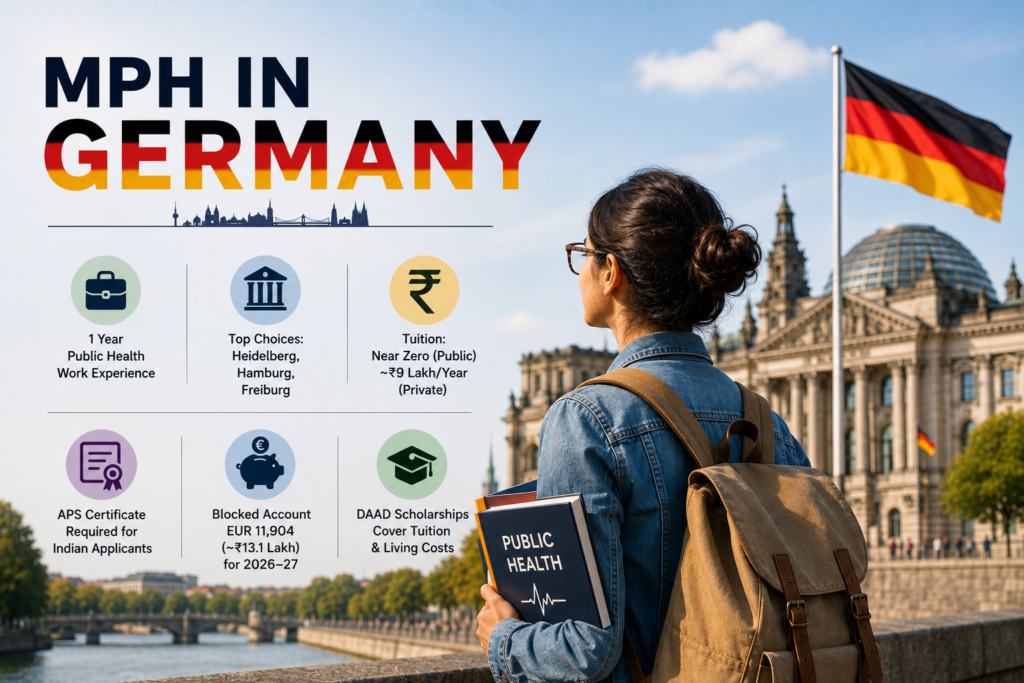
- Most MPH-type programs in Germany ask for one year of public health work experience.
- Heidelberg, Hamburg, and Freiburg run the main MPH-equivalent programs for international students.
- Tuition ranges from close to zero at LMU to about Rs.9 lakh a year at private universities.
- Indian applicants need an APS certificate before applying to most German universities.
- The 2026-27 blocked account requirement is EUR 11,904, close to Rs.13.1 lakh at today’s rate.
- DAAD funds public health-related scholarships that can cover tuition and living costs.
Top Universities Offering MPH in Germany
Germany’s public health options mostly come as an MPH, an MSc in International Health, or an MSc in Global Health, each with its own entry bar. Here is the list of top universities:
| University | City | QS World Rank 2027 | Program | Duration | Work Experience Needed |
|---|---|---|---|---|---|
| Heidelberg University | Heidelberg | #86 | MSc International Health | 1 year | Yes, 1 year in public health, low/middle income settings preferred |
| Hamburg University of Applied Sciences | Hamburg | Not QS-covered (applied sciences institution) | Master of Public Health (MPH) | 1.5 years | Yes, 1 year of public health or relevant research |
| University of Freiburg | Freiburg | Outside the global top 100 | MSc Global Urban Health | 1 year | Yes, professional experience in health |
| Technical University of Munich (TUM) | Munich | #25 | MSc Health Science: Prevention & Health Promotion | 2 years | Not formally required |
| LMU Munich | Munich | #61 | MSc International Health | 1 year | Recommended, not mandatory |
| University of Europe for Applied Sciences (private) | Iserlohn | Private, not QS-ranked | MSc International Public Health Management | 1-2 years | Not required |

Choose your dream country
 UK
UK
 USA
USA
 Germany
 Australia
 Ireland
 Canada
 UAE
UAE
 France
 Sweden
 Italy
Italy
 Other
Other
When do you want to study abroad?
What's your highest level of education?
Have you completed Class 12th?
What was your Class 12 CGPA/percentage?
Are you a student or a parent/guardian?
What do you want to study?
Select your current city
How Leap will help you

Personalised University Shortlist

Express Applications with Quicker Admits

End-to-End Application Support
Counselor insight: The most common mistake is shortlisting Heidelberg or Hamburg without the required one year of health sector experience, then getting rejected at the document stage instead of at interview. Without that experience, a private university or an open-entry MSc is a more realistic first target.
MPH Admission in Germany: Eligibility and Work Experience
MPH admission in Germany splits into two clear tracks, gated mainly by whether the programme demands prior work experience.
| Detail | Track 1: Experience-Gated | Track 2: Open Entry |
|---|---|---|
| Universities | Heidelberg, Hamburg, Freiburg | UE Germany, Arden University Berlin |
| Bachelor's requirement | Health-related field: medicine, nursing, public health, biology or similar | Any bachelor's; health or allied-health field preferred at Arden |
| Work experience | 1 year of relevant professional or research experience, required | Not required; treated as a bonus, not a gate |
| English score | IELTS 6.5 or TOEFL iBT 88-110 | IELTS 6.0 (Arden), B2 English (UE Germany) |
| GRE | Not required | Not required |
Hamburg's own admissions page states applicants need "proof of one year of professional experience in public health or qualified scientific work." Arden asks for a UK honors degree or equivalent at a second-class level in a clinical or allied health field.
MPH in Germany After MBBS, BDS, or BAMS
MPH in Germany after MBBS: with a year of clinical or public health experience, you are a strong fit for Heidelberg or Hamburg. Your degree covers the health-sciences requirement, and clinical or hospital administration experience usually satisfies the work-experience clause.
MPH in Germany after BDS: Your dental degree is accepted as a health-sciences qualification, but reviewers look closely at whether your experience touched public health or community dentistry rather than purely chair-side practice. If it's entirely clinical, an open-entry program is the safer first move.
MPH in Germany after BAMS: recognition is mixed. Some German universities accept AYUSH degrees as health-sciences qualifications; others don't classify them clearly. Email the admissions office directly before applying rather than assuming eligibility from a generic checklist.
Counselor insight: We have seen BAMS applicants rejected purely because the admissions team could not map their degree to Germany's health-sciences classification, not because the profile was weak. A short email before applying saves months.
Documents for MPH Germany Admission
| Document | Covers | India-Specific Detail |
|---|---|---|
| Academic transcripts | Marksheets from Class 10 | Original or notarised; some universities want uni-assist verification |
| APS Certificate | Verifies Indian credentials with the German Embassy | Mandatory since November 2022, it costs about Rs.18,000 (EUR 165) and takes 4-8 weeks |
| English proficiency | IELTS or TOEFL | 6.0-6.5 IELTS or 88-110 TOEFL depending on the program |
| Statement of purpose | Your fit for public health | Read closely on the experience-gated track to explain unclear job titles |
| Recommendation letters | Academic or professional references | 2-3, at least one from a workplace supervisor if experience-gated |
| Proof of work experience | Employer attestation | Must state duration and duties explicitly, not a generic relieving letter |
The APS certificate for Germany is the document that surprises most applicants, since it must be obtained before your university shortlist is even final. Processing runs four to eight weeks, and an incomplete submission is rejected outright, not corrected.
MPH Cost in Germany
MPH costs in Germany depend more on your city and university than on any single national average, since some public universities charge nothing and others charge a real fee.
1. Tuition Fees
| University | Tuition Fee (per year) |
|---|---|
| Heidelberg University | Rs.3,30,300 (EUR 3,000) |
| Hamburg University of Applied Sciences | Rs.5,28,480 (EUR 4,800) |
| University of Freiburg | Rs.3,30,300 (EUR 3,000), same Baden-Württemberg non-EU fee as Heidelberg |
| Technical University of Munich (TUM) | Rs.8.09 lakh to Rs.13.21 (EUR 8,000-12,000) for non-EU students since Winter 2024/25; some Master's programs are exempt, so confirm with TUM directly |
| LMU Munich | No tuition fee; semester contribution of roughly Rs.9,360 to Rs.16,500 (EUR 85-150) |
| University of Europe for Applied Sciences (private) | From Rs.8,98,196 (EUR 8,158) |
Sources: Heidelberg University program page; DAAD, HAW Hamburg program page; Study.eu, tuition fees in Germany; TUM tuition fees guide; LMU Munich, official fees and tuition page.
2. Cost of Living by City
| City | Monthly Cost, Excluding Rent | 1BR Rent Outside City Centre |
|---|---|---|
| Heidelberg | Rs.1,13,381 (EUR 1,029.8) | Rs.96,313 (EUR 874.78) |
| Hamburg | Rs.77,070 to Rs.99,090 (EUR 700-900) for rent, food and other expenses combined | Included in the range above |
| Berlin | Rs.1,16,794 (EUR 1,060.8) | Rs.1,04,859 (EUR 952.40) |
Sources: Numbeo, Cost of Living in Heidelberg, April 2026; DAAD, HAW Hamburg program page; Numbeo, Cost of Living in Berlin, July 2026.
Add the blocked account every Indian student needs regardless of city: EUR 11,904 a year for 2026-27 (about Rs.13,10,630), released at EUR 992 a month once you arrive. It is your own money, refunded if the visa is denied, but it must go through a recognized provider like Expatrio or Fintiba, not a regular Indian bank. Sharing a flat (a WG, in German) typically cuts the rent portion by close to half compared with living alone.
For a complete breakdown of city-wise expenses, see our guide on the cost of living in Germany for Indian students.
Counselor insight: Students consistently underbudget health insurance. It runs EUR 80-160 a month and is mandatory for both visa and enrollment, not optional.
3. Scholarships
| Scholarship | Type | Amount |
|---|---|---|
| DAAD Scholarships | Merit-based, full or partial | Varies by programme; can cover tuition and living costs |
| Deutschlandstipendium | Merit-based, across German universities | EUR 300 a month (about Rs.33,030) |
| Heidelberg MScIH DAAD-EPOS Scholarship | Programme-specific, administered through Heidelberg's Institute of Global Health, for applicants from or working in low- and middle-income countries | Covers tuition, stipend and living costs; requires 1 year of relevant LMIC work experience and IELTS 6.5 |
| LMU Munich Study Scholarship | University-administered, funded by the State of Bavaria, based on academic merit and demonstrated financial need | Up to EUR 650 a month (about Rs.71,565) for up to 10 months |
Note: Heidelberg itself does not fund the MScIH directly; the DAAD-EPOS route above is administered through its Institute of Global Health, but the money comes from DAAD, so budget accordingly rather than assuming it is a Heidelberg-funded scholarship. Neither of the first two scholarships guarantees funding for a specific program covered in this guide, so check each university's own scholarship page as well.
MPH in Germany Application Timeline for the Indian Academic Year
| Month | What to do? |
|---|---|
| Feb-March | Finalise shortlist, request transcripts, start APS process |
| April-May | Final-year exams: submit APS if not already done |
| June-July | Clear IELTS/TOEFL; finalise SOP and recommendations |
| August | Submit applications; most deadlines fall mid-July to September |
| September | Admission decisions; open blocked account; book visa appointment |
| October | The winter semester begins |
Hamburg's own windows run from 1 June to 30 September for an April start and 1 December to 31 March for an October start, so for the more common winter intake, your application period effectively opens in December of the previous year.
Check our winter intake in Germany guide for exact deadlines across more universities.
Visa and Blocked Account for MPH in Germany
- The German student visa process needs your APS certificate, blocked account confirmation, proof of health insurance, and accommodation details, submitted together once you have an admission letter.
- Visa processing at Indian consulates has generally taken 6 to 12 weeks through 2026, so build in a buffer rather than applying at the last moment.
- The blocked account (Sperrkonto) requirement for 2026-27 is EUR 11,904 a year, released at EUR 992 a month once you land in Germany.
- The blocked account must be opened through a recognized provider such as Expatrio or Fintiba, not a regular Indian bank.
- The full amount is refunded if your visa application is ultimately denied.
See our guide on how to get a Germany study visa for the complete document checklist.
What to Do If Your MPH Germany Application Goes Wrong?
Delayed results
Contact APS India for a provisional slot hold rather than submitting an incomplete file.
Low IELTS/TOEFL score
Most universities allow one retake, but check whether your specific program accepts a conditional offer pending it.
Visa refused
The usual reasons are an underfunded blocked account, incomplete APS documentation, or a motivation letter that does not connect your background to the program. Address the specific reason cited before reapplying rather than resubmitting the same file.
Missed the winter deadline
Hamburg's MPH and a few others also run a summer intake, so October is not your only shot.
Jobs After MPH in Germany and What They Pay
MPH jobs in Germany lean toward health policy, epidemiology, hospital administration, and international health organizations, backed by institutions like the Robert Koch Institute. These are broad market averages, not guaranteed offers, and salary after MPH in Germany depends heavily on sector and city.
| Role | Average Salary (EUR/year) | Average Salary (INR/year) |
|---|---|---|
| Public Health Advisor | EUR 55,500 | Rs.61,10,550 |
| Epidemiologist | EUR 60,000 | Rs.66,06,000 |
| Health Policy Analyst | EUR 64,000 | Rs.70,46,400 |
Sources: Bundesagentur für Arbeit Entgeltatlas and Stepstone Gehaltsreport 2026. Figures represent a median gross salary across experience levels.
Non-EU graduates get an 18-month post-study job-seeker visa to find work tied to their degree, after which an EU Blue Card or standard work permit takes over. See LeapScholar's post-study work visa in Germany guide for the full process.
Counselor insight: The salary ranges above are real, but public health hiring in Germany moves differently from tech hiring; most roles at the RKI, state health departments, and international NGOs come through sector networks, not job boards. An MPH graduate who built supervisor relationships during their degree and attended public health conferences in Germany typically converts the 18-month job seeker visa in under 9 months. One who treats it as a passive waiting period often runs close to the limit. German B2 before graduation is not required for most programs, but it is a practical prerequisite for most public-sector health roles.
3 Key Takeaways on MPH in Germany
- Check your eligibility track before you shortlist: The gap between Heidelberg's experience-gated MSc and a private university's open-entry MPH is wider than most comparisons suggest, so check whether your degree and work experience meet the requirements for that specific program.
- Budget with one consistent set of numbers: Tuition is often the smallest line item once the blocked account and living costs are added, so use the same exchange rate and the same year's figures throughout your planning rather than mixing sources.
- Start your APS certificate three to five months before your intended intake: It is the one document that moves at its pace no matter how fast the rest of your file comes together, and a delay here can cost you an entire admission cycle.
Verified by: LeapScholar's Germany counseling team, with hands-on experience guiding Indian students through public health and health sciences admissions to German universities.
Have questions about your MPH in Germany application? Book a free session with a LeapScholar Germany counselor.
Frequently Asked Questions About MPH in Germany
-
Is Germany a strong choice for an MPH?
It depends on what you're optimizing for. If you have a health-sciences background and want a low-cost, research-heavy program, Germany delivers that well. If you're hoping to browse dozens of specializations the way you can in the US or UK, you'll find the shelf much shorter here; Germany runs a handful of strong options, not a catalog.
-
What is the salary after MPH in Germany?
Public Health Advisors, Epidemiologists and Policy Analysts earn between EUR 55,500 and EUR 64,000 a year, which works out to roughly Rs. 61-70 lakh. Treat that as a ballpark, not a promise; your actual number will move a fair bit depending on whether you land in the public sector, a private hospital group, or an NGO.
-
Do I need work experience for an MPH in Germany?
For Heidelberg, Hamburg, and Freiburg, yes, a full year of it, and they check the details carefully. If you're straight out of your bachelor's with no relevant experience yet, look at the private universities or an open-entry M.Sc. instead of waiting a year to reapply.
-
Is the GRE required for an MPH in Germany?
No, and this misconception trips up a lot of applicants who assume every public health master's abroad works like the US system. None of the programs covered here ask for it.
-
What is the difference between MPH and MSc International Health in Germany?
On paper, both lead to a public health career. In practice, "MSc International Health" or "Global Health" usually means a research-heavy curriculum built around low- and middle-income country contexts, while "Master of Public Health" tends to be the more applied, practice-facing version. Don't shortlist by title alone; pull up the actual module list before you decide.
-
How much does MPH in Germany cost with living expenses?
LMU charges nothing beyond a small semester fee, UE Germany runs about EUR 8,158 a year (Rs.8,98,196), and TUM can go up to EUR 12,000 a year for non-EU students depending on the program. On top of whichever tuition figure applies to you, budget EUR 700 to EUR 1,060 a month for living costs, plus the EUR 11,904 (Rs.13,10,630) blocked account your visa depends on.
-
What happens if my German student visa is rejected?
You're allowed to reapply, but read your refusal letter properly first. Most rejections trace back to an underfunded blocked account, a gap in the APS paperwork, or a motivation letter that doesn't clearly connect your background to the program. Fix that specific issue rather than sending the same file back a second time.
-
Are there scholarships for MPH in Germany for Indian students?
Yes, DAAD is the main one, funded on merit and open to Indian applicants, and Deutschlandstipendium adds EUR 300 a month on top for those who qualify. Neither one is a given for every program in this guide, though, so it's worth checking each university's own funding page as a backup.
-
Is the dMAT required for an MPH in Germany?
No. The Digital Master Test only applies to Indian applicants coming from an Engineering, Commerce, Accounting, Finance, Economics, Business or Management background, and every core MPH program here, Heidelberg, Hamburg, and Freiburg, admits from a health sciences degree instead. The one exception is UE Germany's MSc in International Public Health Management, which requires a business-related bachelor's degree; therefore, applicants should confirm their dMAT status with APS India before applying.
-
Is it worth studying a master's in Germany compared to other countries?
Ultimately, it depends on whether you value cost or choice more. Germany wins on tuition and on the strength of its healthcare system. It loses if what you actually want is a wide menu of niche public health specializations, since the US and UK still offer more of those.









Have Questions? Get Guidance to reach your Dream University
Connect with India's finest counsellors and biggest study abroad community.
Get Guidance