
Quick Read
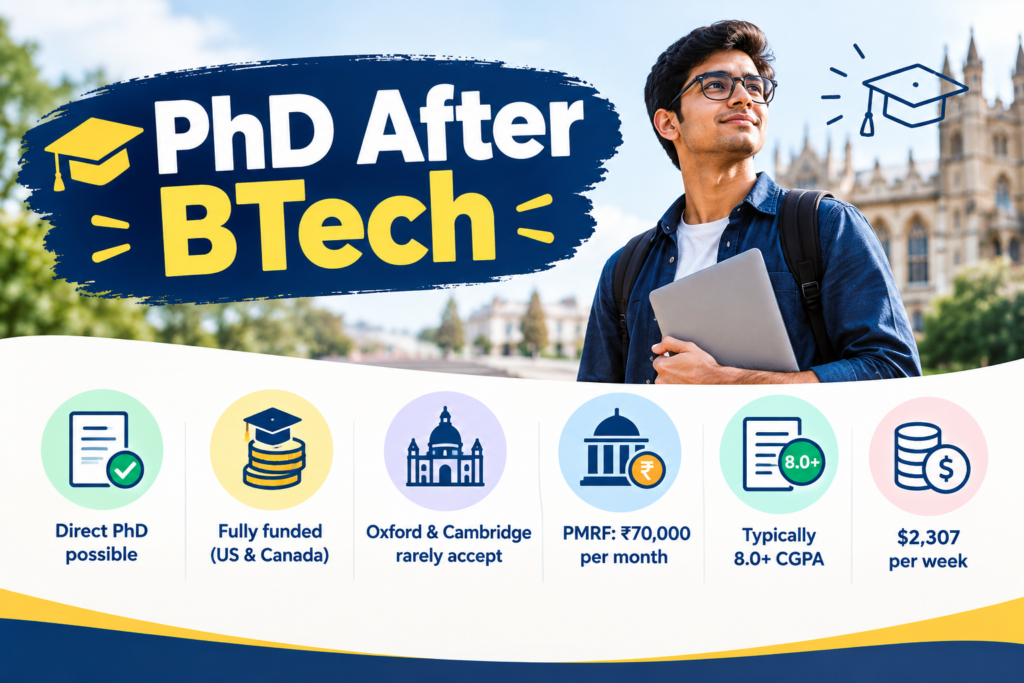
- Students can do a PhD after BTech with no Master’s degree in between.
- In the US and Canada, a PhD after BTech is typically fully funded.
- Oxford and Cambridge rarely accept direct entry without a Master’s.
- India’s PMRF scheme pays Rs. 70,000 a month to top BTech graduates entering a PhD directly.
- Most direct PhD programmes expect a CGPA of 8.0/10 or higher.
- Doctoral degree holders in the US earn a median of $2,307 a week.
Can You Do a PhD After BTech?
Yes. You can go straight from a BTech into a PhD without doing a Master’s first. This isn’t a loophole or a rare exception; it’s a standard admissions route in several countries.
The US and Canada treat it as completely normal. Most competitive UK universities don’t; they generally still expect a Master’s first. That single difference decides where you should actually apply.

Choose your dream country
 UK
UK
 USA
USA
 Germany
 Australia
 Ireland
 Canada
 UAE
UAE
 France
 Sweden
 Italy
Italy
 Other
Other
When do you want to study abroad?
What's your highest level of education?
Have you completed Class 12th?
What was your Class 12 CGPA/percentage?
Are you a student or a parent/guardian?
What do you want to study?
Select your current city
How Leap will help you

Personalised University Shortlist

Express Applications with Quicker Admits

End-to-End Application Support
Top Countries Abroad Providing PhD After BTech to Indian Students
Not every country treats direct entry the same way, and some are far more open to it than others. Here's where Indian BTech graduates actually get admitted without a Master's, and what each country is known for.
| Country | Known For | Universities Known for Direct-Entry PhDs |
|---|---|---|
| USA | The most established direct-entry system, no Master's needed for most STEM PhDs | MIT, Stanford, UC Berkeley, Caltech |
| Canada | Research-driven admission, strong for engineering and computer science | University of Toronto, UBC, McGill |
| Germany | Low or no tuition, structured PhD programmes tied to research institutes | TU Munich, RWTH Aachen, Max Planck Institutes |
| UK | Selective and less automatic than the US; competitive scholarships needed | Imperial College London and UCL are more open to direct entry than Oxford or Cambridge |
| Australia | Growing acceptance of direct entry, strong funding via the Research Training Program | University of Melbourne, ANU, UNSW |
For a complete country-by-country breakdown, our guide on how to study a PhD abroad covers the full picture.
Is a PhD After BTech Abroad Actually Funded?
This is the one thing to get right before you apply anywhere. In the US and Canada, a PhD is a paid position, not a fee you cover. In the UK, funding is something you have to win, not something you're handed by default. Here's how it actually breaks down by country.
| Country | Funded by Default? | Typical Stipend |
|---|---|---|
| USA | Yes, for most STEM PhDs | $25,000-$45,000/year (Rs. 23.6 lakh-Rs. 42.5 lakh) |
| Canada | Yes, competitive but standard | Similar structure to the US |
| Germany | Mostly, low or no tuition either way | Modest stipend via a university or research institute position |
| UK | No, you need to win a scholarship | UKRI studentships pay £21,805/year (Rs. 27.8 lakh) where awarded |
| India | Yes, via institute fellowship or PMRF | Rs. 37,000-70,000/month depending on scheme |
Source: UKRI stipend guidance
My insight: Oxford and Cambridge rarely admit straight from a BTech with funding attached; most departments still want a Master's first. When a student asks whether they can do a PhD after BTech at either university, funding is the real question, not admission.
Eligibility for a Direct PhD After BTech
Universities look at broadly the same things everywhere, though the exact bar shifts by country.
| Requirement | India | Abroad (US, Canada, Europe) |
|---|---|---|
| Academic score | CGPA 8.0/10 or higher | CGPA 7.5-8.0/10 or strong equivalent |
| Entrance exam | GATE, or UGC NET/CSIR NET for science fields | GRE, increasingly optional |
| English proficiency | Not usually required | IELTS 6.5+ or TOEFL 90+ |
| Research proposal/SOP | Often required | Almost always required |
| Letters of recommendation | 2-3 | 2-3 |
Documents Required
| Document | Notes |
|---|---|
| Academic transcripts | BTech and Class 10/12 mark sheets |
| Entrance exam scores | GATE, UGC/CSIR NET, or GRE depending on destination |
| Statement of Purpose | Explains your research interest and fit with the department |
| Letters of recommendation | Usually 2-3, from professors or research supervisors |
| CV/Resume | Academic projects, publications, internships |
| English proficiency scores | IELTS or TOEFL, for most programmes abroad |
| Research proposal | Required by most PhD-specific applications |
My insight: Students often gather every document except the research proposal, then rush it in the last week. Committees can tell. Start the proposal early, even a rough draft, since it usually needs several rounds of feedback from a mentor before it's ready.
PMRF and IIT Schemes: Direct PhD After BTech in India
India has three real routes into a direct PhD after BTech, and they're funded quite differently.
| Scheme | Who Qualifies | Funding |
|---|---|---|
| PMRF (Prime Minister's Research Fellowship) | Exceptional BTech graduates from IITs, NITs, IIITs, IISc | Rs. 70,000/month plus Rs. 2 lakh annual research grant |
| Institute JRF/SRF fellowship | Regular PhD admits with a valid GATE score | Rs. 37,000/month (JRF), rising to Rs. 42,000/month (SRF) |
| Visvesvaraya PhD Scheme | BTech/BE graduates in Electronics/IT fields at eligible institutes | Government-funded stipend, GATE often optional |
PMRF isn't something you apply to on its own. You first get admitted to a regular PhD programme, and the institute then nominates top candidates based on academic record and research potential. Don't treat PMRF as your admission plan, treat it as a possible outcome once you're already in.
Can I Do a PhD After BTech and MBA?
This question comes up a lot from BTech graduates who did an MBA afterward and assume a PhD isn't relevant anymore. It is, and it's a genuinely well-worn path in one specific direction.
- IIM Fellow Programmes (FPM), India's equivalent of a PhD in Management, admit BTech graduates directly through CAT scores; no MBA is required first.
- If you already have an MBA, that background is treated as an asset, not a detour, since it signals both technical grounding and business context.
- Outside India, PhD in Management programmes at business schools take a similar view: an engineering plus business profile suits research in technology management, operations, and analytics.
- Some IIMs also run Executive FPM tracks that specifically accept Executive MBA holders and professionals with relevant work experience.
Source: IIM Common Admission Test (CAT) official site
My insight: Students with a BTech and MBA sometimes worry the combination looks unfocused on paper. In management research, however, the opposite is true. It signals you can bridge technical and business thinking, which is precisely what most FPM selection committees are looking for.
Planning Calendar for the Upcoming Intake
Most PhD programmes admit students once or twice a year, and the Fall intake is by far the most popular for BTech graduates targeting the US, Canada, or a direct-entry Indian programme.
| Country | Main Intake |
|---|---|
| USA | Fall (August-September), some Spring intake in January |
| Canada | Fall (September), Winter and Summer intakes vary by university |
| UK | Rolling admissions, October to January is typical |
| India | January (Spring session) and July (Monsoon session) |
My insight: For a Fall 2027 start, most US and Canadian applications close between November 2026 and January 2027, well before the actual intake month. Start your documents at least six months ahead of your target deadline, not six weeks.
How to Apply for a Direct PhD After BTech
- Start by shortlisting programmes, and where you can, find a supervisor whose work actually overlaps with what you want to research.
- Figure out which exam the country actually wants, GATE, UGC/CSIR NET, or GRE, before you plan your prep schedule around the wrong one.
- Your SOP takes longer to get right than you'd expect, and so do your recommenders. Start both earlier than feels necessary.
- Pull together everything at once: transcripts, test scores, CV, English scores, and a research proposal, not just the parts you already have ready.
- Submit ahead of the deadline, not on it, since application portals have a habit of crashing in the final 48 hours.
- If there's an interview or a written test, treat it as the real decision point, because for a lot of programmes, it is.
- Get the funding in writing before you say yes to anything. "It's usually funded" from an admissions email is not the same as a funding letter.
Career Outcomes After a Direct PhD
A PhD after BTech pays off in specific ways: it opens research and academic roles that a BTech or even an MTech alone doesn't qualify you for, and it tends to command a real premium in data-heavy and research-driven industry roles too. Here's how that plays out by role.
| Role | India (Annual) | USA (Annual) |
|---|---|---|
| University Professor | Rs. 8-15 lakh | $95,000-$110,000 (Rs. 89.77 lakh-Rs. 103.94 lakh) |
| Data Scientist | Rs. 10-18 lakh | $115,000-$135,000 (Rs. 108.66 lakh-Rs. 127.56 lakh) |
| Research Scientist | Rs. 8-16 lakh | $100,000-$120,000 (Rs. 94.49 lakh-Rs. 113.39 lakh) |
| Postdoctoral Researcher | Rs. 7-9 lakh | $65,000-$78,000 (Rs. 61.42 lakh-Rs. 73.70 lakh) |
Source: BLS CPS Table 37b, 2025 annual averages.
Note: Median weekly earnings for all doctoral degree holders (both sexes) were $2,307 in 2025, ahead of every education level except professional degrees; the male-only breakout in the same table is $2,520, and the female-only breakout is $2,126.
My insight: Most students assume income jumps the day they finish their PhD. It doesn't, not right away. The postdoc stretch right after tends to be tighter financially than the PhD stipend itself, so budget for that gap instead of getting blindsided by it.
Decision Framework: Should You Skip the Master’s?
If you're set on a research career with a strong CGPA and some research exposure: A direct PhD after BTech in the US or Canada is the more efficient route, and it's fully funded.
If your CGPA or research background is thin: An MTech or Master's first gives you time to build the profile direct-entry programmes actually screen for, rather than applying and getting rejected across the board.
If you're drawn to the UK specifically: Go expecting to need either a Master's first or an exceptional undergraduate record plus a scholarship, not a guaranteed funded seat.
3 Takeaways on PhD After BTech
- A direct PhD after BTech is real and common in the US and Canada, where it's typically fully funded, but far less automatic in the UK, where you need to win a scholarship.
- India's PMRF and Visvesvaraya schemes make direct entry genuinely accessible for strong BTech graduates from IITs, NITs, and IIITs.
- A PhD after BTech and MBA is a legitimate, even favoured, combination for management research routes like IIM Fellow Programmes.
Verified by: LeapScholar's PhD and research counseling team, with hands-on experience guiding BTech graduates through direct-entry applications and funding decisions.
Have questions about applying for a PhD straight after BTech? Book a free session with a LeapScholar counselor.
Frequently Asked Questions About PhD After BTech
-
Can I really do a PhD right after BTech, with no Master's at all?
Yes. It's well-established in the US, Canada, and through direct-entry schemes at IITs in India. It's less automatic in the UK, where a Master's is still the more common bridge. If you're asking can I do a PhD after BTech specifically for a UK department? Check their current admission criteria directly rather than assuming the US rule applies everywhere.
-
Is it expensive to do a PhD after BTech abroad?
Not usually, for STEM PhDs in the US and Canada, it's typically fully funded with a tuition waiver and stipend. The UK is the exception where you need to win a scholarship rather than assume one comes with the offer.
-
What CGPA do I actually need?
Most competitive programmes expect 8.0/10 or higher, though some institutes accept 7.0-7.5/10 alongside strong research experience.
-
Do I need GATE for a PhD after BTech in India?
At most IITs and NITs, yes, though some schemes accept UGC NET or CSIR NET for science fields, and a few institute-specific routes waive it for exceptional candidates.
-
Is GRE still required?
Increasingly optional. Many US departments dropped it after 2020, though some competitive programmes still consider a score if you submit one.
-
Can I do a PhD after BTech and MBA?
Yes, and it's genuinely a strength rather than an odd combination for PhD in Management or IIM Fellow Programmes, where a technical plus business background is exactly what these programmes look for.
-
Do I need research experience before applying?
It's not always mandatory, but it matters. One solid undergraduate project or a published paper can make a big difference compared to an application based only on grades.
-
What is PMRF, and can I apply for it separately?
PMRF is India's flagship fellowship for exceptional BTech graduates entering a PhD directly, paying Rs. 70,000/month plus a Rs. 2 lakh annual grant. You can't apply to it on its own; you get admitted to a regular PhD programme first and are then nominated.








Have Questions? Get Guidance to reach your Dream University
Connect with India's finest counsellors and biggest study abroad community.
Get Guidance