
Quick Read
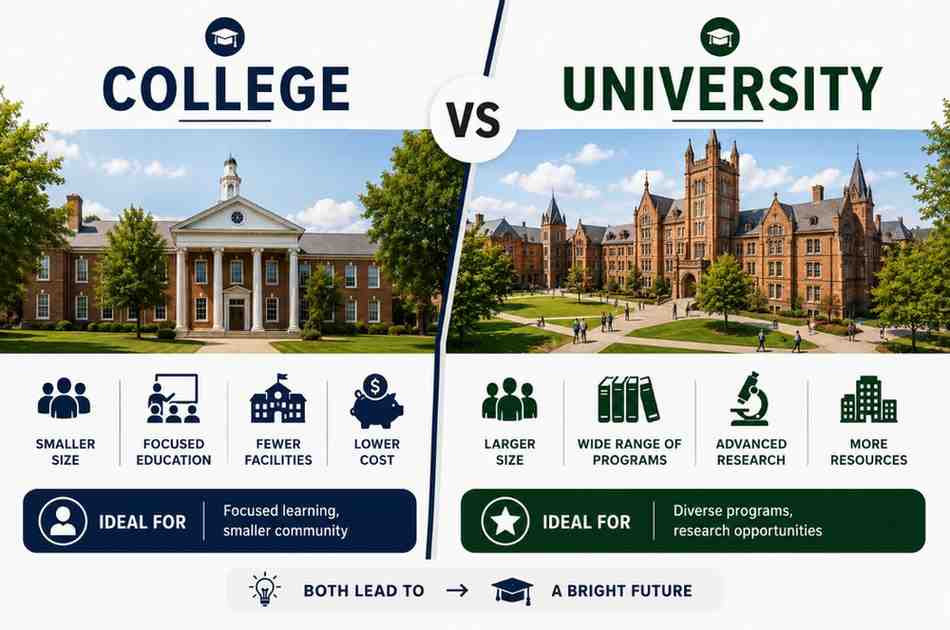
- In India, universities award degrees directly; colleges are affiliated to a university and don’t award their own degree.
- UGC recognises universities under the UGC Act, 1956; AICTE approves technical institutes and colleges under the AICTE Act, 1987.
- Autonomous colleges design their own curriculum but the degree is still awarded through a parent university.
- Deemed-to-be universities can award degrees independently, the same as a full-fledged university.
- Abroad, especially in the US and UK, “college” and “university” follow different legal rules than in India.
- Checking UGC 2(f) and 12(B) or AICTE approval status matters more for your degree’s value than the institution’s name.
What Is the Real Difference Between a College and a University in India?
A university is established by an Act of Parliament (central university) or a State Legislature (state university) or declared a deemed-to-be university by the central government. It has the legal authority to design its own courses, hold examinations, and award its degrees.
A college does not have this authority on its own. Most colleges in India are affiliated colleges: they run under the academic umbrella of a parent university, follow that university’s syllabus and exam pattern, and the degree certificate a student eventually receives carries the university’s name, not the college’s. St. Stephen’s College, for example, is affiliated to the University of Delhi, and its graduates receive a University of Delhi degree.

Choose your dream country
 UK
UK
 USA
USA
 Germany
 Australia
 Ireland
 Canada
 UAE
UAE
 France
 Sweden
 Italy
Italy
 Other
Other
When do you want to study abroad?
What's your highest level of education?
Have you completed Class 12th?
What was your Class 12 CGPA/percentage?
Are you a student or a parent/guardian?
What do you want to study?
Select your current city
How Leap will help you

Personalised University Shortlist

Express Applications with Quicker Admits

End-to-End Application Support
According to the UGC's official FAQ on universities and colleges, both universities and institutions deemed to be universities are degree-granting bodies, but they're established through different routes: universities through a Central or State Act under Section 2(f) of the UGC Act and deemed universities through a government notification under Section 3 of the same act.
In short: "University" is a legal status tied to degree-awarding power. "College" usually means an institution that teaches but borrows its degree-awarding authority from a university.
University vs College vs Institute: Where UGC and AICTE Fit In
Indian students often add a third term to this confusion: institute. Here's how the three are actually regulated.
| Term | Regulator | Can it award its own degree? | Typical examples |
|---|---|---|---|
| University | UGC, under the UGC Act, 1956 | Yes, always | Central, state, and private universities |
| College | UGC (for recognition) + affiliating university | No, unless autonomous or deemed status is granted | Most undergraduate arts, science, commerce colleges |
| Institute (technical) | AICTE, under the AICTE Act, 1987 | Only if it also holds deemed-to-be-university or autonomous status | Engineering, management, pharmacy, architecture colleges |
AICTE doesn't award degrees itself. It approves the institution to run a technical program (engineering, management, pharmacy, architecture, and applied arts) and sets intake, faculty, and infrastructure norms. The degree still comes from whichever university the institute is affiliated with, unless it has AICTE approval as a deemed university.
Counselor insight: Students frequently assume "AICTE-approved" means the same thing as "UGC-recognized." They don't overlap. AICTE approval confirms a technical program meets baseline infrastructure and faculty norms for the current academic cycle; it says nothing about who legally awards the degree. Always check both the AICTE approval and the degree-awarding authority when a technical course is involved.
Related reading: If you're also weighing a diploma against a full degree at this stage, see Diploma vs Degree in India.
Comparison Table: College vs University vs Institute in India
| Factor | University | Affiliated College | Autonomous College | Deemed University |
|---|---|---|---|---|
| Awards its own degree | Yes | No (degree from parent university) | No (degree from parent university, curriculum is self-designed) | Yes |
| Regulator | UGC / state act | UGC + affiliating university | UGC (autonomy granted under UGC Autonomous Colleges Regulations) | UGC, under Section 3 of the UGC Act |
| Curriculum control | Full | Follows university syllabus | Designs its own syllabus | Full |
| Typical programs offered | UG, PG, PhD, research | Mostly UG, some PG | UG, some PG | UG, PG, PhD |
| Research focus | High | Low to moderate | Moderate | Moderate to high |
| Example | University of Delhi | St. Stephen's College (affiliated to DU) | Loyola College, Chennai (autonomous) | BITS Pilani, VIT (deemed) |
Deemed Universities and Autonomous Colleges: What Changes for Your Degree
These two terms are where most of the real confusion sits, because both sound like a step up from a "regular" college, but they change different things.
Deemed-to-be university. Declared by the central government under Section 3 of the UGC Act, on the UGC's recommendation. A deemed university has the same degree-awarding power as any other university, sets its own admission process and fees, and is not affiliated to anyone. Per UGC's own FAQ, if an institution is upgraded to deemed status, students already enrolled can choose to receive their degree from the original affiliating university or the new deemed university, so no one is forced into a change mid-course.
Autonomous college. An autonomous college is still affiliated with a parent university for the purpose of awarding the final degree, but it is granted autonomy (usually under the UGC's Autonomous Colleges scheme) to design its own curriculum, conduct its own internal exams, and update courses faster than the affiliating university's standard syllabus. The degree certificate still names the parent university.
If recognition is withdrawn: UGC's Institutions Deemed to be Universities Regulations, 2023, lay out grounds on which deemed status can be reviewed or revoked. If such an event happens mid-course, UGC's own FAQ framework (used for affiliation changes generally) indicates enrolled students retain the right to complete their degree either under the outgoing arrangement or transition to a new one rather than losing their credits outright. Always confirm the current status directly with the institution and UGC if you hear of a review in progress.
If You’re an Indian Student, Which Should You Choose: College or University?
If you are a Class 12 student choosing between a well-known affiliated college and a lesser-known standalone university: The degree value from a strong affiliated college (say, a top Delhi University or Mumbai University college) is usually higher in employer and peer recognition than a degree from an obscure private university, even though the university technically has "more" legal standing. Check the university's NIRF ranking and NAAC grade, not just its UGC status, before deciding.
If you are a working professional considering a distance or online degree: Confirm the university is UGC-approved specifically for online or distance mode programs. A university can be fully recognized for regular on-campus courses and still not be approved to offer a particular course online. This step is a separate check.
If you are choosing between an AICTE-approved technical institute (diploma or certificate route) and a university engineering degree: A diploma from an AICTE-approved polytechnic is a shorter, more affordable route into a technical career or lateral entry into a degree program, but it is not equivalent to a B.Tech/B.E. degree for eligibility in most postgraduate or overseas applications. If your goal is an MS abroad later, a full degree from a UGC/AICTE-recognized university is the safer path.
Counselor insight: Parents often push for "university" purely on the label, assuming it's automatically better. In practice, a genuinely strong affiliated college with high placement records and NAAC A++ accreditation is frequently a stronger choice than a newly formed private university still building its reputation. Ask for placement data and NIRF/NAAC scores before deciding either way.
For students weighing this decision alongside a study-abroad plan, see How to Study Abroad: A Step-by-Step Guide.
How to Verify If a College or University Is Properly Recognized
Follow these steps before paying any admission fee:
- Check UGC recognition. Search the institution on the UGC website and confirm 2(f) status (recognized as a university/college eligible to award degrees) and 12(B) status (eligible for UGC funding, a strong quality signal).
- Check AICTE approval for technical courses. For engineering, management, pharmacy, or architecture programs, verify current-cycle approval on the AICTE facilities portal, since AICTE approval is renewed cycle by cycle, not granted once for life.
- Ask for the affiliation letter. If it's a college, ask directly which university it's affiliated to and request the current affiliation letter; affiliation is also renewed periodically and can lapse.
- Check NAAC accreditation grade. NAAC grades the institution's overall quality (A++ to C); it is separate from UGC/AICTE recognition but useful for comparing two recognized options.
- Cross-check with the NIRF ranking for a data-backed sense of the institution's standing in teaching, research, and placement outcomes.
| Document to request | What it confirms | India-specific detail |
|---|---|---|
| UGC 2(f)/12(B) certificate | Legal recognition + funding eligibility | Search by exact institution name on ugc.gov.in |
| AICTE approval letter (current cycle) | Technical program meets current-year norms | Required for BTech, MBA, BPharm, BArch |
| University affiliation letter | Which university actually awards your degree | Ask the college directly; don't rely on the prospectus alone |
| NAAC accreditation certificate | Institution-level quality grade | Valid for a fixed cycle, then reassessed |
Is the Difference Between College and University Same Abroad
No. Once Indian students look at the US, UK, Canada, or Australia, the terms shift meaning.
United States: "College" and "university" are largely interchangeable in common usage. What actually matters is accreditation, not the name. Per the U.S. Department of Education, there is no central government authority controlling all institutions; instead, independent accrediting agencies recognized by the Department evaluate quality. Several Ivy League schools, including Dartmouth College, use "college" in their name while offering full graduate and doctoral programs.
United Kingdom: Unlike the US, "university" is a legally protected title. Per the UK Office for Students, an institution must first hold its own degree-awarding powers, granted by the Privy Council on the OfS's recommendation, before it can apply for university title. "College" in the UK can mean anything from a further-education college (vocational, no degree-awarding power) to a constituent college of a collegiate university like Oxford or Cambridge, where the university itself awards the degree.
Canada and Australia: Broadly follow the UK pattern; colleges typically offer diploma, certificate, or applied programs, while universities hold degree-granting authority under provincial or federal legislation.
| Country | What decides "university" status | What "college" usually means |
|---|---|---|
| India | UGC Act recognition (direct or deemed) | Affiliated to a university; degree issued by the university |
| USA | Accreditation by a recognized agency, not the name | Often used interchangeably with university |
| UK | Degree-awarding powers granted via Privy Council/OfS | Further-education college (no degree power) or a college within a collegiate university |
| Canada/Australia | Provincial/federal degree-granting legislation | Diploma or applied-program focused |
If you're applying abroad, the exam and application process is the same regardless of whether your target institution is called a college or a university.
Most undergraduate and postgraduate applications will require IELTS or another accepted English test; check requirements early using LeapScholar's IELTS score requirements guide or the Duolingo English Test accepted universities list if your target school accepts it.
Related reading: Best Country for a Master's for Indian Students
3 Takeaways on Difference Between College and University
- A university awards its own degree; most colleges don't. In India, only a university (central, state, private, or deemed) has legal degree-awarding power under the UGC Act. An affiliated college's degree carries its parent university's name.
- Check UGC and AICTE recognition before the institution's name or label. "University" in the name doesn't guarantee better recognition, and a strong affiliated college can outperform a newly formed university on placement and reputation.
- The distinction changes once you go abroad, so re-verify recognition and accreditation rules specific to your target country (US accreditation vs. the UK's legally protected "university" title) before applying internationally.
Verified by: LeapScholar's counseling team, with hands-on experience guiding Indian students through college, university, and study-abroad admissions decisions.
Have questions about choosing between a college and a university? Book a free session with a LeapScholar counselor.
Frequently Asked Questions About Difference Between College and University
-
Is a university better than a college in India?
Not automatically. A university has direct degree-awarding power, but a well-established affiliated college with strong NAAC accreditation and placement records can offer better outcomes than a newly set up private university still building its reputation. Compare NIRF ranking, NAAC grade, and placement data rather than the label alone.
-
Can a college award its own degree in India?
Only if it holds autonomous or deemed-to-be-university status. A standard affiliated college cannot award its own degree; the degree certificate is issued by the university it's affiliated to, even though teaching happens at the college.
-
What is the difference between a college, an institute, and a university?
A university has UGC-recognized degree-awarding power. A college is usually affiliated to a university for degree purposes. An institute, especially in technical fields, is approved by AICTE for a specific program but still needs a university connection (or deemed status) to actually award the degree.
-
Is a deemed university as reputable as a government university?
UGC's own guidance states there is no difference in the value of a degree from a general-category-deemed university versus a standard university; both are fully recognized degree-granting institutions. Quality still varies by individual institution, so check NAAC grade and NIRF ranking separately.
-
How do I check if my college is UGC-recognized?
Search the exact institution name on the UGC website for 2(f) and 12(B) status, and separately confirm its university affiliation letter is current for the academic year you're applying to.
-
What happens if my college loses its affiliation?
Students already enrolled are typically allowed to complete their degree under the existing arrangement or transition to a new recognized structure without losing earned credits. Confirm your specific situation directly with UGC and the institution rather than relying on secondhand information.
-
Is the college vs university difference the same in the US and UK?
No. In the US, accreditation matters more than the college/university label, and many top schools use "college" in their name. In the UK, "university" is a legally protected title granted by the Privy Council, so the label itself carries more formal weight than in the US.
-
Which matters more for higher studies abroad: a college or university degree from India?
What matters is whether your Indian degree is from a UGC-recognized, accredited institution, not whether it says "college" or "university." Admissions committees abroad evaluate the degree's recognition status and your academic record, not the institution type label.
-
Are AICTE-approved institutes the same as UGC-recognized universities?
No. AICTE approval confirms a technical program (engineering, management, pharmacy, architecture) meets current infrastructure and faculty norms for that academic cycle. It does not by itself grant degree-awarding power; that still comes from UGC recognition of the affiliated or deemed university.







Have Questions? Get Guidance to reach your Dream University
Connect with India's finest counsellors and biggest study abroad community.
Get Guidance