
Quick Read
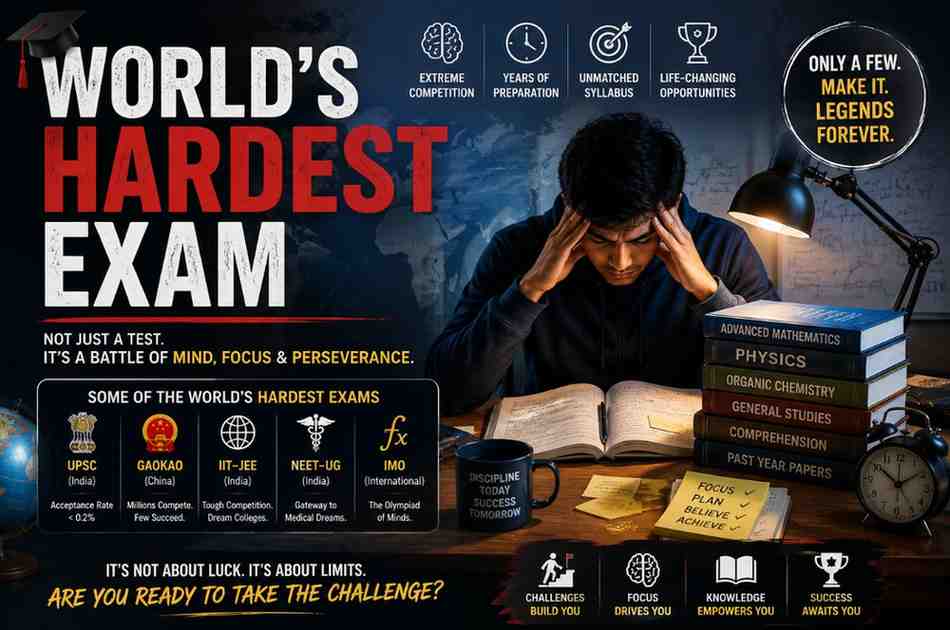
- No official body ranks exam difficulty worldwide.
- China’s Gaokao drew 12.9 million registered candidates in 2026.
- Gaokao requires Chinese citizenship, so Indian students cannot sit it.
- JEE Advanced 2026 qualified 56,880 candidates from 179,694 who appeared.
- UPSC Civil Services 2025 recommended 958 candidates from 9.3 lakh applicants.
- Oxford’s All Souls exam is open only to Oxford graduates.
What Makes an Exam the World’s Hardest Exam
Search for the world’s hardest exam and you will find ten confident rankings that disagree with each other. There is a reason for that. No examination authority, ministry, or ranking body publishes an official global difficulty ranking. Every list you read, including this one, is an editorial judgment built on four different measurements that get blended together and presented as a single number.
Separate those four before you compare anything.

Choose your dream country
 UK
UK
 USA
USA
 Germany
 Australia
 Ireland
 Canada
 UAE
UAE
 France
 Sweden
 Italy
Italy
 Other
Other
When do you want to study abroad?
What's your highest level of education?
Have you completed Class 12th?
What was your Class 12 CGPA/percentage?
Are you a student or a parent/guardian?
What do you want to study?
Select your current city
How Leap will help you

Personalised University Shortlist

Express Applications with Quicker Admits

End-to-End Application Support
- Selection rate: how many candidates get the seat or the post. UPSC Civil Services runs near 0.1%. This is the harshest metric.
- Pass rate: how many clear the standard, regardless of seats. The CA Final and CFA sit here.
- Syllabus breadth: UPSC and the Gaokao are broad. JEE Advanced is narrow and deep.
- Attempt limits and eligibility: how many chances you get, and whether you may sit at all. This ends the most attempts and almost nobody publishes it.
An exam with a 1% pass rate and 10,000 candidates is not comparable to one with a 40% pass rate and 20 lakh candidates. Both appear on the hardest-exam lists.
Counselor insight: When a ranking page lists a "selection rate" of 90% next to a claim that the exam is the toughest in the world, that table was copied from another site without anyone reading it. Students quote these figures back to us in sessions. Open the conducting body's own result page instead. UPSC, NTA, IIT Roorkee, ICAI and CFA Institute all publish their figures directly.
Top 10 World’s Hardest Exam in 2026
Here is the list with figures traced to the body that conducts each exam, and the date each figure belongs to.
1. Gaokao (China). The single route into Chinese undergraduate education, run over two days from 7 June and extending to three or four days in some provinces. China's Ministry of Education announced 12.9 million registered candidates for the 2026 Gaokao, down from 13.35 million the previous year. The paper is marked out of 750, and Tsinghua or Peking University require scores around 600 and above. One attempt per year.
2. UPSC Civil Services Examination (India). Three stages: Prelims, Mains, and the Personality Test. For CSE 2025, more than 9 lakh 30 thousand candidates applied for the Preliminary examination held on 25 May 2025, and 958 candidates were finally recommended for appointment. That is a selection rate close to 0.1% against 1,087 reported vacancies.
3. JEE Advanced (India). Only the top 2.5 lakh JEE Main scorers may sit it, so the pool is pre-filtered. IIT Roorkee reported that 179,694 candidates appeared in both papers of JEE Advanced 2026, held on 17 May 2026, and 56,880 qualified, of whom 10,107 were female candidates. Against roughly 17,000 to 18,000 IIT seats, qualifying is not the same as getting in.
4. All Souls Examination Fellowship (Oxford, UK). Two three-hour papers on each of two days in late September, then a viva. All Souls College normally elects two Examination Fellows each year, who join the College for seven years. Roughly 150 or more candidates typically sit it. Success rate under 2%.
5. USMLE (United States). Three steps for medical licensure, and the numbers split sharply by where you studied. In 2025, 25,660 examinees from non-US schools took Step 1 and 72% passed. First-time takers passed at 75% and repeaters at 54%. Examinees from US MD-granting schools passed at 91%. That 19-point gap is what Indian MBBS graduates plan around.
6. ICAI CA Final (India). Two groups, and the difficulty shows in the both-groups figure. ICAI's result announcement for the May 2026 attempt records 14.07% for both groups, with Group I at 12% and Group II at 20.49%. The January 2026 attempt was harsher at 10.97%.
7. CFA Program (global). Three levels, roughly 300 hours each. CFA Institute reported that of the 24,006 candidates worldwide who sat Level I in February 2026, 45% passed, against a ten-year average of 40%. First-time candidates passed at 50%, while candidates testing after at least one deferral passed at 30%.
8. CCIE (Cisco, global). Cisco requires a core exam shared with the CCNP certification, then an eight-hour, in-person, hands-on lab or practical exam. The lab is the filter: you configure and troubleshoot live equipment under time pressure, with no partial credit.
9. Master Sommelier Diploma (global). Theory by oral questioning, a blind tasting of six wines, and a practical service examination. The pass mark for each of the three sections is 75%, all three must be passed within a three-year window, and since the first examination in 1969 fewer than 300 candidates worldwide have earned the title.
10. Mensa admission test (global). Not an exam you pass or fail in the usual sense. Mensa's constitutional criterion is a score at or above the 98th percentile on an approved intelligence test, properly administered and supervised, with no other qualification for initial membership. The top 2% is a fixed threshold, not a curve.
How the world's hardest exam compare
| Exam | Country | Selects for | Latest official pool | Latest official rate | Attempts | Open to Indian students |
|---|---|---|---|---|---|---|
| Gaokao | China | Undergraduate admission | 12.9 million registered (2026) | Under 0.1% at top universities | Once a year | No |
| UPSC CSE | India | IAS, IPS, IFS, IRS posts | 9.3 lakh+ applied (2025) | 958 recommended, near 0.1% | 6 for General, more by category | Yes |
| JEE Advanced | India | IIT undergraduate seats | 179,694 appeared (2026) | 56,880 qualified | 2, in consecutive years only | Yes |
| All Souls Fellowship | UK | 7-year Oxford fellowship | 150+ candidates | 2 elected, under 2% | Unlimited while eligible | No |
| USMLE Step 1 | USA | Medical licensure | 25,660 non-US examinees (2025) | 72% overall, 75% first-time | Limited retakes | Yes, via ECFMG |
| ICAI CA Final | India | Chartered Accountant licence | 23,776 both groups (May 2026) | 14.07% both groups | Unlimited | Yes |
| CFA Level I | Global | Investment credential | 24,006 (Feb 2026) | 45% | Unlimited | Yes |
| CCIE | Global | Expert network engineer | Not published by Cisco | Not published by Cisco | Lab retakes within time limits | Yes |
| Master Sommelier | Global | Wine service credential | Under 300 titles since 1969 | 75% pass mark per section | 3-year window | Yes |
| Mensa | Global | High-IQ society membership | Not published | Top 2% threshold | Own test usually once | Yes |
Which of the World’s Hardest Exam Indian Students Can Actually Sit
This is the part the ranking lists leave out. Two of the exams sitting in almost every global top five are closed to you regardless of how well you prepare.
Closed to Indian students:
- Gaokao. Chinese citizenship is required, along with twelve years of schooling that includes three years at a Chinese senior secondary school. Indian students who want to study in China apply through international admissions routes and Chinese language proficiency testing instead.
- All Souls Examination Fellowship. You must already hold a degree from the University of Oxford or be registered for a higher degree there, in a humanities or social sciences subject within seven terms of your first degree. An Indian student could become eligible, but only by first completing an Oxford degree.
Open to Indian students: UPSC CSE, JEE Advanced, NEET, GATE, ICAI CA, CFA, CCIE, the Mensa admission test, and USMLE through the ECFMG certification pathway for international medical graduates. The exams to study abroad for Indian students sit in a separate category. The GRE and GMAT are admission tests, not selection tournaments, and they behave differently: you can retake them, and the score is one input among several rather than the whole verdict.
What you need to register
| Exam | Eligibility bar | Documents needed | India-specific note |
|---|---|---|---|
| UPSC CSE | Graduate in any discipline, age 21 to 32 for General | Degree certificate, Aadhaar, category certificate, photo and signature | Provisional certificate is accepted if final degree is pending |
| JEE Advanced | Top 2.5 lakh in JEE Main, Class 12 in 2025 or 2026 | JEE Main application number, Class 10 and 12 marksheets, category certificate | Female and reserved-category candidates pay a lower fee |
| NEET UG | Class 12 with Physics, Chemistry, Biology, age 17+ | Class 10 and 12 marksheets, Aadhaar, category certificate | Registration is Aadhaar-linked for Indian nationals |
| ICAI CA Final | Cleared both Intermediate groups, articleship completed | ICAI registration number, articleship completion certificate | Registration runs through the ICAI Self Service Portal |
| CFA | Bachelor's degree or final-year student, or 4,000 hours experience | Valid international passport, degree proof | The passport must be current at registration and on exam day |
| USMLE Step 1 | Enrolled in or graduated from a recognised medical school | ECFMG registration, MBBS marksheets, passport | Indian graduates apply through ECFMG, not directly to NBME |
Counselor insight: The passport requirement for the CFA catches Indian candidates every single window. Students register in the early window to save the fee, then discover their passport expires before exam day and cannot be renewed in time. Check the expiry date before you pay, not after.
What the World’s Hardest Exam Cost an Indian Student
Registration fees are the smallest part of the bill, but they are the part nobody publishes in rupees.
| Exam | Registration cost | Notes |
|---|---|---|
| UPSC CSE Prelims | Rs.100 ($1) | Waived for women, SC, ST and PwBD candidates |
| JEE Advanced 2026 | Rs.3,200 ($34) general male, Rs.1,600 ($17) female and SC, ST, PwD | Indian exam centres. Foreign centres cost more |
| NEET UG | Rs.1,700 to Rs.2,000 ($18 to $21) approximately | Varies by category. Verify on the NTA notification |
| ICAI CA Final | Rs.3,300 ($35) both groups approximately | Excludes registration and articleship costs |
| CFA, all three levels | Rs.3.34 lakh to Rs.4.37 lakh ($3,520 to $4,600) | CFA Institute states total exam fees for all three levels range from USD 3,520 to 4,600 depending on early or standard registration, starting with the 2026 exams. GST is added at checkout for India-billed candidates |
| USMLE Step 1 | Rs.99,000 ($1,040) approximately, plus an international test delivery surcharge | Verify current fees on the ECFMG and USMLE fee pages |
Exchange rate used: Rs.95 per USD, based on the RBI reference rate of 95.41 on 13 August 2026. Verify the current rate before finalising your budget. UPSC, NEET and ICAI figures should be reconfirmed against the current official notification, since these change by cycle.
Counselor insight: The fee is never the real cost. For a CFA candidate the meaningful number is the deferral penalty, because a deferred attempt drops your pass probability from 50% to 30% and you pay the full registration again. For a USMLE candidate the meaningful number is the year of income you are not earning while preparing. Budget the time, not the form fee.
3 Takeaways on World’s Hardest Exam
- Treat every ranking as an opinion, including this one. No authority publishes a global difficulty ranking, so check the conducting body's own result page before trusting any pass rate or selection figure you read.
- Check eligibility before you are impressed by a ranking. The two exams sitting at the top of most world's hardest exam lists, the Gaokao and the All Souls Fellowship, are closed to Indian students unless you first study in China or at Oxford.
- Map your attempt limits before your first attempt. JEE Advanced allows two consecutive years, UPSC allows six for general category candidates, and a CFA deferral drops your pass probability from 50% to 30%. These rules end more attempts than the papers do.
Verified by: LeapScholar's exams and admissions counseling team, with hands-on experience guiding Indian students through entrance exam planning and overseas application cycles.
Have questions about which exams your target course actually needs? Book a free session with a LeapScholar counselor.
Frequently Asked Questions About the World’s Hardest Exam
-
What happens if I run out of JEE Advanced attempts?
Your two attempts must fall in consecutive years, so a gap year removes an attempt rather than preserving one. Once both are used, IIT admission through JEE Advanced closes permanently. JEE Main remains valid for NITs, IIITs and centrally funded institutions, and state entrance exams and undergraduate engineering abroad stay open. Check your eligibility year before planning a drop year.
-
Which is the toughest professional exam in the world?
The Master Sommelier Diploma has the strongest claim among professional credentials. Fewer than 300 people worldwide have earned the title since the first examination in 1969, and candidates must clear theory, blind tasting and practical service at 75% each within a three-year window. Cisco's CCIE, with its eight-hour hands-on lab, is the closest competitor.
-
What is the hardest exam at Oxford University?
The All Souls College Examination Fellowship is often called the hardest exam in the world. Candidates sit two three-hour papers on each of two days in late September, then face a viva. All Souls normally elects two examination fellows a year from a field of 150 or more, a success rate under 2%. Only Oxford graduates and current Oxford graduate students may apply.
-
Which is Asia's toughest exam?
The Gaokao is generally regarded as Asia's toughest exam, given 12.9 million registered candidates in 2026 and an acceptance rate under 0.1% at elite Chinese universities. India's UPSC Civil Services and JEE Advanced rank close behind on selection rate, and South Korea's Suneung is comparable on national intensity.
-
Which is tougher, JEE or NEET?
It depends on which weakness the exam exposes. JEE Advanced demands multi-concept analytical problem solving and only 56,880 of 179,694 candidates qualified in 2026, from a pool already filtered to the top JEE Main scorers. NEET tests accurate recall across a wide syllabus, and its bottleneck arrives after qualifying, when 11.21 lakh qualified candidates compete for limited government MBBS seats.
-
Is UPSC harder than the Gaokao?
They measure different kinds of difficulty. The Gaokao compresses everything into two days with one attempt per year across 12.9 million candidates. UPSC runs three stages over more than a year and tests breadth, written expression, and interview performance. UPSC has the lower final selection rate. The Gaokao has the larger pool and the harsher single-day pressure.
-
Can Indian students give the Gaokao exam?
Indian citizens cannot sit the Gaokao. Eligibility requires Chinese citizenship and completion of twelve years of schooling that includes three years at a Chinese senior secondary school. Indian students who want to study in China apply through separate international admissions processes at individual universities, usually with Chinese language proficiency testing instead of the Gaokao.
-
Which is the hardest exam in India?
The UPSC Civil Services is India's hardest exam by selection rate. More than 9.3 lakh candidates applied for the 2025 preliminary examination, and 958 were finally recommended, a rate near 0.1% across three elimination stages. JEE Advanced and the ICAI CA Final compete for the title on different measures: conceptual depth for JEE Advanced and a 14.07% both-groups pass rate for CA Final.
-
Which is the toughest no. 1 exam in the world?
The Gaokao is most commonly named the world's hardest exam on grounds of scale and single-attempt pressure. China's Ministry of Education registered 12.9 million candidates for the 2026 Gaokao, and admission to top universities like Tsinghua and Peking sits under 0.1%. No official authority publishes a global difficulty ranking, so this reflects consensus rather than a formal ruling.







Have Questions? Get Guidance to reach your Dream University
Connect with India's finest counsellors and biggest study abroad community.
Get Guidance