
Quick Read
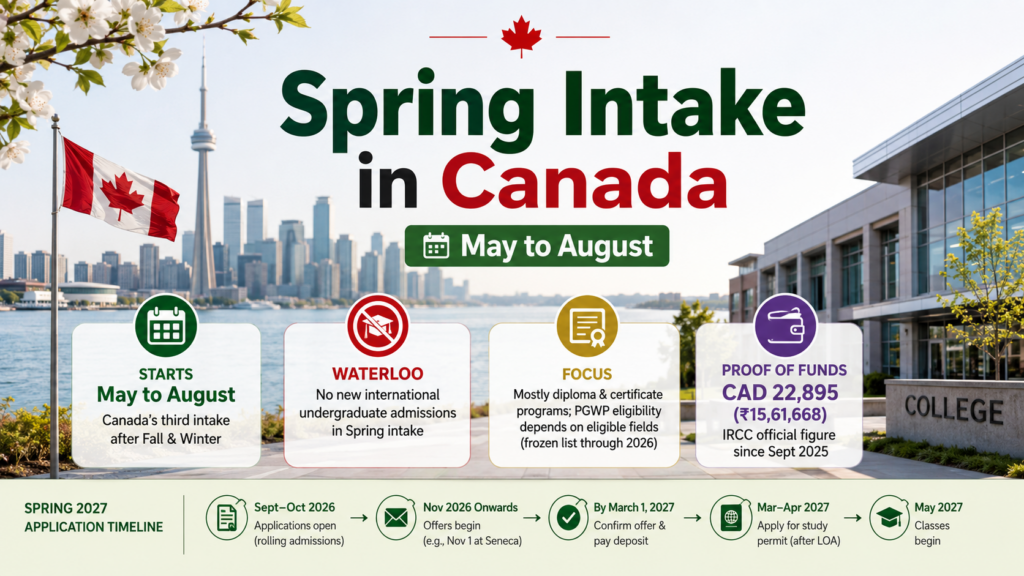
- Spring intake in Canada runs May to August.
- University of Waterloo does not admit new international undergraduates in Spring, only select graduate and non-degree programs.
- Most Spring seats are diploma and certificate programs, where PGWP eligibility now depends on a frozen list of eligible fields through 2026.
- Proof of funds is CAD 22,895 (₹15,61,668), IRCC’s official figure since September 2025.
What Is Spring Intake in Canada, and Which Month Does It Start
Spring intake in Canada, sometimes called the May intake in Canada or Summer intake in Canada, begins in May and runs through August. It is the tertiary intake, after Fall (September) and Winter (January), and it exists mainly to serve diplomas, certificates, and select graduate programs rather than full undergraduate degrees.
Spring intake in Canada, in practical terms, is a smaller, faster entry point, mostly at colleges rather than research universities, with fewer seats but noticeably less competition.

Choose your dream country
 UK
UK
 USA
USA
 Germany
 Australia
 Ireland
 Canada
 UAE
UAE
 France
 Sweden
 Italy
Italy
 Other
Other
When do you want to study abroad?
What's your highest level of education?
Have you completed Class 12th?
What was your Class 12 CGPA/percentage?
Are you a student or a parent/guardian?
What do you want to study?
Select your current city
How Leap will help you

Personalised University Shortlist

Express Applications with Quicker Admits

End-to-End Application Support
Application timing for Spring intake in Canada 2027 varies more than Fall or Winter because most participating colleges run rolling admissions rather than one fixed deadline. Portals commonly open around September or October of the previous year, but seats are reviewed as applications arrive rather than in one batch.
Counselor insight: Students often assume "Spring" means the same academic flexibility as Fall. It doesn't. Because seats are limited and offered on a rolling basis, applying in November for a May intake is genuinely different from applying in November for September, since the pool of open programs shrinks every month rather than resetting once a year.
How Does Spring Intake Compare to Fall and Winter in Canada
Canada intakes 2027 break down into three cycles, and Spring sits clearly apart from the other two. This window is also called the Spring Summer intake in Canada, since it runs from May through August:
| Intakes in Canada | Starts | Scale |
| Fall/September intake | September | Largest: most programs, most scholarships, most seats |
| Winter/January intake | January | Second-largest: fewer programs, less competition |
| Spring/Summer intake | May | Smallest: mostly diplomas and short courses |
Spring intake in Canada is not a smaller version of Fall with the same programs available later. Full undergraduate degrees are rarely offered in Spring at all; the intake exists almost entirely for diploma, graduate certificate, and select postgraduate programs at colleges like Conestoga, Centennial, Humber, and Seneca Polytechnic. If your goal is a Bachelor's degree at a research university, Winter intake in Canada is usually the more realistic fallback to Fall, not Spring.
Counselor insight: Students sometimes choose Spring intake in Canada purely because "it sounds like more time to prepare." That's true, but it also means your program options narrow significantly. Decide on the program first, then check which intake it's actually offered in, rather than picking Spring and hoping to find a matching course.
Most Spring intake seats go toward PGWP-relevant diploma and graduate certificate programs, which makes the post-graduation work permit rules unusually important here. Since November 2024, PGWP eligibility splits by credential level:
- College and non-degree graduates: Need a CLB/NCLC 5 language score and a program in an IRCC-eligible field of study, a list frozen through the end of 2026.
- Degree holders: Need a CLB/NCLC 7 language score, with no field-of-study restriction.
Read expert answers on Canada's study and work permit cost structure for more, or see our Diploma Courses in Canada guide for which fields currently qualify.
Spring Intake in Canada 2027-28: Deadlines and What’s Actually Confirmed
A key correction worth stating plainly: the University of Waterloo does not admit new international undergraduates in Spring, despite being listed with a fixed Spring deadline in several places. Waterloo's own admissions page states it admits first-year students for the term starting in September only. Spring at Waterloo is limited to select graduate programs and non-degree or post-degree studies, both on program-specific timelines rather than one public date.
What can be confirmed for Spring 2027 comes mostly from colleges:
| Institution | Spring Intake Pattern | Confirmed Detail |
| University of Waterloo | Not open to new international undergraduates | Select graduate and non-degree programs only, program-specific dates |
| Conestoga College | Rolling admissions | Applications accepted until program capacity is reached; no fixed public deadline |
| Centennial College | Rolling admissions | No centralised deadline; reviewed as received until seats fill |
| Seneca Polytechnic | Structured but flexible | Applications open roughly a year ahead; first Summer offers issued November 1, confirmation deadline around March 1 |
| Humber College | Rolling, with an equal-consideration marker | Early October opening; February 1 equal-consideration date applies mainly to Fall-heavy programs |
Sources: University of Waterloo, Conestoga College, Centennial College, Seneca Polytechnic, and Humber College, each institution's own admissions page.
Month-By-Month Application Timeline for Spring Intake in Canada
- April-June 2026: Shortlist colleges and confirm your program is actually offered in Spring, not just Fall.
- July-September 2026: Take IELTS or PTE. Collect transcripts and provisional certificates.
- September-October 2026: Portals typically open. Apply as soon as documents are ready, since rolling review means later applicants compete for fewer open seats.
- October-December 2026: Track offer rounds; several colleges issue first offers around November 1.
- January-March 2027: Confirm your offer and pay the deposit promptly. Most confirmation windows close by early March.
- March-April 2027: Apply for your study permit once you have your Letter of Acceptance.
- May 2027: Classes begin.
PAL, GIC and Study Permit Rules for Spring Intake in Canada 2027
The underlying visa rules for Spring intake are identical to Fall and Winter, since IRCC does not set intake-specific study permit policy. Two things changed in the past 18 months that matter here.
Provincial Attestation Letter (PAL)
- Exempt: Master's and PhD applicants at public Designated Learning Institutions, since January 1, 2026.
- Still required: Diploma and undergraduate applicants, the majority of Spring intake seats, allocated on a first-come, first-served basis once you accept your offer.
Study Permit Cap for 2027
- Working figure: 150,000 new international student arrivals, down from 155,000 in 2026.
- Status: Provisional, pending confirmation through the 2027-2029 Immigration Levels Plan by November 1, 2026.
Source: Immigration, Refugees and Citizenship Canada, including the 2026 Ministerial Instructions on attestation letters.
GIC and Proof of Funds
- Required amount: CAD 22,895 (₹15,61,668) in living costs, on top of first-year tuition and travel, per IRCC's cost-of-living figure effective since September 2025.
- GIC status: No longer mandatory for any stream, since IRCC discontinued the Student Direct Stream in November 2024.
- Accepted alternatives: Bank statements, an education loan sanction letter, or documented sponsor income.
Read expert answers on whether GIC is still accepted or mandatory for Canada.
Counselor insight: Diploma applicants sometimes assume a shorter program means a smaller GIC or fund requirement. It doesn't. IRCC's living-cost figure is the same regardless of program length or level, so a one-year diploma applicant needs to show the same CAD 22,895 (₹15,61,668) as a Master's applicant.
Our Canada GIC Amount guide covers which banks offer it and how it's disbursed after arrival.
Government Fees
- Study permit application: CAD 150 (₹10,231)
- Biometrics: CAD 85 (₹5,798)
- Total, paid directly to IRCC: CAD 235 (₹16,029)
Exchange rate used: 1 CAD = ₹68.21 as of September 2026. Verify the current rate before finalizing your budget.
Documents Checklist for Spring Intake in Canada Applications
| Document | India-Specific Detail |
| Academic transcripts and marksheets | Class 10, 12 marksheets, plus a bachelor's transcript for graduate certificate applicants |
| English proficiency score | IELTS or PTE Academic; most diploma programs require 6.0-6.5 overall |
| Statement of Purpose | Should explain why Spring specifically, not just why Canada |
| Letters of Recommendation | 1-2 letters for diploma programs, on institutional letterhead |
| Proof of funds | Bank statement, education loan sanction letter, or GIC showing CAD 22,895 (₹15,61,668) |
| Provincial Attestation Letter | Required for most diploma and undergraduate applicants |
| Passport | Validity should cover your full program length plus a buffer |
Exchange rate used: 1 CAD = ₹68.21 as of September 2026. Verify the current rate before finalizing your budget.
For the PAL allocation process itself, our Provincial Attestation Letter guide covers it step by step.
Which Spring Intake Path in Canada Fits You? A Decision Framework
- If you missed the Fall 2026 deadline entirely: Spring intake in Canada is a genuine option if your target program runs in May, but check program availability first. Many popular diploma programs, like business or IT, run all three intakes; some specialized ones don't run in Spring at all.
- If you're choosing Spring specifically for less competition: That's a real advantage, but confirm it doesn't come at the cost of scholarship access, which is minimal in Spring compared to Fall or Winter.
- If you're applying for a diploma with PGWP plans: Confirm your specific program's CIP code is on IRCC's current PGWP-eligible list before you commit, since the field-of-study freeze through 2026 means an ineligible program won't become eligible mid-year.
Our PGWP eligibility guide breaks this down further.
What to Do If You Miss the Spring Intake in Canada Deadline
Because most Spring seats run on rolling admissions rather than a hard cutoff, "missing the deadline" looks different here than for Fall:
- Check if the program is still open: Rolling admissions mean a program can still be accepting applications well past the dates aggregators list. Contact the institution's international office directly rather than relying on a generic deadline.
- Apply for Fall 2027 instead: If your target program's Spring seats are genuinely closed, Fall offers the same program with far more scholarship and PGWP-eligible options.
- Use the wait productively: If you shift to Fall, spend the extra months confirming your program's PGWP eligibility and strengthening your SOP rather than reapplying with the same file.
Counselor insight: Students sometimes discover only after enrolling that their diploma program isn't on the PGWP-eligible list. Check this before applying, not after acceptance; see what our counselors say about why Canada is rejecting more Indian student visa applications for related documentation pitfalls worth avoiding.
3 Takeaways on Spring Intake in Canada
- Confirm your specific program actually runs in Spring before applying. Waterloo doesn't offer it to new undergraduates, and many specialised diploma programs only run in Fall.
- Treat rolling admissions as a reason to apply earlier, not later. Later applicants compete for a shrinking pool of open seats rather than a fixed cohort size.
- Check your program's PGWP field-of-study eligibility before enrolling, not after. The frozen list means an ineligible program stays ineligible through 2026.
Verified by: LeapScholar's Canada counseling team, with hands-on experience guiding Indian students through Spring intake applications and permit filings.
Have questions about Spring intake in Canada? Book a free session with a LeapScholar counselor.
Frequently Asked Questions About Spring Intake in Canada
-
When is Spring intake in Canada, and which month does it start?
Spring intake in Canada, also called the May intake in Canada, kicks off in May and wraps up in August. It's the smallest of Canada's three intakes, so seats are limited.
-
What are the Spring intake in Canada deadlines for 2027?
Most colleges skip a fixed date here and just review applications as they come in. Seneca Polytechnic is the exception, with a real pattern: portals open about a year out, first offers land around November 1, and confirmations close near March 1.
-
Does the University of Waterloo offer Spring intake in Canada for international students?
Not for new undergrads. Waterloo only takes first-year international students in September. Its Spring term is reserved for select graduate and non-degree or post-degree programs, each on its own timeline.
-
Which colleges offer Spring intake in Canada?
Conestoga, Centennial, Humber, and Seneca Polytechnic all run Spring intake in Canada for diploma and certificate programs, mostly through rolling admissions.
-
Is Spring intake in Canada good for Indian students?
It can be, especially if you missed Fall or Winter, or want a diploma program with less competition. Just know scholarships are thinner and programs fewer than Fall, so confirm your course actually runs in May.
-
Is a GIC mandatory for Spring intake in Canada 2027 study permits?
No, a GIC isn't mandatory for any study permit stream anymore. What IRCC wants is proof of CAD 22,895 (₹15,61,668) in living costs, and a GIC, bank statements, or an education loan all satisfy that.
-
Do Spring intake diploma graduates qualify for a PGWP?
Only if your program sits on IRCC's current PGWP-eligible field-of-study list, frozen through 2026, and you clear the CLB/NCLC 5 language bar. Check the list before you apply, not after you've enrolled.
-
What is the Canada PAL requirement for Spring intake applicants?
Diploma and undergraduate Spring applicants still need a Provincial Attestation Letter, handed out first-come, first-served once you accept an offer. Master's and PhD applicants at public DLIs have been off the hook since January 1, 2026.
-
What English test score do I need for Spring intake in Canada diploma programs?
Most diploma programs ask for IELTS 6.0 to 6.5 overall, but it varies by program and college, so confirm before booking your test.
-
How many intakes in Canada are there, and how many intakes does Canada have overall?
Three: Fall (September), Winter (January), and Spring or Summer (May). Spring is the smallest, with the least program choice and fewest scholarships.
-
What is spring 2027 intake in Canada, and when does spring intake start in Canada?
Spring 2027 intake in Canada is simply the admission cycle for programs starting that May. It runs May through August, mostly at colleges offering diploma and certificate programs rather than full degrees.
-
When is spring admission in Canada?
Spring admission in Canada typically opens about a year before the May start, though most colleges review applications on a rolling basis rather than a fixed cutoff. Earlier is always better.
-
Spring intake means which month in Canada?
Spring intake in Canada means the May-to-August term, the smallest and least competitive of the three, and the usual backup for students who missed Fall or Winter.
-
Which are the best spring intake universities in Canada?
Very few research universities run it for new international students. Spring intake universities in Canada are mostly colleges: Conestoga, Centennial, Humber, and Seneca Polytechnic, all offering diploma and certificate programs.









Have Questions? Get Guidance to reach your Dream University
Connect with India's finest counsellors and biggest study abroad community.
Get Guidance