
Quick Read
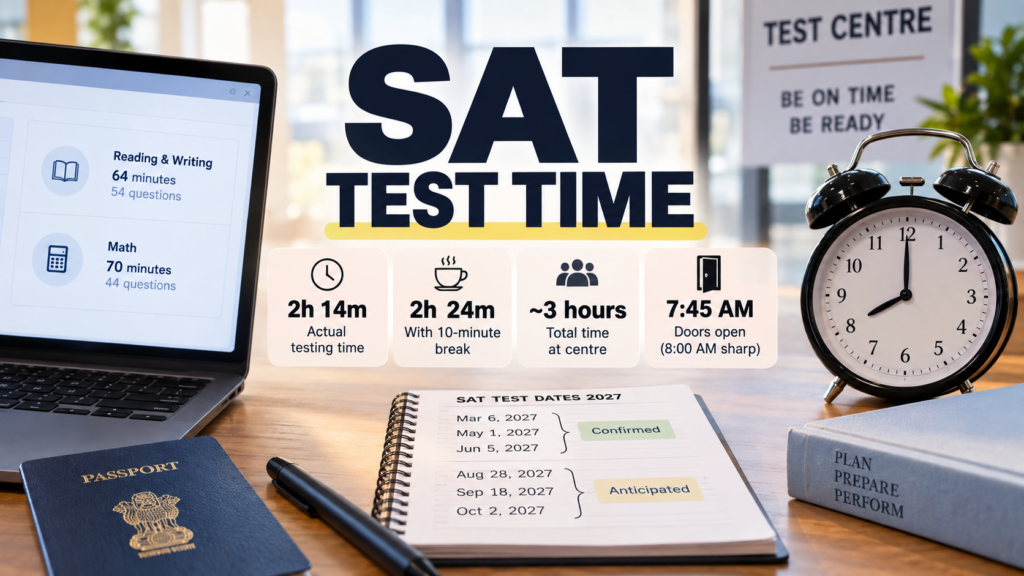
- The SAT’s actual testing time is 2 hours 14 minutes, split across Reading & Writing and Math.
- Indian test centres open at 7:45 AM and shut the doors at 8:00 AM sharp.
- Budget close to 3 hours total at the centre once check-in and the break are added.
- Confirmed SAT test dates run through June 2027, with the 2027-28 cycle now anticipated by College Board.

How Long Is the SAT Test Time in 2027?
SAT test time, under standard conditions, is 2 hours and 14 minutes (134 minutes) of actual testing.
- That figure doesn’t include the break.
- Add the one mandatory 10-minute break, and the SAT test time runs to 2 hours 24 minutes, with the first question to the last.
- With check-in, device setup, and instructions, realistic SAT test time at your centre is close to 3 hours.
- There’s no optional essay anymore. College Board discontinued it worldwide in 2021, so any source quoting an SAT test time of 3 hours 50 minutes with an essay is describing a test that no longer exists.
Counselor insight: The most common test-day surprise for Indian students isn’t the test itself. It’s underestimating the total time commitment. Families plan around “2 hours 14 minutes” and get caught out when check-in alone takes 30 to 45 minutes. Block out your entire Saturday morning, not just the testing window.
Source: College Board – How Long Does the SAT Take?
SAT Test Time Breakdown: Section, Module, and Extended-Time Comparison
The digital SAT splits into two sections, each divided into two adaptive modules. Your Module 1 performance in a section decides how hard Module 2 is, so there’s no easy half to coast through.
| Section | SAT Test Time | Modules | Questions |
| Reading & Writing | 64 minutes | 2 x 32 min | 54 |
| Math | 70 minutes | 2 x 35 min | 44 |
| Total | 134 min (2h 14m) | 4 modules | 98 |
For students with approved accommodations, here’s the SAT test time breakdown per section for extended time:
| Testing Condition | R&W Time | Math Time | Total Testing Time |
| Standard | 64 min | 70 min | 2h 14m |
| 50% Extended Time | 96 min | 106 min | 3h 22m |
| 100% Extended Time | 128 min | 140 min | 4h 28m |
Extended time still includes breaks. Your school or test centre schedules the exact break length for accommodated students.
Once you know the SAT test time length for each section, the natural next question is what score that effort should be aiming for.
If you’re mapping SAT test time against a target score, our guide to what counts as a good SAT score breaks down percentile bands by university tier.
Counselor insight: Because unused time in Module 1 can’t carry over, don’t “save time” for later in a section. Finish Module 1 with eight minutes spare? Use it to recheck flagged questions in that module, since it disappears the moment Module 2 starts.
Source: College Board – Extended Time for SAT/PSAT Assessments

Full SAT Test-Day Timeline: Minute by Minute
Beyond section timing, most students want the actual SAT testing schedule in clock time, not just durations. Here are the SAT times that the College Board publishes for a standard Saturday administration:
| Time (Local/IST) | What’s Happening |
| 7:15 AM | Students using a College Board loaner device arrive |
| 7:45 AM | Doors open; all students check in |
| 8:00 AM | Doors close, no late admission |
| 8:15 to 8:30 AM | Testing officially starts |
| ~8:15 to 8:47 AM | Reading & Writing Module 1 |
| ~8:47 to 9:19 AM | Reading & Writing Module 2 |
| ~9:19 to 9:29 AM | 10-minute break |
| ~9:29 to 10:04 AM | Math Module 1 |
| ~10:04 to 10:39 AM | Math Module 2 |
| 10:45 to 11:00 AM | Standard-time testing ends |
At Indian test centres, all of this runs on IST, not US Eastern Time. If your centre is in Mumbai, Delhi, or Bengaluru, “7:45 AM” on your admission ticket means 7:45 AM IST. The module timings above are approximate, since Bluebook inserts brief untimed transition screens between modules. Always follow your proctor’s cues over a clock estimate.
Counselor insight: I’ve had students arrive at 7:50 AM assuming a few minutes of grace. There isn’t one. Once the doors close at 8:00 AM, you will need to re-register and pay again for a future date.
Source: College Board – What to Expect on Test Day
Documents and Costs for SAT Test Day in India
| Item | Required? | India-Specific Detail |
| Admission ticket | Mandatory | Download and print from your College Board account before test day |
| Valid photo ID | Mandatory | A passport is the safest bet for Indian test-takers; school IDs are often not accepted at international centres |
| Testing device | Mandatory | Own a laptop/tablet or a College Board loaner, with the Bluebook app pre-installed and set up |
| Calculator | Optional | Bluebook has a built-in Desmos calculator for all of Math; an approved physical calculator is also allowed |
For Indian students, SAT exam fees work out to $68 base plus a $43 international fee, so $111 (₹10,545 at ₹95/$1) before tax. Card payments from India typically attract roughly 18% GST on the foreign-currency conversion, bringing the realistic total closer to $131 (₹12,445).
- Families earning under ₹8 lakh annually: 90% fee waiver
- Families earning ₹8 to 15 lakh annually: 50% fee waiver
Eligible students can access reduced fees through the College Board India Scholars Program.
Exchange rate used: ₹95 per US dollar. Verify the live rate before finalizing your budget.
Source: College Board – International Fees
See our full SAT scholarship guide for Indian students for the application process. If you’re weighing the SAT against other standardized options before committing to the fee, our ACT vs SAT comparison is worth a read first.
Counselor insight: Students applying for the fee waiver often wait until the week of registration to check eligibility. Apply for your India Scholars Program voucher as soon as you register for the SAT, since the discount only applies at checkout and can’t be claimed retroactively.
When Should You Take the SAT? 2027-28 Planning Calendar
College Board has confirmed dates through mid-2027 and released anticipated dates for the 2027-28 SAT testing schedule.
| Test Date | Status | Best For |
| March 6, 2027 | Confirmed | Class 11 students, first attempt |
| May 1, 2027 | Confirmed | Retake after a March attempt |
| June 5, 2027 | Confirmed | Final shot before Class 12 board-exam prep begins |
| August 28, 2027 | Anticipated | Class 12 early applicants (registration deadline not yet published) |
| September 18, 2027 | Anticipated | Early Action/Early Decision candidates |
| October 2, 2027 | Anticipated | Regular Decision candidates |
| November 6, 2027 | Anticipated | Last comfortable window before December deadlines |
| December 4, 2027 | Anticipated | Final Regular Decision attempt |
College Board labels the fall 2027 to spring 2028 dates “anticipated” since registration deadlines haven’t been published yet; treat them as directional until confirmed. Check full SAT exam dates closer to each cycle for confirmed deadlines. For a fuller picture of what the SAT is testing, and why is it worth this planning effort? See our complete guide to the SAT exam.
Source: College Board – SAT Dates & Deadlines
Counselor insight: Indian students consistently pick test dates around application deadlines and forget to check them against CBSE/ICSE board exam months. March SAT test time regularly clashes with pre-board practicals in some schools. Map your SAT date against your school’s exam calendar before you lock it in.
SAT Test Time Decision Framework for Indian Students
- Class 11, first attempt: Target March or May 2027. This leaves a full retake window before Class 12 boards, so you don’t lose prep time.
- Class 12, targeting Early Decision/Early Action for Fall 2028 admission: August or September 2027 gives you a result before early deadlines, with October as a built-in retake buffer.
- Preparing for JEE Mains alongside the SAT: June 2027, right after boards, avoids the worst overlap.
Many JEE aspirants find SAT Math comes easier than JEE Math, so it’s worth putting more prep hours into Reading & Writing instead.
What to Do If SAT Test Time Goes Wrong
- You arrive after 8:00 AM: Not admitted, no exceptions. You’ll need to re-register for a future date and pay the fee again.
- Your device or Bluebook malfunctions: Flag the proctor immediately. Genuine technical failures are documented and can lead to a rescheduled test at no extra cost, but only if reported during the session.
- You’re running out of time in a module: There’s no negative marking on the digital SAT, so fill in every remaining question in the last two minutes rather than leaving blanks. A guess costs nothing; a blank guarantees zero.
3 Key Takeaways on SAT Test Time
- SAT test time is 2 hours 14 minutes of actual testing (2h24m with the break), but the budget is close to 3 hours total at the centre for check-in and wrap-up.
- Arrive by 7:45 AM IST; doors close at 8:00 AM, and late arrivals are not admitted under any circumstances.
- Pick your 2027-28 test date against your own board-exam calendar, not just university application deadlines. Confirmed dates run through June 2027, and the fall 2027 to spring 2028 cycle is still anticipated.
Verified by: LeapScholar’s SAT and US admissions counseling team, with hands-on experience guiding Indian students through Digital SAT registration and test-day planning.
Have questions about your SAT test date or test-day schedule? Book a free session with a LeapScholar counselor.
Frequently Asked Questions About SAT Test Time
-
How long is SAT test time in total?
SAT test time is 2 hours 14 minutes of actual testing, or 2 hours 24 minutes, counting the mandatory break. Including check-in and setup, plan for close to 3 hours total at the test centre.
-
What time does the SAT start and end?
Test centre doors open at 7:45 AM local time and close at 8:00 AM. Testing typically starts between 8:15 and 8:30 AM, and standard-time testing ends between 10:45 and 11:00 AM.
-
What time should I arrive at the SAT test centre?
Arrive by 7:45 AM at the latest. Many counselors recommend closer to 7:30 AM, since some centres run multiple exams and check-in queues move slowly.
-
How long is each section of the SAT?
Reading & Writing runs 64 minutes across two 32-minute modules. Math runs 70 minutes across two 35-minute modules, for 134 minutes of total SAT test time.
-
Does the SAT still have an essay?
No. The College Board discontinued the SAT essay worldwide in 2021, and the digital SAT format doesn’t include one at all. Any SAT test time figure that adds 50 minutes for an essay is outdated.
-
How long is the SAT with extended time?
With 50% extended time, testing lasts 3 hours and 22 minutes. With 100% extended time, it takes 4 hours and 28 minutes. Both require documented, pre-approved accommodations.
-
When is the next SAT test date?
Confirmed dates run through June 2027 (March 6, May 1, June 5). College Board has also released anticipated 2027-28 dates: August 28, September 18, October 2, November 6, and December 4, 2027.
-
How many questions are on the SAT, and how long do I get per question?
The SAT has 98 questions across 134 minutes, roughly 82 seconds per question on average, though Math allows more time per question than Reading & Writing.
-
What happens if I arrive late for my SAT test time slot?
You will not be admitted once the 8:00 AM door-close cutoff passes. You’ll have to register again for a future test date and pay the fee a second time.










Have Questions? Get Guidance to reach your Dream University
Connect with India's finest counsellors and biggest study abroad community.
Get Guidance