
Quick Read
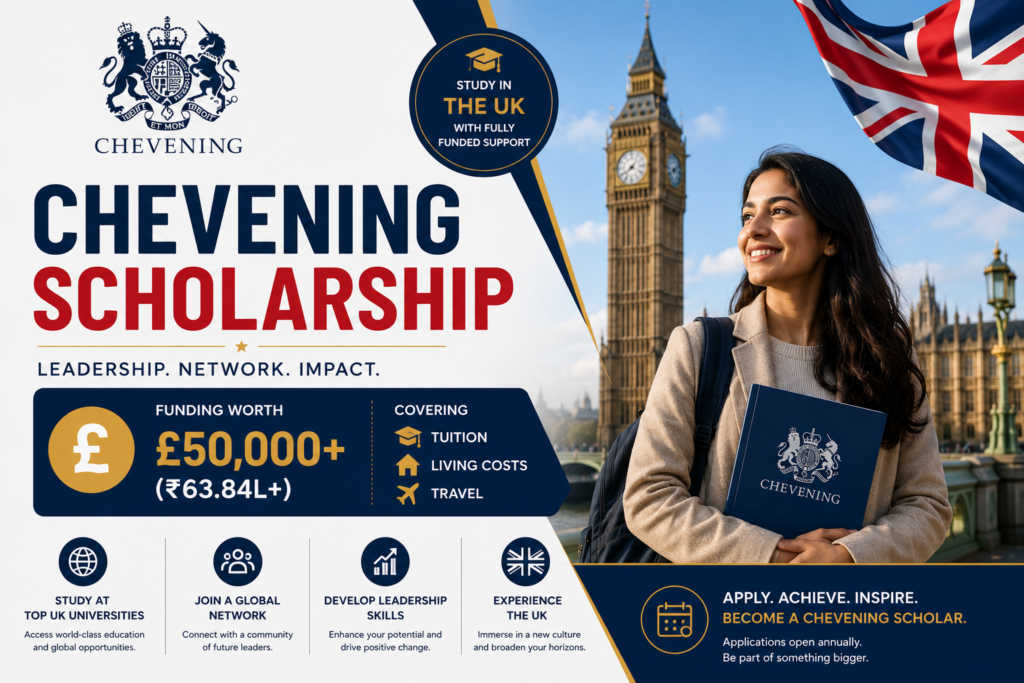
- Fully funded 1 year UK Master’s worth up to Rs. 63.84 lakh+.
- Required: a bachelor’s degree (UK 2:1 equivalent) and 2,800 post-graduation hours of work.
- Applications open in August 2026, closes in October 2026, results will be available in June 2027.
- You will have to return to India for a minimum of 2 years after completion of the program.
What is the Chevening Scholarship?
The Chevening Scholarship is the UK government’s flagship international awards program, funded by the Foreign, Commonwealth and Development Office (FCDO) and partner organizations.
Chevening is not an academic award. Selection is based on demonstrated leadership, the ability to network effectively, and a credible plan to create positive change in India after returning.
If you are exploring study in the UK, the Chevening Scholarship is the most prestigious government-backed option available to Indian students.
| Aspect | Details |
|---|---|
| Funded by | UK Foreign, Commonwealth and Development Office (FCDO) and partner organisations |
| Founded | 1983 |
| Coverage | Fully funded one-year Master’s degree |
| Awards per year | 1,500 globally |
| Alumni network | 60,000+ across 160+ countries, including ministers, CEOs, ambassadors, and heads of state |
| India eligible | Yes |
| Official site | chevening.org |
Chevening Scholarship 2027: Key Dates
The 2026-27 cycle is now closed. The next cycle targets students beginning their Master’s in September/October 2027.
| Milestone | Expected Date |
|---|---|
| Applications open | August 2026 |
| Application deadline | 7 October 2026 (12:00 UTC / 5:30 PM IST) |
| Reading committee review | October 2026 to January 2027 |
| Interviews at British High Commission | March to April 2027 |
| Final results announced | June 2027 |
| University offer deadline | 9 July 2027 |
| Studies begin in UK | September to October 2027 |
Important note to the students: The portal closes at exactly 12:00 UTC on deadline day with no extensions and no exceptions. Submit at least 48 hours early to avoid last-minute technical issues.
Chevening Scholarship Eligibility for Indian Students
Meeting every criterion below is mandatory. If you fail to meet any one of these criteria, your application will be removed before a human reads it.
You must:
- Hold citizenship of a Chevening-eligible country (India is eligible)
- Hold a bachelor’s degree equivalent to a UK upper-second-class (2:1) Honours, broadly equivalent to 60-65% aggregate
- Have accumulated a minimum of 2,800 hours of work experience after your graduation date, accumulated through full-time, part-time, voluntary, paid, or unpaid work.
- Paid and unpaid internships count, including those undertaken during your undergraduate years, unless they were mandatory employment required as part of your course
- Have finished your undergraduate studies at least two years before the application deadline
- Commit to returning to India for a minimum of two years after the scholarship ends (this is a formal contractual condition, not optional)
- Apply to three eligible UK Master’s courses and secure an unconditional offer from at least one by 9 July 2027
You cannot apply if you:
- Hold British or dual British citizenship (with narrow exceptions for British Overseas Territory citizens and BN(O) holders applying from Hong Kong)
- Have previously studied in the UK on a UK government-funded scholarship
- Are a current or recent employee (within two years), former employee, or relative of an employee of the UK government, British Embassy, British High Commission, the British Council, the Association of Commonwealth Universities, or sponsoring UK universities
- Hold refugee status in a non-Chevening-eligible country
On English language requirements: Chevening does not set its minimum English score. However, every UK university you apply to will have its own minimum English score. Most programs require IELTS 6.5 overall.
On age limits: There is no age limit set by Chevening. Since you need a completed degree and 2,800 post-graduation hours, most applicants are at least 24-25 at the time of application. The scholarship has been awarded to professionals in their 40s and 50s.
Counselor Insight: A common eligibility error from Indian applicants is assuming all work done during college is ineligible. Chevening’s rule is more specific: only mandatory employment that counts toward your undergraduate or postgraduate course is excluded. Paid and unpaid internships taken voluntarily, including during college, do count. If you are borderline on the 2,800-hour threshold, calculate each work period carefully against this definition before applying.
Read our guide on IELTS score requirements for UK universities to check program-specific thresholds.
Chevening Scholarship Amount in GBP and INR
| Component | GBP | INR |
|---|---|---|
| Tuition fees | Full cost of program | Varies by course |
| MBA tuition cap | £22,000 maximum | Rs.28.09 lakh |
| Monthly stipend: outside London | £1,378/month | Rs.1.76 lakh/month |
| Monthly stipend: London (within M25) | £1,690/month | Rs.2.16 lakh/month |
| Economy return flights | Covered in full | Covered in full |
| Arrival allowance (one-time) | £200-300 | Rs.25,500-38,300 |
| Visa application cost | Covered in full | Covered in full |
| Thesis/dissertation grant | £500 | Rs.63,840 |
| Estimated total package | £30,000 to £50,000+ | Rs.38.3 to 63.84 lakh+ |
Key points on funding:
Tuition: Direct payment to your institution. There is no limit on taught Masters programmes. MBA programmes are the exception with a cap of £22,000 (Rs.28.09 lakh). Any fees above this amount will be covered by you.
Monthly Stipend: Depends on the location of your university. If you’re within the M25 (places like UCL, LSE, King’s College London, Imperial) you get the higher London rate. The lower rate will apply to universities outside London, including Oxford, Cambridge, Edinburgh and Manchester.
Note: Oxford and Cambridge are not within the M25 boundary and are paid the outside London stipend rate, despite being two of the most expensive places to live in the UK as a student. Factor that into your budget plans.
Dependants: If you are planning to bring your partner or children along, keep in mind that Chevening does not cover any of their costs. Visas, rent, daily expenses, all of it comes out of your own pocket. With the UK tightening its student visa rules recently, this is something worth sorting out financially before you even apply.
Counsellor Insight: MBA fees at top UK schools can run well past £22,000, and Chevening only covers up to that amount. The gap can be significant, so look up the actual course fees early and have a plan for the difference.
Read more about UK student visa requirements for Indian students.
How to Apply for a Chevening Scholarship for Indian Students?
The application is online at chevening.org. You do not need any documents when you first apply; those are only collected if you are shortlisted for an interview.
Step 1: Select three UK universities
Before opening the application, identify three Master’s programmes that align with your career goals. Your three choices should point in the same direction. Indian applicants commonly apply to the University of Oxford, University of Cambridge, University of Leeds, and University of Birmingham. Apply to each university through their own admissions portal alongside your Chevening application.
Step 2: Register on the portal
Create an account on chevening.org. You will receive a unique access code that is required every time you return to your application, so keep it saved.
Step 3: Complete the form and write four essays
Each essay has a 300-word limit. Use it fully, as brief responses are rarely convincing. Chevening screens for AI-generated writing, and flagged essays can result in disqualification, so write in your own words. Our SOP for UK universities guide is a helpful reference for structuring strong written applications.
Step 4: Submit on time
Applications are locked once submitted and cannot be edited. Go through every section carefully before you finalise.
Step 5: If shortlisted, attend the interview
Shortlisted candidates need to upload their documents and attend an in-person interview at the British High Commission. Slots are allocated on a first-come-first-served basis, so book yours as soon as you receive the invitation.
Counsellor Insight: At the BHC interview, most candidates are not caught out by general Chevening questions. The panel reads your application and will ask you to expand on specific examples from your essays. Pick every example you wrote about and prepare to speak on each for three to four minutes, without notes.
The Four Chevening Essays
Each essay targets a different selection criterion, and has a word limit of 300 words.
| Essay | Focus | What is Chevening really asking for? |
|---|---|---|
| Essay 1 | Leadership and influence | A specific example of when you drove meaningful change: tangible outcomes, not job titles |
| Essay 2 | Networking | How professional relationships have created outcomes for you, and how you will specifically use the 60,000+ Chevening alumni network |
| Essay 3 | Why these courses, why UK | Specific modules, faculty, and research strengths at each institution; not generic praise of UK education |
| Essay 4 | Career plan | A specific, time-bound vision for what you will do in India after returning; short-term and long-term goals tied to national impact |
Documents Required for Chevening Scholarship
No documents are needed when you submit the initial application. They are uploaded only after you are shortlisted for an interview.
| Document | When is it required? | Notes |
|---|---|---|
| Valid passport or national ID | Interview stage | Must be current |
| Bachelor’s degree certificate | Interview stage | Official copy, original language |
| Academic transcripts | Interview stage | All undergraduate years |
| Two reference letters | Interview stage | Professional or academic contacts only; not relatives or friends |
| Short professional biography | Interview stage | Provided as part of the interview pack |
On referees: They must know you in a professional or academic capacity. Approach them 6-8 weeks before the deadline and brief them specifically on what Chevening evaluates. A generic reference letter written in two weeks is one of the most common weak points in otherwise strong Indian applications.
Chevening Scholarship Acceptance Rate: India vs Global
| Metric | Global | India |
|---|---|---|
| Estimated annual applicants | 60,000 | 1,000 to 1,200 |
| Scholarships awarded | 1,500 | 100 to 110 |
| Overall acceptance rate | 2 to 3% | 8 to 10% |
| Post-interview success rate | 1 in 5 | 1 in 5 |
India’s acceptance rate is materially better than the global average because India receives a larger scholarship allocation relative to its applicant pool, reflecting the UK’s strong diplomatic and educational relationship with India.
The shortlisting stage eliminates most strong applications. Once you reach the interview, your odds improve to roughly one in five. For a broader look at UK funding options, see our guide to scholarships for Masters in UK for Indian students.
Why Does Your Application Get Rejected?
- Vague career goals: “I want to contribute to India’s development” is not a statement that says anything to the committee. Be specific about the roles you want to play, the institutions you want to work with, and the timeline you are working toward.
- Not using the complete word count: A 100-word answer to a 300-word question shows that no effort was made. Use the space provided to make a good argument.
- Misjudging work experience: Exclusions Only include employment that was a mandatory assessed component of your undergraduate degree. Your 2,800 hours can include internships, part-time employment, and even unpaid work you did while in college.
- Three disconnected course choices: If your three programs have no obvious link, the reading committee will question whether you have a real direction. Your choices should point toward one clear career path.
- Leaving referees too late: A reference put together in two weeks reads like one. Reach out to your referees early, explain what Chevening looks for, and give them enough time to write something meaningful.
- Over-relying on AI for essays: Chevening actively looks for this. The essays are meant to reflect your specific experiences and your own way of thinking. Write in your own voice, use examples only you would know, and avoid anything that sounds polished in a generic way.
3 Key Things to Remember Before You Apply to Chevening Scholarship
- Verify eligibility before writing a single essay. The 2,800 post-graduation work hours rule, the no-British-citizenship condition, and the return obligation are hard stops. A strong essay cannot override an eligibility failure.
- The four essays are the scholarship’s. A specific, evidenced, internally consistent narrative across all four questions, each within the 300-word limit, is what separates shortlisted candidates from the rest. Start drafting now, not when the portal opens in August.
- India’s odds are better than the headline figure suggests. A global acceptance rate of 2 to 3% sounds daunting, but Indian applicants compete for a country-specific allocation, giving an 8 to 10% success rate for well-prepared applications.
If you want personalized guidance on whether your profile is competitive and which UK programs align with your goals, talk to a LeapScholar counselor.
Frequently Asked Questions About Chevening Scholarship
-
Does the Chevening Scholarship cover full tuition fees?
For most program, the full tuition is covered and paid straight to your university. Where things differ is with MBA program, Chevening puts a ceiling of £22,000 (Rs.28.09 lakh) on those. If the program costs more than that, the remaining amount comes from you.
-
Is there an age limit for the Chevening Scholarship?
None at all. The scholarship has gone to people well into their 40s and 50s, so age plays no part in how your application is reviewed. In practice, most applicants are at least in their mid-twenties simply because you need a finished degree and 2,800 hours of work experience to qualify.
-
Can I apply for a PhD through Chevening?
No, that is not something Chevening covers. It is strictly for one-year taught Master’s degrees. If you are looking at a PhD, undergraduate degree, or a distance-learning course, you will need to explore other funding routes.
-
What is the Chevening Scholarship deadline for 2027?
Compared with the previous cycles, the portal will open in the month of August 2026, and closes in October 2026. That being said, always verify the dates on the official site once the dates are announced for accurate planning.
-
Can I reapply after being rejected?
Absolutely. A rejection is not the end of it, and quite a few scholars were not selected on their first attempt. You can reapply the following cycle with no restrictions. The one exception is if you have already held a Chevening award before, in which case a five-year gap applies before you can apply again.
-
Does Chevening fund my partner or children?
No, the funding is only for you as the scholar. If your family joins you in the UK, everything from visa fees to rent to groceries is something you will need to budget for independently.
-
What is the acceptance rate for Indian students?
Around 1,000 to 1,200 Indians apply in a typical year, competing for roughly 100 to 110 places. That works out to an acceptance rate of 8 to 10% for Indian applicants, which is notably better than the global figure of 2 to 3%. The reason is that India receives a larger country allocation, a reflection of the close ties between India and the UK.
-
Do I need a university offer letter before applying?
No. Both your Chevening application and your university applications go in at the same time, so there is no need to wait for an offer before you start. What you do need is an unconditional offer from at least one of your three chosen program by around 9 July 2027.
-
How important are the four essays?
More than any other part of the application. Your qualifications and work experience establish that you meet the criteria, but the reading committee spends its time on your essays. Each one is capped at 300 words, and you are expected to use them well. A thin response with half the word count rarely makes the cut against a fully developed argument.









Have Questions? Get Guidance to reach your Dream University
Connect with India's finest counsellors and biggest study abroad community.
Get Guidance