
Quick Read
- Public university SCM masters costs about Rs.27,500 (€250) per semester in fees.
- WHU and Frankfurt School charge Rs.11–16.5 lakh (€10,000–15,000) per year.
- DAAD scholarship pays a monthly stipend of Rs.1,09,120 (€992) but does not cover private-university tuition.
- EU Blue Card eligibility for shortage roles starts near Rs.50.5 lakh (€45,934) annual salary; the standard threshold is Rs.55.8 lakh (€50,700).
- Graduates get an 18-month post-study work visa to search for jobs.
- APS certificate and IELTS 6.5+ are mandatory for most English-taught programs.
What Is a Masters in Supply Chain Management in Germany?
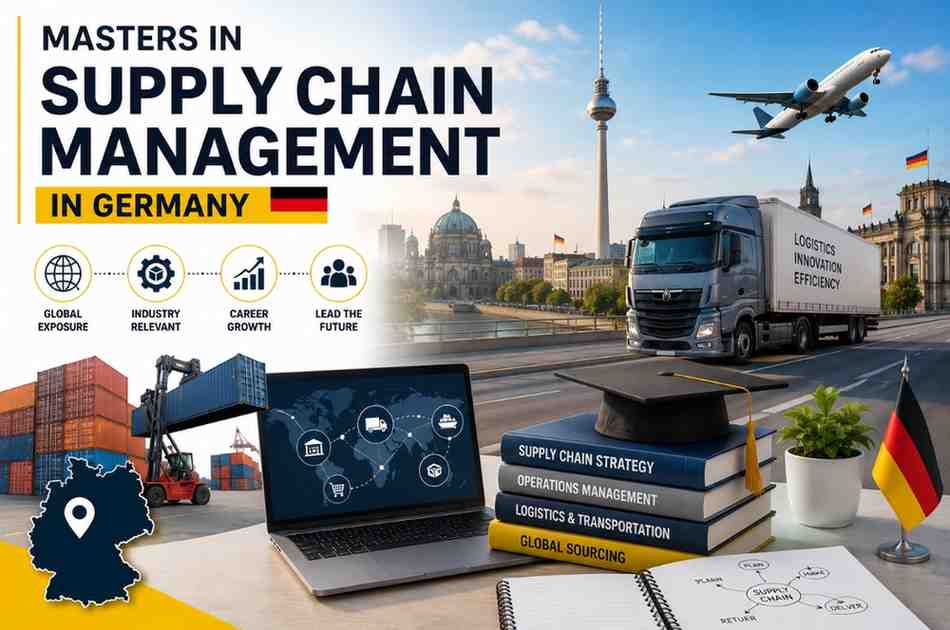
A masters in supply chain management in Germany trains you to plan, move, and control the flow of goods, from raw material sourcing to final delivery. It differs from an MBA with an SCM specialization in scope:
| MSc in Supply Chain Management | MBA with SCM Specialization | |
|---|---|---|
| Focus | Technical, analytics-heavy, quantitative modeling | Managerial, leadership, cross-functional strategy |
| Typical background needed | BTech, BE, or a quantitative bachelor’s | Bachelor’s + 2–5 years’ work experience |
| Entrance exam | Rarely required | GMAT or GRE common |
| Duration | 1.5 to 2 years | 1 to 2 years |
Counselor insight: Most Indian students assume “supply chain management” is one degree. It isn’t. A BTech graduate with no work experience fits an MSc far better than an MBA-SCM, which most German business schools reserve for applicants who already have a few years on the job. If you are shortlisting a masters in supply chain management in Germany right now, this distinction should shape your entire university list, not just your final choice.

Choose your dream country
 UK
UK
 USA
USA
 Germany
 Australia
 Ireland
 Canada
 UAE
UAE
 France
 Sweden
 Italy
Italy
 Other
Other
When do you want to study abroad?
What's your highest level of education?
Have you completed Class 12th?
What was your Class 12 CGPA/percentage?
Are you a student or a parent/guardian?
What do you want to study?
Select your current city
How Leap will help you

Personalised University Shortlist

Express Applications with Quicker Admits

End-to-End Application Support
Germany is a strong choice specifically for this subject because of its industrial base. DHL, Siemens, BMW, BASF, and Volkswagen all run large-scale logistics and procurement operations out of Germany, and the Fraunhofer Institute for Material Flow and Logistics (IML) in Dortmund is a recognized global research hub for the field.
Top Universities for a Masters in Supply Chain Management in Germany
Universities offering a masters in supply chain management in Germany split cleanly into three categories: public technical universities, private business schools, and specialized logistics institutes.
| University | Program | Type | Approx. Annual Tuition | GMAT/GRE |
|---|---|---|---|---|
| Technical University of Munich (TUM) | Master in Management & Technology (Operations & SCM track) | Public | Rs.33,000–49,500 (€300–450 semester fee) | Not required |
| University of Mannheim | Mannheim Master in Operations & Supply Chain Management (MMOSCM) | Public | Rs.27,500–38,500 (€250–350 semester fee) | Not required |
| WHU – Otto Beisheim School of Management | MSc in Management (Supply Chain Management track) | Private | Rs.22.2–24.2 lakh (€20,200–22,000) | Often required |
| Frankfurt School of Finance & Management | Master in Management (Digital Business, Technology & Operations concentration) | Private | Rs.19.5 lakh (€17,750) | Accepted, not mandatory |
| Kühne Logistics University (KLU), Hamburg | MSc Global Logistics & Supply Chain Management | Private | Rs.16.5–22 lakh (€15,000–20,000) | Not required |
Counselor insight: WHU and KLU are ranked among Europe's strongest for SCM-specific research and industry placement, but neither charges public-university fees. If budget is the deciding factor, TUM and Mannheim deliver comparable industry access at a fraction of the cost.
Cost of Studying Masters in Supply Chain Management in Germany
Tuition and fees:
| Cost Component | Public University | Private University |
|---|---|---|
| Tuition fee | None (semester contribution only) | Rs.11–22 lakh/year (€10,000–20,000) |
| Semester contribution | Rs.7,700–47,300/semester (€70–430) | Rs.7,700–47,300/semester (€70–430), added on top of tuition |
| Blocked account (visa proof) | Rs.13.09 lakh/year (€11,904), per DAAD | Rs.13.09 lakh/year (€11,904), per DAAD |
Living costs (source: DAAD official cost-of-living data):
- Average monthly spend: Rs.96,360 (€876), based on DAAD's 2023 social survey
- Visa financial-proof requirement: Rs.1,09,120/month (€992)
- Typical range across German cities: Rs.99,000–1,32,000/month (€900–1,200)
Counselor insight: Families budgeting for this program consistently underestimate the blocked account requirement. It's not an optional buffer; German consulates will not issue a student visa without proof of Rs.13.9 lakh sitting in a blocked account, on top of whatever tuition you've already paid.
Eligibility Requirements Masters in Supply Chain Management in Germany
Eligibility for a masters in supply chain management in Germany depends heavily on which track you target, MSc or MBA-SCM.
| Requirement | MSc Track | MBA-SCM Track |
|---|---|---|
| Academic background | BTech, BE, BBA, or BCom with a quantitative component | Bachelor's in any field |
| Minimum GPA | 65%+ or equivalent (varies by university) | 60%+ typically |
| Work experience | Not required, though it strengthens applications | 2–5 years usually expected |
| English proficiency | IELTS 6.5+ or TOEFL iBT 80+ | Same |
| GRE/GMAT | Rarely required for MSc tracks | Commonly required, especially at private business schools |
Since 29 June 2026, APS India and g.a.s.t. have added the Digital Master Test (dMAT) to the APS documentation process. It does not replace your APS certificate. It is a second document inside the same file.
For a masters in supply chain management in Germany, this catches almost everyone. The affected disciplines are Engineering, Business or Management, Commerce, Accounting, Economics and Finance, which is the same list as the academic backgrounds in the eligibility table above. A BTech applying to Mannheim's MMOSCM and a BCom applying to an MBA-SCM track at Frankfurt School are both in scope.
Does the dMAT Apply to Your SCM Application?
Since 29 June 2026, APS India and g.a.s.t. have added the Digital Master Test (dMAT) to the APS documentation process. It does not replace your APS certificate. It is a second document inside the same file.
For a masters in supply chain management in Germany, this catches almost everyone. The affected disciplines are Engineering, Business or Management, Commerce, Accounting, Economics and Finance, which is the same list as the academic backgrounds in the eligibility table above. A BTech applying to Mannheim's MMOSCM and a BCom applying to an MBA-SCM track at Frankfurt School are both in scope.
Two things decide it, and neither is your university or your track:
| dMAT required? | |
|---|---|
| Winter intake, October 2026 start | No. The requirement begins with Summer Semester 2027 |
| Summer intake, April 2027 start, or any later intake | Yes, if your bachelor's is in an affected field |
| Complete APS application filed before 29 June 2026 | No, whatever your field. See the exemption rules |
| Public MSc at TUM or Mannheim | Yes, if the above applies. This is not a GMAT-style university requirement |
| Private MSc at WHU, Frankfurt School or KLU | Same. It sits with APS, not with the school |
Source: d-mat.de and APS India.
Counselor insight: This is where the "public universities rarely need entrance exams" line stops being the whole picture. That is true of the GMAT and GRE, and this article says so correctly. The dMAT is a different animal: it is an APS documentation requirement, so a tuition-free MSc at TUM with no GMAT still needs it for a 2027 intake, while a WHU applicant with a strong GMAT is not exempt either. If you are weighing the two tracks on test burden, the dMAT vs GRE comparison explains why an APS test and an admissions test behave differently in your timeline.
The practicals. The fee is Rs. 16,500 (EUR 150), non-refundable and separate from your APS fee; the full breakdown is on the dMAT exam fee page. Registration runs on the g.a.s.t. portal independently of your APS application, and seats at each test center in India are allotted first come, first served with no waitlist. Confirm your cycle on the exam dates page. The certificate follows roughly three weeks after your test date, and your score report carries no pass mark and no SCM-specific cutoff; each university weighs it independently, and only a small number currently use it as an active selection criterion. How the two documents move through one submission is set out in the APS and dMAT guide.
What it tests. Nothing from an SCM syllabus, and nothing from your BTech either. It is an aptitude paper built as a core module plus a subject module, both in English, laid out on the exam pattern page. The core module measures general analytical reasoning, and three formats account for most of the difficulty Indian candidates report, mainly because nothing in an Indian engineering or commerce degree resembles them: figure sequences, Latin squares and mathematical equations. In the introductory phase, affected applicants take the General Academic Module as their subject module.
Four focused weeks is enough. Take one mock test cold before you study anything, then work through the syllabus, drill the unfamiliar formats with sample questions, and build the schedule around the preparation plan.
Documents checklist for Masters in Supply Chain Management in Germany
| Document | India-Specific Detail |
|---|---|
| APS Certificate | Mandatory for Indian applicants before visa filing |
| IELTS/TOEFL scorecard | Most programs need IELTS 6.5+ |
| Bachelor's marksheet and provisional certificate | University-issued, not just the consolidated CGPA sheet |
| Statement of Purpose (SOP) | Program-specific, not generic |
| GMAT/GRE score (MBA-SCM only) | Check per-university requirement; see GMAT requirement for Germany master's |
| Blocked account confirmation | Rs.13.9 lakh (€11,904), confirmed per DAAD's official finance page |
Counselor insight: Book your APS certificate appointment the moment you shortlist universities. It is the single most common bottleneck in a Germany application timeline, and Indian applicants routinely underestimate how many weeks it takes to process.
Is Supply Chain Management a Good Career in Germany? Salary and Job Scope
A masters in supply chain management in Germany leads to salary bands that scale sharply with experience level. Figures below are sourced from Glassdoor Germany (2026 data):
| Role Level | Annual Salary (EUR) | Annual Salary (INR) |
|---|---|---|
| Junior Supply Chain Manager | €36,500–46,100 | Rs.40.2–50.7 lakh |
| Supply Chain Specialist | €53,000–68,250 | Rs.58.3–75.1 lakh |
| Supply Chain Manager (mid-level) | €69,500–107,400 | Rs.76.5–1.18 crore |
| Senior Supply Chain Manager | €64,375–122,600 | Rs.70.8 lakh–1.35 crore |
| Director, Supply Chain Management | €111,000–226,000 | Rs.1.22–2.49 crore |
Employers actively hiring SCM graduates: DHL, Siemens, BASF, Volkswagen, Bosch, Continental, Amazon Europe.
Stay-back and work options:
- Post-study work visa: 18 months to search for a job after graduation
- EU Blue Card: Requires a job offer meeting the salary threshold. As of January 1, 2026, the official thresholds are Rs.55.8 lakh (€50,700) for standard occupations and Rs.50.5 lakh (€45,934.20) for shortage occupations and recent graduates, confirmed by Berlin's official EU Blue Card service page
Counselor insight: A fresh SCM graduate's starting salary sits below the standard Blue Card threshold but usually clears the reduced threshold for recent graduates. This is exactly why the "recent graduate" category exists, and most students don't know to ask their employer to apply for it.
DAAD Scholarship for Masters in Supply Chain Management in Germany
The relevant program is the DAAD Study Scholarships: Master Studies for All Academic Disciplines, funded by the German Federal Foreign Office. It's a living-cost scholarship, not a tuition waiver: it pays your monthly expenses, insurance, and travel, but if you're headed to a private school like WHU, Frankfurt School, or KLU, you still fund tuition separately. At public universities like TUM or Mannheim, that gap doesn't exist since there's no tuition fee to begin with.
| Covers | Monthly stipend of Rs.1,09,120 (€992), health/accident/liability insurance, a travel allowance between India and Germany, and an annual study allowance of Rs.50,600 (€460) |
| Eligibility | Bachelor's degree completed, not older than 6 years at the deadline; admission letter from a German university (or proof of application, with the actual letter due before funding starts); no German language requirement if your program is English-taught; must not have lived in Germany for more than 15 months |
| Duration | 10 to 24 months, usually one academic year with extensions for strong academic performance |
| Deadline | Published annually on the DAAD portal, generally for funding starting the following October; confirm the exact date for your specific program each cycle |
Counselor insight: Most Indian applicants wait for their university admission letter before applying to DAAD. You don't have to wait for your admission letter; proof that you've applied is enough to start, as long as the actual admission letter arrives before your funding period begins.
Application Timeline for a Masters in Supply Chain Management in Germany
| Month (Indian academic year) | What to Do |
|---|---|
| July–August | Shortlist universities; start APS certificate booking |
| September–October | Take IELTS/TOEFL; begin SOP drafts |
| November–December | Finalize applications for Winter intake (October start) |
| January–March | Track admission decisions; apply for DAAD scholarship if eligible |
| April–May | Book visa appointment; open blocked account |
| June–July | Finalize accommodation and travel for October intake |
Counselor insight: Indian students chasing a Winter intake routinely leave APS certification until after their final semester exams. That single delay pushes an entire application cycle by a full year.
What to Do If Things Go Wrong With Your Germany SCM Application
- Missed the Winter intake deadline: Most public universities also run a Summer intake (April start); check individual program calendars rather than assuming Winter is the only option.
- IELTS score below 6.5: Some universities accept a Medium of Instruction certificate instead if your bachelor's was taught entirely in English; confirm with the specific admissions office before retaking the test.
- APS appointment delayed: APS processing backlogs are common during peak season (March–June); book at least 3 months before your application deadline, not 3 weeks.
- Visa appointment delayed after admission: German missions in India can have multi-week visa appointment backlogs; apply for your appointment the same week you receive your admission letter, not after your blocked account is fully funded.
Public vs Private Universities for Supply Chain Management in Germany: Which Is Better?
| Factor | Public University | Private University |
|---|---|---|
| Cost | Far lower (Rs.27,500–49,500/semester) | Rs.11–22 lakh/year |
| GMAT/GRE | Rarely required | Often required or preferred |
| Industry connections | Strong, but less curated | Very strong, often curriculum-embedded |
| Class size | Larger | Smaller, more personalized |
| Best for | Budget-conscious BTech graduates | Applicants with work experience and budget for private tuition |
Neither is objectively "better" for a masters in supply chain management in Germany. A public university gets you the same German work-visa pathway at a fraction of the cost. A private business school gets you a smaller cohort and deeper corporate recruiting ties at a real financial premium.
Quick detour: From tuition-free Masters programs to a €73,164 median salary and PR in 21 months, our complete Software Engineering in Germany guide maps the entire journey, fact-checked against Bitkom, BA Entgeltatlas and German law.
3 Takeaways on Masters in Supply Chain Management in Germany
- Match your track to your profile: a public MSc at TUM or Mannheim suits a final-year BTech graduate with no work experience, while WHU or Frankfurt School suits applicants with 2+ years of industry experience and GMAT scores.
- Start your APS certificate and IELTS preparation at least 8 months before your target intake. This single step causes more year-long delays than any other part of the application.
- Budget in INR before you shortlist: factor in the Rs.13.9 lakh blocked account requirement on top of tuition, since it is a strict visa condition, not an optional buffer.
Verified by: LeapScholar's Germany counseling team, with hands-on experience guiding Indian students through German university applications and visa filing.
Have questions about a masters in supply chain management in Germany? Book a free session with a LeapScholar counselor.
Frequently Asked Questions About Masters in Supply Chain Management in Germany
What is the eligibility for masters in supply chain management in Germany?
Most universities want a bachelor's in engineering, business, or another quantitative subject, usually with marks around 60 to 65% or the equivalent grade. You'll also need IELTS 6.5+ or TOEFL iBT 80+ if the program is English-taught. And don't skip the APS certificate. Every Indian applicant needs one, regardless of which university ends up on your list.
Is GRE or GMAT required for masters in supply chain management in Germany?
Not if you're applying to a public university MSc like TUM or Mannheim; most of these skip the GRE and GMAT entirely. Private schools have different requirements. WHU and the Frankfurt School often ask for a GMAT score, especially on MBA-SCM or Master in Management tracks built for applicants who already have a couple of years of work experience.
How much does a masters in supply chain management cost in Germany?
Public universities keep this refreshingly simple: just a semester contribution of Rs.27,500 to 49,500 (€250 to €450), with no separate tuition fee at all. Private business schools change that math completely. WHU, Frankfurt School, and KLU charge Rs.11 to 22 lakh (€10,000 to 20,000) a year in tuition alone, before you've even added living costs of roughly Rs.99,000 to 1,32,000 a month.
Which German universities offer masters in supply chain management in English?
TUM, University of Mannheim, WHU, Frankfurt School, and Kühne Logistics University all run fully English-taught programs in this space. You'll still need IELTS 6.5+ or TOEFL iBT 80+ at most of them, unless your bachelor's was taught entirely in English, in which case a Medium of Instruction certificate can often substitute.
Is supply chain management a good career in Germany for Indians?
It's genuinely one of the stronger post-master's paths. Germany's logistics and manufacturing base, DHL, Siemens, BMW, and Volkswagen, is constantly hiring SCM graduates. Junior roles start around Rs.40 to 51 lakh a year, climbing past Rs.2 crore at the director level, backed by a real post-study work visa and Blue Card pathway. It's exactly why so many students choose a masters in supply chain management in Germany over other European options.
What is the DAAD scholarship stipend for supply chain management students?
You're looking at Rs.1,09,120 (€992) a month, plus full health and liability insurance, a travel allowance, and Rs.50,600 (€460) as an annual study allowance. One thing worth remembering here: it doesn't touch tuition. So if you're headed to WHU or Frankfurt School, you're still funding that part on your own.
Can I get a masters in supply chain management in Germany without work experience?
For MSc tracks at public universities like TUM and Mannheim, work experience isn't a key factor. A strong quantitative bachelor's is much more important there. It's the MBA-SCM route and some private Master in Management programs where 2 or more years of experience become a genuine requirement, not just something nice to have on your application.
What happens if I miss the Winter intake deadline for Germany?
Don't panic; it isn't automatically a lost year. Several public universities also run a summer intake starting in April. That said, not every program offers both windows, so check your specific shortlisted university's calendar directly instead of assuming Winter is your only option.
What is the average salary after a masters in supply chain management in Germany?
Fresh graduates usually start between Rs.40 to 51 lakh a year as junior supply chain managers, moving up to Rs.58 to 75 lakh as a specialist within a few years. Beyond that, senior and director-level SCM professionals earn anywhere from Rs.70 lakh to over Rs.2 crore, and where you land largely depends on which masters in supply chain management in Germany track you chose and which city you work in.







Have Questions? Get Guidance to reach your Dream University
Connect with India's finest counsellors and biggest study abroad community.
Get Guidance