
Quick Read
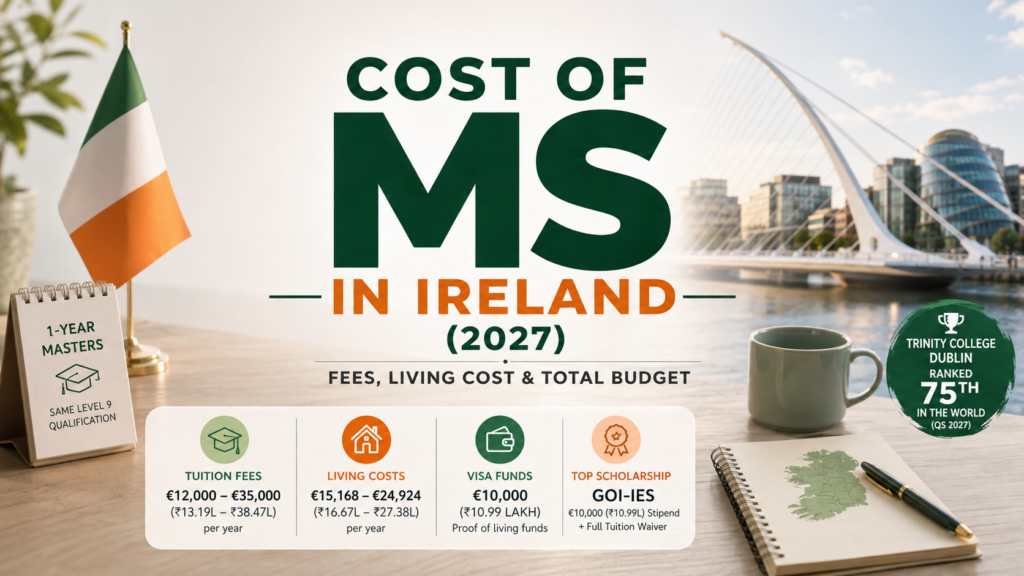
- MS tuition in Ireland runs €12,000-€35,000 (₹13.19L-₹38.47L) yearly.
- Indian students must prove ₹10.99 lakh in visa funds.
- Trinity College Dublin ranks 75th in QS 2027 rankings.
- GOI-IES scholarship offers ₹10.99 lakh stipend plus full tuition waiver.
How Much Does MS in Ireland Cost? The 2027-28 Total
The cost of MS in Ireland for Indian students has two parts: tuition and living expenses. For a 1-year MSc, the standard format at most Irish universities, the combined total falls between €25,168 and €59,924 (₹27.66 lakh to ₹65.87 lakh), depending on university, city, and course.
| Component | Annual Cost (EUR, with INR) |
| Tuition (non-EU) | €10,000-€35,000 (₹10.99L-₹38.47L) |
| Living costs | €15,168-€24,924 (₹16.67L-₹27.38L) |
| Total (1-year MS) | €25,168-€59,924 (₹27.66L-₹65.87L) |

Choose your dream country
 UK
UK
 USA
USA
 Germany
 Australia
 Ireland
 Canada
 UAE
UAE
 France
 Sweden
 Italy
Italy
 Other
Other
When do you want to study abroad?
What's your highest level of education?
Have you completed Class 12th?
What was your Class 12 CGPA/percentage?
Are you a student or a parent/guardian?
What do you want to study?
Select your current city
How Leap will help you

Personalised University Shortlist

Express Applications with Quicker Admits

End-to-End Application Support
Exchange rate: 1 EUR = ₹109.90 as of August 2026. Rates change daily; verify the live rate before finalizing your budget.
Note: If your program runs 2 years (some research master's and conversion-plus-MSc combinations do), budget roughly double: €50,336 to €119,848 (₹55.32 lakh to ₹1.32 crore) total, since Irish universities charge tuition per year, not as a flat program fee.
Counselor insight: Most students underbudget by ignoring the Student Levies and Charges (SLC) fee, typically €300-350 (₹32,970-₹38,465) a year on top of tuition. It's small, but visa officers check whether your fund proof accounts for every line item, not just headline tuition.
Source: Higher Education Authority: Free Fees Initiative
Is the Cost of MS in Ireland Cheaper Than in the USA, UK, or Germany?
This is usually the first decision point for Indian students comparing destinations.
| Country | Length | Total Cost (INR) | Key Trade-off |
| Ireland | 1 yr | ₹27.6L-₹65.9L | Shortest degree, no GRE, high Dublin living costs |
| Germany | 2 yrs | ₹15L-₹40L | Near-free tuition, but APS certificate adds delay |
| UK | 1 yr | ₹28L-₹49L | Same 1-year format, generally pricier tuition |
| USA | 2 yrs | ₹50L-₹1.1Cr | Strongest brand, double the duration and cost |
The one-year Irish MSc is the core value argument: the same Level 9 qualification that takes two years in the US, Canada, or Australia, saving roughly ₹10-15 lakh and a full extra year in the job market.
Counselor insight: Students comparing Ireland to Germany often ask why pay tuition when Germany is nearly free. The answer is time: Germany's APS certificate adds 3-4 weeks to months of processing that Ireland doesn't require, which matters if you're graduating in 2027.
Related reading: USA vs Ireland: Which Is Better for Indian Students?
Source: APS India: Official FAQs
Cost of MS in Ireland: Tuition Fees by University (2026/27 Official Figures)
Tuition is the biggest lever in your total cost of MS in Ireland, and it varies more by course type than by university prestige.
| University | Program Example | Non-EU Tuition (EUR, with INR) | QS Rank 2027 |
| Trinity College Dublin | MSc Management | €24,000 (₹26.38L) | 75 |
| University College Dublin | MSc Computer Science | €15,440 (₹16.97L) | 100 |
| University of Galway | Non-EU postgrad (varies) | €15,640-€55,000 (₹17.19L-₹60.45L) | 275 |
| Dublin City University | Non-EU postgrad (varies) | €15,900-€23,000 (₹17.47L-₹25.28L) | 408 |
Note: STEM courses sit toward the higher end; Arts and Social Science run 20-30% cheaper at the same university.
Institution type matters too: research universities (TCD, UCD, UCC) charge €14,000-€35,800 (₹15.39L-₹39.34L), Technological Universities run €13,500-€16,000 (₹14.84L-₹17.58L), and private colleges like NCI charge a flat €14,500-€17,000 (₹15.94L-₹18.68L), the low-cost end for tuition fees for masters in Ireland for international students.
Counselor insight: Don't assume a Technological University is a downgrade. In Dublin's tech corridor, employers prioritize specialization and internship records over the university that issued the degree, and recent QS rankings have narrowed the reputation gap.
Sources: TCD Trinity Business School Fees | UCD Course T102 Fees | University of Galway Fees & Funding | QS World University Rankings 2027 coverage, Irish Times
Explore related university options: Which universities in Ireland have high acceptance rates?
Cost of Living for MS Students in Ireland: Dublin vs Other Cities
The cost of living in Ireland for Indian students adds €15,168 to €24,924 (₹16.67 lakh to ₹27.38 lakh) a year on top of tuition, and where you live changes this more than what you eat.
| City | Monthly Living Cost (EUR, with INR) |
| Dublin | €1,600-€2,077 (₹1.76L-₹2.28L) |
| Galway | €1,050-€1,450 (₹1.15L-₹1.59L) |
| Cork | €1,100-€1,500 (₹1.21L-₹1.65L) |
| Limerick | €950-€1,350 (₹1.04L-₹1.48L) |
Note: Galway, Cork, and Limerick run 25-35% cheaper than Dublin, mainly since shared-flat rent outside Dublin runs roughly half the capital's rate. The cost of studying in Ireland for Indian students per month depends heavily on city choice, not just university.
Typical Monthly Expenses in Ireland
| Expense | Dublin | Outside Dublin |
| Shared accommodation | €700–€1,100 (₹76,930–₹1.21L) | €450–€700 (₹49,455–₹76,930) |
| Groceries | €250–€450 (₹27,475–₹49,455) | — |
| Transport & health insurance | €160–€240 (₹17,584–₹26,376) | — |
Counselor insight: Purpose-built student accommodation (PBSA) looks convenient online, but it's often billed in two or three lump-sum installments rather than monthly. Budgeting only the monthly figure leaves you short when the first installment of your tuition payment lands.
Source: TU Dublin Cost of Living Guide
Ireland Student Visa Funds Requirement for MS Cost Planning
No breakdown of the cost of MS in Ireland is complete without the visa fund rule since it decides whether your application is accepted.
For courses longer than 8 months, Irish Immigration Service Delivery (ISD) requires immediate access to at least €10,000 (₹10.99 lakh) for living costs, beyond tuition already proven. Shorter courses need €833/month (₹91,547/month), capped at €6,665 (₹7.32 lakh).
| Document | Requirement | India-Specific Detail |
| Bank statement | 6 months, consistent balance | Avoid "loan cycling": a large deposit before the statement window is a red flag |
| ITR (self or sponsor) | Last 2-3 assessment years | No-income graduates submit a notarised declaration and rely on sponsor ITRs |
| Loan sanction letter | RBI-registered bank/NBFC | Supports the bank statement; doesn't replace it |
| Tuition fee proof | Receipt or fee confirmation | Separate from the €10,000 (₹10.99 lakh) fund; scholarships cover tuition only |
Counselor insight: A full-tuition scholarship does not satisfy the €10,000 (₹10.99 lakh) living-fund rule. Students who assume their GOI-IES award covers everything get their visa held up, since the scholarship letter proves tuition, not living costs.
Source: Irish Immigration Service Delivery: Information on Student Finances
Related Q&A: Is 2 years ITR mandatory for an Ireland student visa? | Minimum budget for London and Ireland
For the full visa document checklist, see Ireland Student Visa Requirements.
Scholarships That Cut the Cost of MS in Ireland for Indian Students
Scholarships are the most direct way to cut the average cost of MS in Ireland, and the flagship option is government-funded.
| Scholarship | Amount | Note |
| GOI-IES (Government of Ireland) | €10,000 (₹10.99L) stipend + full tuition/registration waiver | ~60 awards annually; non-EU/EEA/UK/Switzerland applicants; 2026/27 cycle closed 12 March 2026 |
| UCD Global Excellence | 50%-100% of tuition | Automatically assessed at admission for 75%+ GPA applicants |
| Trinity College Dublin merit awards | 5%-15% tuition reduction | Awarded at offer stage, no separate application |
| University-specific merit awards | €1,000-€5,000 (₹1.10L-₹5.50L) | Most universities offer these automatically |
UCD Global's official page confirms the GOI-IES 2027/28 call hasn't opened: "information regarding 2027/28 will be provided in due course." Based on recent cycles (late-January opening, mid-March close), expect a similar window for September 2027; check hea.ie from January 2027.
Counselor insight: GOI-IES timing is unforgiving. The award ties to the September intake of the same calendar year. Apply for January 2028 instead of September 2027, and you can't use the 2027 GOI-IES cycle; the next window opens the following January.
Source: Higher Education Authority: GOI-IES Policy Page
For the full scholarship list and application strategy, see Scholarships for Masters in Ireland for International Students and the Ireland Scholarships hub.
Related Q&A: Sponsored work visa process in Ireland
Can Part-Time Work Cover Your Living Costs While Studying MS in Ireland?
International students on Stamp 2 permission can work up to 20 hours a week during term time and 40 hours during scheduled holidays (June-September, mid-December to mid-January). Ireland's minimum wage is €14.15 (₹1,555) an hour for workers aged 20+, effective 1 January 2026; a further 79-cent rise was recommended for 2027, but Budget 2027 (expected October 2026) had not confirmed it at the time of writing.
| Work Pattern | Weekly Earnings (EUR, with INR) |
| 20 hrs/week (term time) | €283 (₹31,101) |
| 40 hrs/week (holidays) | €566 (₹62,201) |
Working the maximum legal hours consistently supplements living costs meaningfully but rarely covers Dublin rent in full. Treat it as a top-up to savings, a loan, or a scholarship, not a substitute for funding on paper.
Counselor insight: Visa officers don't accept projected part-time earnings as proof of funds. Your bank statement and sponsor documents must independently satisfy the €10,000 (₹10.99 lakh) rule; work income only helps once you've landed in Ireland.
Source: Citizens Information: Minimum Wage Increases
Month-by-Month Cost of MS in Ireland and Application Planning Calendar
Mapping your MS in Ireland cost planning to the Indian academic year avoids two common failures: missing the GOI-IES deadline and starting the visa fund "seasoning" period too late.
| Month (for Sept 2027 intake) | Action |
| Aug-Sept 2026 | Shortlist universities and start IELTS prep |
| Oct-Dec 2026 | Submit applications and start the 6-month bank statement history |
| January 2027 | GOI-IES call likely opens (verify on hea.ie) |
| Feb-March 2027 | Confirm offers, pay deposit, scholarship deadlines close |
| April-May 2027 | Book VFS appointment (peak season books 2-4 weeks out) |
| June-July 2027 | Submit visa via AVATS, finalise fund documents |
| August 2027 | Receive visa decision, book flights, and book accommodation |
| September 2027 | Arrive and register for IRP within 90 days |
Miss the September 2027 window, and most universities run a January 2028 intake, though GOI-IES won't apply.
Counselor insight: The €10,000 (₹10.99 lakh) rule needs a clean 6-month bank statement history. Start building that history in month one of your timeline, not the month before your visa interview, and you will remove the single most common cause of delay.
Related reading: Ireland Intake 2026-2027: Deadlines and Application Guide
Related Q&A: When do UK/Ireland Master's applications start? | Is a Master's one year in the UK and Ireland?
If You Are Short on Funds or Miss a Deadline for MS in Ireland
Budgets slip and documents get delayed. Here's what to do in each scenario.
- Missed the GOI-IES deadline: Shift to university merit scholarships (UCD Global Excellence, TCD reductions), which run rolling deadlines with no separate application in most cases.
- Bank balance doesn't show €10,000 (₹10.99 lakh) yet: Avoid a large deposit close to your application date; this reads as "loan cycling." Get a loan sanction letter from an RBI-registered bank instead.
- Parent's ITR doesn't match the bank balance: File belated returns if within 2 years of the assessment year, ensuring the income source explains the funds shown.
- Visa refused on financial grounds: Not permanent. Address the reason cited and reapply; non-disclosure of a prior refusal can trigger a 5-year bar.
- Course fee increased before enrollment: Fees are revised annually. Budget a 5-8% buffer over the quoted figure for your actual enrollment year.
For loan options to bridge a funding gap, see Study Loan for Ireland for International Students.
Related Q&A: Visa fee refund if Ireland application rejected
Which Budget Bracket Fits Your MS in Ireland Plan?
- If your family budget is ₹28-45 lakh: Target a Technological University, a private college like NCI, or a non-Dublin public university (Galway, Cork) for Business, Arts, or Data Analytics. This bracket doesn't comfortably cover STEM at Trinity or UCD once Dublin living costs are added.
- If your family budget is ₹45-65 lakh: STEM or Business at UCD, UCC, Galway, or DCU is realistic, including Dublin with shared accommodation outside the city centre. This scenario is where a merit scholarship (UCD Global Excellence, TCD reduction) makes the most practical difference.
- If your family budget is ₹65 lakh or more: Trinity or UCD in Dublin, including higher-cost STEM and Business programs, is realistic without scholarship dependency. The decision is less about affordability and more about weighing QS rank and department strength against the high cost of living in Dublin.
Counselor insight: Students consistently overestimate university brands and underestimate city cost of living. A Trinity offer on a ₹45 lakh budget usually means a compromise on accommodation quality that hurts study time far more than a slightly lower-ranked Galway degree would.
3 Takeaways on Cost of MS in Ireland for Indian Students
- Budget ₹27.6 lakh to ₹65.9 lakh for a 1-year MS in Ireland, and confirm your specific university's fee on its official page rather than relying on averaged ranges.
- You need immediate, provable access to €10,000 (₹10.99 lakh) in living funds through 6 months of clean bank statements, entirely separate from tuition proof or scholarship letters.
- If eligible, apply for the GOI-IES scholarship in the January-March window tied to your intake year. Missing it means waiting a full cycle, since the award does not carry over to a later intake.
Verified by: LeapScholar's Ireland counseling team, with hands-on experience guiding students through GOI-IES applications, merit-waiver processes, and INIS visa documentation.
Have questions about the cost of MS in Ireland? Book a free session with a LeapScholar counselor.
Frequently Asked Questions About the Cost of MS in Ireland for Indian Students
-
How much does MS in Ireland cost for Indian students in total?
A standard 1-year program costs €25,168-€59,924 (₹27.6L-₹65.9L) in total: non-EU tuition of €10,000-€35,000 (₹10.99L-₹38.47L) plus living costs of €15,168-€24,924 (₹16.67L-₹27.38L). STEM programs in Dublin sit toward the higher end; Arts and Business outside Dublin sit lower.
-
What is the cheapest university in Ireland for MS?
Technological universities and private colleges like NCI offer the lowest non-EU tuition, €13,500-€17,000 (₹14.84L-₹18.68L). Galway, Cork, and Limerick also have living costs that are 25-35% lower than Dublin.
-
How much bank balance is required for an Irish student visa?
For courses longer than 8 months, you need at least €10,000 (₹10.99 lakh) in immediate access for living costs, in addition to proven tuition. Show this via 6 months of consistent bank statements, not a single large recent deposit.
-
Is the cost of MS in Ireland cheaper than the USA or Australia?
Yes, generally. Irish MSc programs run for 1 year against the USA's and Australia's typical 2, saving roughly ₹10-15 lakh combined even though annual Irish tuition itself isn't the cheapest. Compared to the UK, Ireland's tuition is broadly similar or slightly lower for equivalent 1-year programs.
-
Are there scholarships to reduce the cost of MS in Ireland?
Yes. GOI-IES offers a €10,000 (₹10.99 lakh) stipend plus full tuition waiver for around 60 students annually. UCD and Trinity also offer automatic merit-based reductions of 5%-100%, assessed at the time of admission.
-
How much does it cost to live in Dublin as a student?
According to TU Dublin's official data, living costs in Dublin range from €1,600 to €2,077 a month (₹1.76L to ₹2.28L), which is 25-35% higher than in Galway, Cork, or Limerick, mainly due to steeper shared-accommodation rent.
-
Can I work part-time in Ireland to cover my living costs?
Up to 20 hours a week during term and 40 during holidays, at €14.15 (₹1,555) an hour. This supplements your budget meaningfully but won't fully cover Dublin rent, and visa officers don't count projected work income toward the €10,000 (₹10.99 lakh) requirement.
-
What is included in the cost of MS in Ireland besides tuition and rent?
Groceries (€250-€450/month, ₹27,475-₹49,455), transport and insurance (€160-€240/month, ₹17,584-₹26,376), and a student levies and charges fee of €300-€350 (₹32,970-₹38,465) a year, which many students forget to budget for.
-
What happens if I can't show the full €10,000 (₹10.99 lakh) for my Ireland visa?
Avoid a large lump-sum deposit shortly before applying; this reads as "loan cycling." Combine savings with a letter confirming your education loan from an RBI-registered bank, and make sure sponsor ITR income logically matches the funds shown.
-
Is a 1-year master's in Ireland cheaper than a 2-year program elsewhere?
Yes. A 1-year Irish MSc means one year of tuition and living costs instead of two years. That's why the average cost of a master's in Ireland compares well with 2-year destinations, even though annual Irish tuition alone isn't the lowest.








Have Questions? Get Guidance to reach your Dream University
Connect with India's finest counsellors and biggest study abroad community.
Get Guidance