
Quick Read
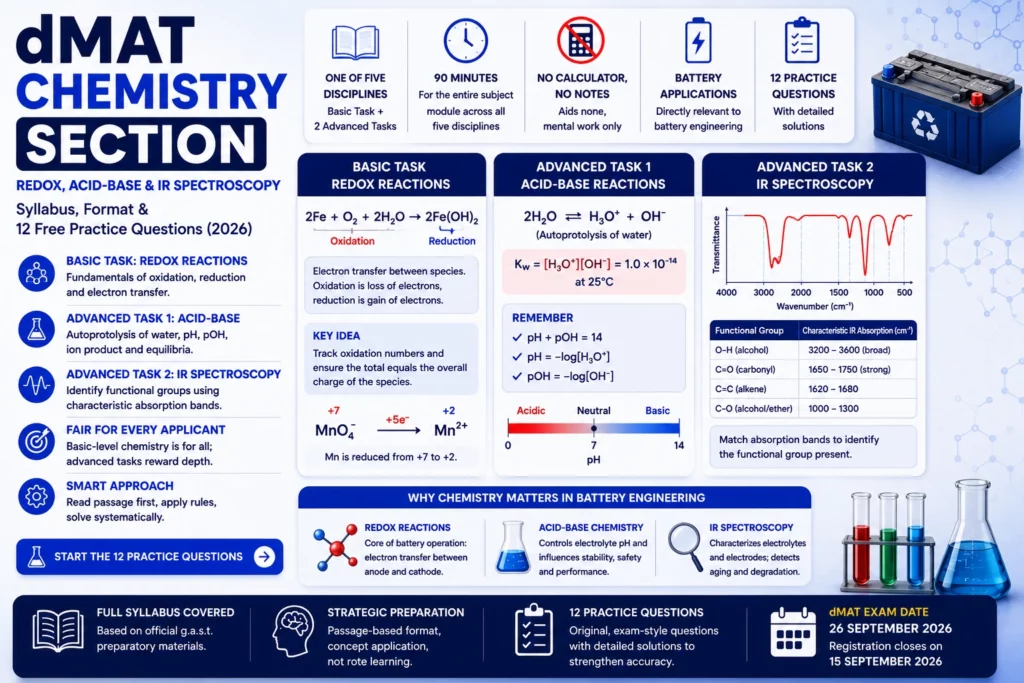
- Chemistry is one of five disciplines in the dMAT Battery Science module, tested in the Basic Task plus two Advanced Tasks
- Basic Task: redox reactions. Advanced Tasks: acid-base reactions, then infrared spectroscopy
- Both advanced topics map to real battery engineering: acid-base to electrolyte pH, IR spectroscopy to characterizing electrolytes and electrode ageing
- Basic-level chemistry is fair game for every applicant regardless of degree; the advanced tasks are where a chemistry or chemical engineering background pays off
- Method: read the passage for stated rules first, track oxidation numbers by tallying to the overall charge, and keep pH + pOH = 14 ready for acid-base questions
- Attempt 12 free practice questions below using this method
This guide sets out what the chemistry module covers, based on the official g.a.s.t. preparatory materials, and gives you 12 practice questions to work through before test day, which is set for 26 September 2026.
What Is the dMAT Chemistry Section?
The subject module tests five engineering areas: chemistry, physics, computer science, electrical engineering, and mechanical engineering. Chemistry sits inside a Basic Task, which every applicant sits in regardless of degree, and two Advanced Tasks, which go substantially deeper.
Basic Task: Redox Reactions.
The Basic Task builds from the older idea of oxidation and reduction (oxidation as combining with oxygen and reduction as losing it) to the modern definition: any reaction where electrons move between species. Iron rusting is oxidation; mercury oxide breaking down is reduction. The thermite reaction, in which aluminum reduces iron oxide while itself being oxidized, is the textbook example of both at once.
Advanced Task 1: Acid-Base Reactions
This centres on the autoprotolysis of water, two water molecules reacting so one hands a proton to the other, producing hydronium and hydroxide ions. From there, the material builds to pH, pOH, the ion product of water, and how acid/base strength determines which way an equilibrium lies.
Advanced Task 2: Infrared Spectroscopy
It is about reading a spectrum. Molecular bonds stretch and bend at frequencies set by bond strength and atomic mass, and matching an absorption band to a known frequency range identifies the functional group that produced it.
Battery cells are redox systems, controlled electron transfer between anode and cathode. Electrolyte chemistry depends on acid-base behavior and pH. IR spectroscopy is a standard tool for characterizing electrolytes, electrode coatings, and aging breakdown products. This is the exact undergraduate chemistry a battery engineering program relies on from year one.
How to Solve dMAT Chemistry Questions
Read the passage before you look at the questions. Chemistry passages in this module tend to state the rules you need explicitly (the sign convention for an oxidation number, the definition of Kw, and the frequency range for a functional group), so your first read should be about locating those rules, not solving anything yet.
Track oxidation numbers with a quick mental tally. Assign the ones you know for certain (oxygen at -2, hydrogen at +1) first, then use the fact that the total must equal the overall charge, zero for a neutral molecule or the ion charge for a polyatomic ion, to solve for the one you do not know.
For acid-base questions, keep pH plus pOH equal to 14 and the ion product of water, Kw, equal to 1.0 10⁻¹⁴ at 25 degrees Celsius, ready to use immediately. Most questions here require just one substitution to get an answer once you have the right relationship in front of you.
For infrared spectroscopy, do not try to memorize every possible absorption frequency. Learn the handful that come up constantly: a broad band above 3200 cm⁻¹ for O-H, a sharp strong band near 1700 cm⁻¹ for a carbonyl group, and the general rule that lighter atoms and stronger bonds both push a vibration higher.
Finally, use elimination. With four options and one correct answer, you often get to the right choice faster by ruling out two clearly wrong options before finishing the calculation than by working through every option in full.
dMAT Chemistry Practice Questions with Answers (Free)
The 12 questions below cover all three chemistry topics: redox basics and oxidation numbers, identifying whether a given reaction is redox, acid-base chemistry built around the autoprotolysis of water, and infrared spectroscopy. Each set opens with a short passage, the same format the real exam uses, followed by three questions and a full solution path.
Work through them without notes and without a calculator, exactly as the exam requires.
📄 Input 1 · Redox Basics and Oxidation Numbers
An oxidation number is assigned to every atom in a compound to track electron distribution. Oxygen is almost always −2. Hydrogen is normally +1. An element on its own, uncombined with anything else, has an oxidation number of 0. Across a neutral molecule, oxidation numbers must sum to zero; across a polyatomic ion, they must sum to the ion's overall charge. Questions 1 to 3 refer to this input.
Question 1 Easy
In the reaction 2Mg + O2 → 2MgO, what happens to the oxidation number of magnesium?
- a) It increases from 0 to +2, so magnesium is oxidised
- b) It decreases from 0 to −2, so magnesium is reduced
- c) It stays at 0, unchanged throughout
- d) It increases from +2 to +4, so magnesium is oxidised further
✦View Solution PathHide Solution Path▼
Answer: a. Magnesium starts as the free element, so its oxidation number is 0. In MgO it forms a +2 ion, so its oxidation number rises to +2. An increase in oxidation number means electrons have been lost, and losing electrons is oxidation.
Question 2 Medium
What is the oxidation number of nitrogen in the nitrate ion, NO3−?
- a) +3
- b) +4
- c) +5
- d) +6
✦View Solution PathHide Solution Path▼
Answer: c. Each of the three oxygens carries −2, giving a total of −6. The ion's overall charge is −1, so the oxidation numbers must sum to −1. Nitrogen must therefore be +5, since +5 plus −6 equals −1.
Question 3 Hard
What is the oxidation number of chromium in the dichromate ion, Cr2O72−?
- a) +7
- b) +3
- c) +4
- d) +6
✦View Solution PathHide Solution Path▼
Answer: d. Seven oxygens at −2 each total −14. The ion's overall charge is −2, so the two chromium atoms together must contribute +12 to reach −2 overall. Dividing +12 between the two chromium atoms gives +6 each.
📄 Input 2 · Identifying Whether a Reaction Is Redox
A redox reaction is any reaction in which electrons transfer from one species to another, shown by a change in oxidation number between reactants and products. Many reactions look dramatic, with gas released, heat given off or a precipitate forming, without any oxidation number changing at all. The only reliable test is to compare oxidation numbers before and after. Questions 4 to 6 refer to this input.
Question 4 Easy
Which of these four reactions is a redox reaction?
- a) AgNO3(aq) + NaCl(aq) → AgCl(s) + NaNO3(aq)
- b) Zn(s) + 2HCl(aq) → ZnCl2(aq) + H2(g)
- c) BaCl2(aq) + Na2SO4(aq) → BaSO4(s) + 2NaCl(aq)
- d) NaOH(aq) + HCl(aq) → NaCl(aq) + H2O(l)
✦View Solution PathHide Solution Path▼
Answer: b. Zinc goes from an oxidation number of 0 as the free metal to +2 in ZnCl2, while hydrogen goes from +1 in HCl to 0 in H2. Both change, so electrons have moved. The other three are exchange reactions between ions: every element keeps the same oxidation number on both sides.
Question 5 Medium
In the combustion of methane, CH4 + 2O2 → CO2 + 2H2O, what is the change in the oxidation number of carbon?
- a) It decreases from +4 to −4
- b) It increases from −4 to +4
- c) It stays at −4 throughout
- d) It increases from −2 to +2
✦View Solution PathHide Solution Path▼
Answer: b. In CH4, each hydrogen is +1, so four hydrogens total +4, and the molecule is neutral, so carbon must be −4. In CO2, each oxygen is −2, so two oxygens total −4, and carbon must be +4 for the molecule to be neutral. Carbon rises from −4 to +4, so it is oxidised.
Question 6 Hard
Calcium carbonate reacts with hydrochloric acid: CaCO3 + 2HCl → CaCl2 + H2O + CO2. Despite the vigorous fizzing as carbon dioxide is released, is this a redox reaction?
- a) Yes, because a gas is evolved
- b) Yes, because hydrochloric acid always causes electron transfer
- c) No, because none of the elements change oxidation number
- d) No, because acids can never take part in redox reactions
✦View Solution PathHide Solution Path▼
Answer: c. Checking each element: calcium stays +2, carbon stays +4, oxygen stays −2, and hydrogen stays +1 on both sides. No oxidation number changes, so no electrons have moved, however dramatic the fizzing looks. Option d is also wrong as a general rule, since acids do take part in redox reactions elsewhere, such as with reactive metals.
📄 Input 3 · Acid-Base Reactions and Autoprotolysis of Water
Water can react with itself: two water molecules undergo autoprotolysis, 2H2O → H3O+ + OH−, where one molecule donates a proton and behaves as an acid while the other accepts it and behaves as a base. The ion product of water, Kw, equals [H3O+][OH−] and is 1.0 × 10⁻¹⁴ at 25 degrees Celsius. pH is defined so that pH plus pOH equals 14 at this temperature. Questions 7 to 9 refer to this input.
Question 7 Easy
In the autoprotolysis reaction 2H2O → H3O+ + OH−, one water molecule donates a proton and behaves as an acid. What species does that molecule become?
- a) OH−
- b) H3O+
- c) H2O, unchanged
- d) H+, as a free ion in solution
✦View Solution PathHide Solution Path▼
Answer: a. An acid that donates a proton becomes its conjugate base. When a water molecule loses a proton, it is left with one fewer hydrogen and an extra negative charge, which is the hydroxide ion, OH−. The proton itself is picked up by the second water molecule to form H3O+.
Question 8 Medium
A solution has [H3O+] = 1 × 10⁻³ mol/L. What is its pOH?
- a) 3
- b) 7
- c) 14
- d) 11
✦View Solution PathHide Solution Path▼
Answer: d. [H3O+] = 1 × 10⁻³ mol/L gives a pH of 3. Since pH plus pOH equals 14, pOH = 14 − 3 = 11.
Question 9 Medium
A solution has [OH−] = 2.0 × 10⁻⁵ mol/L. Using Kw = 1.0 × 10⁻¹⁴, what is [H3O+]?
- a) 5.0 × 10⁻¹⁰ mol/L
- b) 2.0 × 10⁻¹⁰ mol/L
- c) 5.0 × 10⁻⁹ mol/L
- d) 2.0 × 10⁻⁹ mol/L
✦View Solution PathHide Solution Path▼
Answer: a. Rearranging Kw = [H3O+][OH−] gives [H3O+] = Kw ÷ [OH−] = (1.0 × 10⁻¹⁴) ÷ (2.0 × 10⁻⁵) = 5.0 × 10⁻¹⁰ mol/L.
📄 Input 4 · Infrared Spectroscopy and Functional Groups
Molecular bonds stretch and bend at frequencies that depend on bond strength and on the mass of the atoms involved: lighter atoms and stronger bonds both push the vibration to a higher wavenumber. Infrared spectroscopy reads these vibrations as absorption bands and matches them to known functional groups. Questions 10 to 12 refer to this input and the table below.
| Functional group | Approximate band | Character |
|---|---|---|
| O−H (alcohol or acid) | 3200 to 3550 cm−1 | broad |
| N−H (amine) | 3300 to 3500 cm−1 | medium, often two bands |
| C−H (alkane) | 2850 to 3000 cm−1 | sharp |
| C=O (carbonyl) | 1680 to 1750 cm−1 | strong, sharp |
Question 10 Easy
Which functional group is responsible for a strong, sharp absorption band near 1700 cm−1?
- a) O−H of an alcohol
- b) C=O of a carbonyl group
- c) C−H of an alkane
- d) N−H of an amine
✦View Solution PathHide Solution Path▼
Answer: b. The table lists the carbonyl C=O band at 1680 to 1750 cm−1, described as strong and sharp, matching a band near 1700 cm−1 directly. The other three groups all absorb at noticeably higher wavenumbers.
Question 11 Medium
A spectrum shows a broad band at about 3100 cm−1, overlapping with sharper bands near 2900 cm−1, plus a strong sharp band at 1715 cm−1. Which functional group set is most consistent with this spectrum?
- a) An alcohol only
- b) A ketone only
- c) A carboxylic acid
- d) A primary amine
✦View Solution PathHide Solution Path▼
Answer: c. A carboxylic acid carries both an O−H group and a C=O group. Its O−H stretch is broad and sits low enough to overlap the C−H region, and its carbonyl gives the strong sharp band near 1715 cm−1. An alcohol alone would not explain the carbonyl band, and a ketone alone would not explain the broad O−H band.
Question 12 Hard
A C−H stretch typically absorbs near 2900 cm−1, while an O−H stretch absorbs at a noticeably higher wavenumber, near 3400 cm−1, even though the two bonds are of broadly comparable strength. What best accounts for the higher wavenumber of the O−H stretch?
- a) Oxygen is more electronegative, which always raises the frequency regardless of atomic mass
- b) O−H bonds are always weaker than C−H bonds
- c) The O−H stretch is not a real vibration, only an overtone of another band
- d) Vibration frequency depends on the mass of the bonded atoms as well as bond strength, and both O−H and C−H involve the same light hydrogen atom paired with heavier partners of similar mass
✦View Solution PathHide Solution Path▼
Answer: d. The passage states that vibration frequency depends on both bond strength and the mass of the atoms involved. Since carbon and oxygen have similar mass, the difference between the two stretches comes down to bond strength rather than mass alone, and the O−H bond is in fact the stronger of the two, which is consistent with its higher wavenumber. Options a, b and c each contradict a stated part of the passage.
Who Must Take the dMAT Chemistry Section?
Everyone assigned the module sits the Chemistry Basic Task, a mechanical or electrical engineer isn’t let off redox reactions any more than a chemist is let off Fourier series or the Rankine cycle. Basic-level material is accessible to any engineering graduate with first-year chemistry behind them.
Your background matters in the Advanced Tasks. Chemistry or chemical engineering graduates should find acid-base equilibria and IR spectroscopy familiar territory and can pick up marks others find harder to reach from the passage alone. If chemistry isn’t your focus, the passage supplies most of what you need; what’s tested is application under time pressure, not memorization.
dMAT Chemistry Syllabus: Basic and Advanced Tasks
| Layer | Topic | What it tests |
|---|---|---|
| Basic Task | Redox reactions | Oxidation numbers, electron transfer, recognising which reactions are and are not redox |
| Advanced Task 1 | Acid-base reactions | Autoprotolysis of water, pH and pOH, conjugate acid-base pairs, acid and base strength |
| Advanced Task 2 | Infrared spectroscopy | Matching absorption bands to functional groups, how bond strength and atomic mass affect vibration frequency |
The one test that matters: if an oxidation number changes between reactants and products, electrons have moved, and the reaction is redox. If nothing changes, it isn’t, however dramatic the fizzing or color change looks.
Quick reference: oxygen is almost always −2, hydrogen is normally +1, an uncombined element is 0, and a neutral molecule’s oxidation numbers sum to zero.
dMAT Chemistry Study Plan Before 26 September 2026
With dMAT registration closing on 15 September 2026 and the exam itself on 26 September, here is how to spend your chemistry preparation time across a four-week run-up, alongside your work on the other four disciplines.
| Week | Focus |
|---|---|
| 1: Diagnose | Attempt the 12 practice questions cold. Note whether Basic Task (oxidation numbers, identifying redox) or the Advanced Tasks cost the most time |
| 2: Rebuild Basic Task | One evening on oxidation number rules and the redox-vs.-non-redox distinction, a refresher, not new learning |
| 3: Go deep | If chemistry is your background: pH/pOH calculations and IR spectra reading are automatic. If not: lighter pass, prioritize your own discipline’s advanced areas |
| 4: Rehearse conditions | Timed, no notes, no calculator, on-screen. Chemistry is one-fifth of the 90-minute subject test; practice the actual per-passage time budget |
Frequently Asked Questions About the dMAT Chemistry Section
Do I need a chemistry degree to do well on this section?
No, not for the Basic Task, which is redox reactions and is designed to be accessible to any engineering graduate. The two Advanced Tasks go deeper, and this is where a chemistry or chemical engineering background helps more.
Will I need to balance full chemical equations?
The published materials focus on oxidation numbers, identifying redox behavior, acid-base relationships, and reading IR spectra, rather than balancing complex equations from scratch.
Is a periodic table provided?
The official materials do not describe supplying one, and no calculator or other tool is permitted anywhere in the dMAT. Passages that require a specific atomic mass or electronegativity value typically state it directly.
How does the chemistry section relate to actual battery science?
Directly. Battery cells work through redox reactions at the electrodes; electrolyte behavior depends on acid-base chemistry and pH, and infrared spectroscopy is a standard technique for analyzing electrolytes and electrode materials.
What if I studied chemistry a long time ago and feel rusty?
Redox, acid-base equilibria, and IR spectroscopy are first- and second-year undergraduate topics in most chemistry and chemical engineering programs. A focused week of revision is usually enough to bring them back.









Have Questions? Get Guidance to reach your Dream University
Connect with India's finest counsellors and biggest study abroad community.
Get Guidance