
Quick Read
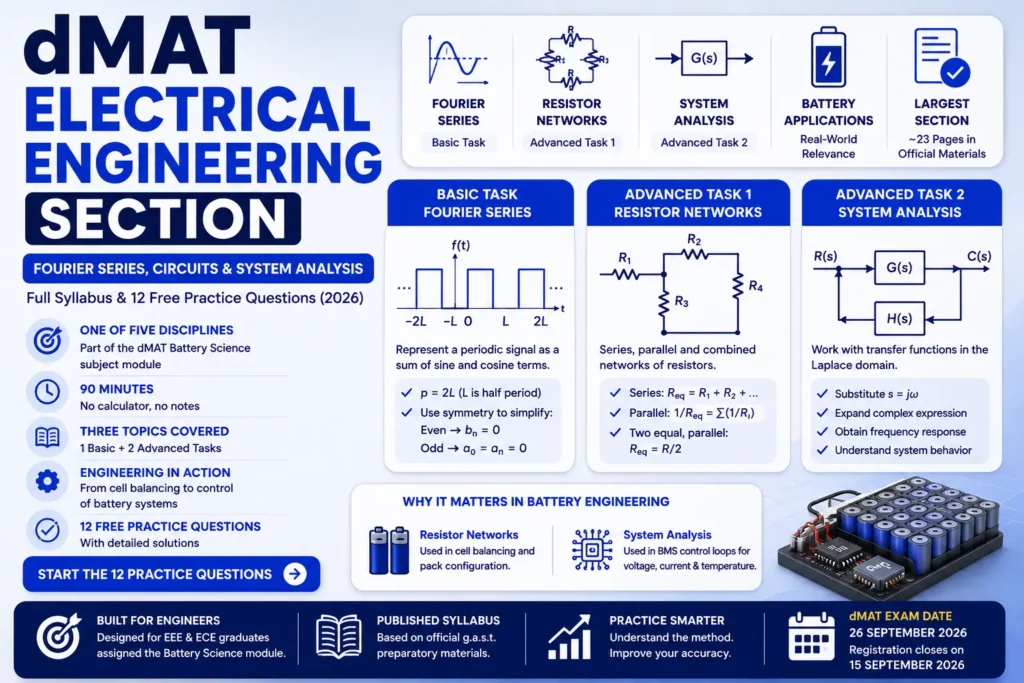
- Electrical Engineering is one of five disciplines in the dMAT Battery Science module, tested in the Basic Task plus two Advanced Tasks
- Basic Task: the Fourier series. Advanced Tasks: series/parallel resistor networks, and system analysis via transfer functions
- Longest of the five discipline sections (~23 pages in the official materials), budget more revision time here
- Both advanced topics map to real battery engineering: resistor networks to cell balancing, system analysis to battery management control loops
- Method: check signal symmetry before calculating, convert period to L immediately, trace circuit topology before applying formulas
- Attempt 12 free practice questions below using this method
This guide walks through what each part in this module actually asks, why it sits inside a battery-focused exam at all, and gives you 12 original practice questions with full solution paths so you can check where you stand before test day.
What Is the dMAT Electrical Engineering Section?
The dMAT Battery Science subject module has two layers. The Basic Task gives every candidate one foundation topic in each of five engineering areas, electrical engineering being one of them. The Advanced Tasks then go deeper, with two topic sets per discipline, ten in total across the module.
Basic Task: Fourier series
A periodic signal repeats: f(t + p) = f(t). By convention p = 2L, so L is always half the period. A Fourier series models the signal as a sum of trigonometric terms; the larger n, the closer the fit.
| Term | What it does |
| a0 ÷ 2 | The model’s mean value |
| a_n, b_n | Fit the cosine/sine terms to the signal’s shape |
| Even function (f(-t) = f(t)) | Every b_n = 0 |
| Odd function (f(-t) = -f(t)) | a0 and every a_n = 0 |
Advanced Task 1: Resistor Networks.
Resistors combine differently depending on arrangement.
| Arrangement | Rule |
| Series | Resistances add directly |
| Parallel | Reciprocals add up: 1/total = Σ(1/each) |
| Two equal resistors, parallel | Combine to exactly half one resistor’s value |
Advanced Task 2: System Analysis.
The harder of the two advanced topics. This topic works with transfer functions in the Laplace domain and describes system response without solving a time-domain differential equation. The key move is to substitute s = jω into the transfer function and expand the resulting conjugate complex expression, and you get the frequency response. This connects to battery work through control loops reacting to voltage, current, and temperature in real time.
How to Solve dMAT Electrical Engineering Questions
- Check symmetry before you calculate anything. If a Fourier series question describes or graphs a signal, spend five seconds deciding whether it is even, odd, or neither. That single check can eliminate half the terms you would otherwise need to find.
- Keep the p = 2L convention in mind. A common way to lose an obvious mark is reading the period off the passage and forgetting that the formulas use L, which is half of it. Convert immediately, before touching any other calculation.
- Identify the circuit topology before you apply a formula. With resistor networks, the biggest time cost is misreading which resistors are in series and which are in parallel within a combined network. Trace the current path, even mentally, before you add or reciprocal-add anything.
- Treat s = jw as a substitution, not a new topic. System analysis questions often test whether you understand that the frequency response is the same transfer function evaluated along a specific line in the complex plane, rather than an unrelated formula to memorize separately.
- Use elimination when the algebra gets heavy. System analysis can involve several steps of complex arithmetic. If a sanity check, such as a si.gn or an order of magnitude, rules out two of the four options, you often do not need to complete the full expansion.
- Budget more time for these passages. The electrical engineering material is denser than the other four discipline sections, with more formulas and notation per line. Read once for structure, then return for the specific numbers each question needs.
dMAT Electrical Engineering Practice Questions with Answers
The 12 questions below are split into four input sets of three: periodic signals and p = 2L, the Fourier coefficients, even and odd function shortcuts, and series and parallel resistor networks. Every question is original, written to test the same reasoning the official materials test without reusing their wording, figures, or numbers.
📄 Input 1 · Electrical Engineering: Periodic Signals and the Period p = 2L
A signal f(t) is periodic when f(t + p) = f(t) for every t, where p is the period, the time after which the pattern repeats exactly. Alternating current is a familiar periodic signal. Fourier analysis writes this period using the convention p = 2L, so L is always half of p, and the trigonometric terms in the series are built from arguments involving L. Battery packs also show periodic behaviour, for example in repeated charge-discharge cycling, which is part of why signal theory sits inside a battery-focused syllabus. Questions 1 to 3 refer to this input.
Question 1 Easy
A charge current waveform is found to repeat every 20 ms. Expressed in the p = 2L convention used in Fourier analysis, what is L for this signal?
- a) 10 ms
- b) 20 ms
- c) 40 ms
- d) 5 ms
✦View Solution PathHide Solution Path▼
Answer: a. The convention is p = 2L, so L = p ÷ 2. With p = 20 ms, L = 20 ÷ 2 = 10 ms.
Question 2 Medium
A signal has L = 9 ms in the p = 2L convention. If the signal is measured at t0 = 5 ms, at which of these times will it next take the same value purely by periodicity?
- a) 14 ms
- b) 23 ms
- c) 27 ms
- d) 9 ms
✦View Solution PathHide Solution Path▼
Answer: b. The period is p = 2L = 2 × 9 = 18 ms. By definition f(t + p) = f(t), so the value at t0 = 5 ms recurs at t0 + p = 5 + 18 = 23 ms.
Question 3 Hard
An engineer confirms that a voltage signal satisfies f(t + 15) = f(t) for all t, and also f(t + 25) = f(t) for all t. Both 15 and 25 are therefore periods of the signal. What is the value of L, in the p = 2L convention, for the fundamental (smallest) period?
- a) 5
- b) 10
- c) 2.5
- d) 20
✦View Solution PathHide Solution Path▼
Answer: c. If two numbers are both periods of the same signal, the fundamental period divides both of them, and is found from their greatest common divisor. Here that is the greatest common divisor of 15 and 25, which is 5. So the fundamental period p = 5, and L = p ÷ 2 = 2.5.
📄 Input 2 · Electrical Engineering: The Fourier Coefficients a0, an and bn
A periodic signal can be modelled as a sum of trigonometric terms, called a Fourier series. The constant term a0 divided by 2 gives the mean, or average, value of the signal. The coefficients an multiply the cosine terms and bn multiply the sine terms; together they adapt the shape of the model to match the measured signal as closely as possible. Adding more terms, that is, increasing n, always brings the model closer to the real signal. Questions 4 to 6 refer to this input.
Question 4 Easy
In a Fourier series, the term a0 ÷ 2 represents which feature of the modelled signal?
- a) The frequency of oscillation
- b) The phase shift
- c) The peak amplitude
- d) The mean (average) value of the signal
✦View Solution PathHide Solution Path▼
Answer: d. The passage states directly that a0 divided by 2 gives the mean value of the signal. It is the constant, non-oscillating part of the model.
Question 5 Medium
Which coefficients scale the cosine terms and which scale the sine terms in a Fourier series expansion?
- a) an scales cosine, bn scales sine
- b) an scales sine, bn scales cosine
- c) a0 scales both cosine and sine terms
- d) Neither; both types of term are scaled by a0
✦View Solution PathHide Solution Path▼
Answer: a. By the standard convention used throughout this topic, an is the coefficient attached to the cosine terms and bn is the coefficient attached to the sine terms. a0 is separate again, and covers only the mean value.
Question 6 Easy
A battery management engineer models a periodic voltage ripple using a Fourier series and finds the model does not fit the measured ripple closely enough. According to the passage, what is the most direct way to improve the fit?
- a) Reduce a0 to zero
- b) Increase the number of terms n included in the model
- c) Decrease the period p of the signal
- d) Remove the bn coefficients
✦View Solution PathHide Solution Path▼
Answer: b. The passage states that adding more terms, that is, increasing n, always brings the model closer to the real signal. The period itself is a property of the measured signal and is not something you can decrease to improve a fit.
📄 Input 3 · Electrical Engineering: Even and Odd Function Shortcuts
Symmetry can shorten the work of finding a Fourier series. A function is even when f(−t) = f(t), so its graph is a mirror image about the vertical axis; for an even function every bn coefficient is zero, leaving only cosine terms and the mean value. A function is odd when f(−t) = −f(t); for an odd function a0 and every an are zero, leaving only sine terms. A signal that is neither even nor odd offers no such shortcut. Questions 7 to 9 refer to this input.
Question 7 Easy
A signal satisfies f(−t) = f(t) for all t. What term describes this symmetry, and which Fourier coefficients vanish as a result?
- a) Odd; all an vanish
- b) Odd; all bn vanish
- c) Even; all bn vanish
- d) Even; all an vanish
✦View Solution PathHide Solution Path▼
Answer: c. f(−t) = f(t) is the definition of an even function. For an even function every bn coefficient is zero, so only cosine terms and the mean value remain to be found.
Question 8 Medium
A voltage waveform is confirmed to be an odd function about t = 0. Which of the following is guaranteed?
- a) bn = 0, so only cosine terms remain
- b) Both an and bn are zero
- c) The signal cannot be periodic
- d) a0 = 0 and all an = 0, so only sine terms remain
✦View Solution PathHide Solution Path▼
Answer: d. For an odd function, a0 and every an are zero, so the model is built entirely from sine terms. Being odd says nothing about whether the signal is periodic; it is a statement purely about symmetry.
Question 9 Hard
An engineer tests a periodic signal and finds that f(−t) = −f(t) is false, and f(−t) = f(t) is also false, so the signal is neither even nor odd. What can be concluded about its Fourier series?
- a) Both an and bn coefficients may be non-zero, so both cosine and sine terms are generally needed
- b) The signal has no valid Fourier series
- c) Only a0 is defined for the signal
- d) The period of the signal must be doubled before analysis is possible
✦View Solution PathHide Solution Path▼
Answer: a. The even and odd shortcuts only apply when the symmetry condition actually holds. Without either symmetry, there is no reason for a0, an or bn to vanish, so the general series, with both cosine and sine terms, is needed. This does not affect whether the signal is periodic or has a valid Fourier series at all.
📄 Input 4 · Electrical Engineering: Series and Parallel Resistor Networks
Resistors can be wired in series, in parallel, or in combinations of both. In series, resistances simply add: Rtotal = R1 + R2 + … In parallel, it is the reciprocals that add: 1 ÷ Rtotal = 1 ÷ R1 + 1 ÷ R2 + … A useful special case is two equal resistors in parallel, which always gives exactly half the value of one of them. This matters in battery packs, where balancing circuits and pack configuration both rely on deliberately combining resistors in series and in parallel. Questions 10 to 12 refer to this input.
Question 10 Medium
Three resistors of 4 ohm, 6 ohm and 10 ohm are connected in series across a pack's balancing circuit. What is the total resistance?
- a) 15 ohms
- b) 20 ohms
- c) 24 ohms
- d) 8.3 ohms
✦View Solution PathHide Solution Path▼
Answer: b. In series, resistances simply add: 4 + 6 + 10 = 20 ohms.
Question 11 Medium
Two identical 8 ohm resistors, used to balance adjacent cells in a pack, are connected in parallel. What is the combined resistance?
- a) 16 ohms
- b) 8 ohms
- c) 4 ohms
- d) 2 ohms
✦View Solution PathHide Solution Path▼
Answer: c. Two equal resistors in parallel always combine to exactly half the value of one of them. Half of 8 ohms is 4 ohms.
Question 12 Hard
A pack designer needs a 5 ohm balancing resistor but only has 20 ohm resistors in stock. How many 20 ohm resistors must be connected in parallel to obtain 5 ohms, and why?
- a) Two, because parallel connections always halve the resistance regardless of how many resistors are used
- b) Three, because the reciprocals of three equal terms average out to give 5 ohms
- c) Two, because two equal resistors in parallel always give one quarter of the value
- d) Four, because 1 ÷ Rtotal = 4 ÷ 20 gives Rtotal = 5 ohms
✦View Solution PathHide Solution Path▼
Answer: d. For n equal resistors of value R connected in parallel, the total is R ÷ n. Here 20 ÷ n = 5 requires n = 4. Checking it the other way, 1 ÷ Rtotal = 4 × (1 ÷ 20) = 4 ÷ 20 = 1 ÷ 5, so Rtotal = 5 ohms, confirming four resistors are needed.
Who Must Take the dMAT Electrical Engineering Section?
Every candidate meets the Fourier series Basic Task, regardless of degree; nobody skips a discipline at this level. This is deliberate: it keeps the basics fair across backgrounds.
Your background matters in the Advanced Tasks. Resistor networks and system analysis use notation standard to Indian EEE/ECE undergraduate programs, so an EEE/ECE degree should translate directly into marks here; just refresh the module’s specific conventions, since your department may have taught them differently.
dMAT Electrical Engineering Syllabus: Basic and Advanced Tasks
| Task | Topic | What it covers |
|---|---|---|
| Basic Task | The Fourier Series | Periodic signals and f(t + p) = f(t), the period convention p = 2L, coefficients a0, a_n and b_n, and the even and odd symmetry shortcuts |
| Advanced Task 1 | Series and Parallel Connections of Ohmic Resistors | Series addition of resistance, parallel addition of reciprocals, the equal-resistor special case, and the link to cell balancing and pack configuration |
| Advanced Task 2 | System Analysis | Transfer functions in the Laplace domain, the substitution s = jw, conjugate complex expansion, the resulting frequency response, and the link to control systems and battery management |
dMAT Electrical Engineering Study Plan Before 26 September 2026
Registration closes on 15 September 2026, ahead of the exam on 26 September. The dMAT registration fee is EUR 150, roughly Rs. 13,500 at recent exchange rates, so factor that into your planning alongside study time.
| Week | Focus |
| 1: Diagnose | Attempt the 12 practice questions above plus official low-difficulty exercises for all three topics. Identify whether gaps sit in symmetry rules, resistor arithmetic, or the s = jω substitution |
| 2: Rebuild fundamentals | Fourier series and resistor networks, one or two focused sessions, extra time on even/odd shortcuts |
| 3: Go deep on system analysis | The hardest, most fade-prone topic. Work through medium/high-difficulty exercises until the steps feel routine |
| 4: Rehearse full conditions | Timed, no notes, no calculator, on-screen. Watch d-mat.de videos. Confirm registration and documents. Plan ~3.5 hours at the test centre |
Frequently Asked Questions About the dMAT Electrical Engineering Section
Is this section only relevant if I studied EEE or ECE?
The Basic Task on the Fourier series is compulsory for everyone taking the module, whatever your degree. The two Advanced Tasks are where an electrical background gives a real advantage, but the material stays undergraduate-level and learnable by anyone.
Do I need to memorize the Fourier series formula in full?
No. The passage typically supplies the formula and values. What is tested is whether you can apply the period convention, the coefficients, and the symmetry shortcuts, not whether you can recite the series from memory.
Which Advanced Task should I prioritize if I am short on time?
Resistor networks build on arithmetic most candidates find comfortable, so they recover quickly. System analysis is more abstract and fades faster, so give it the larger share of your remaining time.
Is there negative marking?
The materials do not describe a penalty for a wrong answer; they instruct you to guess when unsure. Confirm the current position on d-mat.de before your exam date.









Have Questions? Get Guidance to reach your Dream University
Connect with India's finest counsellors and biggest study abroad community.
Get Guidance