
Quick Read
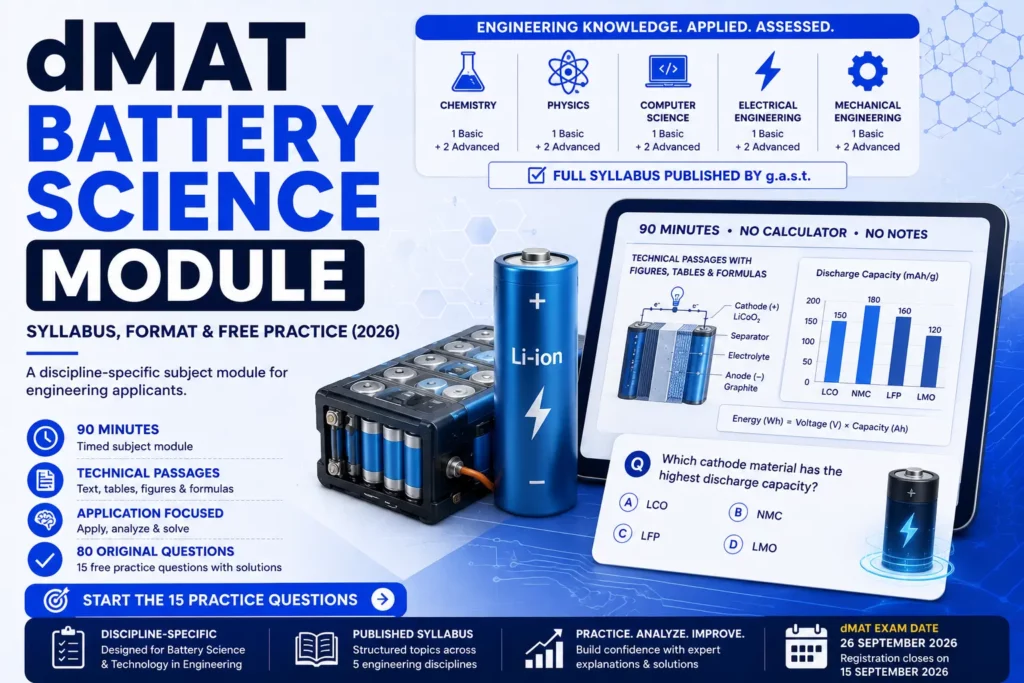
- A discipline-specific dMAT subject module, not the General Academic Module; you sit one or the other, never both
- 90 minutes: technical reading passages, four-option single-choice questions, no calculator or notes
- Covers five engineering areas: one basic topic each in chemistry, physics, computer science, electrical and mechanical engineering, plus two advanced topic sets per discipline
- A full syllabus IS published by g.a.s.t.; despite what most guidance claims
- To practice: read each passage for structure first, then answer by elimination; attempt the 15 free questions below using this method
If you have been told your dMAT includes the Battery Science and Technology in Engineering subject module, you have probably already found the frustrating part: most guidance says there is nothing published to revise from.
That is not true. g.a.s.t. publishes free preparatory materials that set out the module’s structure in detail, with worked examples and full solution paths across every topic area. This guide explains what is included in the materials and what the module actually requires of you, and it provides 15 practice questions that cover all five disciplines.
What Is the dMAT Battery Science and Technology in Engineering Subject Module?
The dMAT has two parts. The Core Module tests general study aptitude through figure sequences, mathematical equations, and Latin squares. The subject module tests whether you can apply the engineering knowledge from your Bachelor’s degree.
Battery Science and Technology in Engineering is one of those subject modules. It exists because German universities offering battery-focused Master’s programs, including RWTH Aachen’s MSc in the field, wanted a way to assess applicants from very different national education systems on comparable terms.
The module was developed by g.a.s.t. together with partner universities in Germany, and every exam is evaluated centrally at the TestDaF Institut in Bochum.
This is not the General Academic Module. That is a separate track for applicants outside these engineering fields. You will take one of these modules, but never both. If you are unsure which option applies to you, confirm it at registration rather than assuming, because the two tests are very different.
dMAT Battery Science Module Format
Each task begins with a technical reading passage, followed by several questions on it. Every question has exactly four answer options and exactly one correct answer. Passages, questions, and options may all contain figures, tables, and formulas.
You have 90 minutes for the entire subject test. You are not allowed to take notes, and no calculator or other tool is available. If you do not know an answer, the official instruction is to guess rather than leave it blank.
How to Solve dMAT Battery Science Questions
The most common misunderstanding about this module is that it is a memory test. It is not. The passage in front of you supplies most of the information you need. What is being assessed is whether you can apply undergraduate-level understanding to material you are reading for the first time.
That changes how you should prepare.
- Read the passage for structure, not detail. Note where the definitions, the formula, and the data table sit. You will come back to them for specific questions rather than needing to hold everything in your head.
- Identify what each question is actually asking. Many questions can be answered directly from one line of the passage plus one step of reasoning. Look for the single number or relationship the question turns on.
- Use elimination. With four options and one correct answer, ruling out two obviously wrong options often gets you to a confident choice faster than working the problem forward from scratch.
- Watch your pace. Ninety minutes across the whole subject test means you cannot afford to sink five minutes into one item. Mark your best guess and move on.
- Practice without notes from day one. Students who work through problems on paper build a method that collapses in the exam, where nothing is available. It feels harder at first, and it is worth it.
Who Must Take the dMAT Battery Science Module?
You will sit for this module if you are applying to a Master’s program in battery science or a closely related engineering field at a German university that uses it, and your dMAT registration assigns it to you.
Your undergraduate background matters less than the program you are applying to. The module deliberately spans five engineering disciplines at the basic level, so a mechanical engineering graduate is not disadvantaged by the chemistry section, and a chemistry graduate is not disadvantaged by the electrical engineering section.
Where your background does matter is in the advanced tasks, which go substantially deeper within each discipline.
dMAT Battery Science Syllabus: Basic and Advanced Tasks
The module has two layers, and understanding the split is the single most useful thing you can do before you start revising.
| Layer | What it covers |
|---|---|
| Basic Tasks | One foundation topic in each of the five engineering areas |
| Advanced Tasks | Two deeper topic sets per discipline, ten sets in total |
Here is the full published breakdown. Each discipline links to a full section guide with free practice questions:
| Discipline | Basic Task | Advanced Tasks |
|---|---|---|
| Chemistry | Redox reactions | Acid-base reactions; infrared spectroscopy |
| Physics | Electric circuits and Ohm’s law | Oscillations and corrections; waves and solid states |
| Computer Science | Data types and memory | Combinational logic; linear transformations of high-dimensional data sets |
| Electrical Engineering | Fourier series | Series and parallel resistor networks; system analysis |
| Mechanical Engineering | Synthetic materials | Mathematics II; the Rankine cycle |
If the topic list looks like general engineering rather than battery engineering, that is deliberate. Battery work is cross-disciplinary, and each foundation topic maps onto a real part of it: redox chemistry to cell reactions, circuits to cell behavior, data types to battery management systems, Fourier analysis to signal processing, and polymers to casings and housings. You are not expected to have studied batteries before.
dMAT Battery Science Practice Questions with Answers (Free)
The 15 questions below cover all five disciplines, three per area, at mixed difficulty. Each one includes a full solution path.
Work through them without notes and without a calculator, exactly as you will in the exam.
📄 Input 1 · Chemistry: Redox Reactions
Oxidation is the loss of electrons and reduction is the gain of electrons. When both happen together the reaction is a redox reaction. Oxidation numbers track this: an atom in an uncombined element has an oxidation number of 0, oxygen is almost always −2, and hydrogen is normally +1. A change in oxidation number between reactants and products is the signal that electrons have moved. Questions 1 to 3 refer to this input.
Question 1 Easy
In the reaction Zn + Cu2+ → Zn2+ + Cu, what happens to the zinc?
- a) It is reduced, gaining two electrons
- b) It is oxidised, losing two electrons
- c) It is unchanged, acting only as a catalyst
- d) It is both oxidised and reduced
✦View Solution PathHide Solution Path▼
Answer: b. Zinc goes from an oxidation number of 0 as the free element to +2 as Zn2+. An increase in oxidation number means electrons have been lost, and loss of electrons is oxidation. The copper ion gains those two electrons and is reduced.
Question 2 Medium
What is the oxidation number of sulphur in SO3?
- a) +2
- b) +4
- c) +6
- d) −2
✦View Solution PathHide Solution Path▼
Answer: c. Each oxygen carries −2, so three oxygens total −6. The molecule is neutral, so the oxidation numbers must sum to zero. Sulphur must therefore be +6.
Question 3 Hard
Which of these is not a redox reaction?
- a) 2 Na + Cl2 → 2 NaCl
- b) 4 Fe + 3 O2 → 2 Fe2O3
- c) 2 HgO → 2 Hg + O2
- d) NaOH + HCl → NaCl + H2O
✦View Solution PathHide Solution Path▼
Answer: d. In the neutralisation of sodium hydroxide with hydrochloric acid, every element keeps the same oxidation number on both sides, so no electrons are transferred. The other three all involve a change in oxidation number, which is the test for a redox reaction.
📄 Input 2 · Physics: Electric Circuits
Current I is measured in amperes, voltage U in volts and resistance R in ohms. Ohm's law relates them as R = U ÷ I. When resistors are connected in parallel, the total resistance is found from 1 ÷ Rtot = 1 ÷ R1 + 1 ÷ R2 + ... Resistance in a conductor converts electrical energy into heat. Questions 4 to 6 refer to this input.
| Quantity | Symbol | Unit |
|---|---|---|
| Current | I | ampere (A) |
| Voltage | U | volt (V) |
| Resistance | R | ohm |
Question 4 Easy
A 12 V supply drives a current of 3 A through a single resistor. What is its resistance?
- a) 0.25 ohms
- b) 4 ohms
- c) 36 ohms
- d) 15 ohms
✦View Solution PathHide Solution Path▼
Answer: b. Ohm's law gives R = U ÷ I, so R = 12 ÷ 3 = 4 ohms.
Question 5 Medium
Two 6 ohm resistors are connected in parallel. What is the total resistance?
- a) 12 ohms
- b) 6 ohms
- c) 3 ohms
- d) 1.5 ohms
✦View Solution PathHide Solution Path▼
Answer: c. Using 1 ÷ Rtot = 1÷6 + 1÷6 = 2÷6 = 1÷3, so Rtot = 3 ohms. For two equal resistors in parallel the total is always half of one of them.
Question 6 Hard
A third resistor is added in parallel to an existing parallel pair. What happens to the total resistance of the network?
- a) It increases, because there is more material to pass through
- b) It stays the same, because parallel branches are independent
- c) It depends on whether the new resistor is larger or smaller than the others
- d) It decreases, because another path is available for current
✦View Solution PathHide Solution Path▼
Answer: d. Every extra parallel branch adds another term to 1 ÷ Rtot, so the reciprocal grows and the total resistance falls. This is true whatever the value of the added resistor, because each new path gives current an additional route.
📄 Input 3 · Computer Science: Data Types and Memory
A variable is a named location in memory. In a typed language each variable is declared with a data type, which fixes how much memory is reserved and what range of values it can hold. Questions 7 to 9 refer to this input.
| Type | Memory | Holds |
|---|---|---|
| boolean | 1 bit | true or false |
| short | 16 bit | integers |
| int | 32 bit | integers |
| float | 32 bit | up to about 1038 |
| double | 64 bit | up to about 10308 |
Question 7 Easy
How much more memory does an int reserve than a short?
- a) Twice as much
- b) Four times as much
- c) The same amount
- d) Half as much
✦View Solution PathHide Solution Path▼
Answer: a. An int reserves 32 bits and a short reserves 16 bits, so an int uses twice the memory.
Question 8 Medium
A calculation may produce a value of roughly 10120. Which type is the smallest that can still hold it?
- a) double
- b) float
- c) int
- d) short
✦View Solution PathHide Solution Path▼
Answer: a. A float reaches only about 1038, so it cannot hold 10120. A double reaches about 10308 and is the smallest listed type that can. The integer types are far smaller still.
Question 9 Hard
Why does a string not have a fixed memory requirement in the table?
- a) Strings are stored outside memory
- b) Strings are always converted to integers before storage
- c) A string always reserves 64 bits like a double
- d) A string is a sequence of characters of any length, so its size depends on its contents
✦View Solution PathHide Solution Path▼
Answer: d. The other types hold a single value of known width, so their size is fixed at declaration. A string is a sequence of characters whose length is not known in advance, so the memory it needs depends on how many characters it actually holds.
📄 Input 4 · Electrical Engineering: Fourier Series
A periodic signal repeats over time, so that f(t + p) = f(t) where p is the period. Such signals can be modelled as a sum of trigonometric functions called a Fourier series, with coefficients an and bn adapting the model to the signal. The larger n becomes, the closer the fit. The period is written p = 2L. Symmetry simplifies the work: for an even function, whose graph is symmetric about the vertical axis, the bn coefficients are zero. For an odd function, a0 and the an coefficients are zero. Questions 10 to 12 refer to this input.
Question 10 Medium
A signal is found to be an even function. Which coefficients vanish?
- a) All an
- b) All bn
- c) Both a0 and an
- d) None of them
✦View Solution PathHide Solution Path▼
Answer: b. For an even function the bn coefficients are zero. This halves the work, because only the cosine terms and the mean value remain to be found.
Question 11 Medium
A periodic signal has a period of 4 seconds. What is the value of L?
- a) 1
- b) 2
- c) 4
- d) 8
✦View Solution PathHide Solution Path▼
Answer: b. The period is defined as p = 2L. With p = 4, L = 4 ÷ 2 = 2.
Question 12 Hard
An engineer increases the number of terms n used in a Fourier series model. What is the effect?
- a) The model fits the original signal more closely
- b) The period of the signal changes
- c) The signal stops being periodic
- d) The coefficients an and bn all become zero
✦View Solution PathHide Solution Path▼
Answer: a. Each additional term adds another trigonometric component to the sum. The larger n becomes, the more closely the series reproduces the modelled signal. The period itself is a property of the signal and does not change.
📄 Input 5 · Mechanical Engineering: Synthetic Materials
Synthetic materials divide into three groups by physical behaviour. Thermoplastics become soft between roughly 80 and 160 degrees and can be reshaped completely, holding the new shape once cooled, but losing it again if reheated. Thermosets are hardened materials that stay hard at higher temperatures; they do not burn, melt or weld, they decompose above a certain range, and their shape can only be changed by machining. Elastomers change shape briefly under pressure or stretching and return to their original shape once the force is removed. Questions 13 to 15 refer to this input.
| Group | On heating | Reshaping |
|---|---|---|
| Thermoplastics | Soften at 80 to 160 degrees | Reshaped repeatedly |
| Thermosets | Stay hard, then decompose | Machining only |
| Elastomers | Do not soften | Recover their own shape |
Question 13 Easy
A component must be melted down and moulded into a new shape several times. Which group suits it?
- a) Thermosets
- b) Elastomers
- c) Thermoplastics
- d) None of the three
✦View Solution PathHide Solution Path▼
Answer: c. Only thermoplastics soften on heating and can be completely reshaped, and they can go through that cycle more than once. Thermosets decompose instead of melting, and elastomers do not soften at all.
Question 14 Medium
An engineer needs to change the shape of a finished thermoset part. What is the only option?
- a) Heat it until it softens, then remould it
- b) Weld an additional section onto it
- c) Machine it, in a way comparable to working wood
- d) Dissolve it in a solvent and recast it
✦View Solution PathHide Solution Path▼
Answer: c. Thermosets stay hard when heated and cannot be melted or welded, so remoulding and welding are both ruled out. The passage states their shape can only be changed by machining, comparable to woodworking.
Question 15 Hard
A seal is compressed during assembly and must return to its original dimensions afterwards, without softening in a warm engine bay. Which group is correct, and why?
- a) Thermoplastics, because they hold a new shape after cooling
- b) Elastomers, because they recover their shape after the force is removed and do not soften on heating
- c) Thermosets, because they can be machined to size
- d) Thermoplastics, because they can be reshaped repeatedly
✦View Solution PathHide Solution Path▼
Answer: b. The seal has two requirements: it must recover its shape, and it must not soften when warm. Elastomers meet both, since they return to their original shape once the force is removed and do not soften when heated. A thermoplastic would deform permanently in a warm engine bay.
dMAT Battery Science Study Plan Before 26 September 2026
With registration closing on 15 September 2026 and the exam on 26 September, a four-week plan works well.
Week 1: Diagnose. Work through the official Core Module exercises at all three difficulty levels and find your weakest subtest. Attempt the 15 practice questions above and note which of the five disciplines cost you the most time.
Week 2: Rebuild foundations. Refresh the five basic task topics using your Bachelor’s notes. One evening per discipline is usually enough, since you are refreshing rather than learning.
Week 3: Go deep in your discipline. Spend most of this week on the two advanced task areas that match your engineering background, since those carry the harder, more discriminating questions.
Week 4: Rehearse conditions. Time yourself. No notes, no calculator, working entirely on screen. Watch the official information videos on d-mat.de so the digital interface is familiar before test day. Plan for about three and a half hours at the test centre: roughly three hours of testing, split into a 75-minute Core Module and a 90-minute subject module, with a 30-minute break between them.
Frequently Asked Questions About the dMAT Battery Science Module
Is there really a published syllabus for the subject module?
Yes. The official g.a.s.t. preparatory materials set out the five basic task areas and the ten advanced task sets, each with exercises and worked solutions. It is free to download.
Is the Battery Science module the same as the General Academic Module?
No. They are separate subject modules covering different content. You will be assigned one of them.
Do I need to have studied batteries before?
No. The topics are standard undergraduate engineering fundamentals. The battery framing explains why those particular topics were chosen, not *what* prior coursework is expected.
Can I use a calculator?
No. No calculator, no notes, and no other tool in any part of the dMAT.
How many questions are in the subject module?
The materials specify the 90-minute duration and the four-option format rather than a fixed question count. Plan around the time limit rather than a target number.
Is there negative marking?
The preparatory materials do not state a penalty for wrong answers; they simply instruct you to guess when unsure. Confirm the current position on d-mat.de before exam day.
What if I am assigned the wrong module?
Contact g.a.s.t. at kontakt@gast.de. They handle registration, test format, and module assignment. APS India handles the APS procedure and exemptions.










Have Questions? Get Guidance to reach your Dream University
Connect with India's finest counsellors and biggest study abroad community.
Get Guidance