
Quick Read
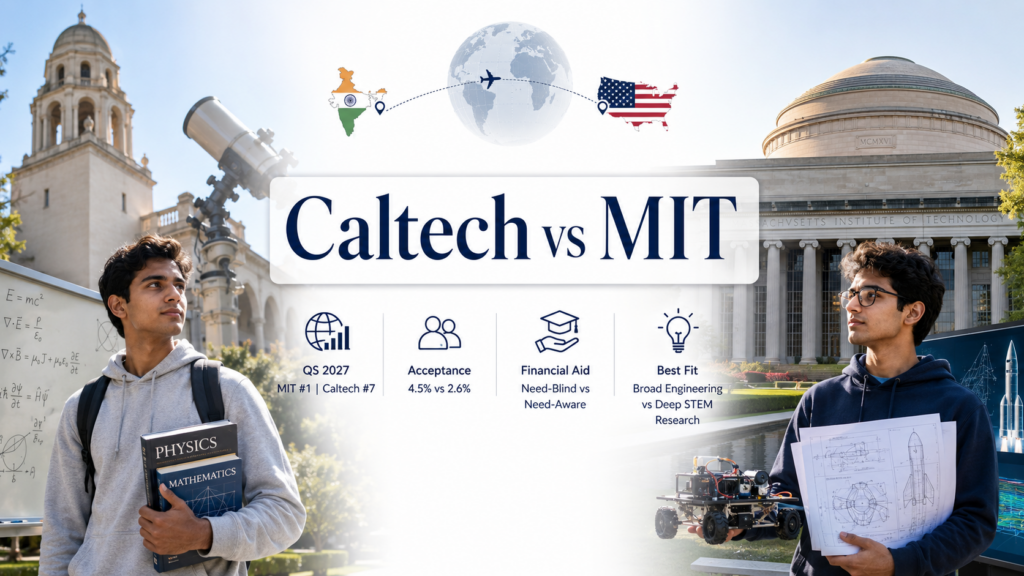
- MIT ranks #1 and Caltech ranks #7 in the QS World University Rankings 2027.
- Caltech’s acceptance rate (about 2.6%) is lower than MIT’s (about 4.5%).
- MIT is need-blind for Indian applicants; Caltech is need-aware for international students.
- Caltech’s 2026-27 cost of attendance is USD 98,622 (₹94.81 lakh); MIT’s is USD 92,760 (₹89.17 lakh).
Caltech vs MIT: Quick Comparison for Indian Students
Before the details, here is how Caltech vs MIT breaks down on the numbers that matter most to an Indian applicant. On Caltech vs MIT ranking alone, the gap has held steady for years, so it’s worth looking past rank to the factors below.
| Parameter | Caltech | MIT |
| QS World Ranking 2027 | 7 | 1 |
| Undergraduate enrollment | ~1,000 | ~4,500 |
| Acceptance rate (most recent full cycle) | ~2.6% | ~4.5% |
| Aid policy for international students | Need-aware | Need-blind |
| 2026-27 cost of attendance | USD 98,622 (₹94.81 lakh) | USD 92,760 (₹89.17 lakh) |
| Academic structure | 6 divisions, 28 majors | 5 schools + 1 college, 50+ majors |
| Application plans | Restrictive Early Action, Regular Decision | Early Action, Regular Action |

Choose your dream country
 UK
UK
 USA
USA
 Germany
 Australia
 Ireland
 Canada
 UAE
UAE
 France
 Sweden
 Italy
Italy
 Other
Other
When do you want to study abroad?
What's your highest level of education?
Have you completed Class 12th?
What was your Class 12 CGPA/percentage?
Are you a student or a parent/guardian?
What do you want to study?
Select your current city
How Leap will help you

Personalised University Shortlist

Express Applications with Quicker Admits

End-to-End Application Support
Counselor insight: Every Indian family we work with starts this Caltech vs MIT conversation by asking, "Is Caltech better than MIT?" as if it's a fixed fact. That's the wrong first question. Both sit in the global top 10. The question that actually changes your application strategy is whether a school is need-blind or need-aware, as the answer directly affects your odds of receiving aid.
Sources: QS World University Rankings 2027; You can find the full cost of attendance figures for MIT and Caltech under Cost & Financial Aid below.
Academics: Caltech’s Deep STEM Core vs MIT’s Broader Engineering Scope
Caltech
Caltech runs six academic divisions and 28 undergraduate majors, nearly all STEM, built around a mandatory core curriculum in math, physics, chemistry, and biology. There is no business school and almost no non-STEM major. Students in a CBSE or ISC "PCM" stream who want to delve deeply into physics, applied math, or planetary science, with almost no outside distribution requirements, will find that this structure rewards their focus.
MIT
MIT spans five schools plus the Schwarzman College of Computing, with 50-plus majors, including architecture, economics, and the Sloan School of Management. Its General Institute Requirements build a science and humanities foundation before students commit to a major. Students who want to study engineering but are not yet ready to rule out business, policy, or the humanities will find that MIT's breadth keeps that door open.
Counselor insight: Students who assume Caltech vs MIT for engineering has an obvious winner are usually surprised. MIT's engineering school is larger and more department-specific; Caltech folds engineering into its six-division structure with heavy cross-disciplinary contact with physics from year one. Neither is "better" broadly; it depends on whether you want a large engineering school or a small, physics-anchored one.
Sources: Caltech Undergraduate Admissions, Academics; MIT Admissions, The MIT Education.
Caltech vs MIT Acceptance Rate: What It Means for an Indian Applicant
The Caltech vs MIT acceptance rate gap is one of the widest among top-10 global universities, and it changes how you should build your application. Most Indian applicants search "Is Caltech harder than MIT?" before anything else, and the data gives a clear answer.
Caltech
Caltech is harder to get into than MIT. Its most recently confirmed cycle admitted roughly 356 of 13,856 applicants, or nearly 2.6%. Caltech's admissions office doesn't publish an exact percentage but confirms an admit rate under 5% for both REA and RD rounds. Caltech reinstated the SAT/ACT requirement from Fall 2026, so the 2026-27 cycle needs a test score in hand.
MIT
MIT's Class of 2029 admitted 1,324 of 29,282 applicants, an overall rate of 4.5%, as reported directly by MIT's Dean of Admissions. For the common search "Is MIT or Caltech harder to get into?" the answer is Caltech: it's consistently the tighter admit, mainly because its class is roughly a quarter of MIT's, while both draw from deep global pools. MIT has required testing since 2022-23 and continues that policy.
For an Indian applicant, both schools weigh Olympiad medals (IMO, IPhO, and IChO), research experience, and math/physics course rigor far more than JEE rank, which neither considers directly.
Counselor insight: We keep seeing Indian applicants pour all their prep energy into SAT score maximization and under-invest in the research or Olympiad angle. At this level of acceptance rate, a 1560 SAT score without a research narrative is less competitive than a 1480 SAT score with a published paper or a national Olympiad medal at both schools.
Sources: Caltech Undergraduate Admissions, First-Year Application Deadlines; The Tech (MIT's official student newspaper), Class of 2029 Regular Action results.
Cost and Financial Aid: Need-Blind vs Need-Aware for Indian Families
This is the section every Indian family searching Caltech vs MIT actually needs, and it's the one no other guide breaks down in rupees.
| Cost component (2026-27, annual) | Caltech | MIT |
| Tuition | USD 68,574 (₹65.92 lakh) | Included in COA |
| Mandatory fees | USD 2,655 (₹2.55 lakh) | Included in COA |
| Housing | USD 12,711 (₹12.22 lakh) | Included in COA |
| Food | USD 9,285 (₹8.93 lakh) | Included in COA |
| Total cost of attendance | USD 98,622 (₹94.81 lakh) | USD 92,760 (₹89.17 lakh) |
Exchange rate used: 1 USD = ₹96.13. Verify the current rate before finalizing your budget.
Sources: Caltech Financial Aid, On-Campus Cost of Attendance 2026-27; MIT Admissions, Cost & Affordability.
Caltech's financial aid policy
Caltech is need-blind only for domestic and DACA applicants. For international citizens, including Indian applicants, it is need-aware: financial need can factor into the admission decision because aid funds for international students are limited. Caltech still meets 100% of demonstrated need for every admitted student.
MIT's financial aid policy
MIT is need-blind for every applicant, including international students, and meets 100% of demonstrated need for all four years. Since 2025-26, MIT families earning under USD 200,000 (₹1.92 crore) typically pay no tuition, and those under USD 100,000 (₹96.13 lakh) pay nothing toward the total cost. The median price paid by an MIT undergraduate who received a scholarship was USD 10,268 (₹9.87 lakh) in 2024-25.
Counselor insight: This is the single most consequential difference in the whole Caltech vs MIT comparison for an Indian family. If you need significant aid, Caltech's need-aware policy means the committee sees your financial profile before making a decision. MIT's applicants never face that exposure. Treat this situation as a real strategic factor, not a footnote.
Sources: Caltech Undergraduate Admissions, Afford; MIT Student Financial Services, Making MIT Affordable.
Scholarships and Funded Routes for Indian Students
| Funding option | Applies to | What it covers | Level |
| Caltech need-based aid | Admitted Caltech students, incl. international | Average aid package: USD 74,780 (₹71.89 lakh); need-aware for international applicants | Undergraduate |
| MIT need-based aid | All admitted MIT students, including international | 100% demonstrated need met; tuition-free under USD 200,000 (₹1.92 crore) family income | Undergraduate |
| Fulbright-Nehru Fellowships | Indian graduates, researchers, PhD scholars | Tuition, stipend, travel, and visa support for research or teaching in the US | Postgraduate/research |
| College Board India Scholars Program | Indian Class 11/12 students | Discount voucher reducing SAT registration cost | Test prep (not tuition) |
Fulbright-Nehru and similar government-backed routes apply to postgraduate and research-stage study rather than undergraduate admission, so they sit alongside Caltech or MIT's own aid, not instead of it.
Sources: College Board BigFuture, Caltech Tuition and Costs; USIEF, Fulbright-Nehru Fellowships for Indian Citizens.
Documents and Requirements Checklist for Caltech and MIT Applications
Once you've settled the "Is Caltech better than MIT?" question for your own profile, whichever way that answer landed, here's exactly what the application asks for.
| Document | Caltech requirement | MIT requirement | India-specific detail |
| Standardised test | SAT or ACT (required from Fall 2026) | SAT or ACT (required) | Register through the College Board India Scholars Program if fee assistance is needed |
| School transcript | Official Secondary School Report | Official Secondary School Report | CBSE/ISC/State Board marksheets need a school-certified English translation if not already in English |
| English proficiency | Required unless English is the medium of instruction | Recommended for certain non-native speakers | TOEFL, IELTS, or Duolingo accepted at both |
| Recommendation letters | Two teacher evaluations (STEM + humanities/social science) | Two teacher letters (math/science + humanities/language) | Request from teachers who taught your final two years, not just Class 12 |
| Financial aid forms | CSS Profile (Caltech code 4034) + international certification | CSS Profile + International Student Financial Aid Application | Indian families need bank statements and, where applicable, a Chartered Accountant-certified income statement |
| Application platform | Common App or QuestBridge | MIT's own application portal (no Common App) | MIT does not accept the Common App; Caltech does |
Counselor insight: The most common document mistake we see is a provisional Class 12 marksheet with no note explaining India's board-exam timeline. Both offices know the 10+2 system, but a one-line clarification in the portal avoids follow-up emails during a tight decision window.
Month-by-Month Caltech and MIT Application Calendars for 2026-27
| Month | Caltech (Fall 2027 entry) | MIT (Fall 2027 entry) |
| August 2026 | The application portal opens; finalise SAT/ACT registration | The application portal opens |
| September–October 2026 | Draft essays; request recommendation letters | Draft essays; request recommendation letters |
| November 1, 2026 | Restrictive Early Action deadline | Early Action deadline |
| Mid-December 2026 | REA decisions released | EA decisions released |
| January 5, 2027 | Regular Decision deadline | Regular Action deadline |
| February 2027 | CSS Profile financial aid deadline for RD applicants | Financial aid materials due (mid-February) |
| Mid-March 2027 | RD decisions released | RA decisions released |
| May 1, 2027 | Enrollment decision deadline | Enrollment decision deadline |
This lines up with the Indian academic calendar: REA/EA falls right as Class 12 board exam prep intensifies, and decisions land in mid-March, before most board results are out, so neither school waits on your Class 12 marks.
Sources: Caltech deadlines cited above under Acceptance Rate (Caltech Undergraduate Admissions, First-Year Application Deadlines); MIT Admissions, Deadlines & Requirements.
Caltech vs MIT for Engineering, Research, and Career Outcomes
A common question in this Caltech vs MIT search is Caltech vs MIT aerospace engineering specifically, since both schools have deep space and aviation research ties. The searches "Does Caltech have aerospace engineering?" and "Does MIT have aerospace engineering?", each have different answers, which are covered below for each school.
Caltech
Caltech's SURF program places nearly every undergraduate into paid research by sophomore year, aided by a 3:1 faculty ratio. Does Caltech have aerospace engineering as its major? not quite: it sits inside the Division of Engineering and Applied Science, with deep ties to the Jet Propulsion Laboratory, which Caltech manages for NASA. Caltech reports a median starting salary range of USD 120,000 to USD 129,000 (₹1.15 crore to ₹1.24 crore).
MIT
MIT's Undergraduate Research Opportunities Program (UROP) gives students hands-on research experience early, with over 91% of undergraduates participating before graduation. It also has a dedicated Department of Aeronautics and Astronautics (Course 16), one of the oldest and largest in the US. Graduates entering industry report an average starting salary of USD 145,820 (₹1.40 crore).
For aerospace engineering, Caltech is known for its close ties to NASA's Jet Propulsion Laboratory (JPL), while MIT offers a larger department with more specializations and research opportunities.
Counselor insight: Don't choose based on which starting salary number is bigger. Both sit well above the US graduate average, and both schools place students into the same tier of employers, from national labs to Big Tech to PhD programs at each other's rivals. Choose based on which research environment, SURF's tight-knit model or UROP's larger scale, suits how you like to work.
Sources: Caltech Undergraduate Admissions, Life After Caltech; MIT starting salary figure cited above under Cost & Financial Aid (MIT Admissions, Cost & Affordability).
Decision Framework: Which Should You Choose, Caltech or MIT?
If you're still weighing "Caltech vs MIT: Which is better" for your specific profile, match yourself to one of these three scenarios rather than defaulting to the Caltech vs MIT ranking order.
- If you are a Physics or Astronomy Olympiad medalist who wants to start research in year one: Caltech's small cohort, 3:1 faculty ratio, and JPL proximity mean faster access to hands-on research with less competition for lab spots. In this Caltech vs MIT scenario, Caltech is the stronger pick.
- If you're a strong all-round STEM student who also wants to keep a business, policy, or interdisciplinary option open: MIT's breadth across 50-plus majors and its Sloan School of Management give you room to pivot without transferring. Choose MIT.
- If your family will need substantial financial aid and can't absorb admissions uncertainty tied to that need: MIT's need-blind policy removes financial need as a factor in your admissions decision entirely. Caltech's need-aware policy means your aid requirement is visible during evaluation. Apply to MIT with more confidence here, and treat Caltech as a need-aware reach, where your profile must be exceptional on non-financial grounds too.
What If You Don’t Get Into Caltech or MIT (Or the Aid Isn’t Enough)?
Not every strong Caltech vs MIT applicant gets an offer from either school, and that's true even for students with near-perfect profiles. Whether the honest answer to "is caltech harder than mit" or "is mit or caltech harder to get into" ever worked in your favor, here's what to do next.
- Rejected from both: This is the outcome for over 95% of applicants to each school, including exceptionally strong ones. Apply broadly to other top US STEM programs (Georgia Tech, UIUC, Purdue, and Carnegie Mellon) in the same cycle rather than treating Caltech and MIT as your only options.
- Waitlisted: Neither school ranks its waitlist. MIT reviews waitlisted applicants only after May 1, based on remaining seats; Caltech's REA deferrals move into the Regular Decision pool for a fresh review. Don't decline other offers while waiting.
- Admitted, but the aid offer falls short: At MIT, an inadequate offer is worth appealing with updated financial documentation, since the aid office does revise offers on corrected information. At Caltech, because international aid funds are capped, a shortfall is harder to close through appeal alone. Line up outside scholarships and be realistic about whether the gap is bridgeable before you commit.
3 Takeaways on Caltech vs MIT for Indian Students
This Caltech vs MIT decision comes down to three things, not a search for "Caltech vs MIT: Which is better?" in the abstract:
- Match your academic style to Caltech's depth or MIT's breadth, not to prestige rankings alone, since both sit in the global top 10 and the right choice depends on how you want to study, not which one "wins."
- If financial aid is essential to your decision, you should budget explicitly around Caltech's need-aware policy for international applicants; in contrast, MIT's need-blind policy removes that risk from the admissions process itself.
- Build a research or Olympiad-backed profile regardless of which school you target, since both weigh documented STEM depth over test scores or JEE-style rank far more heavily than most Indian applicants expect.
Verified by: LeapScholar's USA counseling team, with hands-on experience guiding Indian students through STEM admissions to top-tier US universities.
Have questions about applying to Caltech or MIT? Book a free session with a LeapScholar counselor.
Frequently Asked Questions About Caltech vs MIT for Indian Students
-
Is Caltech better than MIT?
Neither is universally "better." In terms of Caltech vs MIT ranking, MIT ranks #1 and Caltech #7 in the QS World University Rankings 2027, but Caltech's small size and STEM-only focus suit a student wanting intense, early research exposure, while MIT's breadth suits one wanting engineering plus flexibility. There's no single answer to Caltech vs MIT, which is better; it depends on your academic style.
-
Is Caltech harder than MIT to get into?
Yes. The Caltech vs MIT acceptance rate comparison consistently favors MIT: Caltech's rate sits around 2.6% for its most recent complete cycle, compared to MIT's roughly 4.5%, largely because Caltech's undergraduate class is about a quarter of MIT's size.
-
Is MIT or Caltech harder to get into for international students specifically?
Both are harder for international applicants than domestic ones, since international admit rates run lower at nearly every highly selective US university. MIT's need-blind policy for international students at least removes financial need from that calculation; Caltech's need-aware policy for international applicants adds financial capacity as an additional factor.
-
Do Indian students get financial aid at Caltech and MIT?
Yes, both meet 100% of demonstrated financial need for admitted students. The difference is in admissions: MIT doesn't consider your family's ability to pay when deciding whether to admit you, while Caltech does factor it in for international applicants because aid funds are capped.
-
Which is better for engineering, Caltech or MIT?
Caltech vs MIT for engineering isn't a clean win. MIT's engineering school is larger with more department-specific tracks; Caltech integrates engineering tightly with physics through its six-division core. Pick based on whether you want a bigger, specialized school or a smaller, interdisciplinary one.
-
Can I apply to both Caltech and MIT in the same cycle?
Yes, this is common and doesn't conflict, provided you follow each school's early-round restrictions. Caltech's Restrictive Early Action limits you from applying Early Action or Early Decision elsewhere, but you can still apply Regular Decision to MIT in the same cycle or apply Regular to both.
-
Does Caltech or MIT have a dedicated aerospace engineering program?
MIT has a dedicated Department of Aeronautics and Astronautics. Caltech offers aerospace engineering through its Division of Engineering and Applied Science, with strong research links to NASA's JPL. Choose Caltech for space-focused research and MIT for a broader, dedicated aerospace program.
-
What GPA or test score do I need for Caltech or MIT?
Neither school publishes a minimum GPA or test-score cutoff. Competitive applicants typically have a near-perfect academic record in math and science, SAT scores in the 1500s or ACT scores of 34 or higher, and, for Indian applicants specifically, an Olympiad medal or documented research project that is more important than the test score alone.
-
What does the Caltech vs MIT rivalry and prank culture actually involve?
The Caltech vs MIT rivalry is a decades-long, good-humored prank tradition rather than a real institutional rivalry, most famously the 2005 Caltech prank at MIT's Campus Preview Weekend and MIT's cannon theft the following year. It reflects shared culture, not competition for the same students in any meaningful admissions sense.
-
Where can I read real student experiences comparing Caltech and MIT?
Caltech vs MIT Reddit threads on communities like r/ApplyingToCollege and r/gradadmissions carry first-person accounts from current students and alumni, though they treat individual opinions as anecdotal rather than definitive, since fit varies enormously by department and research area. Searching Caltech vs MIT Reddit alongside official admissions data, rather than instead of it, gives the fullest picture.





Have Questions? Get Guidance to reach your Dream University
Connect with India's finest counsellors and biggest study abroad community.
Get Guidance