
Quick Read
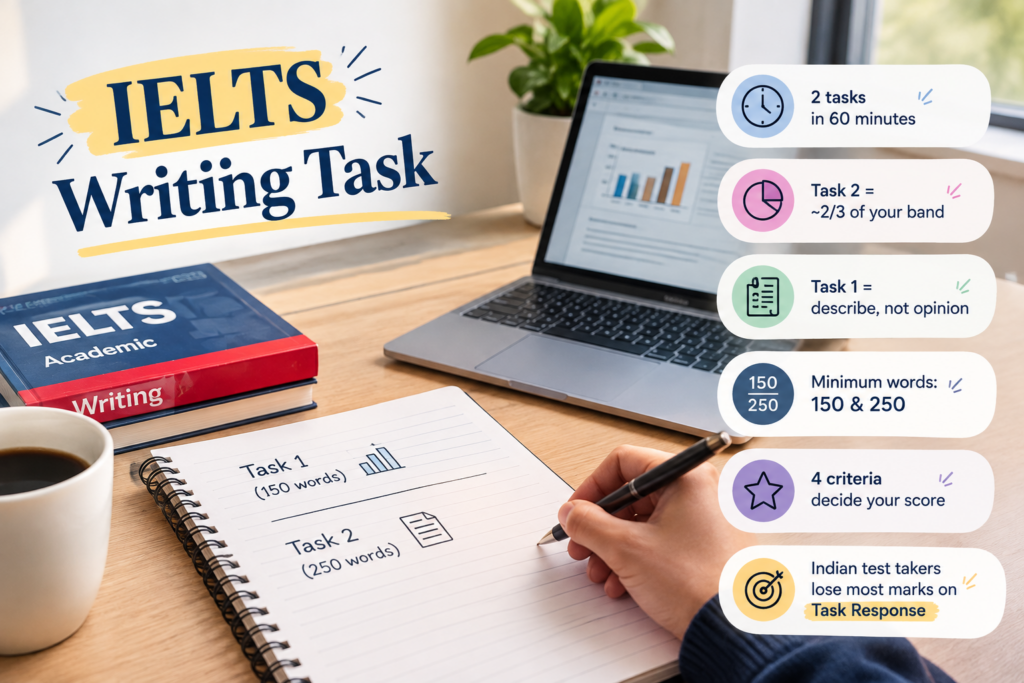
- The IELTS writing task has two parts, Task 1 and Task 2, completed in 60 minutes total.
- Task 2 counts for roughly two-thirds of your Writing band, so it matters more.
- Academic Task 1 asks you to describe a chart, graph, or diagram, not write an opinion.
- Minimum word counts are 150 for Task 1 and 250 for Task 2, no exceptions.
- Four criteria decide your score: Task Response, Coherence, Vocabulary, and Grammar.
- Indian test takers most often lose marks on Task Response, not grammar.
What the IELTS Writing Task Actually Tests
The IELTS writing task checks one thing: can you produce clear, organized English on the spot, under pressure, without a dictionary or someone to check your work? That’s different from knowing grammar rules in isolation, which is why candidates with strong spoken English can still struggle here.
It runs for one hour, split into two parts marked independently of each other. The real challenge isn’t the time limit; it’s that Task 1 and Task 2 are graded on different terms and genuinely need different skills to do well.
| Part | Time | Minimum Words | What You Actually Do |
|---|---|---|---|
| Writing Task 1 | 20 minutes | 150 | Describe a chart, graph, or diagram (Academic) or write a letter (General Training) |
| Writing Task 2 | 40 minutes | 250 | Write a formal essay responding to a question or argument |
Task 2 counts for roughly double the marks of Task 1 in your final Writing band. That’s why most experienced trainers recommend giving Task 2 its full 40 minutes, even if it means finishing Task 1 a little too quickly. Spending too long on Task 1 and then rushing Task 2 is one of the most common and most costly mistakes candidates make in this exam.
My insight: Students preparing on their own almost always practice Task 2 more, since it feels like the “real” essay. Task 1 gets treated as a warm-up, and it shows on test day when candidates run out of things to say after 100 words. Give Task 1 genuine practice time too, not just Task 2.
IELTS Writing Task 1: Academic vs General Training
Task 1 looks similar on paper across both modules, but the actual task is nothing alike once you sit down to write it. Here’s how the two versions actually differ.

Excel in IELTS with India’s Top Online Coaching
Leap has helped more than 1 Lakh students achieve 7+ IELTS band.
Academic vs General Training at a Glance
| Detail | Academic Task 1 | General Training Task 1 |
|---|---|---|
| What you get | A graph, chart, table, or diagram | A situation requiring a letter |
| What you write | A factual report describing the visual | A formal, semi-formal, or informal letter |
| Tone | Neutral, data-focused | Depends on who you’re writing to |
| Common trap | Adding your own opinion on the data | Missing one of the three bullet points given |
If you’re still deciding which module you’re even taking, IELTS Academic vs General Training is worth reading first, since that choice shapes everything else about how you prepare.
Excel in IELTS with India’s Top Online Coaching
Leap has helped more than 1 Lakh students achieve 7+ IELTS band.
What an Academic Task 1 Opening Actually Sounds Like
Here’s a short excerpt from an Academic Task 1 response, based on a typical line graph question about tourist numbers over two decades:
“The line graph illustrates the number of tourists visiting a Caribbean island between 1995 and 2015. Overall, tourist numbers rose considerably over the period, with the sharpest increase occurring after 2005.”
That’s the overview sentence, and it’s the single most important line in any Task 1 Academic response.
For the full set of official sample scripts across different chart types, see the IELTS Academic Writing sample tasks PDF, which includes real graded scripts, not just descriptions of what a good one looks like.
My insight: The most common Task 1 mistake we see isn’t grammar; it’s candidates trying to describe every single data point on the chart instead of picking the two or three biggest trends. Examiners reward selection and comparison, not a line-by-line narration of the graph.
IELTS Writing Task 2: Essay Types You’ll Actually See
IELTS doesn’t publish an official list of essay types, but after enough exposure to past papers, trainers generally agree Task 2 questions fall into five recognizable patterns.
| Essay Type | What It Asks | How to Structure It |
|---|---|---|
| Opinion (Agree/Disagree) | State how much you agree with a claim | Clear position in intro, one reason per body paragraph |
| Discussion (Both Views) | Discuss two opinions, then give yours | One view per paragraph, your opinion in the conclusion |
| Problem-Solution | Identify a problem and propose fixes | Problem paragraph, then solution paragraph |
| Advantages-Disadvantages | Weigh the pros and cons of something | One paragraph each, balanced coverage |
| Double Question | Answer two related questions directly | One paragraph per question, both fully answered |
Misreading which type you’re dealing with is one of the fastest ways to lose marks on Task Response, since a discussion question answered like an opinion essay (or vice versa) never fully addresses what was asked.
My insight: Discussion questions are the ones we see misread most often. Candidates read “discuss both views” and jump straight to their opinion, skipping the balanced coverage of both sides that the question actually asked for. That single misread can cap Task Response at Band 5, no matter how good the language is.
How the IELTS Writing Task Is Scored: The 4 Band Criteria
Every response you write, whether it’s Task 1 or Task 2, gets marked against the same four things, and each one carries equal weight, 25% of that task’s score. Your Task 1 and Task 2 scores are calculated separately first and then combined, with Task 2 carrying twice the weight, to give you your final Writing band.
| Criterion | What the Examiner Is Really Looking For |
|---|---|
| Task Response (Task 2) / Task Achievement (Task 1) | Did you actually answer what was asked, and did you develop it enough? |
| Coherence and Cohesion | Can a reader follow your argument without getting lost between paragraphs? |
| Lexical Resource | Do you reach for the right word, or does your vocabulary feel thin and repeated? |
| Grammatical Range and Accuracy | Can you handle more than one type of sentence and do it mostly without slipping up? |
My insight: Indian test takers tend to over-invest in Lexical Resource, hunting for impressive vocabulary, while under-investing in Task Response, actually answering every part of the question. Examiners weigh both equally, so a simpler essay that fully answers the question consistently outscores a fancier one that drifts off-topic.
IELTS Writing Task 2 Sample Essay: What Band 9 Actually Looks Like
Here’s a genuine full-length response to a common Task 2 question, written to Band 9 standard, not an outline of what one should contain.
Question:
Some people think that the government should provide free public transport to reduce traffic congestion and pollution. To what extent do you agree or disagree?
Answer:
Traffic jams and dirty air are two of the most obvious problems facing big cities today, and one proposed fix is simply making public transport free. I mostly agree with this idea, but I don’t think it works on its own without a few other changes.
The strongest argument in favor of free public transport is that cost is a genuine barrier for many commuters. When bus and train fares are removed, people who currently drive short distances purely to save time or hassle have a real financial incentive to switch. Cities that have trialled fare-free transport, such as Tallinn in Estonia, have reported measurable increases in ridership, which directly reduces the number of private vehicles on the road and, by extension, both congestion and emissions.
That said, free transport on its own rarely resolves the deeper issue. If buses and trains are already packed or don’t run often enough, dropping the fare just moves the frustration around instead of getting people out of their cars. Governments would need to find that lost fare money somewhere else too, perhaps through congestion charges on private vehicles, if the whole policy is going to hold up financially over time.
So overall, I think free public transport is a sensible step toward tackling congestion and pollution, but whether it actually works depends on whether it’s backed by real investment in capacity, alongside other policies that make driving less appealing.
This response stays on topic throughout, develops both sides with specific reasoning, and uses varied sentence structures without straining for complexity. That combination, not just fancy vocabulary, is what separates a Band 9 response from a Band 6 or 7 one on the same question.
What Actually Changes Between Band 6, 7, and 9
Rather than three separate essays repeating the same content at different quality levels, here’s what genuinely shifts as the band rises on this same question.
| Feature | Band 6 | Band 7 | Band 9 |
|---|---|---|---|
| Position | Stated but inconsistently maintained | Clear, mostly consistent | Clear and fully maintained throughout |
| Development | Ideas listed with limited explanation | Ideas explained with some examples | Ideas fully developed with specific, relevant examples |
| Vocabulary | Simple, sometimes repetitive | Some less common words used | Wide range used naturally and precisely |
| Grammar | Mix of simple and complex sentences, several errors | Good range of structures, occasional errors | Wide range, mostly error-free |
The jump from 6 to 7 is mostly about depth of explanation. The jump from 7 to 9 is about consistency, not adding more content.
Common Mistakes That Cost Marks
- Writing under the word count to save time, which triggers an automatic penalty under Task Response or Task Achievement
- Memorizing a full essay in advance, which examiners are trained to identify and penalize
- Giving an opinion in Academic Task 1, where only factual description is expected
- Using the same three or four linking words throughout an essay instead of a natural range
- Running out of time on Task 2 because too long was spent on Task 1
My insight: The mistake that’s hardest to self-diagnose is the inconsistent position in Task 2. Candidates agree with a statement in the introduction, then drift toward the opposite view by the final paragraph without noticing. Reading your own conclusion against your own introduction before submitting catches such errors in under a minute.
How to Practice for the IELTS Writing Task?
Good IELTS writing practice isn’t about writing more essays randomly; it’s about practicing under the exact conditions you’ll face on test day.
- Set a timer for 20 minutes on Task 1 and 40 minutes on Task 2 every single practice session, no exceptions
- Review official sample scripts before writing your own, so you know what a real graded response actually looks like
- Get feedback against the four criteria specifically, not a generic “good” or “needs work”
- Practice both writing task 1 and writing task 2 in the same sitting at least twice a week to build the pacing habit
- Use real past questions rather than invented ones, since phrasing patterns do repeat
Consistent, timed IELTS writing practice over three to four weeks moves the band score far more reliably than reading model answers alone.
3 Key Takeaways on the IELTS Writing Task
1. Task 2 decides more of your score than Task 1 does, so protect its 40 minutes. If you’re running behind, it’s usually better to shorten Task 1 slightly than to rush the essay that counts for twice as much.
2. A Band 9 essay isn’t full of rare words; it’s just consistent. Look back at the sample essay above and you’ll notice the vocabulary isn’t exotic. What holds it together is a clear position from start to finish and ideas that are actually explained, not just listed.
3. Real practice means timed practice against real questions. Reading model answers helps you understand the format, but the band jump comes from writing under the same 20 and 40-minute limits you’ll face on test day, using real past questions rather than ones you’ve made up yourself.
Verified by: LeapScholar’s IELTS training team, with hands-on experience helping Indian students improve their Writing band score.
Have questions about your IELTS preparation? Book a free session with a LeapScholar counselor.
Frequently Asked Questions About IELTS Writing Task
-
How long is the IELTS writing task?
You get 60 minutes total for both parts. Most people spend about 20 minutes on Task 1 and 40 minutes on Task 2, since Task 2 is more important for your final score. Running short on Task 2 time is one of the most common regrets test takers mention afterward.
-
What’s the difference between IELTS writing task 1 and writing task 2?
Task 1 asks you to describe visual data (Academic) or write a letter (General Training), while Task 2 is always an essay. They’re graded on the same four criteria, but Task 2 counts for roughly double the weight, so it’s worth prioritizing if your time starts running out.
-
Are 250 words enough for IELTS writing task 2?
It’s the minimum, not a target to hit exactly. Most Band 7-plus responses land somewhere between 260 and 300 words. Going under 250 triggers a penalty, but padding well past 300 rarely helps and often introduces more errors.
-
Can I use the same essay for different IELTS writing task 2 questions?
No, and examiners are specifically trained to catch memorized content. Even a well-written, prepared essay will be marked down under Task Response if it doesn’t directly answer the actual question asked on your test day.
-
What band do I need in IELTS writing for a good university?
Most universities look for a Writing band of 6.5 or 7, though some competitive postgraduate programs ask for 7.5. Since Task 2 is weighted more heavily, a strong Task 2 answer can meaningfully lift a weaker Task 1 score.
-
How can I improve my IELTS writing practice at home?
Time yourself strictly, mark your own work against the actual band descriptors rather than guessing, and read official sample answers before attempting similar IELTS writing task questions. Passive reading without timed writing practice rarely leads to much improvement.
-
Is IELTS writing task 1 or task 2 harder?
Depends who you ask, honestly. Task 1 feels harder for people who struggle to describe data neutrally without adding opinions. Task 2 feels harder for those who freeze up under the pressure of building a full argument in 40 minutes. Either way, Task 2 matters more for your score, so it’s worth the extra prep time regardless.
-
What happens if I run out of time on IELTS writing task 2?
You’ll likely lose marks on Task Response for an incomplete argument, and possibly on Coherence if your conclusion is missing entirely. An unfinished essay with a clear structure and a rushed final sentence still scores better than one that trails off mid-paragraph, so if time’s tight, wrap up your point rather than abandoning it.
-
How many paragraphs should an IELTS writing task 2 essay have?
Four works well for most question types: an introduction, two body paragraphs, and a conclusion. Trying to cram in a fifth paragraph usually means each one gets thinner and less developed, which hurts Task Response more than having fewer, fuller paragraphs would.











Have Questions? Get Guidance to reach your Dream University
Connect with India's finest counsellors and biggest study abroad community.
Get Guidance