
Quick Read
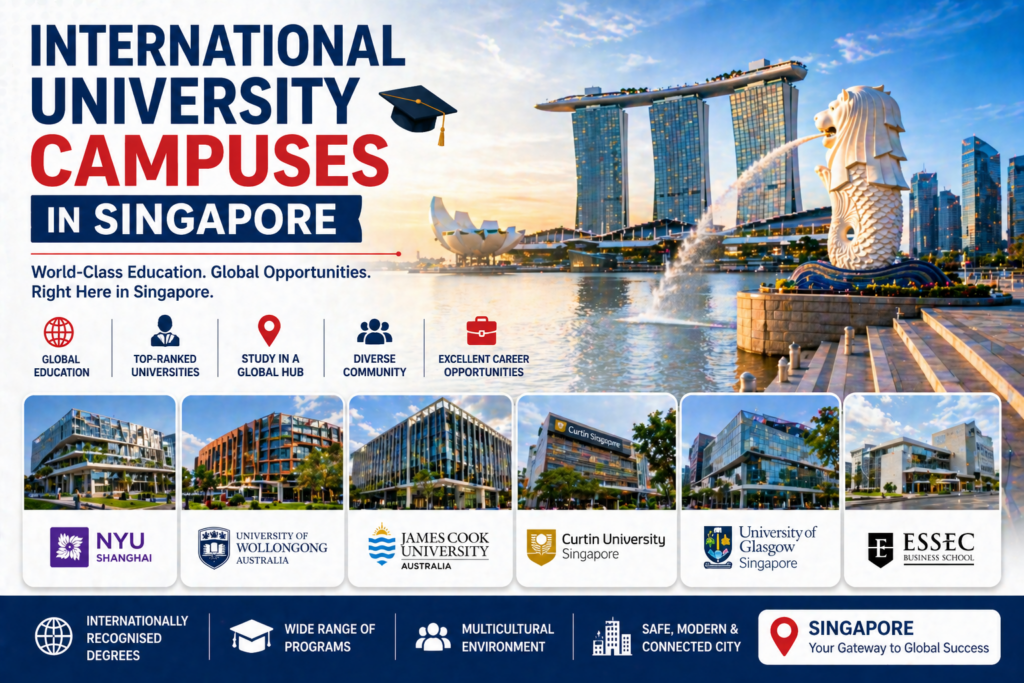
- Over 12 foreign university campuses operate in Singapore, awarding home-country degrees.
- Tuition at international university campuses in Singapore starts from Rs. 13,32,000 per year.
- Indian students require a Student’s Pass from ICA, not a separate study visa.
- Singapore ranks among Asia’s top study destinations, with NUS at #8 globally (QS 2026).
Full List of International University Campuses in Singapore (2026)
| Year Established | University / Institute | Home Country | Programme Type | Status |
| 1998 | University of Adelaide | Australia | Twinning/partner (no standalone campus) | Active twinning only |
| 2000 | INSEAD | France | MBA, EMBA, Executive Education | Active |
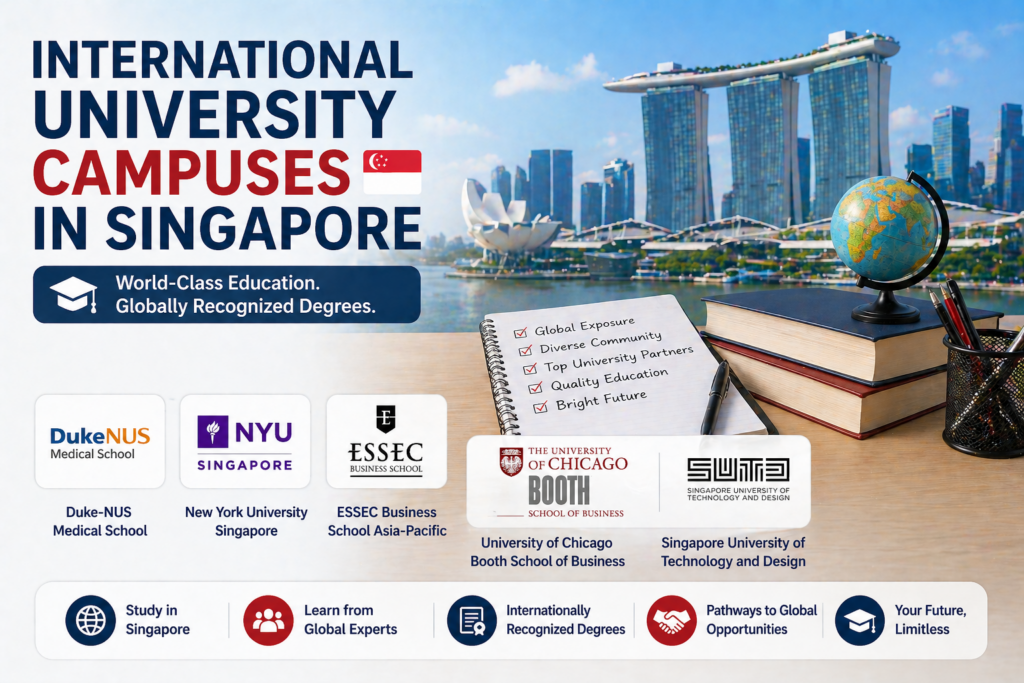
| 2000 | University of Chicago Booth School of Business | USA | Executive MBA | Active |
| 2003 | James Cook University Singapore | Australia | BBA, Psychology, IT, Education | Active |
| 2004 | SP Jain School of Global Management | India | BBA, MBA, MGB | Active |
| 2005 | ESSEC Business School | France | MBA, MiM, MSc Finance | Active |
| 2008 | Curtin University Singapore | Australia | Business, Engineering, IT | Active |
| 2008 | DigiPen Institute of Technology Singapore | USA | Computer Science, Game Design | Active |
| 2011 | Embry-Riddle Aeronautical University Asia | USA | Aviation, Aerospace Engineering | Active |
| Collaborative | Duke-NUS Medical School | USA/Singapore | MD (Graduate Medical) | Active |
| Collaborative | TUM Asia (Technische Universität München) | Germany | Engineering Masters | Active |
| Collaborative | EHL Hospitality Business School | Switzerland | BBA, MBA | Active |
All active degrees are awarded by the home institution. Tuition at the Singapore campus may differ from the home campus; always verify directly with the institution.

Choose your dream country
 UK
UK
 USA
USA
 Germany
 Australia
 Ireland
 Canada
 UAE
UAE
 France
 Sweden
 Italy
Italy
 Other
Other
When do you want to study abroad?
What's your highest level of education?
Have you completed Class 12th?
What was your Class 12 CGPA/percentage?
Are you a student or a parent/guardian?
What do you want to study?
Select your current city
How Leap will help you

Personalised University Shortlist

Express Applications with Quicker Admits

End-to-End Application Support
Detailed Profiles: Key International University Campuses in Singapore for Indian Students
1. INSEAD Asia Campus
INSEAD is one of the two INSEAD campuses in the world. Students can transfer between Singapore and Fontainebleau mid-program.
- Tuition: Rs.74,00,000 to Rs.81,40,000 (SGD 1,00,000 to SGD 1,10,000) total for MBA
- GMAT: 700+ competitive median; below 670 rarely advances
- IELTS: 7.0 minimum
- Intake: January and September
- Work experience: Minimum 2 years; average applicant has 5 to 6 years
- Scholarship: Deepak and Sunita Gupta Endowed Scholarship available for Indian applicants
Counselor insight: INSEAD essays ask how you have grown and pivoted, not how consistently you performed. A high-scoring but one-dimensional profile rarely advances to an interview.
2. University of Chicago Booth School of Business
Booth, Singapore EMBA only. Not for early-career applicants. Same degree as Booth Chicago and London.
- Programme: Executive MBA Asia 21 months, alternate weekend format
- Tuition: Approximately Rs. 65,86,000 (USD 89,000) total
- GMAT/GRE: Not required
- Work experience: Minimum 10 years; average applicant has 14 to 15 years
- Intake: January annually
- Scholarship: Limited merit-based fellowships available; contact admissions directly, School of Global Management
3. SP Jain School of Global Management
SP Jain Singapore tri-city degree: Students physically rotate between Dubai, Singapore, and Sydney each trimester.
- Tuition: Rs. 24,05,000 to Rs. 38,48,000 (SGD 32,500 to SGD 52,000) total for MBA
- GMAT/GRE: Required
- IELTS: 6.5 minimum
- Work experience: 2+ years for MBA; not required for BBA
- Intake: January and August
- Scholarship: Merit scholarship of up to 20% tuition waiver for GMAT 700+ (housing deposits, flights).
Counselor insight: Per-city setup costs (housing deposits, flights) add approximately SGD 8,000 to SGD 12,000 per city on top of monthly living expenses. Confirm the full multi-city budget before accepting.
4. ESSEC Business School Asia-Pacific
ESSEC Singapore ranked #10 globally for Masters in Management (Financial Times 2025). Fresh graduates are eligible for the MiM; no work experience is required.
- Tuition: Rs. 12,58,000 to Rs. 55,61,000 (SGD 17,052 to SGD 75,157) per year, depending on the program
- Programmes: MiM (2 to 3 years), MSc Finance (12 months), MSc Marketing Management and Digital
- GMAT: Required; approximately 670 average for MiM
- IELTS: 7.0 minimum
- Intake: August; rolling for some programmes
- Scholarship: ESSEC Excellence Scholarships and need-based aid available; check the ESSEC financial aid page, University of Singapore
Counselor insight: Most Indian applicants apply to the MBA and overlook the MiM, which accepts fresh graduates with strong academics and no work experience. For a BCom or BBA graduate with 75%+ and a GMAT above 670, MiM is a faster, cheaper path to a Paris-Singapore network than an MBA.
5. James Cook University Singapore
JCU Singapore awards the same degree as JCU Queensland. No on-campus accommodation.
- Tuition: Rs. 14,80,000 to Rs. 18,13,000 (SGD 20,000 to SGD 24,500) per year
- IELTS: 6.0 minimum
- GMAT/GRE: Not required
- Intake: March, July, October
- Off-campus accommodation: SGD 550 to SGD 2,000 (Rs. 40,700 to Rs. 1,48,000) per month
- Scholarship: Limited merit scholarships for students with strong academic records; check JCU Singapore scholarships, University Singapore
6. Curtin University Singapore
Curtin Singapore degrees awarded by Curtin University, Perth, Australia, are accredited.
- Tuition: Rs. 13,32,000 to Rs. 16,28,000 (SGD 18,000 to SGD 22,000) per year
- Programmes: Commerce (Accounting, Finance, Marketing), Engineering (Petroleum), IT, Environmental Science
- IELTS: 6.0 for undergraduate; 6.5 for postgraduate
- GMAT/GRE: Not required
- Intake: February and July
- Scholarship: Limited merit scholarships available; check Curtin Singapore scholarships, Institute of Technology Singapore
7. DigiPen Institute of Technology Singapore
DigiPen Singapore offers bachelor's degrees only; there are no postgraduate programs on this campus.
- Tuition: Rs. 15,54,000 to Rs. 18,50,000 (SGD 21,000 to SGD 25,000) per year
- IELTS: 6.0 minimum
- Portfolio: Required for BA Game Design
- GMAT/GRE: Not required
- Intake: August only; all programmes are 4 years
- Scholarship: Singapore government bursaries available for eligible students; no institution-level merit scholarships published by Aeronautical University Asia
8. Embry-Riddle Aeronautical University Asia
ERAU Asia aviation and aerospace focus: qualifications recognized by CAAS (Civil Aviation Authority of Singapore).
- Tuition: Rs. 15,93,000 to Rs. 26,16,000 (SGD 21,420 to SGD 35,343) per year
- Programmes: BS Aeronautical Science, BS Aerospace Engineering, MSc Aviation and Aerospace Sustainability, MSc Business Analytics (Aviation)
- IELTS: 6.0 for undergraduate; 6.5 for postgraduate
- GMAT/GRE: Not required
- Intake: January and August
- Scholarship: ERAU Merit Scholarships and need-based grants available; check ERAU Asia financial aid Medical School
9. Duke-NUS Medical School
The Duke-NUS program in North America is an MD program, not an MBBS. Degree jointly awarded by Duke University and NUS.
- Tuition: Rs. 46,36,000 (SGD 62,650) per year
- Entry: Any undergraduate degree; MCAT or equivalent; strong science prerequisites; research experience
- IELTS: 7.0 minimum
- Intake: July annually
- Scholarship: SINGA PhD award covers full tuition and a SGD 2,000/month stipend for research PhD students at NUS; Duke-NUS MD students should check institutional bursaries directly for publications and clinical exposure far more heavily than a NEET rank. A BSc Biology or BTech Biotechnology applicant with published research is stronger than one with only entrance exam scores.
Counselor insight: Duke-NUS weighs research publications and clinical exposure far more heavily than a NEET rank. A BSc Biology or BTech Biotechnology applicant with published research is stronger than one with only entrance exam scores.
10. TUM Asia (Technische Universität München)
TUM Asia QS #37 globally. TUM Munich awards degrees; all programs are in English. No GMAT or GRE required.
- Tuition: Rs. 17,76,000 to Rs. 21,27,000 (SGD 24,000 to SGD 28,800) per year
- Programmes: MSc Aerospace Engineering, MSc Electrical Engineering and IT, MSc Mechatronics, MSc Industrial Chemistry, MSc Green Electronics
- Minimum entry: 65% aggregate or 6.5 CGPA
- IELTS: 6.5 minimum
- Intake: August; 1.5 to 2 years' duration
- Scholarship: DAAD scholarships (German Academic Exchange Service) are open to Indian students at TUM; SINGA is available for PhD track students or NTU for the same academic profile because TUM Asia is underrepresented in Indian counseling. Engineering graduates with 7.5+ CGPA have a realistic shot without a GRE score.
Counselor insight: Lower competition than NUS or NTU for the same academic profile, because TUM Asia is underrepresented in Indian counseling. Engineering graduates with 7.5+ CGPA have a realistic shot without a GRE score.
11. EHL Hospitality Business School Singapore
EHL Singapore ranked #1 globally for hospitality management (QS 2026). Includes a mandatory semester in Lausanne, Switzerland, and an 18-month industry placement built into the degree.
- Tuition: Rs. 22,20,000 to Rs. 29,60,000 (SGD 30,000 to SGD 40,000) per year, approximately
- Programme: Bachelor's in International Hospitality Management 3 years
- IELTS: 6.5 minimum
- GMAT/GRE: Not required
- Intake: August
- Scholarship: EHL Merit Scholarships and industry-sponsored bursaries available; check EHL financial aid (Twinning Only)
12. University of Adelaide (Twinning Only)
The University of Adelaide (QS #82, 2026) has no standalone Singapore campus. Students complete Year 1 or 2 locally, then transfer to Adelaide to finish the degree.
- Not a full Singapore degree, you will need to relocate to Australia to complete
- Programmes via twinning: Business, IT, Engineering
- Entry: 60% aggregate in 12th; IELTS 6.0 to 6.5
- A separate Australian student visa is required at the transfer stage
- Scholarship: Adelaide scholarships apply only from Year 2 onwards in Australia; confirm eligibility with the twinning partner before enrolling in Singapore: What Indian Students Often Overlook
Tuition and Cost Comparison: International University Campuses in Singapore
| University | Programme | Annual Tuition (INR) | Annual Tuition (SGD) | Est. Annual Living Cost (INR) |
| INSEAD Singapore | MBA (full programme) | Rs. 74,00,000+ | SGD 1,00,000+ | Rs. 14,80,000 |
| SP Jain Singapore | MBA Global (total) | Rs. 24,05,000 | SGD 32,500 | Rs. 13,32,000 |
| TUM Asia | MSc Engineering | Rs. 19,61,000 | SGD 26,500 | Rs. 13,32,000 |
| Duke-NUS | MD | Rs. 46,36,000 | SGD 62,650 | Rs. 14,80,000 |
| DigiPen Singapore | BS Computer Science | Rs. 17,83,000 | SGD 24,100 | Rs. 13,32,000 |
| JCU Singapore | BBA | Rs. 17,83,000 | SGD 24,100 | Rs. 11,10,000 |
| Curtin Singapore | BS Business | Rs. 15,61,000 | SGD 21,100 | Rs. 11,10,000 |
According to the NUS official living costs page, total annual student living expenses (excluding vacation periods) are estimated at SGD 11,750, including on-campus accommodation, approximately SGD 980/month excluding housing, or SGD 1,460/month all-in. For students in off-campus shared accommodation, overall monthly costs typically run SGD 1,500 to SGD 2,000 (Rs. 1,11,000 to Rs. 1,48,000), consistent with figures published by NUS. Off-campus shared accommodation costs SGD 700 to SGD 1,000 (Rs. 51,800 to Rs. 74,000) per month per person in areas such as Jurong, Clementi, and Woodlands.
Eligibility and Admission Requirements for Indian Students
Indian Qualifications Accepted
International university campuses in Singapore recognize Indian academic credentials well. The following documents are standard:
- 10th and 12th marksheets from CBSE, ICSE, or any recognised state board
- Degree certificate and official transcripts from a UGC-recognised university
- Provisional certificate accepted for final-year students; final certificate required before joining
- State board mark sheets may need attestation for some programmes
Entry Requirements by Institution
| Institution & Program | Academic Minimum (Class 12 / UG) | Entrance Exam (GMAT/GRE/MCAT) | English Proficiency (IELTS/TOEFL) | Work Experience Requirements |
| INSEAD MBA | No fixed minimum | Required (GMAT 680+ competitive) | IELTS 7.0 / TOEFL 100 | Min. 2 years (Avg. 5-6 years) |
| NUS MS | 3.0/4.0 GPA equivalent | Recommended | IELTS 6.5 | Not required for most programs |
| NTU MBA | Second-class upper honors | Required (650+ competitive) | IELTS 6.0 | 2+ years preferred |
| SP Jain MBA | 50% aggregate | Required | IELTS 6.5 | 2+ years |
| TUM Asia MSc | 65% aggregate / 6.5 CGPA | Not required | IELTS 6.5 | Not required |
| JCU Singapore BBA | 60% in Class 12th | Not required | IELTS 6.0 | Not applicable (UG) |
| Curtin Singapore | 60% in Class 12th | Not required | IELTS 6.0 | Not applicable (UG) |
| DigiPen BS | 12th (Math & Physics focus) | Not required | IELTS 6.0 | Not applicable (UG) |
| Duke-NUS MD | Any Undergraduate degree | MCAT preferred | IELTS 7.0 | Research experience valued |
Singapore Tuition Grant Scheme: What Indian Students at Public Universities Must Know
The Singapore Tuition Grant (TG) Scheme is a subsidy provided by the Ministry of Education Singapore to reduce tuition fees for international students enrolled in selected full-time programmes at Singapore's publicly funded Autonomous Universities: NUS, NTU, SMU, SUTD, SIT, and SUSS. Indian students are eligible to apply.
What the grant covers
The TG reduces annual tuition fees by approximately SGD 10,000 to SGD 14,000 (Rs. 74,000 to Rs. 1,03,600) per year, depending on the programme. As an example, NUS MS Computer Science tuition for an international student without the TG is approximately SGD 42,200 (Rs. 31,23,000) per year. With the TG, this reduces to approximately SGD 28,000 (Rs. 20,72,000) per year, a saving of around Rs. 10,50,000 annually.
The 3-year bond obligation
Accepting the TG comes with a legal commitment. International students who receive the Tuition Grant must serve a 3-year bond after graduation by working full-time with a Singapore-registered company. You must be employed full-time in a Singapore entity for 3 years to fulfil your bond obligations after you have graduated. The employer must be registered with Singapore's Accounting and Corporate Regulatory Authority (ACRA), which includes local companies as well as Singapore-registered subsidiaries of international companies.
Breaking the bond requires payment of liquidated damages, the full amount of subsidy received, plus 10% interest compounded annually. The duration of the service obligation is fixed at 3 years, regardless of the duration of study at subsidised rates.
You are also required to nominate two sureties (guarantors), individuals of any nationality aged 21 to 64, who are not undischarged bankrupts, who will be jointly liable for liquidated damages if you fail to complete the bond.
Bond deferment
You can apply to MOE for bond deferment if you wish to pursue further studies immediately after graduation. Deferment is not automatic; it requires advance MOE approval and a Banker's Guarantee of approximately SGD 65,000 (Rs. 48,10,000) for the outstanding bond period.
This grant does not apply to foreign university campuses
The Tuition Grant is only available at Singapore's six publicly funded Autonomous Universities. The Tuition Grant Scheme supports international students' study in Singapore by defraying part of the cost of school fees at the Institutes of Higher Learning. It does not apply to any of the foreign university campuses covered in this article: INSEAD, SP Jain, ESSEC, TUM Asia, JCU Singapore, Curtin Singapore, DigiPen, ERAU Asia, EHL, or Duke-NUS. Students at these institutions pay the institution's own fee structure in full, with no MOE subsidy.
If your goal is to reduce overall tuition cost through the TG, your programme must be at NUS, NTU, SMU, SUTD, SIT, or SUSS. Before accepting the TG, confirm that you are prepared to remain employed in Singapore for 3 years post-graduation. Indian students who intend to return to India immediately after graduating should not accept the grant, as the bond is legally enforceable and breaking it is costly.
Singapore Student’s Pass: What Indian Students Must Know
Singapore does not issue a traditional study visa. Students at approved institutions must hold a Student's Pass issued by the Immigration and Checkpoints Authority (ICA). The process is institution-driven.
Process:
- Receive an offer letter from the institution
- The institution submits your application through ICA's SOLAR+ system
- You receive an In-Principle Approval (IPA) letter for your entry document into Singapore
- Arrive and collect the Student's Pass card within 30 days
Fees: SGD 30 application (Rs. 2,220) + SGD 60 issuance (Rs. 4,440). Processing: 4 to 6 weeks.
Work rights: Up to 16 hours per week during term; full-time during official vacation periods.
Counselor insight: The most common mistake Indian students make is applying directly to ICA before the institution initiates the process. This creates a duplicate application and delays enrollment by 3 to 6 weeks. Wait for your institution's international student office to prompt you.
What to Do When Things Go Wrong
Rejected by NUS or NTU: Both shortlist fewer than 15% of international applicants for competitive Master's programs. Apply immediately to TUM Asia, SP Jain, or Curtin Singapore; their deadlines are typically 4 to 8 weeks later. Waiting for a waitlist update before applying elsewhere is a common mistake at international university campuses in Singapore.
Low GMAT score (below 650): TUM Asia and DigiPen do not require GMAT. NTU has waived the GMAT for applicants with strong professional experience. Request a waiver review directly from the admissions office. It is a standard process.
Final-year results delayed by Indian university: Submit with the latest available transcript and a registrar's letter confirming your expected graduation date. The offer will be conditional on final results, not blocked by the delay.
Student's Pass rejected by ICA: Your institution's international student office must file the appeal, not you directly. Contact the admissions office the same day you receive the rejection.
Missed the August intake deadline: The next intake is January (INSEAD, SP Jain) or the following August. Use the gap to improve your GMAT score, strengthen your LOR, or add a relevant certification.
Conclusion: 3 Specific Takeaways for Indian Students
1. Apply to NUS and NTU between March and May 2026 for the August intake, not July. Shortlisting of strong international applicants happens 2 to 3 months before the published deadline. Late applicants compete from a much smaller remaining pool.
2. Cost-adjust before shortlisting. TUM Asia, JCU Singapore, and Curtin Singapore offer internationally recognized degrees at Rs. 13,32,000 to Rs. 19,61,000 per year. If your target career is in Singapore or Southeast Asia, a lower-cost international university campus in Singapore delivers the same geographic outcome.
3. Let your institution initiate the Student's Pass; do not apply to ICA yourself. Students who submit independent applications before the institution starts the process create duplicate filings that delay enrollment by 3 to 6 weeks.
Have questions about international university campuses in Singapore? Book a free session with a LeapScholar counselor.
Frequently Asked Questions About International University Campuses in Singapore
-
Q1. Which international university campus in Singapore is best for an MBA?
A) INSEAD Singapore is the highest-ranked MBA option. For budget-conscious professionals, NTU MBA (Rs. 24,98,000 total) and SP Jain MBA Global (Rs. 24,05,000 to Rs. 38,48,000 total) offer strong Singapore-market outcomes at significantly lower cost.
-
Q2. Do public universities in Singapore accept international students?
A) All six publicly funded universities, NUS, NTU, SMU, SUTD, SIT, and SUSS, accept international students. NUS and NTU are the most competitive. International students are eligible for the Tuition Grant, which reduces fees in exchange for a 3-year Singapore employment bond.
-
Q3. Can Indian students work while studying at international university campuses in Singapore?
A) Student's Pass holders can work up to 16 hours per week during the term and full-time during official vacation periods, with a Singapore-registered employer. Singapore has no universal minimum wage and uses a sector-specific Progressive Wage Model. Part-time service industry roles at international university campuses in Singapore typically pay SGD 8 to SGD 12 per hour.
-
Q4. Which universities have campuses in Singapore?
A) Singapore hosts campuses from INSEAD (France), SP Jain (India), ESSEC (France), James Cook University (Australia), Curtin University (Australia), DigiPen (USA), Embry-Riddle (USA), EHL (Switzerland), TUM Asia (Germany), Duke-NUS (USA/Singapore collaborative), and University of Chicago Booth (USA, EMBA only). All award degrees from their home institution.
-
Q5. Which are the best international university campuses in Singapore?
A) For MBA: INSEAD (#1 globally) and ESSEC (#5 for MiM). For engineering: TUM Asia (QS #37 globally). For hospitality: EHL (#1 globally). For the lowest fees with an internationally recognized degree, JCU Singapore and Curtin Singapore. "Best" depends entirely on your field, budget, and career target.
-
Q6. What are the disadvantages of studying in Singapore?
A) Singapore is one of the most expensive cities in Asia. Monthly living costs run SGD 1,500 to SGD 2,000 (Rs. 1,11,000 to Rs. 1,48,000). Smaller campuses like JCU and Curtin have limited alumni networks compared to NUS or NTU. Competition for admission to top programs is high, and post-study work rights are tied to finding an employer willing to sponsor an Employment Pass.
-
Q7. Can I get PR in Singapore after studying?
A) There is no automatic PR pathway for international graduates. You must first secure full-time employment and an Employment Pass, then apply for Permanent Residency through the ICA. Most successful applicants have 2 to 5 years of Singapore work experience before being granted PR. Graduates from NUS, NTU, or globally ranked foreign campuses have stronger PR approval rates than those from smaller institutions.
-
Q8. How do I get admission to international university campuses in Singapore?
A) Apply directly through each institution's official admissions portal; there is no central application system. You will need academic transcripts, IELTS or TOEFL, GMAT or GRE (where required), SOP, and LORs. After receiving an offer, your institution handles the Student's Pass application through ICA's SOLAR+ system on your behalf.







Have Questions? Get Guidance to reach your Dream University
Connect with India's finest counsellors and biggest study abroad community.
Get Guidance