
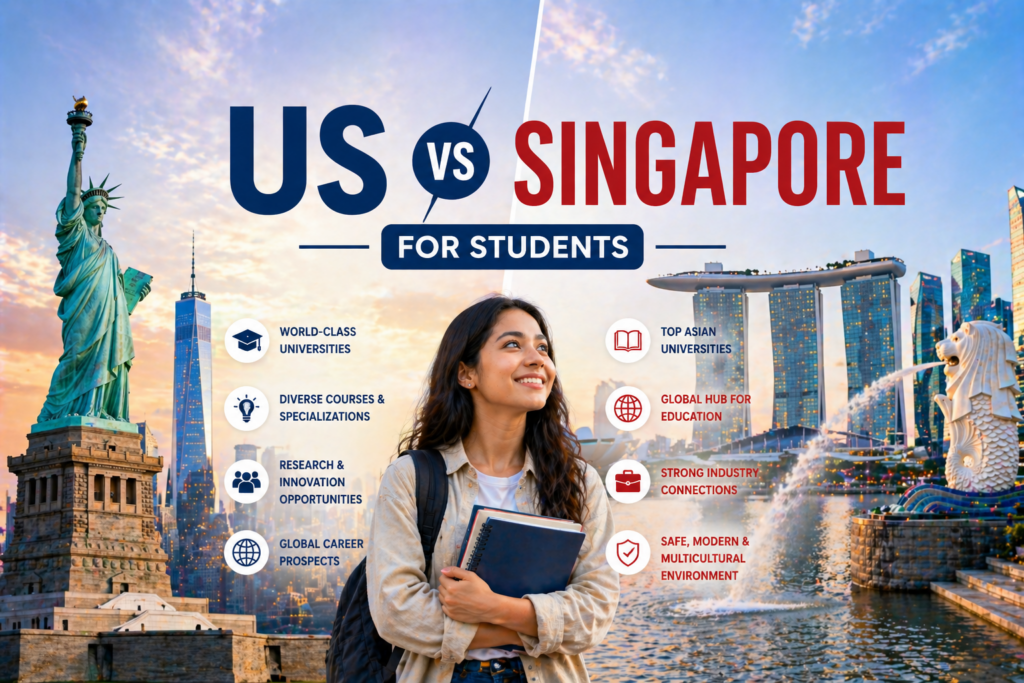
Quick Read
- NUS ranks 8th globally; the US has 50+ top-200 universities.
- F1 visa rejection for Indian students hit 61% in 2025.
- Singapore’s total 2-year cost is around Rs. 45 lakh-1 crore.
- The Singapore Student Pass approval rate is around 85-90%.
Top Universities in US vs Singapore for Indian Students
Top Universities in Singapore
Singapore’s university landscape is small but genuinely elite. According to QS World University Rankings 2026, NUS is 8th in the world, and NTU is 12th. For Computer Science, NUS is joint 4th globally (QS Subject Rankings 2026). SMU specializes in business, law, and information systems.
| University | QS World Rank (2026) | Annual Tuition (International Students) | Annual Tuition in INR | Strongest Areas & Notable Rankings |
|---|---|---|---|---|
| National University of Singapore (NUS) | #8 | SGD 18,000-40,000/year (PG coursework) | Rs.13.3-29.6 lakh/year | Asia’s Top University. CS, Engineering, Medicine, and Law. Ranked Top 10 globally in 28 different subjects. |
| Nanyang Technological University (NTU) | #12 | SGD 60,000-70,000 (full program, 18 months) | Rs.44.4-51.8 lakh (total) | Engineering (especially Material Science), CS, Education, and Natural Sciences. |
| Singapore Management University (SMU) | #511 | SGD 22,850-48,270/year (PG research, non-subsidised) | Rs.16.9-35.7 lakh/year | Business & Management, Accounting & Finance (Top 50 globally), Law, and Social Sciences. |
| Singapore University of Technology and Design (SUTD) | #519 | SGD 15,800-35,000/year (varies by program) | Rs.11.7-25.9 lakh/year | Design, AI, Architecture, and Interdisciplinary Engineering. |
| Singapore Institute of Technology (SIT) | Not Globally Ranked | SGD 25,000-50,000 (full PG program) | Rs.18.5-37 lakh (total) | Applied Sciences, Cybersecurity, and Healthcare (Focus on industry-integrated learning). |
| Singapore University of Social Sciences (SUSS) | Not Globally Ranked | SGD 20,000-30,000/year | Rs.14.8-22.2 lakh/year | Social Work, Human Resources, and Adult Education (Focus on lifelong learning). |

Choose your dream country
 UK
UK
 USA
USA
 Germany
 Australia
 Ireland
 Canada
 UAE
UAE
 France
 Sweden
 Italy
Italy
 Other
Other
When do you want to study abroad?
What's your highest level of education?
Have you completed Class 12th?
What was your Class 12 CGPA/percentage?
Are you a student or a parent/guardian?
What do you want to study?
Select your current city
How Leap will help you

Personalised University Shortlist

Express Applications with Quicker Admits

End-to-End Application Support
Note: Fees above are non-subsidised rates (what international students without the MOE Tuition Grant pay). The MOE Tuition Grant reduces these costs by 40-60% but requires a 3-year work bond in Singapore after graduation.
Top Universities in the USA
The US has over 50 universities in the QS top 200 and several hundred more accredited programs below that. This range is the core structural advantage of the US over Singapore. Students across a wide range of profiles can find a program that fits.
| University | QS Rank 2026 | Annual Tuition (USD) | Annual Tuition (INR Approx.) |
|---|---|---|---|
| Massachusetts Institute of Technology (MIT) | #1 | $44,720 | ₹42.3 Lakh |
| Stanford University | #5 | $61,308 | ₹57.9 Lakh |
| Carnegie Mellon University (CMU) | #22 | $57,420 | ₹54.3 Lakh |
| Purdue University | #109 | $10,746 – $29,128 | ₹10.2–27.5 Lakh |
| University of Texas at Austin | #180 | $12,000 – $22,000 | ₹11.4–20.8 Lakh |
| Arizona State University (ASU) | #216 | $15,372 – $33,000 | ₹14.5–31.2 Lakh |
| Northeastern University | #344 | $30,420 – $57,800 | ₹28.7–54.6 Lakh |
Counselor insight: At NUS and NTU, Indian students are competing with applicants from IITs, top Chinese universities, and strong Southeast Asian schools. A CGPA of 7.5/10 from a tier-2 engineering college in India is simply not competitive enough for most programs there. The same profile, however, would get you into a range of funded US state university programs like Purdue or UT Austin, where total tuition can be under Rs.12 lakh/year. Know which tier you are actually competing in before you build your shortlist around NUS.
Education System of US vs Singapore
Both countries teach in English, but the structure of the education system is quite different. Understanding the differences before you apply will save you confusion later.
| Particulars | United States (USA) | Singapore |
|---|---|---|
| Grading System | Decentralized and flexible, it varies significantly by university. Often uses a 4.0 GPA scale. | Centralized and consistent across public universities. Usually, the grading scale is either a 5.0 scale (NUS/NTU) or a 4.3 scale (SMU). |
| Bachelor's Duration | Typically 4 years. 3-year options are rare but emerging in specific programs. | 3–4 years. Many technical/general degrees are 3 years; honors degrees are usually 4 years. |
| Master's Duration | 1.5–2 years for most professional and academic tracks. | 12–18 months for most taught (coursework) programs. |
| PhD Duration | 4–6 years. Often includes 2 years of coursework before the dissertation; usually funded. | 4–5 years. Typically involves 1 year of coursework followed by a Qualifying Exam (QE); often funded at NUS/NTU. |
| Admission Intakes | Fall (August) and Spring (January). Fall is the primary intake for scholarships. | August (Main) and January (limited programs). Application windows are often shorter. |
| Credit System | Credit Hours: highly flexible with a heavy emphasis on elective variety. | Module-based (units/AUs); follows a more structured, pre-defined academic path. |
| Research Funding | Extensive opportunities for TA (teaching) and RA (research) positions across most tiers of universities. | Strong at NUS and NTU; can be more competitive or limited at newer or private institutions. |
| Teaching Style | Interactive and seminar-heavy; focuses on participation, projects, and broad liberal arts exposure. | Structured and rigorous; emphasizes mastery of content, STEM excellence, and high-stakes examination. |
The program duration difference is practically important. A Singapore master's at 12-18 months means you graduate sooner, start earning sooner, and pay one fewer semester of rent in an expensive city. On a tight budget, that difference alone can be worth Rs.10-15 lakh.
Admission Requirements in the US vs Singapore for Indian Students
| Requirement | United States (USA) | Singapore (NUS / NTU / SMU) |
|---|---|---|
| Min. CGPA | 3.0–3.5 / 4.0 (Approx. 7.0–8.0 on a 10-point scale). | 3.2–3.5 / 4.0 (Approx. 7.5–8.5 on a 10-point scale). Often stricter for top-tier programs. |
| GRE | Required by most PG programs, though many are now "test-optional." | Required by some programs; highly recommended for competitive technical degrees. |
| GMAT | Standard requirement for MBA. | This is required for MBA programs and most Master's programs in Finance or Business. |
| English Proficiency | IELTS: 6.5–7.0 or TOEFL: 80–100. | IELTS: 6.5 or TOEFL: 85+. It can be waived if the previous degree's Medium of Instruction (MOI) was English. |
| SOP | The typical length is 500 to 1,000 words, and the focus is on the personal journey and "fit." | The document should be between 500 and 1,000 words long, be very academic in tone, and frequently reference specific faculty research. |
| LORs | 2–3 letters from professors or professional supervisors. | 2–3 letters; academic references are usually preferred over professional ones for MS. |
| Work Experience | Generally not required for MS; strongly preferred for MBA (3–5 years). | Generally not required for MS; mandatory for MBA (usually 2+ years). |
| Transcripts | Official sealed copies: A WES evaluation is sometimes required to convert grades. | Official sealed copies sent directly from your home university. |
| Provisional Degree | Accepted for I-20 and visa; final degree usually due within 6 months. | Accepted for conditional offers; the timeline is strictly enforced by the Registrar. |
| Application Fee | USD 50–150 per university (~₹4,700–₹14,200). | SGD 50–100 per university (~₹3,700–₹7,400). |
Counselor insight: Two things Indian applicants miss consistently. First, the Medium of Instruction Certificate: if your undergraduate degree was taught in English, this one document can waive the IELTS requirement at several Singapore universities. It is free, takes two days to get from your college, and can save you Rs.15,000 and months of test prep. Second, a generic SOP. At NUS and NTU, they quickly filter out an SOP that does not name a specific professor, lab, or research group. The admissions teams there are small, and they read every application carefully. Spend real time on your SOP.
Cost of Living in US vs Singapore for Indian Students
| Expense Category | Singapore (Monthly) | USA (Monthly) |
|---|---|---|
| Rent (Shared, Off-campus) | ₹51,842 – ₹88,872 (SGD 700–1,200) | ₹56,742 – ₹1,13,484 ($600–1,200) |
| Food & Groceries | ₹22,218 – ₹33,327 (SGD 300–450) | ₹23,642 – ₹47,285 ($250–500) |
| Transport | ₹5,924 – ₹9,627 (SGD 80–130) | ₹9,457 – ₹23,642 ($100–250) |
| Health Insurance | Included at most public universities | ₹7,566 – ₹18,914 ($80–200, mandatory) |
| Miscellaneous | ₹14,812 – ₹29,624 (SGD 200–400) | ₹11,348 – ₹23,642 ($120–250) |
| Total Monthly Estimate | ₹94,796 – ₹1.63 Lakh | ₹1.08 – ₹2.27 Lakh |
Source: Singapore cost of living: Numbeo Singapore 2026, USA cost of living: Numbeo United States 2026
Counselor insight: The cost comparison looks straightforward until you factor in US assistantships. A TA or RA position at a US university typically covers Rs.9-14 lakh of annual tuition and pays a monthly stipend of Rs.94,570-1.89 lakh ($1,000-2,000). A research-track student who secures funding at a mid-tier US university can end up paying less in net terms than a self-funded student at NUS. Before you write off the US on cost grounds, check whether the programs on your shortlist offer TA/RA positions and ask about funding directly in your SOP or in an email to the program coordinator.
Scholarships in US vs Singapore for Indian Students
Scholarships in Singapore
| Scholarship | Coverage & Benefits | Who Can Apply |
|---|---|---|
| SINGA (Singapore International Graduate Award) | Full tuition + SGD 2,700–3,200/month stipend (₹2.0–2.37 lakh). Includes SGD 1,500 airfare grant and SGD 1,000 settling allowance. | International students with a passion for research (PhD) in Science and Engineering at NUS, NTU, SUTD, or A*STAR. |
| SIPGA (Singapore International Pre-Graduate Award) | SGD 2,000/month stipend (₹1.48 lakh) for a short-term research attachment (2–6 months). | Undergraduates (3rd/4th year) or Master’s students looking for research experience at A*STAR, NUS, or NTU. |
| MOE Tuition Grant | Tuition fees are reduced by 40% to 60%, depending on the course or tier. This is a subsidy, not a cash stipend. | International students at public universities. Crucial: Requires a 3-year work bond in a Singapore-registered entity after graduation. |
| NTU Research Scholarship | Full tuition + monthly stipend (typically SGD 2,200–2,700) (Rs.1,62,932-2,00,962). Stipend increases after passing the Qualifying Exam (QE). | Top-tier PhD research candidates applying directly to Nanyang Technological University. |
| NUS Global Merit Scholarship | Full tuition + SGD 6,000 (Rs.4,44,360) annual living allowance + SGD 2,000 (Rs.1,48,120) one-time computer allowance + travel grants for exchange programs. | High-achieving undergraduate applicants with exceptional grades and leadership records. |
Scholarships in the USA
| Funding Type | Coverage & Benefits | Who Can Apply |
|---|---|---|
| Teaching Assistantship (TA) | Full/Partial Tuition Waiver + monthly stipend typically ranging from $2,500 to $4,500 (~₹2.3 to 4.2 lakh). | Graduate students (MS/PhD) who assist in teaching undergrads. Often awarded at admission. |
| Research Assistantship (RA) | Full/Partial Tuition Waiver + monthly stipend. Tied to a professor’s research grant. | Students working on specific lab or faculty research. High availability in STEM fields. |
| Fulbright-Nehru Master's Fellowship | Full tuition + living allowance + airfare + health insurance + J-1 visa support. | Indian citizens with 3+ years of work experience and a high-impact leadership profile. |
| AAUW International Fellowships | $20,000 (Master's) or $25,000 (PhD) per year (~₹19–23.7 Lakh). | International women pursuing full-time graduate study. Not restricted to any specific subject. |
| University Merit Scholarships | Ranges from $5,000 to full tuition. Varies wildly by university (e.g., USC, NYU, Michigan). | High-achieving applicants. Often automatic; no separate application required for many schools. |
Post-Study Work Opportunities in US vs Singapore for Indian Students
What happens after you graduate matters as much as the degree itself. The two countries offer very different paths here.
United States: OPT and STEM OPT
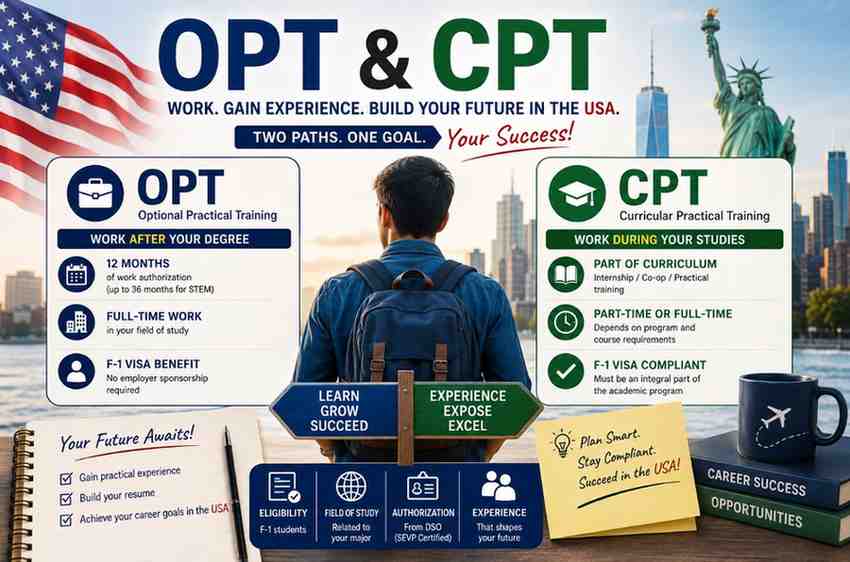
F1 visa holders can apply for Optional Practical Training (OPT) after completing their degree. Standard OPT gives 12 months of US work authorization. For STEM degrees, a 24-month STEM OPT extension is available, giving a total of 36 months. Your employer must be registered with E-Verify and sign a formal training plan.
After OPT, staying in the US long-term requires an H1B visa. The H1B is a lottery, with around 25-30% of registrations being selected recently. For Indian nationals specifically, the employment-based green card queue runs into decades because of per-country caps. Plan for your future honestly before you commit.
Singapore: Long-Term Visit Pass and Employment Pass
After graduating in Singapore, you apply for a Long-Term Visit Pass (LTVP) of up to 12 months to search for a job. Once you have an offer, your employer sponsors an Employment Pass (EP). From January 2026, the qualifying salary for a new EP is SGD 5,600/month (Rs.4.14 lakh/month) for most sectors and SGD 6,200/month (Rs.4.59 lakh/month) for financial services.
Singapore PR is a realistic post-study outcome. You can apply after 1-2 years of working on an Employment Pass. The process is competitive, but the queue is not decades-long like the US green card for Indians. Graduates from NUS, NTU, and SMU working in tech or finance tend to have better PR outcomes.
| United States (USA) | Singapore (Employment Pass) | |
|---|---|---|
| Work Duration | 12 months (Standard OPT); extended to 36 months for STEM degree holders. | The 12-month Long-Term Visit Pass (LTVP) allows you to stay back in the country to find a job, after which you can apply for an Employment Pass (EP) that is renewable every 2–3 years. |
| Sponsorship | Requires an E-Verify-registered company for STEM OPT; H1B requires a lottery win. | Employer must sponsor EP and meet COMPASS points (40+ points based on salary, qualifications, and diversity). |
| Min. Salary (2026) | No set "minimum" for OPT, but H1B selection is now wage-weighted (higher pay = better lottery odds). | SGD 5,600/month (₹4.15 Lakh) for general sectors; SGD 6,200/month (~₹4.60 Lakh) for financial services. |
| Long-Term Path | H1B lottery is followed by a green card. (Note: GC wait for Indian nationals can exceed 20+ years). | EP renewable indefinitely. Eligibility for Permanent Residency (PR) usually begins after 2–3 years of working. |
| Avg. Tech Salary | $90,000–$130,000/year (₹85.5–123.5 lakh) for entry-level Software Engineers. | SGD 75,000 – 105,000/year (₹55.5–77.8 lakh) for entry-level tech/data roles. |
| Job Market | Massive. Home to Big Tech (MAANG) and the largest VC ecosystem in the world. | Concentrated. The hub for Asia-Pacific headquarters, Fintech, and high-end Logistics. |
Source: Singapore Employment Pass qualifying salary 2025: Ministry of Manpower Singapore; Singapore PR eligibility: Immigration and Checkpoints Authority Singapore, US Bureau of Labor Statistics Occupational Outlook Handbook
Counselor insight: Singapore's Employment Pass pathway is more predictable than the H1B lottery, but the job market is genuinely smaller. Singapore has about 5.9 million people. The US has 330 million. The number of companies, roles, and salary bands available in the US is simply in a different category. If you are targeting Big Tech, Wall Street, or US-based consulting, the US is the only realistic option, and the visa risk is worth managing. If you are open to Asia-Pacific careers in finance, tech, or consulting and want a faster and more certain path to PR, Singapore makes more structural sense.
US vs Singapore: Which Country Should You Choose?
| Your Profile / Goal | Recommended Choice | Why? |
|---|---|---|
| The budget is under ₹50 lakh, and the focus is on an Asia-Pacific career. | Singapore | Lower total cost (₹43–96 lakh for 2 years). Student Pass approval is high (85–90%) with no interview, and the PR pathway is significantly faster. |
| Targeting Big Tech, Wall Street, or US Consulting. | USA | The only realistic path for these specific goals. STEM OPT provides 36 months of work authorization, and the job market scale is unmatched globally. |
| Strong Profile (CGPA 8.5+, GRE 318+) but worried about visa. | Apply to Both | Keep both options open. Do not withdraw your Singapore application after receiving a US admit. The US F1 visa has higher rejection risks; having an NUS/NTU backup prevents losing an academic year. |
| MBA Applicant (Targeting Asia Finance/Consulting). | Singapore | Higher ROI. NUS/SMU MBAs (₹37–52 lakh) are prestigious in Asia. A US MBA (₹70 Lakh–₹1.1 Cr+) only makes sense for a GMAT of 720+ and a specific desire to work in the US. |
| Mid-Profile Student (CGPA 7.0–7.5, GRE 305–315). | USA | NUS and NTU are extremely selective and likely out of reach. US mid-tier schools (ASU, UT Austin, Purdue) offer many more seats and specialized programs that fit this profile. |
Verified by LeapScholar's Singapore counseling team. Have questions about the US vs Singapore for Indian students? Book a free session with a LeapScholar counselor.
Frequently Asked Questions About US vs Singapore for Indian Students
-
Is Singapore cheaper than the US for Indian students?
Yes. The total 2-year cost in Singapore is approximately Rs. 43-96 lakh. In the US, the same calculation runs Rs.75 lakh to Rs.1.6 crore. The gap narrows if you secure TA/RA funding in the US, which can cover Rs.9-14 lakh of annual tuition, but Singapore is cheaper in the self-funded scenario.
-
Is the Singapore Student Pass easier to get than the US F1 visa?
Yes, significantly. The Student Pass is processed online with no interview, has an estimated 85-90% approval rate, and takes 2-4 weeks. The US F1 rejection rate for Indian students was 61% in 2025 (US Department of State data), requires an in-person embassy interview, and has wait times of up to 12 weeks during peak season.
-
Which is better for an MS in Computer Science: the US or Singapore?
NUS is joint 4th in the world for Computer Science in the QS Subject Rankings 2026, ahead of most US universities other than MIT, Stanford, and CMU. If your CGPA is above 8.5 and your GRE is above 318, NUS gives you an elite degree at a lower total cost. If your profile is below that, the US offers a much wider range of ranked programs with potential TA/RA funding.
-
Can Indian students work part-time in Singapore?
Yes. International students at NUS, NTU, and SMU can work up to 16 hours per week during term time and full-time during scheduled school vacations. No separate work permit is needed beyond the Student Pass.
-
Which country is better for an MBA: the US or Singapore?
For Asia-Pacific career goals and cost efficiency, Singapore works well. The NUS MBA (18 months, Rs.37-51.8 lakh total) is strong for finance and consulting roles in Asia. For global brands and US or European career placement, a top US MBA costs Rs.70.9 lakh to Rs.1.13 crore but opens very different doors. If your GMAT is above 720 and your goal is the US market, go to the US. If your GMAT is 650-700 and your goal is the Asia-Pacific region, Singapore.
-
What happens if my F1 visa is rejected?
A single 214(b) denial is not permanent. Reapply with stronger evidence of ties to India: property documents, family employment letters, or documented post-degree career plans in India. If denied twice, apply to Singapore or another country for the next cycle. Many US universities grant a one-year deferral when students document a visa denial with the refusal slip.
-
Can I get PR in Singapore after studying there?
Yes, and it is more achievable than US PR for Indian nationals. You can apply for Singapore Permanent Residency after 1-2 years of working on an Employment Pass post-graduation. Approval is not guaranteed, but the timeline is practical. Graduates from NUS, NTU, and SMU in tech, finance, and engineering have better outcomes.
-
What are the admission requirements for NUS and NTU for Indian students?
For PG programs: CGPA of 3.2-3.5 on a 4-point scale (roughly 7.5-8.5 on a 10-point Indian scale); GRE 315+ for most engineering and computing programs; IELTS 6.5 or TOEFL 85+; 2-3 LORs; and an SOP that names specific professors or research areas. Transcripts must be sent directly from your university in a sealed envelope.










Have Questions? Get Guidance to reach your Dream University
Connect with India's finest counsellors and biggest study abroad community.
Get Guidance