
Quick Read
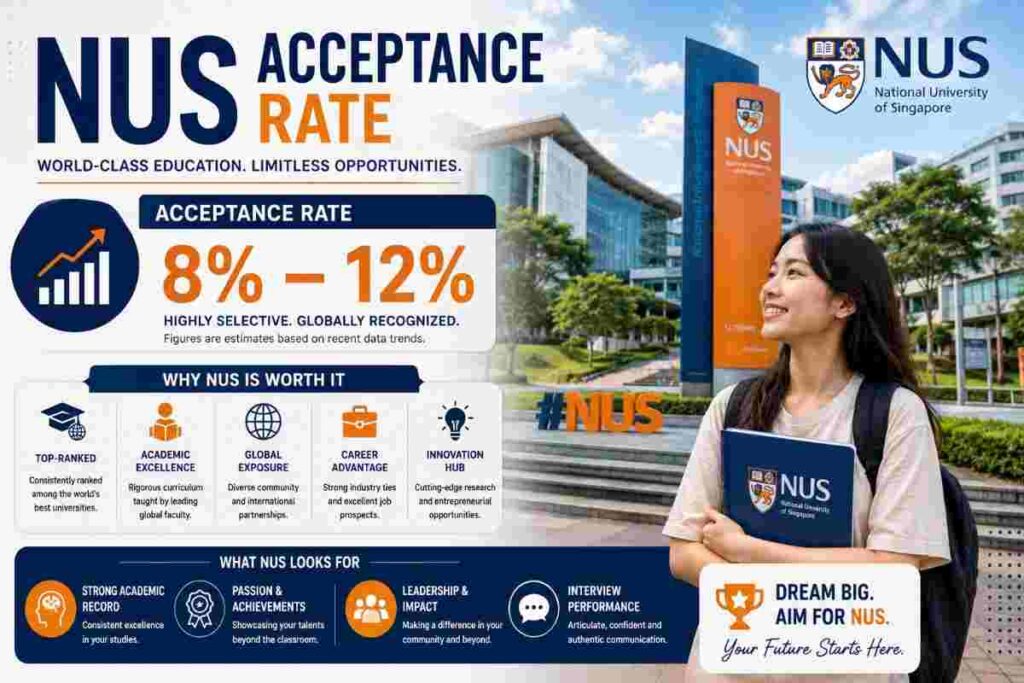
- NUS publishes no official institution-wide acceptance rate figure.
- Estimates for international applicants cluster around 5% to 8%.
- NUS filled roughly 7,370 undergraduate program places last year.
- CBSE and ISC applicants need no SAT and no IELTS.
- State Board applicants must submit SAT, ACT or AP scores.
What is the NUS Acceptance Rate, and Why Does Every site say something different?
NUS does not publish an acceptance rate. Not for undergraduates, not for postgraduates, not for international applicants. Every percentage you will read, including on this page, is an estimate built from enrolment data and applicant volumes.
The most widely used estimate for international applicants is 5% to 8%. The broader 5% to 10% figure includes domestic Singaporean applicants, who enter through the Joint Admissions Exercise and are admitted at higher rates. If you hold an Indian passport, plan around 5% to 8%.

Choose your dream country
 UK
UK
 USA
USA
 Germany
 Australia
 Ireland
 Canada
 UAE
UAE
 France
 Sweden
 Italy
Italy
 Other
Other
When do you want to study abroad?
What's your highest level of education?
Have you completed Class 12th?
What was your Class 12 CGPA/percentage?
Are you a student or a parent/guardian?
What do you want to study?
Select your current city
How Leap will help you

Personalised University Shortlist

Express Applications with Quicker Admits

End-to-End Application Support
Why the numbers on page one of Google range from 5% to 25%:
| Source | Figure quoted | What it is actually measuring |
|---|---|---|
| Admissions consultancies | 5% | International pool only, no denominator disclosed |
| Third-party aggregators | 5% to 10% | Domestic and international pools combined |
| University directory sites | 16% | Usually enrolment against applications, all levels |
| Other directory sites | 25% | Method not disclosed, likely includes PG coursework |
| NUS Office of Admissions | No figure | Publishes grade profiles and program places instead |
Two structural reasons the estimates diverge. Denominator confusion: applications, offers made and offers accepted are three different numbers, and pages rarely say which they used. Pool confusion: NUS assesses A-Level, polytechnic, IB and international-qualification applicants through separate processes with separate requirements.
Counselor insight: When a consultant quotes a precise NUS acceptance rate, ask which pool and which denominator. If they cannot answer, they read it on a blog. What should drive your decision is not the percentage but the program place count in the next section.
What NUS Publishes Instead of a National University of Singapore Acceptance Rate
There is no official NUS acceptance rate, but this is the selectivity data NUS does release, and it is more useful than any estimate. The Office of Admissions publishes an Indicative Grade Profile with the number of places each program filled, plus the 10th and 90th percentile grades of admitted applicants.
Program places taken up in AY2025/2026, excluding double degrees:
| Program | Places filled |
|---|---|
| Humanities and Sciences | 1,976 |
| Engineering | 1,259 |
| Business Administration | 914 |
| Common Computer Science Programs | 893 |
| Nursing | 343 |
| Medicine | 286 |
| Business Analytics | 274 |
| Law | 252 |
| Computer Engineering | 203 |
| Pharmacy | 193 |
| Architecture | 165 |
| Data Science and Economics | 103 |
| Business Artificial Intelligence Systems | 93 |
| Dentistry | 80 |
| Pharmaceutical Science | 65 |
| Information Security | 47 |
| Landscape Architecture | 47 |
| Environmental Studies | 45 |
| Food Science and Technology | 45 |
| Industrial Design | 43 |
| Philosophy, Politics and Economics | 43 |
That totals roughly 7,370 places across every program NUS lists, shared between Singaporean citizens, permanent residents and international students, with internationals a minority of the pool.
The grade profiles are equally blunt. For Law, Medicine, Dentistry, Common Computer Science Programmes, Business Analytics, Computer Engineering, Data Science and Economics, Pharmaceutical Science and Philosophy, Politics and Economics, the representative A-Level profile is AAA/A at both the 10th and 90th percentile. Even the bottom decile of admitted students had straight As. There is no soft edge to those programs.
One important gap: NUS publishes no grade profile at all for international qualifications. It explains that IB and NUS High School sample sizes are too small to produce a meaningful profile, and it never publishes one for CBSE, ISC or State Board applicants. So nobody, including NUS, can tell you the Class 12 percentage that gets you in.
Counselor insight: Use the place count, not the percentage, to build your shortlist. Information Security filled 47 seats and Environmental Studies 45. Applying to three programs that each fill under 50 places is not a shortlist, it is one bet placed three times. Pair one tight program with one that fills several hundred.
National University of Singapore Acceptance Rate by Program for Indian Students
The NUS admission rate is not uniform. The percentages below are estimates based on enrolment trends and competitive benchmarking, and NUS does not confirm program-wise figures. The places column is official.
| Program | Estimated rate (international) | Official places filled | Class 12 benchmark (CBSE/ISC) |
|---|---|---|---|
| Computer Science | 3% to 5% | 893 | 95%+ |
| Engineering | 3% to 5% | 1,259 | 93%+ |
| Business | 5% to 8% | 914 | 92%+ |
| Business Analytics | 3% to 5% | 274 | 95%+ |
| Law | Below 3% | 252 | Not open to most Indian applicants, see below |
| Medicine / Dentistry | Below 3% | 286 / 80 | Not open to most Indian applicants, see below |
| Data Science and Economics | 3% to 5% | 103 | 95%+ |
| Humanities and Sciences | 8% to 15% | 1,976 | 85%+ |
The single most important restriction, and it is nowhere else on this SERP. NUS's own admission pages for both CBSE and ISC and State and other Boards state that applicants who will sit their Class 12 examination after the application closing date are not eligible for dentistry, law, medicine, or nursing.
Indian Class 12 exams run February to April with results in May, while applications close in February, so almost every applicant applying in their final school year falls into this category. If Medicine or Law at NUS is the plan, you need completed results in hand before applying, which means applying a year later.
Architecture, industrial design, and landscape architecture may also run an aptitude test in June to decide eligibility.
Counselor insight: Read that eligibility line before you write a single essay. Every year students spend months on an NUS Medicine application they were never eligible to submit. If Medicine abroad is the goal and you cannot wait a year, Singapore is the wrong shortlist for it.
Two Official Routes that Change your Real NUS Acceptance Rate Odds
Both come straight from NUS and neither appears on any competing page.
Aptitude-Based Admissions. NUS runs a formal route for applicants whose grades do not match the published profiles but who show strong aptitude and achievement in their field. NUS confirms that since AY2020/2021 the published grade profiles already include offers made this way, so the picture looks bleaker than it is: students below the visible bar did get in.
First Choice Bonus Points. NUS adds bonus points to your admission score for your first-choice non-interview single-degree program. Your choice ordering is not neutral, it carries actual weight in the evaluation.
Counselor insight: Order your choices around the bonus, not around prestige. Putting a program you would decline first, purely because it sounds better, spends the bonus on an outcome you do not want.
Admission Requirements for Indian Students
The National University of Singapore acceptance rate is only half the picture. Requirements differ sharply by Indian board, and most published guidance gets this wrong.
| Requirement | CBSE / ISC | State and other Boards |
|---|---|---|
| Class 12 result | Good pass in five subjects including English | Good passes in five subjects including English |
| Standardised test (SAT, ACT with Writing, AP) | Not required | Required |
| English test (IELTS, TOEFL) | Not required | Not required |
| JEE Main or Advanced | Not required | Not required |
| Program eligibility if results come after closing | Not eligible for dentistry, law, medicine, or nursing | Not eligible for dentistry, law, medicine, or nursing |
| Result submission | CBSE by the stated May deadline; ISC within 3 calendar days of release | Within 3 calendar days of release |
| Application fee | SGD 20 (Rs. 1,492) | SGD 20 (Rs. 1,492) |
Exchange rate used: Rs. 74.58 per Singapore dollar. Verify the current rate before finalising your budget.
Three corrections, because the internet gets them wrong. NUS does not require IELTS or TOEFL from Indian Standard 12 applicants on either board. It does not require the SAT from CBSE or ISC applicants. It does require a standardised test from State Board applicants, with details in NUS's standardised test document. Postgraduate programs set their own English and test rules.
An internet printout of your Class 12 result is accepted provisionally, provided your full name is clearly visible. NUS states it assesses applications holistically on academic and non-academic achievement.
Counselor insight: If you are a State Board student, book your SAT in the year before you apply, not in the application year. A weak December SAT with a February deadline leaves you no retake window, and unlike your CBSE peers you cannot simply skip the test.
NUS Application Timeline and Deadlines for AY2027-28
The AY2026-27 window has closed. NUS has published the next cycle: 16 December 2026 to 17 February 2027, with outcomes from mid-May to end-July and an appeal window in late May.
| When | What you do |
|---|---|
| Jul to Aug 2026 | Class 12 results or predicted grades in hand. Check program prerequisites and the eligibility restriction on medicine, law, dentistry, and Nursing |
| Sep to Oct 2026 | State Board students sit the SAT. Request LORs, giving teachers six weeks. Draft your motivation content |
| Nov 2026 | Finalize your program choice order around the First Choice bonus. Prepare documents |
| 16 Dec 2026 | Application portal opens. Create your Applicant Portal account in the first week |
| Dec 2026 to Jan 2027 | Submit. Pay the SGD 20 fee. Upload everything |
| 17 Feb 2027 | Deadline. No late submissions |
| Mar to May 2027 | Interviews and selection tests for the asterisked programs. Check email daily |
| Mid-May to Jul 2027 | Outcomes released progressively. Appeal window opens late May |
| On offer | Accept, then apply for hostel the same day. Apply for your Student's Pass through ICA |
Counselor insight: Accepting your offer does not put you in the hostel queue. That is a separate application, and waitlists fill within days of the first offer round. Do it the afternoon your offer arrives.
What NUS costs an Indian Student
Indian students are classified as non-ASEAN international students, and the fee depends entirely on whether you take the MOE Tuition Grant.
| Fee scenario | Per year (SGD) | Per year (INR) |
|---|---|---|
| With MOE Tuition Grant, 3-year Singapore work bond | 21,400 to 30,450 | Rs. 15.96 lakh to Rs. 22.71 lakh |
| Without the grant, no bond | 33,400 to 44,450 | Rs. 24.91 lakh to Rs. 33.15 lakh |
Source: NUS Office of the University Registrar, AY2026/2027 undergraduate tuition. Computing runs SGD 39,700 (Rs. 29.61 lakh) without the grant, and Medicine far higher. Fees are cohort-based, so your intake year's rate is fixed for your degree. Exchange rate: Rs. 74.58 per Singapore dollar.
Scholarships are auto-considered on submission, with no separate form for most. The NUS International Undergraduate Scholarship and the Science and Technology Undergraduate Scholarship both cover tuition after the Tuition Grant and carry the same 3-year work bond. SINGA, for PhD applicants, is bond-free.
Full breakdowns sit in our guides to NUS fees for Indian students and scholarships in Singapore.
Counselor insight: Run the grant maths rather than avoiding the bond on instinct. On Computing the grant saves roughly Rs. 13.7 lakh a year, so refusing it costs close to Rs. 55 lakh across four years to avoid three years of work in one of Asia's strongest graduate job markets.
What the National University of Singapore Acceptance Rate means for your Profile
You are a CBSE or ISC student with 95% or above, targeting computer science or engineering.
You are competitive, and you need no SAT and no IELTS, which puts you ahead of State Board peers on effort alone. But Common Computer Science showed AAA/A at the 10th percentile, so grades only get you into the pool. Put your genuine first choice first to collect the bonus points, and make your non-academic record specific rather than long.
You are a State Board student with 85% to 90%.
Your realistic path is Humanities and Sciences, which filled 1,976 places, rather than Computing. Your SAT is mandatory and is where you can still move the needle, so sit it early with a retake in reserve. Read the Aptitude-Based Admissions page before writing NUS off, because it exists for your profile. Apply to NTU and SMU in the same cycle.
You are finishing a BTech at an NIT or IIT with a 7.8 to 8.5 CGPA, targeting an MS or PhD.
Postgraduate admissions sit outside everything above. Requirements, deadlines and English rules are set per programme, so verify each rather than assuming undergraduate rules apply. At PhD level the supervisor relationship carries real weight, so contact your target professor four to six months before the deadline. Our guides to MS in Singapore and master's intakes in Singapore cover the process.
What to Do if your NUS Application does not work out
You missed 17 February. There is no late submission. The next window opens December 2027, enough time to change your profile materially rather than resubmit the same one better worded.
You are not eligible for your target program. If Medicine, Law, Dentistry or Nursing is the goal and your results arrive after the deadline, you have two options: apply the following year with completed results, or change country. There is no workaround.
Your Class 12 score is below 88%. For Computing, Engineering and Business you will struggle past shortlisting. Apply to NTU and SMU in parallel, not after a rejection, and read the Aptitude-Based Admissions criteria.
Your marksheet is delayed. Submit an internet printout within three calendar days of the result declaration, with your full name clearly visible, through the Applicant Portal. Do not wait for the physical document, and do not submit twice, since NUS warns that duplicate submissions affect processing.
You were rejected. The NUS acceptance rate makes this the common outcome, not a personal verdict. The appeal window is late May. Appeal only if something genuinely changed: a new result, a significant achievement absent from the original file, or an administrative error. Asking NUS to reconsider the same application rarely changes the outcome.
Counselor insight: A rejection is not the end of the Singapore plan. NTU sits at 12th in QS 2027, two places behind NUS at 10th, and its Indian graduates place well across finance, technology and research. Our NTU acceptance rate guide has the entry bar. Apply to NUS and NTU together, every time.
3 Takeaways on NUS Acceptance Rate
- Stop chasing the percentage and use the program places. NUS publishes no acceptance rate, but it does publish that Information Security filled 47 seats and Humanities and Sciences filled 1,976. That difference should shape your shortlist more than any estimate.
- Check your board's rules before you write anything. CBSE and ISC applicants need no SAT and no IELTS. State Board applicants must sit a standardised test. Neither group is eligible for medicine, law, dentistry, or nursing if results arrive after the deadline.
- Diarise 16 December 2026 and 17 February 2027. The National University of Singapore acceptance rate is not what decides your outcome. Eligibility, choice ordering and the deadline are.
Verified by: LeapScholar's Singapore counseling team, with hands-on experience guiding Indian students through NUS and NTU applications, program eligibility checks, MOE Tuition Grant decisions and Student's Pass processing with ICA.
Have questions about your NUS acceptance rate? Book a free session with a LeapScholar counselor.
Frequently Asked Questions About NUS Acceptance Rate
-
What is the NUS acceptance rate?
NUS publishes no official figure. The working estimate for international applicants is 5% to 8%, and the wider 5% to 10% figure includes Singaporean applicants who are admitted at higher rates. What NUS does publish is program place counts, roughly 7,370 undergraduate places filled last year across all nationalities.
-
What should I do if my profile looks too weak for NUS?
Read NUS's Aptitude-Based Admissions page, which exists for applicants whose grades do not match the published profiles, and note that the published profiles already include offers made through it. Then apply to NTU and SMU in the same cycle rather than treating them as a fallback after rejection.
-
What are the NUS application dates for AY2027-28?
The international qualifications window runs 16 December 2026 to 17 February 2027, with outcomes from mid-May to end-July 2027 and an appeal window in late May. Always confirm on the NUS Office of Admissions site rather than a third-party page.
-
Which programs have the lowest NUS acceptance rate?
By published grade profile, Law, Medicine, Dentistry, Common Computer Science Programmes, Business Analytics, Computer Engineering, Data Science and Economics, Pharmaceutical Science, and Philosophy, Politics and Economics all showed AAA/A at the 10th percentile. Several also fill under 300 places.
-
Is JEE required for NUS?
No. NUS explicitly states that JEE Main and JEE Advanced are not required for Indian Standard 12 applicants on either board. A strong JEE performance may still evidence aptitude, but it is not part of the stated requirements.
-
Can I apply to NUS Medicine or Law from Class 12 in India?
Usually not in your final school year. NUS states that applicants sitting their Class 12 examination after the application closing date are not eligible for dentistry, law, medicine, or nursing. Since Indian results arrive in May and applications close in February, you generally need completed results before applying.
-
Do Indian students need IELTS or TOEFL for NUS?
Not for undergraduate admission on either Indian board. NUS lists the English requirement as not required for both CBSE and ISC and State Board applicants. Postgraduate programs set their own English requirements, so check your specific program page.
-
Do CBSE and ISC students need the SAT for NUS?
No. NUS's own admission page for Central and ISC Boards lists the standardised test as not required. State Board and other board applicants must submit SAT, ACT with Writing, or Advanced Placement scores. This is the biggest single difference between the two Indian routes.
-
What is the NUS acceptance rate for Indian students specifically?
There is no defensible number, because NUS neither publishes country-level data nor a grade profile for Indian qualifications. Treat 5% to 8% as an order of magnitude, then assess yourself against the program place count and the eligibility rules for your board, which are official.








Have Questions? Get Guidance to reach your Dream University
Connect with India's finest counsellors and biggest study abroad community.
Get Guidance