
Quick Read
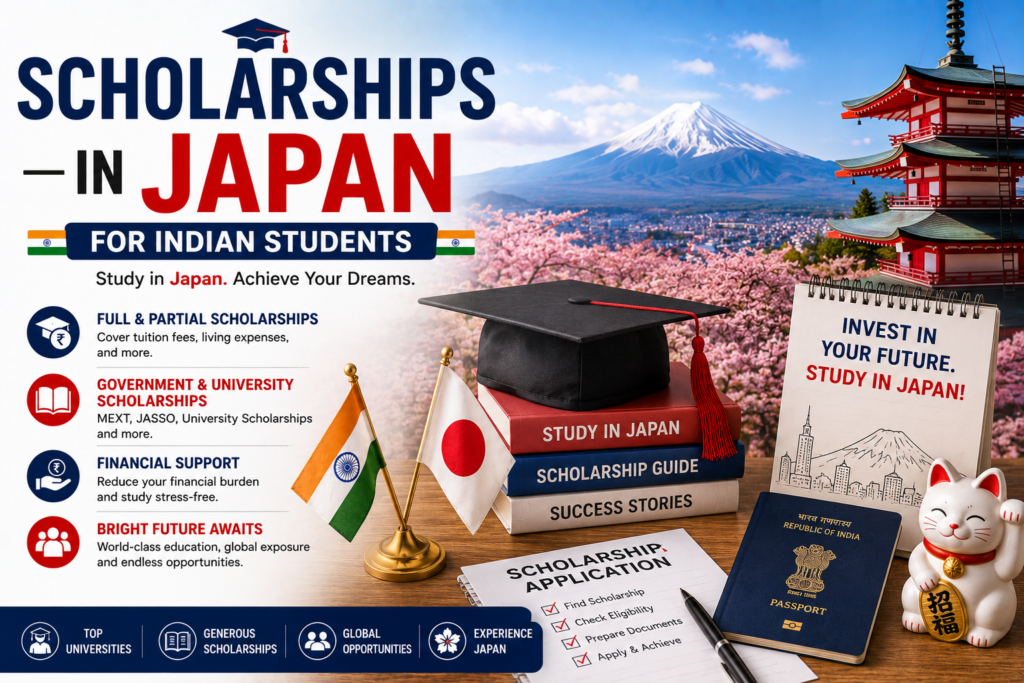
- MEXT covers full tuition plus Rs.67,900-84,100 a month for Indian students.
- The MEXT 2027 embassy window has closed; MEXT 2028 opens April 2027.
- JASSO pays enrolled students Rs.27,800 monthly, on top of any tuition award.
- Honjo Foundation gives postgraduates up to Rs.1,33,400 monthly, no Japanese required.
Why Scholarships in Japan for Indian Students Matter
Monthly living costs in Tokyo run Rs.80,000-1,10,000 ($960-1,320), and Japan’s living costs stay high even in cheaper cities. Scholarships in Japan for Indian students are what make that number manageable, and MEXT and JASSO alone fund thousands of international seats a year, a very different reality from the lottery-style awards common in the US or UK.
Counselor insight: Most Indian applicants research only MEXT and stop there. Seats go unfilled every year in JASSO nominations, the Honjo Foundation, and university-specific awards simply because Indian students never apply. A shortlist of 3-4 scholarships, not just one, is what actually changes the outcome.

Scholarships in Japan for Indian Students: Full Comparison
| Scholarship | Funded By | Level | Monthly Stipend (INR approx.) | Tuition | Japanese Required? |
| MEXT (Embassy Route) | Government of Japan | UG / PG / PhD | Rs.67,900-84,100 | Full waiver | No, but helps |
| MEXT (University Route) | Government of Japan | PG / PhD | Rs.67,900-84,100 | Full waiver | No, but helps |
| JASSO Honors Scholarship | Japan Student Services Org. | UG / PG / PhD | Rs.27,800 | No | Preferred |
| Honjo International Scholarship | Private Foundation | Master’s / PhD | Rs.1,04,400-1,33,400 | No | No |
| ADB-Japan Scholarship | ADB + Govt. of Japan | Master’s only | Living allowance | Full | No |
| JJ/World Bank Scholarship | World Bank + Govt. of Japan | Master’s only | Living allowance | Full | No |
| Mitsui and Co. India Scholarship | Mitsui and Co. | UG (Class 12 entry) | Covered | Full | Yes (trained) |
| University-Specific (UTokyo, Kyoto) | Individual universities | UG / PG / PhD | Varies | Partial/Full | Varies |
MEXT Scholarship: The Flagship Route Among Scholarships in Japan for Indian Students
A fully funded scholarship to study in Japan for Indian students almost always means MEXT, officially the Monbukagakusho Scholarship, run by Japan’s Ministry of Education, Culture, Sports, Science and Technology. It covers full tuition, a monthly stipend of Rs.67,900-84,100 (¥117,000-¥145,000, varying by level), round-trip airfare, medical insurance, and a Japanese language preparatory year for undergraduates.
The MEXT 2027 Cycle Has Closed: What That Means for You
If you are researching Japan scholarships for Indian students for 2026 or 2027 right now, note this first. According to the Embassy of Japan in India’s official scholarship page, the Research Student window for the 2027 intake ran 20 April-15 May 2026, and the Undergraduate, KOSEN, and Specialized Training College windows ran 23 April-25 May 2026. Both are shut.
If you’re only starting now, your realistic target is MEXT 2028, beginning studies in April or October 2028, with the application window expected to reopen around April 2027.
Counselor insight: Students who miss a MEXT window often search for unofficial “reopening” dates. There are none. Use the months before the 2028 window opens to write and rewrite your research plan, and if you’re targeting the university route, start emailing potential supervisors now.
MEXT Categories
- Research Student (Master’s/PhD): Under 35 as of April 1 of the application year; 16 years of completed education required. The route most working professionals use for a Japanese scholarship for Indian postgraduate students.
- Undergraduate: For Class 12 graduates under 25. One-year Japanese language course, then a 4-year degree (6 years for medicine). The entry point for a Japanese scholarship for Indian students after 12th grade.
- College of Technology (KOSEN): Technical diplomas, open after Class 10.
- Young Leaders Program: For working professionals in government or policy, stipend roughly Rs.1,40,400 (¥242,000).
Embassy Route vs. University Route
The Embassy Recommendation route, used by most Indian MEXT scholars, runs through the Embassy of Japan in New Delhi: a written exam (Maths, Physics, Chemistry for science; English, Math, and Japanese for humanities); an interview; and then the embassy forwards its recommendation to MEXT.
If you live outside North India, you likely don’t apply to New Delhi directly. The Consulate-General of Japan in Mumbai handles Maharashtra, Gujarat, Goa, and Madhya Pradesh; Kolkata handles West Bengal, Bihar, Odisha, and Jharkhand; Chennai handles Tamil Nadu, Telangana, Kerala, Andhra Pradesh, and Puducherry; and Bengaluru handles Karnataka alone. Confirm your regional jurisdiction before you prepare documents, since each consulate sets its own submission counter and, occasionally, its own local timeline within the embassy’s overall window.
The University Recommendation route means applying directly to a Japanese university’s own MEXT scheme and suits research students who already have a professor willing to supervise them.
Counselor insight: Indian students often assume the university route is the easier shortcut. It isn’t. It requires an existing relationship with a professor, built at least six to eight months before the deadline. Without that, the embassy route is the more realistic path.
MEXT Research Student applications from India have risen sharply, and the acceptance rate for this category is now estimated to be roughly 2-9% globally. If you’re asking how to get a scholarship to study in Japan against those odds: apply with a specific, supervisor-named research plan, and apply to more than one program in parallel.
JASSO: The Living-Allowance Backup Among Scholarships in Japan for Indian Students
If MEXT doesn’t work out, the JASSO Scholarship, run by the Japan Student Services Organization, is the most widely available support for students already admitted to a Japanese university. It doesn’t cover tuition; it pays a monthly living allowance directly into your Japanese bank account: roughly Rs.27,800 (¥48,000) for degree-seeking students, Rs.46,400 (¥80,000) for short-term exchange students, and Rs.17,400 (¥30,000) for language-school students.
The reservation route matters most for Indian applicants. When you sit for the EJU (Examination for Japanese University Admission), tick the Monbukagakusho Honors Scholarship Reservation box. Score well, and you carry the reservation to Japan; miss it, and that route is gone for the cycle. Once enrolled, your university nominates JASSO candidates by GPA (minimum 2.30 on a 3.0 scale) and financial need.
Counselor insight: Indian students often dismiss JASSO because the amount looks small next to MEXT. In cheaper cities like Fukuoka or Nagoya, JASSO plus a legal part-time job (up to 28 hours a week on a student visa) covers a meaningful share of monthly expenses.
Private and University Scholarships in Japan for Indian Students
Honjo International Scholarship Foundation: Open to all nationalities for master’s and PhD study, no university pre-selection needed. 2026 stipends are tiered by program length: Rs.1,33,400 (¥230,000) for 1-2 year degrees, Rs.1,21,800 (¥210,000) for 3-year degrees, and Rs.1,04,400 (¥180,000) beyond that. Applications open every August via the Honjo Foundation’s site.
ADB-Japan Scholarship: For master’s students from ADB member countries, including India, at designated partner universities. Requires unconditional admission first; see ADB’s official scholarship page and LeapScholar’s ADB-Japan Scholarship guide.
Joint Japan/World Bank Graduate Scholarship: Needs 3+ years of development-sector work experience and admission to one of 44 participating master’s programs. See the World Bank’s JJ/WBGSP page and LeapScholar’s JJ/WBGSP guide.
Mitsui and Co. India Scholarship: Built specifically for Indian Class 12 graduates, covering one year of Japanese language training plus a four-year undergraduate degree, for a total of five years of funding. This information is confirmed on the official Study in Japan portal.
University-specific awards: Kyoto University alone nominates enrolled students for around 90 private scholarship programs a year, most expecting JLPT N2. UTokyo and Osaka University run similar internal fellowships, but nominations happen after admission, so arrive with funds secured rather than counting on one.
Counselor insight: Private awards like Honjo are undersubscribed by Indian applicants because they don’t require university pre-selection. Apply here in parallel with MEXT, not after it, since Honjo’s own document-review results land months before MEXT’s final decision.
Who Should Apply for Which Scholarship in Japan for Indian Students
Final-year B.Tech or BSc student, graduating in 2027: Target MEXT Research Student for the 2028 cycle, opening around April 2027. Start your research plan now, and in parallel, apply for direct admission with a JASSO reservation ticked on your EJU form as a funded fallback.
Graduated 2-3 years ago, working in India: MEXT Research Student is open to you as long as you’re under 35 on April 1 of the application year. With 3+ years in a development-related field, the ADB-Japan or JJ/World Bank Scholarship is worth pursuing once you hold an admission letter.
Just finished Class 12, want engineering or computer science in Japan: Your two realistic routes for a Japan scholarship for Indian students after 12th are MEXT Undergraduate (under 25, next window April 2027) and the Mitsui and Co. India Scholarship, which is built specifically for Indian undergraduates.
Documents You Need for Scholarships in Japan for Indian Students
| Document | India-Specific Detail |
| Application form | MEXT’s form is offline: download, print, and courier it to the Embassy. No online portal. |
| Academic transcripts | Class 10, Class 12, and all undergraduate mark sheets are attested. |
| Graduation/passing certificate | If not yet graduated, get a bona fide or expected graduation letter. |
| Recommendation letters | Minimum of 2 recommendation letters from faculty or supervisors, on institution letterhead. |
| Research/study plan | Required for PG and PhD; 2-4 pages, naming a field and ideally a supervisor. |
| Medical certificate | Standard MEXT health form, signed by a registered practitioner. |
| Passport copy | Valid for at least 18 months from your intended departure date. |
| Language proof | IELTS/TOEFL for English-medium programs; JLPT for Japanese-medium and JASSO priority. |
| LOA (University Route) | A Letter of Acceptance or conditional offer from a Japanese professor. |
2026-27 Application Calendar: All Scholarships at a Glance
| Scholarship | Window Opens | Deadline | Results |
|---|---|---|---|
| MEXT (2028 cycle) | Expected April 2027 | Expected mid-late May 2027, based on the 2027 cycle’s 15-25 May pattern | November-December 2027 |
| JASSO Honors (EJU reservation) | Tied to EJU registration, held twice a year | Set by each EJU sitting; confirm on JASSO’s EJU page | Nomination each semester after enrollment, based on GPA and need |
| Honjo Foundation | Guidelines released every August | Typically follows within the same document-review cycle; confirm on Honjo’s site | Document-review results and interviews in February |
| ADB-Japan Scholarship | Rolling, tied to your university’s nomination cycle | No fixed date; you must hold unconditional admission first | Communicated by your university after internal shortlisting |
| JJ/World Bank Scholarship | Window 2 typically opens late March | Window 2 typically closes late May | Communicated by your participating university after the window closes |
What to Do When It Goes Wrong
Missed the MEXT deadline. No extensions exist. Start preparing for the next cycle now, and apply for direct university admission with a JASSO reservation ticked on your EJU form so you aren’t left with zero funded options.
Rejected at embassy screening. This scenario is common on a first try; most successful MEXT scholars applied 2-3 times. Vague research plans are the most common cause. A plan naming a specific research question and a potential supervisor performs better.
Admission but no scholarship. Enroll, then talk to the international student office about JASSO nomination, which happens each semester based on GPA and need. A strong first semester genuinely helps.
Student visa delayed or refused. Usually, the reason is a documentation gap: incomplete financial proof, an admission letter missing course duration, or an unexplained academic gap. Read our Japan student visa guide, request the specific refusal reason from the embassy, and address each point in your reapplication.
IELTS/TOEFL score fell short. Many MEXT categories don’t require IELTS. But for self-funded admission with a JASSO reservation, a low score blocks your application. Retake it while preparing for the next MEXT cycle.
3 Takeaways on Scholarships in Japan for Indian Students
1. Target MEXT 2028, not 2027. The 2027 embassy windows closed between 15 and 25 May 2026. Your realistic entry point is the April 2027 window for the 2028 intake. Start your research plan now.
2. Don’t skip the EJU reservation tick box. If self-funded admission is even a backup plan, ticking the JASSO reservation is impossible to undo later in the cycle.
3. Apply to more than one program at once. MEXT results land in November-December, Honjo interviews happen in February, and JJ/WBGSP closes around May. These windows overlap, so applying to two or three programs really increases your chances.
Have questions about scholarships in Japan for Indian students? Book a free session with a LeapScholar counselor.
Frequently Asked Questions About Scholarships in Japan for Indian Students
-
Q1. Can a 12th pass apply for a MEXT scholarship?
Yes. Class 12 graduates under 25 can apply through the MEXT Undergraduate category, run through the Embassy of Japan in India. It funds a one-year Japanese language course followed by a 4-year degree (6 years for medicine).
-
Q2. Can an Indian student study in Japan for free?
Yes, with the right scholarship. MEXT covers full tuition, a monthly stipend, and airfare, and Mitsui & Co. India Scholarship offers similar full funding built specifically for Indian Class 12 graduates.
-
Q3. Is IELTS mandatory for MEXT?
No. The Embassy of Japan runs its English assessment for most MEXT categories, so IELTS isn’t a standard requirement, though a strong score helps if a specific university program asks for one separately.
-
Q4. Is there an age limit for MEXT?
Yes. Research Students must be under 35 as of April 1 of the application year, while Undergraduate applicants are typically capped at 25.
-
Q5. How many Indians apply for MEXT every year?
Estimates put annual Indian applications at 5,000-8,000 across all categories, with roughly 70-100 selected each year according to Embassy of Japan in India data, which is why a specific, supervisor-named research plan matters so much.
-
Q6. Can I work while on a MEXT scholarship?
Yes. MEXT scholars can take up part-time work for up to 28 hours a week with permission from Japan’s immigration authorities, the same rule that applies to any international student visa holder.
-
Q7. How many Indian students are currently studying in Japan?
As of 2024, around 1,600 Indian students are studying in Japan, which is a small number compared to the US or UK. Japan’s government is now targeting 15,000 Indian students within the next few years through expanded scholarships and English-taught programs.
-
Q8. What are the fully funded scholarships in Japan for Indian students?
MEXT, the Honjo International Scholarship Foundation, the ADB-Japan Scholarship, the Joint Japan/World Bank Scholarship, and the Mitsui and Co. India Scholarship all cover full or near-full costs, though most require admission before you apply.
-
Q9. How much CGPA is required for MEXT?
There’s no fixed CGPA cutoff. Embassy screening favors a consistently strong academic record, roughly 65% or a GPA around 2.5-3.0 out of 4.0, backed by a specific research or study plan.
-
Q10. Which universities in Japan offer MEXT scholarships?
Nearly every national university and many public and private ones accept MEXT scholars, including the University of Tokyo, Kyoto University, Osaka University, and Tohoku University, through either the embassy or university recommendation route.
-
Q11. Can I apply to both the Research Student and Undergraduate MEXT categories in the same cycle?
No. MEXT requires you to apply under a single category matching your current academic level, since eligibility, age limits, and the exam syllabus differ between them. Choose Undergraduate if you’ve completed Class 12, or Research Student if you already hold a bachelor’s degree.










Have Questions? Get Guidance to reach your Dream University
Connect with India's finest counsellors and biggest study abroad community.
Get Guidance