
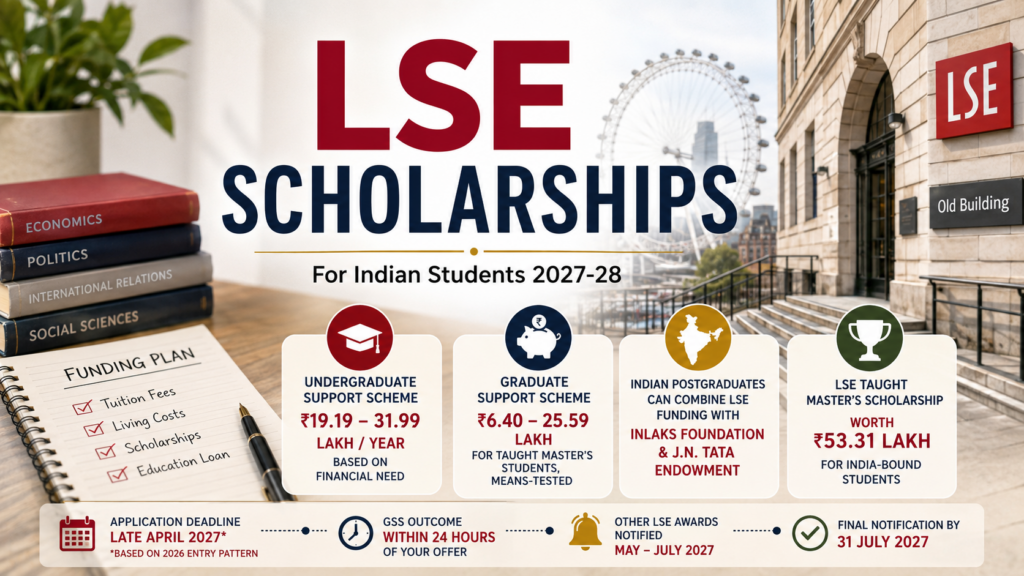
Quick Read
- Undergraduate Support Scheme: ₹19.19-31.99 lakh/year based on financial need.
- GSS: ₹6.40-25.59 lakh for taught master’s students, means-tested.
- Indian postgraduates can combine LSE funding with Inlaks and J.N. Tata Endowment.
- LSE’s Taught Master’s Scholarship: Worth ₹53.31 lakh for India-bound students.
What Scholarships Does LSE Offer Indian Students?
LSE scholarships for international students fall into two categories, and knowing which one you’re applying for changes your entire approach.
| Category | Basis | Application Route |
| Internal LSE schemes (Undergraduate Support Scheme, Graduate Support Scheme) | Financial need first, academic merit second | Built into your existing admission application; no separate form |
| Merit or country-specific external awards (Inlaks, J N Tata, Marchant Foundation LLM, etc.) | Academic merit, professional achievement, and need combined | Separate application directly with each foundation, on its own timeline |
LSE’s own funding philosophy runs opposite to how many Indian students assume UK university scholarships work: need is assessed first, merit second.
Counselor insight: Students often apply to five or six external LSE scholarships before realizing the Undergraduate Support Scheme or Graduate Support Scheme requires zero separate hunting. It’s built into your existing application. Complete that form properly before chasing anything else.
How far a scholarship stretches depends on your program’s actual fee:
| Level | Typical overseas fee range |
| Undergraduate | Around £25,000 a year (₹31,98,500) |
| Postgraduate (taught master’s) | Widely variable; £40,000+ a year (₹51,17,600+) for some programmes |
A scholarship covering £15,000 (₹19,19,100) means something very different for a £25,000-a-year (₹31,98,500) course versus a £42,000-a-year (₹53,73,480) one, so always check your specific program’s fee page before budgeting.
Exchange rate note: £1 = ₹127.94, as of early August 2026. Verify the current rate before finalizing your budget.
Why competition stays intense every cycle:
- University of the Year 2025: Times and Sunday Times Good University Guide
- 1st in London for the 15th year running: Complete University Guide
- 5th in the world for social sciences and management: QS World University Rankings by Subject 2026
Source: LSE Financial Support, official page; rankings verified against LSE’s official rankings page
LSE Undergraduate Support Scheme: Amount and Eligibility
The LSE Undergraduate Support Scheme is the primary route for undergraduate LSE scholarships for international students, including Indian applicants.
| Detail | Figure |
| Eligibility | Overseas fee status student with any offer at LSE |
| Amount | £15,000-£25,000 per year (₹19,19,100-₹31,98,500) |
| Renewal | Renewed each year of your programme, subject to satisfactory academic progress |
| Application | Automatic consideration once you submit your LSE Undergraduate Scholarship Application |
Source: LSE Undergraduate Support Scheme, official page
LSE also runs several other undergraduate awards Indian applicants can be considered for automatically, including the Beacon Scholarship, Bluemoon Foundation Scholarship Fund, Global School of Sustainability Scholarships, LSE Mauritius Scholarship, Pestalozzi International Scholarship, Singapore LSE Trust Undergraduate Scholarship, and Uggla Family Scholars Program.
Indian, Bangladeshi, and Canadian citizens also have a dedicated needs-based award: the Rajeeb Mukherjee Memorial Scholarship, worth £9,000 (₹1,151,460), confirmed live on LSE’s official undergraduate funding page.
For a fuller picture of what your CGPA might realistically unlock, see how much scholarship you can expect with a high CGPA.
LSE Graduate Support Scheme: How It Differs from Other LSE Scholarships
The Graduate Support Scheme (GSS) is the largest pool of LSE postgraduate scholarships for international students, and it works differently from every merit-based award on this list.
| Detail | Figure |
| Annual pool | Approximately £3 million (₹38,38,20,000) distributed across Home and Overseas taught master’s students |
| Amount per award | £5,000-£20,000 (₹6,39,700-₹25,58,800), depending on financial need |
| Assessment basis | Means-tested only; academic merit is not assessed |
| Application | Via the LSE Graduate Financial Support Application, accessed after you submit your admission application |
Source: LSE Graduate Support Scheme, official page
GSS is designed to supplement funding you already have, not replace it entirely. If your GSS outcome doesn’t cover your full gap, you’re automatically considered for other LSE scholarships and awards using the same application, with successful candidates typically notified between May and July.
Counselor insight: The GSS decision usually arrives within 24 hours of receiving your LSE offer, through the Graduate Applicant Portal. Most Indian students don’t realize how fast the process turns around and end up delaying their loan sanction letter while waiting unnecessarily.
The scheme excludes specific modular or executive programs, including MSc Finance (Part-time), MSc Health Economics, Policy, and Management, and MSc International Strategy and Diplomacy.
India-Specific LSE Scholarships: Inlaks, J N Tata, and More
Beyond LSE’s own schemes, LSE’s official country-based scholarships page lists several externally funded scholarships specifically for Indian students:
| Scholarship | Focus | Notes |
| Inlaks Foundation | Master’s/MPhil/Doctoral study, USA/UK/Europe | Separate application through the Inlaks Foundation directly |
| J N Tata Endowment | Postgraduate/research/doctoral | Loan-scholarship: separate application through the JN Tata Endowment trust |
| Joint Japan/World Bank Graduate Scholarship Program | Postgraduate study for developing-country nationals | Administered by the World Bank, not LSE |
| Lady Meherbai Tata Education Trust | Postgraduate study for Indian women | Requires minimum 2 years’ relevant work experience |
| Marchant Foundation LLM Scholarship | LLM (Master of Laws) | Priority to Indian applicants currently residing in India |
Source: LSE Country-Based Scholarships (D-K), official page
Note: The Margaret Basu Scholarship, previously listed for Indian postgraduate applicants, no longer appears on LSE’s current official India country-scholarships list, and its scholarship page still shows stale 2023-24 cycle information. Its status for 2027-28 is unconfirmed.
Do not rely on it in your funding plan until you’ve verified directly with LSE’s Financial Support Office. The same caution applies to the QS Leadership Scholarship, the Sir Ratan Tata Post-Doctoral Fellowship, and the Commonwealth Rutherford Fellowship, none of which currently appear on LSE’s own India-specific listing.
LSE Taught Master’s Scholarship and Other High-Value Awards
This program is the LSE full scholarship masters route most Indian applicants never hear about.
| Detail | Figure |
| Amount | £41,666 (₹53,30,748) toward tuition fees and living costs |
| Eligibility | Must intend to reside in India, Europe, or Latin America after your studies |
| Excluded programmes | Economics-affiliated programmes |
| How to apply | Same LSE Graduate Financial Support Application used for the GSS; no separate form |
If you’re not offered GSS funding, this taught Master’s Scholarship is one of the “other LSE awards” for which you’re automatically considered using that same application.
Counselor insight: Because this scholarship explicitly rewards a stated intention to return to India, your personal statement in the Graduate Financial Support Application should say so directly rather than leaving your post-study plans vague. Vague answers get filtered out at the automated assessment stage.
Other high-value awards to know about:
- LSE departments also award smaller entrance scholarships to meritorious master’s students, typically around £2,000 (₹2,55,880), varying by department and academic year.
- MBA-specific and other subject-level awards exist within individual departments; check your target department’s own funding page for current details.
How to Apply for an LSE Scholarship?
The application path depends entirely on which category of LSE scholarship you’re targeting.
For GSS, the Undergraduate Support Scheme, and most other internal LSE scholarships:
- Submit your LSE undergraduate or graduate admission application first.
- Once you hold a conditional or unconditional offer, access the Financial Support Application through the Applicant Portal (undergraduate) or Graduate Applicant Portal (postgraduate).
- Complete the financial information sections in full. Incomplete financial details are the most common reason LSE can’t calculate an accurate need-based outcome.
- Complete the personal statement section too, since this is what triggers automatic consideration for every other LSE scholarship you’re eligible for, beyond GSS or the Undergraduate Support Scheme alone.
- Submit before the deadline, typically in late April and tied to your offer date, not a fixed calendar date.
- Track your outcome via the portal. GSS decisions usually arrive within 24 hours; other LSE scholarship outcomes follow between May and July.
For India-specific external awards (Inlaks Foundation, J N Tata Endowment, Lady Meherbai Tata Education Trust, Marchant Foundation LLM Scholarship):
- Apply separately and directly through each foundation’s own website. These run independently of LSE’s Financial Support Application and on their own timelines.
- Secure your LSE offer first, since most trust awards require proof of admission before considering your application.
- Prepare a separate Statement of Purpose and Letters of Recommendation for each trust, since panels weigh merit and career plans differently from LSE’s need-based process.
Documents Checklist for LSE Scholarship Applications
| Document | India-specific detail |
| Academic transcripts and certificates | All years of Bachelor’s degree, English-translated and attested if from a regional-language board |
| English language certification | IELTS, TOEFL, or PTE Academic scorecard, if required for your programme |
| Updated CV | Should reflect work experience relevant to trust-specific awards like Inlaks or Lady Meherbai Tata |
| Statement of Purpose | Required separately for most India-specific external awards |
| Letters of Recommendation | 1-2 LoRs depending on scholarship; at least one from an academic supervisor for most trust awards |
| Proof of acceptance | LSE offer letter, conditional or unconditional |
| Financial statement | Family income proof, required for both GSS and India-specific need-based awards |
| Passport copy | Required across almost all LSE scholarship and visa-related applications |
Source: LSE Graduate Financial Support Application guidance, official page
LSE Scholarship Planning Calendar for 2027-28
| Month | Action |
| August-October 2026 | Shortlist LSE programmes; begin your admission application |
| November 2026-January 2027 | Submit your LSE application; research India-specific external awards (Inlaks, J N Tata) separately |
| February-March 2027 | Complete the LSE Graduate or Undergraduate Financial Support Application once you have access via the portal |
| April 2027 (deadline pattern: 23 April for 2026 entry; you must hold an offer by this date to be considered) | LSE Financial Support Application deadline for GSS and most internal awards |
| May-June 2027 | GSS outcomes typically arrive within 24 hours of your offer; other LSE scholarship decisions notified |
| By end of July 2027 | All successful applicants for other LSE awards have been notified; no response by this date usually means unsuccessful |
Once you enroll, there is no opportunity to apply to the GSS or for an LSE scholarship, so complete this before your first term starts.
Should You Prioritise GSS, Merit Awards, or an Education Loan? Decision Framework
- If you have a conditional or unconditional LSE offer and limited savings: Complete the LSE Graduate or Undergraduate Financial Support Application first. It’s automatic, fast, and doesn’t require a separate essay-heavy process like the India-specific trust awards.
- If you have strong academics and 2+ years of relevant work experience: apply to the Inlaks Foundation or Lady Meherbai Tata Education Trust in parallel with your LSE application, since these run on their own timelines and don’t depend on your LSE financial support outcome.
- If your GSS or merit award outcome doesn’t cover your full funding gap: treat an education loan for studying in the UK as your next step, not a last resort. Most LSE scholarships, including the GSS, are explicitly designed to supplement funding, not replace it. If you have no collateral, look into education loans without collateral for LSE and similar institutions.
What to Do If Your LSE Scholarship Application Falls Through
- No GSS award offered: You’re automatically considered for other LSE scholarships using the same application, so there’s no separate step needed. If nothing comes through by the end of July, shift immediately to loan planning rather than waiting further.
- Missed the April deadline: LSE’s financial support deadlines are fixed and tied to your admission application timeline. A missed deadline for one intake generally means waiting for the next cycle; use an education loan to avoid delaying enrollment.
- Admission delayed past the funding deadline: Since GSS eligibility requires an offer by the stated deadline, a late admission decision can cost you a funding cycle. Follow up directly with LSE Admissions if your offer is taking unusually long.
- India-specific trust award rejected: Trusts like Inlaks and J N Tata receive far more applications than they can fund. Rebuild your Statement of Purpose with more specific post-study plans before reapplying the following cycle, and don’t wait on their outcome before submitting your LSE Financial Support Application.
3 Takeaways on LSE Scholarships
- Complete your LSE graduate or undergraduate financial support application immediately after your admission application. This single step covers the GSS, the Undergraduate Support Scheme, and automatic consideration for most other LSE scholarships.
- Verify the Margaret Basu Scholarship and similar older awards directly with LSE’s Financial Support Office before counting on them; several previously listed India-specific scholarships no longer appear on LSE’s current official list.
- Plan for an education loan or India-specific trust award alongside your LSE scholarship application, since GSS and merit awards are designed to supplement funding, not fully replace it.
Verified by: LeapScholar’s UK scholarships and financial aid counseling team, with direct experience guiding Indian students through LSE and other Russell Group funding applications.
Have questions about funding your degree at LSE? Book a free session with a LeapScholar counselor.
Frequently Asked Questions About LSE Scholarships for Indian Students
-
Does LSE give scholarships to Indian students?
Indian students can access LSE’s need-based Undergraduate Support Scheme and Graduate Support Scheme, plus India-specific external awards including the Inlaks Foundation, J N Tata Endowment, and Marchant Foundation LLM Scholarship, alongside the Rajeeb Mukherjee Memorial Scholarship for undergraduate applicants specifically.
-
Does LSE offer full scholarships for a master’s degree?
LSE’s highest-value single award, the Taught Master’s Scholarship for International Students, covers £41,666 (₹53,30,748) toward tuition and living costs for students returning to India, Europe, or Latin America. Whether the amount counts as “full” depends on your specific program’s total cost, since LSE postgraduate fees vary significantly by department.
-
What is the LSE scholarship deadline for 2027-28?
Based on the 2026 entry pattern, the Financial Support Application deadline falls in late April, tied to receiving an offer by that date. LSE will confirm the exact 2027-28 dates closer to the cycle; always verify directly rather than assuming the same date repeats.
-
What are the LSE requirements for Indian students applying for scholarships?
You need a conditional or unconditional LSE offer, proof of financial need for GSS or the Undergraduate Support Scheme, and, for India-specific trust awards, additional documents like a Statement of Purpose, Letters of Recommendation, and proof of academic merit or relevant work experience.
-
Is there an LSE scholarship for PhD students?
LSE offers limited direct scholarship funding for PhD students compared to taught master’s and undergraduate programs. Indian PhD applicants typically rely on departmental studentships, external funders like the Commonwealth Scholarship, or research council funding rather than a dedicated LSE PhD scholarship scheme.
-
Are LSE scholarships merit-based or need-based?
Both exist at LSE. The GSS and Undergraduate Support Scheme are means-tested and assess financial need rather than academic merit. India-specific trust awards like Inlaks and Lady Meherbai Tata weigh academic merit and professional achievement more heavily alongside demonstrated need.
-
Can I find genuine LSE scholarship experiences on Reddit?
A search for active, India-specific LSE scholarship discussion threads on Reddit did not turn up a current, verifiable thread at the time of writing. Treat scholarship amounts or deadlines shared on forums as anecdotal, and confirm every figure against LSE’s official fees and funding pages before applying.
-
How do I apply for an LSE scholarship?
For GSS and most internal LSE scholarships, no separate application exists. Complete your LSE Graduate or Undergraduate Financial Support Application after submitting your admission application, and you’re automatically considered for every scheme you’re eligible for. India-specific trust awards require separate applications directly with the respective foundation.
-
What are the benefits of an LSE scholarship beyond tuition?
Most LSE scholarships cover both tuition fees and living costs, not tuition alone. Some, like the Taught Master’s Scholarship, are calculated to contribute meaningfully toward your total cost of study in London, though few cover 100% of expenses without an additional funding source.
-
What happens if I don’t hear back about my LSE scholarship application?
If you haven’t received a notification about other LSE awards by 31 July, the absence typically means your application for those specific awards was unsuccessful. Your GSS outcome, by contrast, arrives separately and much faster, usually within 24 hours of your offer.










Have Questions? Get Guidance to reach your Dream University
Connect with India's finest counsellors and biggest study abroad community.
Get Guidance