
Quick Read
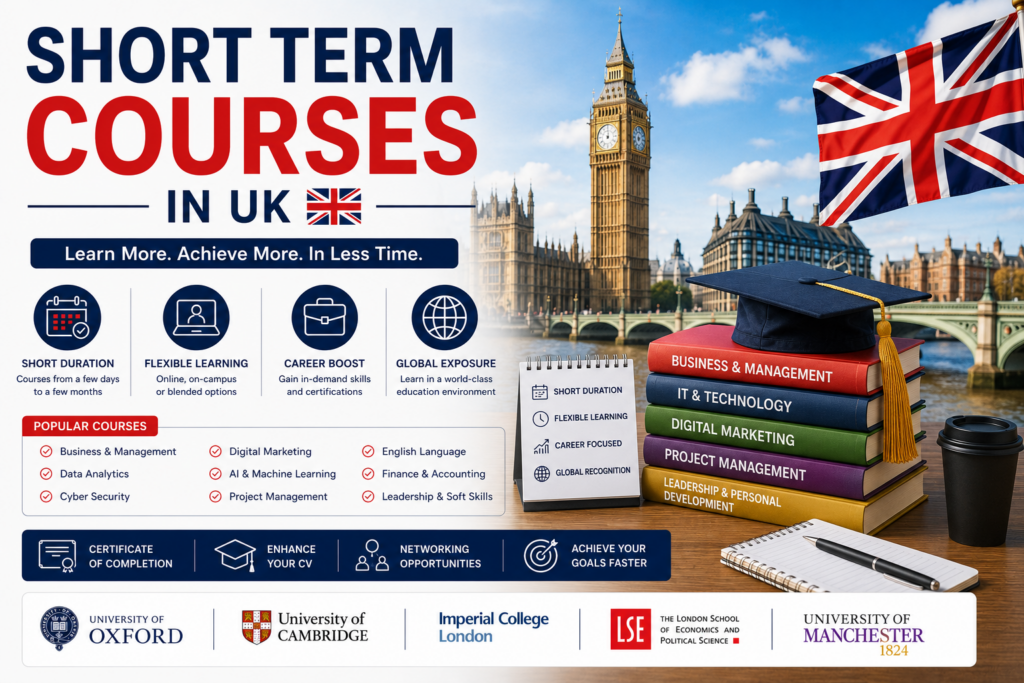
- Short term courses in UK run 1 week to 6 months; tuition is Rs.64,000 to Rs.7.68 lakh.
- Courses under 6 months need a Standard Visitor Visa, not a Student Visa.
- Top fields Indian students choose: Business, Data Science, Digital Marketing, and Healthcare.
- LSE, Oxford, Imperial, and UCL all offer short-course options across multiple disciplines.
Types of Short Term Courses in UK: Which One Applies to You?
Short term courses in UK are structured programs of 1 week to 6 months run by universities and authorized institutes. They cover summer schools, professional certificate courses, English-intensive programs, credit-bearing modules, and pre-sessional courses. Each type carries a different visa route, and picking the wrong one is the single most common mistake Indian applicants make.
| Course Type | Typical Duration | Visa Route | Work Permitted? |
| Short academic/professional courses | Up to 6 months | Standard Visitor Visa | No |
| English language courses | 6 to 11 months | Short-Term Study Visa | No |
| Pre-sessional English programs | 4 to 12 weeks | Standard Visitor Visa (if under 6 months) | No |
| Full degree programs | 1 year+ | UK Student Visa | Yes (part-time) |

Choose your dream country
 UK
UK
 USA
USA
 Germany
 Australia
 Ireland
 Canada
 UAE
UAE
 France
 Sweden
 Italy
Italy
 Other
Other
When do you want to study abroad?
What's your highest level of education?
Have you completed Class 12th?
What was your Class 12 CGPA/percentage?
Are you a student or a parent/guardian?
What do you want to study?
Select your current city
How Leap will help you

Personalised University Shortlist

Express Applications with Quicker Admits

End-to-End Application Support
Counselor insight: The most common confusion we see is Indian students applying for a Short Term Study Visa for a Business or Data Science certificate program. That visa is only for English language courses. For a 3-month Business Management short course at LSE or a 6-week Data Analytics program at Imperial, you need a Standard Visitor Visa. Always check before you pay the course fee.
Top Short Term Courses in UK by Field: What Indian Students Actually Pick
| Field | Top Universities (QS 2027 rank) | Duration | Who It Suits |
|---|---|---|---|
| Business and Management | London Business School, Oxford Said (QS #4), Warwick Business School (QS #68) | 3 weeks to 3 months | Working professionals wanting leadership or strategy credentials without a full MBA |
| Data Science and Analytics | Imperial College London (QS #2), UCL (QS #8), University of Edinburgh (QS #35) | 6 weeks to 4 months | Indian engineering and IT graduates moving into data or analytics roles |
| Digital Marketing | University of Westminster, King's College London (QS #37), London School of Marketing | 8 to 12 weeks | Students in media, communications, or FMCG wanting certified digital skills |
| Healthcare and Life Sciences | London School of Hygiene and Tropical Medicine, UCL (QS #8) | 1 week to 3 months | Students from pharmacy, MBBS, or life sciences backgrounds seeking international exposure |
| Finance and Accounting | London School of Economics (QS #62) | 3 to 6 weeks | Students targeting consulting, investment banking, or economic policy roles |
| Hospitality and Tourism | University of Surrey, Oxford Brookes University | 6 to 12 weeks | Students aiming for hotel management, events, or travel and tourism careers |
Note: If you hold an Indian pharmacy or nursing degree, a short course does not qualify you to practice in the UK. You would still need the relevant conversion or registration route and the pre-registration exam separately.
Counselor insight: LSE and Oxford short courses are critical for Indian CVs in consulting, investment banking, or policy jobs. Some programs require a declaration of purpose. Admission is competitive. Do not assume open enrollment.
Short Term Courses in UK: Fees and Living Costs in INR
Tuition Fees
| Course Category | Tuition Range (GBP) | Tuition Range (INR) |
|---|---|---|
| 1-2 week executive/summer courses | £500 - £1,000 | Rs.64,000 - Rs.1.28 lakh |
| 4-8 week certificate programs | £1,000 - £3,000 | Rs.1.28 lakh - Rs.3.84 lakh |
| 3-6 month diploma/professional programs | £3,000 - £6,000 | Rs.3.84 lakh - Rs.7.68 lakh |
| English language courses (6-11 months) | £3,500 - £7,000 | Rs.4.48 lakh - Rs.8.96 lakh |
Monthly Living Costs (Home Office Minimum Maintenance Figures)
| City | Monthly Living Cost (GBP) | Monthly Living Cost (INR) |
|---|---|---|
| London | £1,529 | Rs.1.96 lakh |
| Outside London (e.g., Edinburgh, Manchester, Leeds) | £1,171 | Rs.1.50 lakh |
These are the current UK Home Office Student route minimum maintenance figures, revised upward in the 2025-26 cycle from £1,483 / £1,136. Short-course applicants on a Standard Visitor Visa are not held to this exact figure by law, but UK Visa and Citizenship Application Services (VACs) use it as the practical benchmark when assessing "sufficient funds," so budget against it.
Cost breakdown for a typical 3-month short course in London (private rental):
- Tuition: Rs.3.84 lakh - Rs.7.68 lakh
- Accommodation (shared flat): Rs.89,600 - Rs.1.28 lakh per month
- Food and daily expenses: Rs.38,400 - Rs.51,200 per month
- Transport (monthly Oyster card): Rs.16,640 - Rs.21,120 per month
- Total estimated 3-month cost: Rs.8.2 lakh - Rs.13.7 lakh
Exchange rate note: All figures calculated at Rs.128 per GBP. Source: Wise / ExchangeRates UK. The GBP-INR rate has ranged from Rs.121 to Rs.129 in 2026. Verify the current rate before finalizing your budget. Monthly living cost figures are based on the UK Home Office's official student maintenance requirements (source: GOV.UK Student visa: Financial requirements).
Counselor insight: Universities do not provide accommodation to short-course students. Book private accommodation through Rightmove or SpareRoom. For London, budget at least Rs.88,000 per month for a shared room. Book early, as the London rental markets are tight from May through September.
For a comparison of these figures against longer degree programs, view our full breakdown of the Cost of Studying in UK
Documents Checklist for Short Term Courses in UK
| Document | Why You Need It |
|---|---|
| Offer letter from the institution | States course name, start/end dates, and total fee the core document for your visa application |
| Passport (valid for full course duration + 6 months) | Mandatory for any UK visa route |
| Proof of funds (3-6 months' bank statements) | Shows genuine, consistent balance covering tuition and living costs |
| Proof of ties to India (job letter, property, family) | Reduces refusal risk; the Home Office checks intent to return |
| English proficiency proof (IELTS/TOEFL or medium-of-instruction letter) | Required unless your institution accepts prior English-medium education |
| Accommodation confirmation | Some VACs request evidence of where you'll stay during the course |
| CV/resume and SOP (for professional courses) | Business, finance, and data courses at LSE, Oxford, and Imperial often require this at admission stage |
Visa Routes for Short Term Courses in UK: What Indian Students Must Know
Route 1: Standard Visitor Visa
The correct visa for most Indian students pursuing short term courses in UK. If your course is in Business, Data Science, Marketing, Healthcare, Finance, or any academic subject and runs for up to 6 months, you should apply for a Standard Visitor Visa. Per Appendix Visitor: Permitted Activities in the UK Immigration Rules, this visa permits short-term study at an accredited institution. You cannot work, extend it from inside the UK, or switch to a Student Visa from within the UK.
Route 2: Short-Term Study Visa (English Language Only)
This visa is specifically for English language courses lasting 6 to 11 months at an accredited institution. It costs £228 (Rs.29,184) plus an Immigration Health Surcharge of £776 (Rs.99,328), totalling £1,004 (Rs.1.28 lakh) in government fees. Processing takes approximately 3 weeks. If your course includes any subject other than English, even optionally, this visa does not apply.
| Factor | Standard Visitor Visa | Short-Term Study Visa |
| Subject | Any (Business, Tech, Health, etc.) | English language only |
| Course duration | Up to 6 months | 6 to 11 months |
| Visa fee | Rs.17,280 (£135), effective 8 April 2026 | Rs.29,184 (£228), effective 8 April 2026 |
| Immigration Health Surcharge | Not required | Rs.99,328 (£776); required |
| Work permitted | No | No |
| Extension from UK | No | No |
| Switching visas within UK | No | No |
Counselor insight: Indian students from states like Maharashtra, Uttar Pradesh, and Delhi have a higher visitor visa refusal rate at UK VACs. The key issue is almost always financial documentation. The Home Office wants to see genuine ties to India (job, family, property) and sufficient funds to cover your stay. Show 6 months' bank statements with a consistent balance, not just a recent top-up.
Planning Calendar for Short Term Courses in UK (2027-28 Intake)
| When | What to Do |
|---|---|
| 5-6 months before start | Shortlist your course and institution. Confirm British Council accreditation for the Short-Term Study Visa route. |
| 4-5 months before start | Check eligibility. Most postgraduate-level short courses need a bachelor's degree; some professional courses need 1-2 years' work experience. Minimum IELTS 6.0 for most programs. |
| 3-4 months before start | Apply and receive your offer letter. Confirm start date, end date, course name, and total fee; this is the main document for your visa. |
| 2-3 months before start | Apply for the correct visa on GOV.UK Standard Visitor Visa for most subjects and the Short-Term Study Visa only for English language courses of 6-11 months. |
| 6-8 weeks before start | Book private accommodation. UK VACs may ask for evidence of where you'll stay. |
| 4-6 weeks before start | Attend biometrics at your nearest UK VAC. India has VACs in Mumbai, Delhi, Chennai, Kolkata, Hyderabad, Bengaluru, Chandigarh, Jalandhar, and Ahmedabad. |
| On approval | Travel to the UK and attend your course. |
Counselor insight: The offer letter is the document UK VACs scrutinize most carefully for short-course visa applications. We have seen refusals where the institution name on the offer letter did not exactly match the accredited institution name on the British Council register. Confirm the exact legal name of the institution on your offer letter before submitting your visa application.
Short Term Courses in UK Without IELTS
Most short term courses in UK ask for proof of English proficiency, but you can often skip IELTS if you meet one of these:
- Your bachelor's degree was taught fully in English (CBSE, ICSE, or English-medium state board background usually qualifies); the institution accepts a letter confirming your proficiency instead of a test score.
- Some providers accept Duolingo English Test or PTE Academic scores in place of IELTS.
- Short executive and summer programs (1-4 weeks) at business schools often waive language testing entirely for working professionals with an English-medium degree.
Always confirm the specific policy with your institution before assuming an exemption; requirements differ by course and are not standardized across universities.
For a full walkthrough, see our guide to Study in UK Without IELTS.
What to Do When Things Go Wrong
Your visitor visa gets refused.
Do not reapply with the same documents. Read the refusal letter carefully. The Home Office states the specific reason. Common triggers for Indian applicants: insufficient financial evidence, large recent deposits that look like "parked" funds, or no clear ties to India. Address each refusal reason specifically in your next application. Allow 4 to 6 weeks to gather fresh documentation.
Your course gets cancelled after you arrive
Contact UKVI (0300 123 2241 from within the UK). Request a written cancellation notice from the institution on official letterhead and keep the document for any future UK visa application to demonstrate you left lawfully, and the cancellation was not your fault. Check your travel insurance policy; course cancellation is a covered event under most comprehensive policies. Do not attempt to join another course without leaving and re-entering on a fresh visa.
You missed your course start date due to a visa delay
Contact the institution's admissions team immediately. Most have a deferral process for the next intake, especially for courses that run multiple times a year. Do not travel to the UK without a valid visa covering your intended study period.
Your IELTS score is too low to enroll
Some UK short course providers accept 6.0 overall with no band below 5.5. Others require 6.5. Ask the institution whether they accept a letter confirming prior English-medium education, which is standard for Indian students from CBSE, ICSE, or English-medium state boards.
3 Takeaways on Short Term Courses in UK
- Match the visa to the subject, not the duration. A Standard Visitor Visa covers any subject up to 6 months; the Short-Term Study Visa is for English language courses only. Confirming the details before you pay tuition avoids the single most common and costly mistake Indian applicants make.
- Budget with the current numbers, not last year's. Tuition runs Rs.64,000 to Rs.7.68 lakh, and monthly living costs are now Rs.1.96 lakh in London and Rs.1.50 lakh outside it, following the Home Office's 2025-26 maintenance fund increase.
- A short course is a credential booster, not a work-rights or PR pathway. If your end goal is UK work experience or settlement, compare this route honestly against a full Master's on a Student Visa before you commit.
Have questions about short term courses in UK or your visa route? Book a free session with a LeapScholar counselor.
Frequently Asked Questions About Short Term Courses in UK for Indian Students
-
Which short term course is best in the UK?
It depends on your career goal. Data Science (Imperial, QS #2, and UCL, QS #8), Finance (LSE, QS #62), and Business Management (Oxford Said, QS #4, and London Business School) consistently offer the strongest ROI for Indian applicants in terms of brand value and employability back in India.
-
Which short term course is most in demand in the UK?
Data Science and Digital Marketing are the top courses driven by employer demand in the tech, financial, and FMCG industries. Business Management programs from LBS and Oxford also see high enrollment from Indian working professionals.
-
Are short courses in UK available with visa sponsorship?
No, courses under 6 months use a Standard Visitor Visa, which Indian students apply for independently. Visa sponsorship applies only to full degree programs on the Student Visa route, where the university acts as a licensed sponsor.
-
Do I need IELTS for short term courses in UK?
Most institutions ask for proof of English proficiency, typically IELTS 6.0 overall. If you completed your bachelor's degree at an English-medium institution, many providers accept a letter confirming this instead. Requirements differ by course, so always check the specific program page.
-
Which visa do I need for a 3-month short course in UK?
A 3-month course in a discipline other than English requires a Standard Visitor Visa. This visa allows for short-term study for up to 6 months at authorized schools. Apply to the UK government's official website at least 4 to 6 weeks before you want to go.
-
Are there free short term courses in UK for Indian students?
Fully-funded short courses are rare but exist through British Council scholarships and Newton Fund programs. The British Council India website lists funded opportunities periodically. These are competitive and require a formal application, references, and a statement of purpose.
-
Can I do a 6-month short term course in UK on a Visitor Visa?
Yes. The Standard Visitor Visa is for studying up to 6 months at an authorized institution. If you are applying with a maximum 6-month boundary, you will be scrutinized more closely; thus, your cover letter should explicitly state your plans of returning and ties to India.
-
Can I extend my short course stay in the UK?
You cannot extend a Standard Visitor visa or a Short-Term Study visa from within the UK. If you need extra time, you must leave, reapply from India, and reenter. Overstaying, even for a few days, is a serious immigration violation that can impact future applications for Student Visas and work visas.







Have Questions? Get Guidance to reach your Dream University
Connect with India's finest counsellors and biggest study abroad community.
Get Guidance