
Quick Read
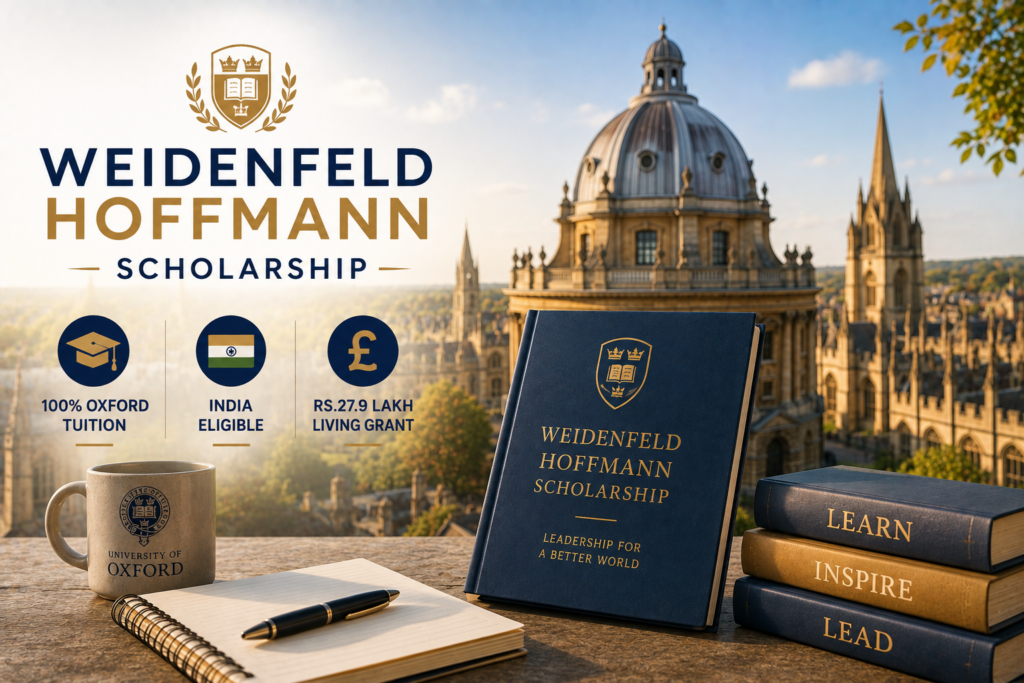
- Covers 100% Oxford tuition plus a Rs.27.9 lakh living grant.
- India is on the official Weidenfeld Hoffmann Scholarship-eligible country list.
- Funds a UK master’s degree via Oxford’s graduate application form.
- Course deadlines for this cycle fall in December 2026 or January 2027.
- Only one-year master’s courses qualify; the scholarship excludes DPhil study.
- Shortlisted candidates attend an online interview, usually in April.
What Is the Weidenfeld Hoffmann Scholarship and Leadership Programme
The Weidenfeld Hoffmann Scholarship and Leadership Programme funds a master’s degree in the United Kingdom, at the University of Oxford, in full for outstanding graduates and early-career professionals from developing and emerging economies and pairs it with a compulsory leadership development program.
Here is what actually sits behind that one-line definition:
- Origin: Set up in 2015 to mark Lord Weidenfeld’s 95th birthday.
- Growth: In 2017, Trustee André Hoffmann donated £9 million, matched by £6 million from the university, roughly doubling the program.
- Funding split: Oxford contributes 40%; the remaining 60% comes from donors to the Weidenfeld Hoffmann Trust.
- Who runs it: The Weidenfeld Hoffmann Trust administers selection and the Leadership Program; Oxford handles course admission.
- The extra commitment: Every scholar completes around 200 hours of training, mentoring, and cultural activities from mid-September to early July, on top of coursework. This training is compulsory.
My insight: Applicants often skim past the Leadership Program while comparing scholarships side by side. It is not optional, and the September induction cannot be deferred, so weigh this commitment before choosing Weidenfeld Hoffmann over a scholarship with no such obligation.
Sources: Weidenfeld Hoffmann Trust, Selection Criteria | University of Oxford
Courses Covered and Who This Scholarship Suits
Over 40 one-year, full-time master’s courses are eligible, grouped roughly by field. This is not the full official list, so confirm your exact course against Oxford’s page before applying:
| Field | Example Eligible Courses |
|---|---|
| Business, Law and Policy | MBA, BCL, MJur, MPP, MSc Law and Finance, MSc Global Governance and Diplomacy, MSt Diplomatic Studies |
| Economics, Data and Computing | MSc Economics for Development, MSc Financial Economics, MSc Advanced Computer Science, MSc Social Data Science, MSc Mathematical Modelling and Scientific Computing |
| Environment and Health | MSc Environmental Change and Policy, MSc Biodiversity, Conservation and Nature Recovery, MSc Sustainability, Enterprise and the Environment, MSc Global Health Science and Epidemiology |
| Migration, Society and Education | MSc Migration Studies, MSc Refugee and Forced Migration Studies, MSc Criminology and Criminal Justice, MSc Evidence-Based Social Intervention and Policy Evaluation, MSc Education (Higher Education) |
| Area and Regional Studies | MSc African Studies, MSt Asian and Middle Eastern Studies, MSc Latin American Studies, MSc Modern South Asian Studies, MSc Russian and East European Studies |
Not covered: DPhil (doctoral) study is excluded entirely, regardless of subject.
Best for: Indian final-year graduates and early career professionals, particularly those with 5 or more years of work experience, since most successful scholars fall into that bracket, combined with a genuinely specific plan to return and work in India or the region rather than just a strong academic profile.
Weidenfeld Hoffmann Scholarship Eligibility for Indian Students
| Criterion | Requirement |
|---|---|
| Home country | India is on Oxford’s official eligible-country list, alongside 100+ other nations |
| Course type | A new, full-time graduate course at Oxford; not a continuation of an existing one |
| Return intent | You must intend to return to your country of ordinary residence once the course ends |
| Career link | You must clearly connect your subject to your career goals and to public life in India or the region |
| Prior offers | You must not hold a deferred Oxford offer from an earlier admissions cycle |
| Current students | Not eligible if already studying at Oxford, unless you are a continuing scholar |
| Age limit | None specified |
| Work experience | Not mandatory, though most successful scholars have 5+ years |
| Dependents | Generally not permitted, since this is not a government-funded award (UK visa rule, effective for courses from 1 January 2024) |
My insight: The “intent to return to India” clause is not a formality. Panels want a specific plan, not a vague promise. Naming the sector, the organization type, or the exact problem you want to work on back home reads very differently from simply writing “I want to give back to my country.”
Weidenfeld Hoffmann Scholarship Amount: What It Actually Covers in Rupees
This guide covers the 2027-28 entry cycle, but Oxford and the Weidenfeld Hoffmann Trust have not yet published 2027-28 award amounts. Every figure below is therefore the latest confirmed rate, 2026-27, which is your best available planning reference until the new figures are released closer to your application.
| Component | Amount (GBP) | Amount (INR) |
|---|---|---|
| Tuition fees | 100% covered, full fee liability | Varies by course (see below) |
| Living grant, 2026-27 (Trust-confirmed) | £21,805 | Rs.27,91,912 |
| Living grant, Oxford’s general baseline | At least £20,780 | Rs.26,60,671 |
| Example course fee: MSc Migration Studies, 2026-27 (overseas) | £40,710 | Rs.52,12,508 |
| Example course fee: Oxford MBA, Saïd Business School, 2026-27 | £88,800 | Rs.1,13,69,952 |
Sources: Weidenfeld Hoffmann Trust; FAQs | University of Oxford; Weidenfeld Hoffmann Scholarships and Leadership Programme | Saïd Business School, Oxford MBA FAQs
Oxford’s official admissions page states the living grant is “at least £20,780” (Rs.26,60,671), a guaranteed floor rather than a fixed figure. The Weidenfeld Hoffmann Trust, the charity that administers this scholarship alongside Oxford, confirms the actual 2026-27 rate as £21,805 (Rs.27,91,912) on its own FAQ page.
Use £21,805 for budgeting, since that is the amount currently in effect. Fees are covered in full regardless of course, so the scholarship’s real value still depends on which course you get into. Use the two fee examples above as reference points, not a single fixed cost.
My insight: The living grant and tuition cover your course and cost of living in Oxford, not flights, visa fees, or the Immigration Health Surcharge. Include these in your budget separately, since applicants who forget them often find themselves unprepared in their first month.
Weidenfeld Hoffmann Scholarship vs Chevening, Rhodes and Clarendon
Indian applicants researching this scholarship are almost always weighing it against Chevening, the Rhodes Scholarship, or Oxford’s own Clarendon Fund. Here is how the four compare, based on each program’s own current figures:
| Scholarship | University | Funds | Amount (approx. Indian applicants) | 2026 Application Window |
|---|---|---|---|---|
| Weidenfeld Hoffmann | Oxford only | 100% tuition + living grant, master’s only | Rs.27.9 lakh living grant + full fees | Opens Sept; course deadline Dec 2026 or Jan 2027 |
| Chevening | Any UK university | Tuition (MBA capped Rs.28.2 lakh) + monthly stipend | Rs.28.2 lakh MBA cap; stipend varies by city | Opens 4 Aug 2026, closes 6 Oct 2026 |
| Rhodes (India) | Oxford only | Full tuition + £20,400/year stipend | Rs.26.1 lakh stipend, only 5 Indian places yearly | 2027 India cycle closed 23 July 2026 and reopens ~June 2027 |
| Clarendon | Oxford only | Full tuition + living grant, automatic | Rs.19.2 lakh grant (2025-26 rate), 200+ awarded yearly | Same Dec/Jan deadline as your Oxford course; no separate form |
The practical differences, in short:
- Clarendon needs no separate application and covers every subject plus DPhil, making it the widest safety net once you hold an Oxford offer.
- Rhodes offers only five spots in India each year and suits younger applicants building a longer academic career.
- Chevening needs no Oxford offer at all since you apply to three UK universities but demands 2,800 hours of work experience and a binding two-year return commitment.
- Weidenfeld Hoffmann sits between these: Oxford-only and master’s-only, like Clarendon, but with an added Leadership Programme obligation and a values-based “intent to return” essay closer to Chevening and Rhodes.
The Trust also runs a joint Chevening-Weidenfeld Hoffmann award, but only if you are independently admitted to both; there is no combined form, and Chevening’s decisions usually arrive later, often in June.
My insight: Do not rank these four purely by rupee value. Weidenfeld Hoffmann’s Leadership Programme and Chevening’s three-university requirement change how much control you keep over your own course choice, and that trade-off matters as much as the amount for most applicants we speak to.
Documents You Need for the Weidenfeld Hoffmann Scholarship Application
There is no separate Weidenfeld Hoffmann Scholarship application portal. Everything happens inside your Oxford graduate application, plus one extra document.
| Document | Purpose | India-Specific Detail |
|---|---|---|
| Oxford graduate application form | Core application to the course | Select “Weidenfeld Hoffmann Scholarships and Leadership Programme” in the Scholarships section |
| Weidenfeld Hoffmann Scholarships Statement | Explains motivation, leadership potential and return plan | Distinct from your Oxford personal statement, do not reuse the same text |
| Academic transcripts and degree certificates | Proof of qualifying degree | Indian mark sheets and provisional/final certificates, officially translated if not in English |
| English language proof | Confirms Oxford’s language requirement is met | IELTS or TOEFL scorecard; requirement varies by course |
| References | Academic or professional recommendation | Referees should address leadership and impact, not just academic ability |
| CV | Shows professional trajectory | Emphasise measurable impact over a list of roles |
The Weidenfeld Hoffmann Scholarships Statement is the part most Indian applicants underestimate. Your Oxford personal statement argues why you deserve a course place. The Statement argues something different: why the trust’s money should back you over another equally qualified candidate from another eligible country and what you will do with your training once back in India.
My insight: Reusing your SOP with minor edits is the most common reason strong applicants get overlooked at the Statement stage. A Statement that reads like a repurposed SOP with “leadership” inserted a few times does not stand out.
Weidenfeld Hoffmann Scholarships and Leadership Programme 2026 Cycle: Should You Apply?
Three real situations that Indian applicants tend to fall into for the Weidenfeld Hoffmann Scholarships and Leadership Programme 2026 application cycle, which opens in September 2026 with course deadlines in December 2026 or January 2027, are The Weidenfeld Hoffmann Scholarships and Leadership Programme Oxford runs this way every year, so the pattern below should hold going forward:
If you are a final-year student graduating in 2026 with a clear return plan, this is worth applying for, provided your course is on Oxford’s eligible list. Build your Statement around a specific problem in India, not a general interest in the subject.
If you are a working professional with 5 or more years of experience, you match the Trust’s typical scholar profile more closely than a fresh graduate. Use your CV and references to show measurable impact, since your experience is what the panel weighs most alongside your return plan.
If you already hold a Chevening nomination or are applying to Chevening in the same cycle, pursue both as two separate applications with separate timelines. Admission to one does not affect the other; the Trust and Chevening run independent processes.
My insight: The strongest statements we see stay narrow. Applicants who pick one concrete problem in India, rather than writing broadly about regional or global impact to sound more ambitious, read as more credible to selection panels.
What to Do If You Miss the Deadline or Don’t Get an Interview Call?
If you miss your course’s December or January deadline: You cannot be considered for that intake. Some Oxford courses accept later admission rounds, but these do not qualify for scholarship consideration even if you are admitted. Apply again the following cycle instead.
If April comes and goes with no interview invitation: This generally means you were not shortlisted. You can still hold your Oxford offer and explore other UK master’s scholarships for Indian students or self-fund while reapplying later if your course allows deferral.
If you are interviewed but not selected: The Trust releases no individual feedback, so treat the situation as a numbers issue, not a reflection of your profile. Around 35 scholars are selected globally each year across 40-plus courses and 100-plus countries, so the pool of strong, unsuccessful candidates is large by design.
Key Takeaways on Weidenfeld Hoffmann Scholarship
- Confirm your course is on Oxford’s eligible list before building your application around this scholarship, since it excludes DPhil study entirely.
- Budget as though the scholarship is not guaranteed. With roughly 35 scholars selected globally each year, apply by the December or January deadline regardless, keeping routes such as Clarendon open.
- Write your Statement from scratch rather than adapting your Oxford personal statement, since the panel is assessing a different question: your leadership record and your specific plan to use this degree back in India.
Verified by: LeapScholar’s UK counseling team, with hands-on experience guiding Indian students through Oxford’s scholarship and visa process.
Have questions about your Oxford scholarship options? Book a free session with a LeapScholar counselor.
Frequently Asked Questions About Weidenfeld Hoffmann Scholarship
-
What is the Weidenfeld Hoffmann Scholarship?
Think of it as Oxford’s answer to “How do we fund a talented graduate who could never otherwise afford us and also make sure they go home and use it well?” The Weidenfeld Hoffmann Scholarships and Leadership Programme Oxford runs each year does exactly that: full tuition, a living grant, and a compulsory leadership track for graduates and professionals from developing and emerging economies.
-
Is the Weidenfeld Hoffmann Scholarship open to Indian students?
Yes, and this trips people up less than you’d think, since India has been on Oxford’s eligible-country list for years. What actually decides your case is everything else: an offer on an eligible one-year course, a genuine plan to return to India, and a Statement that connects your subject to that plan convincingly.
-
How much does the Weidenfeld Hoffmann Scholarship cover in rupees?
For 2026-27, the confirmed living grant works out to roughly Rs.27.9 lakh (£21,805 at Rs.128.04 per GBP). That’s on top of full tuition, which itself swings from around Rs.52 lakh for many MSc programs to over Rs.1.1 crore for the Oxford MBA, so the true value of your award depends heavily on the course you get into.
-
What is the Weidenfeld Hoffmann Scholarship acceptance rate?
Nobody publishes one, so be wary of any site quoting a precise percentage for the Weidenfeld Hoffmann Scholarship acceptance rate. What we do know: the program has historically funded around 35 new scholars a year, drawn from over 100 eligible countries and 40-plus courses. Do the rough math, and it’s clearly one of the harder Oxford awards to land.
-
When is the Weidenfeld Hoffmann Scholarships and Leadership Programme deadline for 2027-28 entry?
Applications open alongside Oxford’s graduate portal in September 2026, but the Weidenfeld Hoffmann Scholarships and Leadership Programme deadline itself is set by your course, usually in December 2026 or January 2027. Miss that course deadline and you are out of the running for that cycle entirely, so treat your Statement as the very first thing you draft, not the last.
-
What courses are eligible for the Weidenfeld Hoffmann Scholarship at Oxford University?
Over 40 one-year master’s courses qualify, from the MBA and MPP to area studies and health science degrees; see the full breakdown by field earlier in this guide. If you’re set on a DPhil, this award isn’t your scholarship. Look at Clarendon or Rhodes instead, since both fund doctoral study.
-
Can I apply for the Weidenfeld Hoffmann Scholarship and Chevening together?
You can, but only in a specific way: apply to both independently and get admitted by both, and only then can the Trust and Chevening consider you for their joint award. There’s no shortcut form that lets you tick both boxes at once, and Chevening tends to announce its results later, often in June.
-
What happens if I don’t get shortlisted for the Weidenfeld Hoffmann interview?
It stings, but it doesn’t mean much beyond that specific cycle. No interview call by around April usually means you weren’t shortlisted, and the Trust doesn’t send feedback given how many applications come in. Your Oxford offer still stands, so look at Clarendon or reapply for Weidenfeld Hoffmann the following year if you’re still eligible.
-
Does the Weidenfeld Hoffmann Scholarship application require work experience?
Not on paper; no minimum is written anywhere. In practice, most successful scholars have five-plus years of experience behind them. If you’re applying straight out of college, lean on academic leadership, research impact, or volunteer work in your Statement instead of manufacturing experience you don’t have.
-
Can dependants join Weidenfeld Hoffmann scholars in Oxford?
Usually not, and this rule catches married applicants off guard every year. A UK visa rule for courses starting on or after 1 January 2024 restricts dependent visas to students on government-funded awards or research degrees. Since this scholarship is privately funded and mostly covers one-year courses, most scholars study in Oxford solo.








Have Questions? Get Guidance to reach your Dream University
Connect with India's finest counsellors and biggest study abroad community.
Get Guidance