
Quick Read
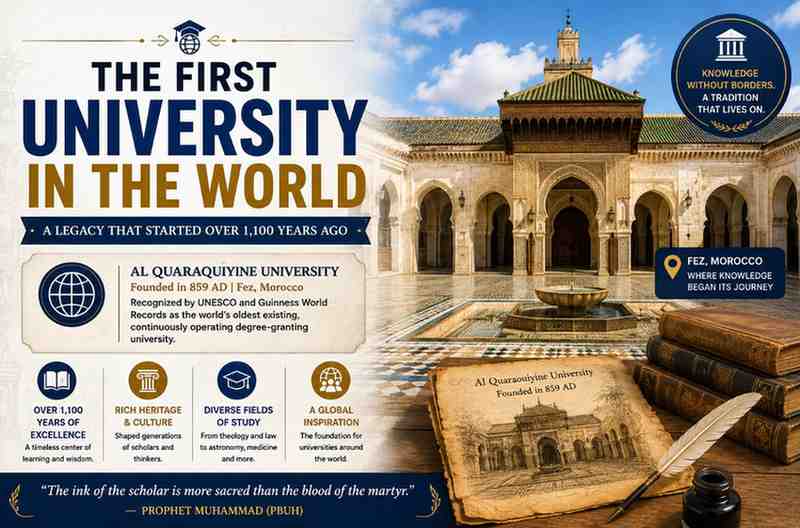
- Al-Qarawiyyin in Morocco, founded 859 CE, holds the Guinness record.
- The University of Bologna, founded in 1088, coined the word universitas.
- UNESCO calls Nalanda the Indian subcontinent’s most ancient university.
- Nalanda Mahavihara became a UNESCO World Heritage Site in 2016.
- Oxford is the oldest English-speaking university, with teaching from 1096.
- Indian students can apply to Bologna and Oxford right now.
Which Was the First University in the World? The Short Answer
If you need one name, it is the University of al-Qarawiyyin in Fez, Morocco, founded in 859 CE. Both UNESCO and Guinness World Records recognise it as the oldest existing, continually operating and first degree-awarding educational institution in the world.
But that is one of three defensible answers, and which one is correct depends entirely on what you mean by “university.”

Choose your dream country
 UK
UK
 USA
USA
 Germany
 Australia
 Ireland
 Canada
 UAE
UAE
 France
 Sweden
 Italy
Italy
 Other
Other
When do you want to study abroad?
What's your highest level of education?
Have you completed Class 12th?
What was your Class 12 CGPA/percentage?
Are you a student or a parent/guardian?
What do you want to study?
Select your current city
How Leap will help you

Personalised University Shortlist

Express Applications with Quicker Admits

End-to-End Application Support
- Oldest still operating: al-Qarawiyyin, Morocco, 859 CE
- First institution to be called a university: Bologna, Italy, 1088
- Most ancient university of the Indian Subcontinent: Nalanda, India, 5th century CE
Notice that Oxford appears on none of those lines. Oxford is the oldest university in the English-speaking world, which is a different and much narrower claim than being the first university in the world.
Counselor insight: Students lose marks on this question for a specific reason. They write one name with no qualifier. In a board or competitive exam answer, the safe construction is "al-Qarawiyyin (859 CE) is recognised by UNESCO and Guinness World Records as the oldest continually operating institution of higher learning, while Nalanda is described by UNESCO as the most ancient university of the Indian Subcontinent." Both facts, one sentence, no risk.
If you want the full ranked list rather than the single answer, our separate guide on the oldest universities in the world covers fifty institutions by founding date.
Why the First University in the World Has More Than One Answer
The disagreement is definitional, not factual. Historians apply four different tests, and each test produces a different winner.
Test 1: Is it still running? This is the Guinness test and it favours al-Qarawiyyin. It also disqualifies Nalanda and Takshashila immediately, because both are archaeological sites today.
Test 2: Did it call itself a universitas? This is the European test and it favours Bologna, where the Latin term for a corporation of students and masters was first applied to an institution of learning.
Test 3: Did it grant formal degrees? This is where al-Qarawiyyin's claim gets complicated. Many scholars argue it functioned as a madrasa until well into the twentieth century and became a university in the modern sense only when Morocco reorganised it into the state system in 1963.
Test 4: Was it an organised residential centre of higher learning? This is the broadest test and it favours Nalanda, which ran for roughly 800 years with resident faculty, resident students and a structured curriculum.
There is also a claimant that predates all of them. The Zaytouna mosque-school in Tunis was founded in 703, more than 150 years before al-Qarawiyyin, and its supporters argue the Guinness recognition is inconsistent.
Counselor insight: The reason your NCERT textbook and a Google answer box disagree is not that one is wrong. They are answering different questions. Indian curricula test the history of organised learning, which is Nalanda's territory. Western reference sources test continuous institutional operation, which is al-Qarawiyyin's. Once you see that, the contradiction disappears.
The First University in the World by Every Definition: Full Comparison
| Institution | Founded | Location | Recognised as | Authority | Still operating |
|---|---|---|---|---|---|
| Takshashila (Taxila) | 5th century BCE onward | Gandhara, now Pakistan | Important Buddhist centre of learning | UNESCO, inscribed 1980 | No, archaeological site |
| Nalanda Mahavihara | 5th century CE (site from 3rd century BCE) | Bihar, India | Most ancient university of the Indian Subcontinent | UNESCO, inscribed 2016 | No, archaeological site |
| Zaytouna | 703 CE | Tunis, Tunisia | Mosque-school predating al-Qarawiyyin | Contested claim | Yes |
| Al-Qarawiyyin | 859 CE | Fez, Morocco | Oldest continually operating, first degree-awarding | UNESCO and Guinness World Records | Yes |
| Al-Azhar | 970 CE | Cairo, Egypt | Major early centre of Islamic learning | University status granted 1961 | Yes |
| University of Bologna | 1088 | Bologna, Italy | Oldest university in the Western world | Its own charter and records | Yes |
| University of Oxford | Teaching by 1096 | Oxford, England | Oldest university in the english-speaking world | Oxford's own history | Yes |
Counselor insight: The "Authority" column is the one to memorise, not the dates. Every one of these institutions has a promotional interest in its own claim, so the claim is only as strong as the body backing it. Al-Qarawiyyin and Nalanda are the two rows where an external authority, not the institution itself, made the finding.
Al-Qarawiyyin: The First University in the World Still Running Today
- Founded: 859 CE in Fez, Morocco
- Founder: Fatima al-Fihri, who used her inherited share of her father's wealth to build a mosque. A madrasa grew around it, then a full institution of higher learning.
- Curriculum: expanded past religious instruction into logic, medicine, mathematics, astronomy and grammar
- Entry requirement, then and now: full memorisation of the Quran, plus Arabic and general sciences
- Library: holds manuscripts by major medieval scholars, restored in the 2010s under Moroccan-Canadian architect Aziza Chaouni
- 1963: folded into Morocco's modern state university system
- Today: degrees in Islamic, religious and legal sciences, taught with students seated in a semi-circle around a sheikh
Counselor insight: Students read that this is the oldest university in the world and add it to a shortlist. It teaches in Arabic, expects Quranic memorisation at entry, and offers only religious and legal disciplines. It is a functioning university and it is not an option for an engineering, business or general humanities degree. Treat it as history, not a shortlist entry.
Was Nalanda the First University in the World? What UNESCO Actually Says
This is the question most Indian readers came for, and the answer needs precision rather than patriotism.
What UNESCO's listing says:
- Nalanda is the most ancient university of the Indian subcontinent.
- It engaged in the organised transmission of knowledge over an uninterrupted period of 800 years
- The site holds remains of a monastic and scholastic institution from the 3rd century BCE to the 13th century CE
- Remains include stupas, shrines, viharas and artworks in stucco, stone and metal
The key detail: UNESCO says "of the Indian Subcontinent," not "of the world." Dropping that qualifier is what turns a correct statement into an incorrect one.
Confirmed facts from the ASI and the Government of India:
- Founded by Kumargupta I of the Gupta dynasty in the 5th century CE
- Patronised by Harshavardhana of Kannauj and later the Pala rulers
- Taught logic, grammar, science and medicine alongside Buddhist philosophy
- Known as a school of discussion and logic for developing formal debate into a teaching tool
- ASI submitted the nomination dossier in January 2015
- Inscribed as a UNESCO World Heritage Site on 15 July 2016
Was Takshashila older than Nalanda?
Yes, by roughly a thousand years, and this is where India's case is strongest and weakest at once.
- UNESCO records Taxila as an important Buddhist centre of learning from the 5th century BCE to the 2nd century CE
- The site was inscribed in 1980
- The wording is "centre of learning," never "university," and that is deliberate
- Teachers there held no formal college membership, and there is no evidence of purpose-built lecture halls or organised residential quarters
- Students attached themselves to individual teachers, which is a school system rather than a university
The modern Nalanda University
- Parliament passed the Nalanda University Act in 2010; first students enrolled in 2014
- The Prime Minister inaugurated the permanent Rajgir campus in June 2024
- The President addressed the second convocation in March 2026, awarding degrees to students from thirty-one countries
- Operates under the Ministry of External Affairs
- Offers PG and doctoral programmes in Buddhist studies, historical studies, ecology and environment studies, languages and management
Counselor insight: For UPSC or state PSC, two dates matter: 5th century CE for the founding under Kumargupta I, and 15 July 2016 for the UNESCO inscription. For a school history answer, the phrase that earns the mark is "organised transmission of knowledge over an uninterrupted period of 800 years." It is what separates Nalanda as a university from Takshashila as a centre of learning.
Bologna and Oxford: Why Both Are Called the First University in the World
Bologna, 1088
- Presents 1088 as the conventional founding year of its Studium
- Describes itself as the oldest university in the Western world
- Organised by students rather than by a church or a crown, hence the motto Alma Mater Studiorum
- Earliest recorded scholar was Irnerius, who catalogued Roman legal materials
- Thomas Becket and Nicolaus Copernicus both studied there
- Recognised as the mother of all universities in 1888, by representatives of more than 800 universities
- Two firsts that matter to women applicants: Bettisia Gozzadini, reputed to have lectured on law in the thirteenth century, and Laura Bassi, the first woman to hold a salaried science professorship
Oxford, 1096
- Oxford's own history page states there is no clear date of foundation
- Teaching existed at Oxford in some form in 1096
- Claims nine centuries of continuous existence as the oldest university in the English-speaking world
- Grew quickly after 1167, when Henry II banned English students from the University of Paris during his quarrel with Thomas Becket
So Oxford is the second-oldest university in continuous operation, after Bologna, and the oldest in the English-speaking world. It is not the first university in the world, and any source telling you otherwise is wrong. See Oxford's current courses, fees and requirements if the history has made you curious about applying.
Counselor insight: Age and quality are separate variables, and students conflate them constantly. Bologna is older than Oxford but ranks lower in the global tables; al-Qarawiyyin is older than both and does not appear in them at all. If you are shortlisting rather than reading history, sort by current ranking and subject strength, not by founding date.
3 Takeaways on First University in the World
- If you are asked for one name, say al-Qarawiyyin, 859 CE, and name UNESCO and Guinness World Records as the authority.
- Nalanda is correctly described as the most ancient university of the Indian Subcontinent, which is UNESCO's own wording and a strong claim, not a weak one.
- Of every claimant to the title, only Bologna, Oxford and the modern Nalanda University at Rajgir accept Indian applications today.
Verified by: LeapScholar's UK and Europe counseling team, with hands-on experience guiding Indian students through UCAS applications, Italian pre-enrolment and study visa documentation.
Have questions about applying to the world's oldest universities? Book a free session with a LeapScholar counselor.
Frequently Asked Questions About First University in the World
-
What should I write if an exam asks which was the first university in the world?
Give the name with its authority and qualifier: al-Qarawiyyin, founded 859 CE in Fez, recognised by UNESCO and Guinness World Records as the oldest continually operating institution of higher learning. Then add that UNESCO separately describes Nalanda as the most ancient university of the Indian subcontinent. Two sourced statements cover both possible expected answers and cannot be marked wrong.
-
Can Indian students study at the first university in the world?
Not at al-Qarawiyyin in any practical sense, since it teaches in Arabic, expects Quranic memorisation at entry, and offers only religious and legal sciences. Bologna and Oxford both admit Indian students. Bologna calculates fees against family income, starting from a first instalment of about Rs.17,275 (€157.04). Oxford charges overseas students Rs.48.1 lakh to Rs.80.8 lakh (£37,380 to £62,820) per year for 2026/27 entry.
-
Which was the first university in India?
For the ancient period, Nalanda Mahavihara in Bihar, founded in the 5th century CE by Kumargupta I of the Gupta dynasty, which UNESCO calls the most ancient university of the Indian subcontinent. Takshashila was older but sits in present-day Pakistan and is classed as a centre of learning. For modern India, the University of Calcutta, University of Madras and University of Bombay were all established in 1857.
-
Who founded the first university in the world?
Fatima al-Fihri, a woman from a merchant family in Kairouan, in present-day Tunisia, who had settled in Fez. After her father's death, she used her inherited share to build a mosque, and a madrasa grew around it into a full centre of higher learning. Al-Qarawiyyin is therefore the oldest continually operating university in the world and the first founded by a woman.
-
Why is the University of Bologna called the first university?
Bologna, founded in 1088, was the first institution to use the term universitas for its corporation of students and masters, which is where the modern word originates. It was organised by students rather than by church or crown, and its earliest recorded scholar was Irnerius. Bologna describes itself as the oldest university in the Western world and was recognised as the mother of all universities in 1888.
-
Is Oxford the first university in the world?
Oxford is the oldest university in the English-speaking world and the second-oldest in continuous operation globally. Its own history page states there is no clear foundation date but that teaching existed there in some form in 1096. It grew rapidly after 1167, when Henry II barred English students from the University of Paris. Sources naming Oxford as first globally are incorrect.
-
Is Takshashila older than Nalanda?
Takshashila predates Nalanda by around a thousand years. UNESCO records it as an important Buddhist centre of learning from the 5th century BCE to the 2nd century CE, and the site was inscribed in 1980. Scholars disagree on whether it counts as a university, because teachers there lacked formal college membership and the site shows no purpose-built lecture halls or organised residential quarters.
-
Was Nalanda the first university in the world?
UNESCO describes Nalanda as the most ancient university of the Indian Subcontinent, engaged in the organised transmission of knowledge over an uninterrupted period of 800 years. That is a regional finding, not a global one. Nalanda was founded in the 5th century CE, roughly 400 years before al-Qarawiyyin, but it ceased to function centuries ago, which is why continuous-operation rankings exclude it.
-
Which is the oldest university in the world still operating today?
Al-Qarawiyyin, which has functioned continuously since 859 CE and was incorporated into Morocco's state university system in 1963. Among institutions that have operated continuously as universities in the European sense, Bologna holds the title from 1088. Oxford follows, with teaching evidenced from 1096, making it the second-oldest university in continuous operation.
-
Which was the first university in the world?
The University of al-Qarawiyyin in Fez, Morocco, founded in 859 CE by Fatima al-Fihri. UNESCO and Guinness World Records recognise it as the oldest existing, continually operating and first degree-awarding educational institution. The claim is contested, because the Zaytouna mosque-school in Tunis was founded earlier in 703, and some scholars date al-Qarawiyyin's transformation into a university proper to its 1963 reorganisation.





Have Questions? Get Guidance to reach your Dream University
Connect with India's finest counsellors and biggest study abroad community.
Get Guidance