
Quick Read
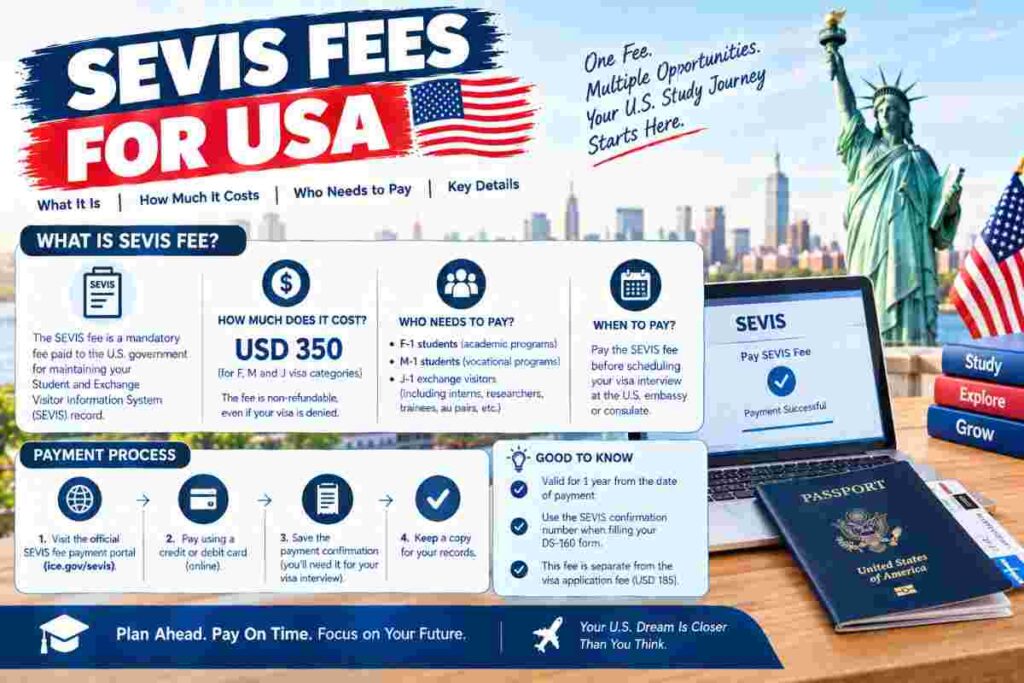
- F-1 SEVIS fees for USA cost Rs.33,558 ($350) per student.
- J-1 exchange visitors pay Rs.21,094 ($220) instead.
- Indian students pay online at FMJfee.com by card.
- Pay at least three business days before your interview.
- Transfer students keeping the same SEVIS ID pay nothing again.
- Refunds cover only duplicate payments and payment errors.
What Are SEVIS Fees for USA?
SEVIS fees for USA study are a one-time federal charge paid to the US Department of Homeland Security before you can be issued an F, M or J visa. The formal name is the I-901 SEVIS fee.
Congress mandated the fee in 2004. It funds the Student and Exchange Visitor Program (SEVP) and the database behind it, which holds your record from the day your university issues your Form I-20 until you finish your degree. According to US Immigration and Customs Enforcement, the fee is separate from visa fees and from any SEVIS administration fee your school charges.

Choose your dream country
 UK
 USA
 Germany
 Australia
 Ireland
 Canada
 UAE
 France
 Sweden
 Italy
 Other
When do you want to study abroad?
What's your highest level of education?
Have you completed Class 12th?
What was your Class 12 CGPA/percentage?
Are you a student or a parent/guardian?
What do you want to study?
Select your current city
How Leap will help you

Personalised University Shortlist

Express Applications with Quicker Admits

End-to-End Application Support
That last point causes real confusion every admission season. Some US universities charge their own international student services fee, sometimes each semester. That money goes to the university, not to SEVP, and it does not count as your I-901 payment. If your offer letter shows a line item with the word SEVIS in it, ask your designated school official (DSO) directly whether the government fee has been paid on your behalf.
Counselor insight: Students routinely assume the SEVIS fee is bundled into the university's application or seat-booking payment. It never is. Until you have an I-901 receipt with your own SEVIS ID printed on it, the fee is unpaid, whatever your fee receipt from the university says.
SEVIS Fees for USA by Visa Category in 2027-28
SEVIS fees for USA study are Rs.33,558 ($350) for F-1 and M-1 students, and Rs.21,094 ($220) for most J-1 exchange visitors. Dependents pay nothing.
| Visa type | Fee (INR) | Fee (USD) | Who this applies to |
|---|---|---|---|
| F-1 and F-3 students | Rs.33,558 | $350 | Degree students at SEVP-certified colleges and universities |
| M-1 and M-3 students | Rs.33,558 | $350 | Vocational and technical programs, including flight training |
| J-1 exchange visitors | Rs.21,094 | $220 | Most standard exchange categories |
| J-1 summer work/travel, au pair, camp counsellor | Rs.3,356 | $35 | Reduced-fee exchange categories |
| Federally sponsored J-1 (program codes G-1, G-2, G-3, G-7) | Nil | None | US government-sponsored programs |
| F-2, M-2 and J-2 dependents | Nil | None | Spouse and children accompanying you |
Exchange rate used: Rs.95.88 per US dollar. Verify the current rate before finalising your budget, and check FMJfee.com for the fee amount on the day you pay.
The amounts have not changed since the DHS final rule that took effect on 24 June 2019.
Counselor insight: If you are on an M-1 visa for a flight training or vocational program, you pay the same Rs.33,558 ($350) as a Master's student. Students preparing for flight school in the US often budget for the lower J-1 figure because a senior told them so. The category on your I-20, not your program length, decides the fee.
What Indian Students Actually Pay in Total for a US Student Visa
The SEVIS fee is one of three separate government charges. For 2027-28, budget between Rs.51,296 ($535) and Rs.75,266 ($785) for the visa stage alone, before tuition, flights or health insurance.
| Charge | Amount (INR) | Amount (USD) | Paid to | When |
|---|---|---|---|---|
| I-901 SEVIS fee | Rs.33,558 | $350 | DHS, via FMJfee.com | After you receive your I-20, before the interview |
| MRV visa application fee | Rs.17,738 | $185 | US Department of State | Before booking your interview slot |
| Visa Integrity Fee | Rs.23,970 | $250 | US Department of State | At visa issuance, where the post collects it |
| Total | Rs.51,296 to Rs.75,266 | $535 to $785 |
Exchange rate used: Rs.95.88 per US dollar. Verify the current rate before finalising your budget.
The MRV fee for the F category is confirmed at $185 on the State Department fee schedule, which covers non-petition-based categories including F, J and M.
The Visa Integrity Fee is the uncertain line. It was created by legislation signed on 4 July 2025 with a statutory minimum of $250, collected at the point a visa is issued rather than when you apply. Rollout across consular posts has been uneven, and university international offices have reported that some posts began collecting it while others had not. Assume you will pay it, and treat it as non-refundable in practice even though the statute contemplates a refund, because the claims mechanism is not operational.
Counselor insight: Families budget tuition to the last rupee and then get caught by roughly Rs.75,000 of visa-stage charges in a six-week window, usually while an education loan is still being sanctioned. Keep this amount in a liquid savings account, not inside the loan sanction. Loan disbursement timelines almost never match interview dates.
Who Pays SEVIS Fees for USA and Who Is Exempt
You pay SEVIS fees for USA study if you are applying for initial F, M or J status, or changing status to one of those categories from inside the US. You do not pay if you are a dependent, a continuing student on the same SEVIS ID, or in a federally sponsored J-1 program.
You pay if you are:
- Applying for an F-1, F-3, M-1 or M-3 visa for initial attendance
- Applying for a J-1 visa outside the exempt program codes
- Inside the US and changing status to F, M or J
- A student who has been out of status for more than five months and is filing for reinstatement
- Returning after more than five months abroad that did not involve authorised overseas study
You do not pay if you are:
- An F-2, M-2 or J-2 dependent
- Transferring between SEVP-certified schools at the same level on the same SEVIS ID
- Changing education level, for example moving from a Master's to a PhD on the same SEVIS ID
- A J-1 in a federally sponsored program with a code starting G-1, G-2, G-3 or G-7
- Applying for employment authorisation such as OPT
There is no fee waiver. ICE is explicit that the I-901 fee cannot be waived, although anyone may pay it on your behalf.
The multiple admits problem. Most Indian students hold three or four I-20s by April. Each one carries a different SEVIS ID. Pay against the I-20 of the school you will actually attend, because the payment attaches to that specific SEVIS ID, and the ID on your receipt must match the ID on your current I-20 at the interview. If you later change your mind, you request a fee transfer rather than paying twice.
Counselor insight: Deposit deadlines at US universities often fall before the student has decided. Pay the enrollment deposit wherever you must, but hold the SEVIS payment until you have committed. A fee transfer is free but takes days and adds an avoidable email chain with SEVP two weeks before your interview.
How to Pay SEVIS Fees for USA from India, Step by Step
You pay SEVIS fees for USA study online at FMJfee.com, which is the only federal website certified to collect I-901 payments. Keep the following ready before you start.
| What you need | Where it comes from | India-specific detail |
|---|---|---|
| Form I-20 or DS-2019 | Your US university or program sponsor | You must have this before paying. There is no way to pay in advance |
| SEVIS ID | Top of the I-20 or DS-2019, begins with the letter N | Copy it digit by digit. A single wrong character sends the payment to a stranger's record |
| School code or program number | School Information section of the I-20, section 2 of the DS-2019 | Not the same as your student ID number |
| Your name exactly as printed on the I-20 | Your I-20 | If your passport shows a single name or an initial expanded differently, match the I-20, then tell your DSO about the mismatch |
| Date of birth as printed | Your I-20 | Indian records sometimes carry a school-certificate DOB that differs from the passport. Match the I-20 |
| A card enabled for international online payments | Your bank | Visa, MasterCard or American Express credit cards, and Visa or MasterCard debit cards |
| A printer or PDF saver | Anywhere | You will need the receipt at the interview and at the port of entry |
The steps:
- Go to FMJfee.com and open the Form I-901.
- Enter your name, address, date of birth, email, country of birth and country of citizenship.
- Enter the SEVIS ID and school code from your I-20.
- Select your visa category and confirm the fee amount shown matches Rs.33,558 ($350) for F and M, or Rs.21,094 ($220) for standard J-1.
- Pay by credit or debit card. Card payment is only available when you complete the form online.
- Print or save the confirmation receipt immediately, then save a second copy to your email and phone.
Two other routes exist. You can pay by international money order or a draft drawn on a US financial institution and payable in US currency, sent with a printed coupon to the SEVP address in St. Louis, Missouri. ICE suggests allowing at least two weeks for mailed payments. Western Union Quick Pay also works, and you must complete the online Form I-901 first to obtain the coupon number.
For almost every Indian student, the online card route is the correct one. The others exist for applicants without card access.
Counselor insight: Save the receipt PDF under a filename with your SEVIS ID in it and put it in the same folder as your I-20 and DS-160 confirmation. Students reprint it from FMJfee.com the night before the interview and discover the site is slow or their email has changed. You can reprint any time using Check I-901 Status, but do not leave it to the last evening.
When to Pay SEVIS Fees for USA: Your 2027-28 Timeline
Pay at least three business days before your visa interview. ICE advises allowing three business days for the payment to be received and verified, and payment information generally posts to SEVIS and the State Department systems within three working days.
You may book your interview before paying. The payment simply has to be verifiable by the time you appear.
| Month | What happens | SEVIS fee action |
|---|---|---|
| Aug to Dec 2026 | Applications for Fall 2027 submitted, GRE and IELTS or TOEFL done | Nothing yet. You cannot pay without an I-20 |
| Jan to Mar 2027 | Admits arrive, financial documents submitted for I-20 | Nothing yet. Keep Rs.51,296 or more liquid |
| Mar to Apr 2027 | I-20s issued, final-semester exams in Indian universities | Decide your university. Do not pay against a backup I-20 |
| Apr to May 2027 | Deposit paid, DS-160 filled, MRV fee paid | Pay SEVIS fees for USA now. Print the receipt |
| May to Jul 2027 | Peak interview season at Indian consulates | Carry the receipt. Keep three business days of buffer if you reschedule |
| Jun to Aug 2027 | Visa stamped, flights booked, final results and degree certificates collected | Carry the receipt to the port of entry |
| Aug to Sep 2027 | Semester begins | Keep the receipt until you graduate |
Indian final-year results frequently arrive later than US universities expect. That affects your I-20 and therefore the earliest date you can pay. It does not change the three-business-day rule.
Counselor insight: Interview slots at Indian consulates open and vanish in minutes during May and June. Students grab a slot for three days later, then realise they have not paid. Pay the SEVIS fee the week your I-20 arrives, even if you have not yet found a slot. The payment does not expire in any way that hurts you, and it removes one variable from a scramble.
Do You Pay SEVIS Fees for USA Again? Refusals, Transfers and the New Fixed-Term Rule
In most repeat situations, you do not pay SEVIS fees for USA study a second time. Here is each case.
After a visa refusal. You do not pay again if you reapply for the same visa type within 12 months of your initial I-901 payment. Apply in month 13 and you pay the full Rs.33,558 ($350) again. If your new I-20 carries a different SEVIS ID, you do not pay again, but you must request a fee transfer.
When transferring schools. No repayment if you move between SEVP-certified schools at the same level while maintaining status on the same SEVIS ID. Ask your DSO to write "Continuing student, transfer" in the remarks box of the new I-20, which prevents questions at the consulate and the border.
When changing education level. No repayment when you finish a Master's and continue to a doctoral program on the same SEVIS ID.
When applying for OPT or any work authorisation. No repayment.
When filing an extension of stay. No repayment when you apply for an extension so you can finish your current program. This matters far more from 2027 than it used to. A DHS final rule effective 15 September 2026 ends admission for duration of status. F students are now admitted for the length of the program listed on the Form I-20, capped at four years, plus 30 days to arrive and 30 days to depart. Students in longer programs and students whose research runs past the four-year mark will have to file an extension of stay with USCIS. That filing carries its own USCIS fee and biometrics, but it does not trigger a second I-901 SEVIS payment.
When you are out of status for more than five months. You do pay again before filing for reinstatement. Under five months, you do not.
Fee transfers. Request one directly on FMJfee.com. Check your payment status, and if a valid payment exists on your record, a transfer request button appears next to the print confirmation button. You enter the new SEVIS ID and school code, and SEVP confirms or declines by email. Transfers also work by email to SEVP with your name, date of birth, old SEVIS ID and new SEVIS ID.
Counselor insight: The 12-month clock runs from the payment date, not from the refusal date. Students refused in March who spend eight months strengthening their profile and reapply the following June often assume they are covered. Check the date on your receipt before you assume, because a second Rs.33,558 is a painful surprise at that stage.
Are SEVIS Fees for USA Refundable?
SEVIS fees for USA study are refundable only in two narrow situations: you paid twice for the same student when only one fee was due, or you paid when no fee was required in your situation.
According to ICE's refund chart, there is no refund if you decide not to come to the US, if your visa or application was denied, if you were denied entry at the port of entry, if you withdrew a change of status or reinstatement application, or if the refund amount would be under $30 (Rs.2,876). Refund requests must reach SEVP within 90 days of the payment that is eligible for refund.
To request one, email fmjfee.SEVIS@ice.dhs.gov with "I-901 SEVIS Fee Refund" in the subject line, along with your name, SEVIS ID exactly as it appears on the receipt, the reason, and contact details. Only the student, or the person for whom the fee was paid, can request the refund. Where a third party paid by card or cheque, the money goes back to that third party.
Plan on the fee being unrecoverable. If your visa is refused, the Rs.33,558 is gone unless you reapply within that 12-month window, in which case it still covers you.
When SEVIS Fee Payment Goes Wrong: What to Do
Payment failures are common for Indian students, and almost all of them are fixable without paying twice.
- Your card is declined. Most Indian debit and credit cards have international online transactions disabled by default. Enable them in your bank app or by calling the bank, and raise the per-transaction limit above Rs.35,000. If your own card still fails, a parent's card works, because third-party payment is permitted.
- You paid on the wrong I-20. Do not pay again. Request a fee transfer on FMJfee.com or by email to SEVP, as long as the new fee is equal to or less than what you paid.
- Your name or date of birth does not match the I-20. Call the SEVP Response Center on 1-703-603-3400, or email fmjfee.SEVIS@ice.dhs.gov with "Name Correction" in the subject line, giving your name, date of birth, SEVIS ID and correct address.
- You mailed the wrong amount. SEVP cannot accept overpayments or underpayments and will return the form and payment. Resubmit with the exact amount. This is one strong reason to pay by card rather than by post from India.
- Your cheque bounced. Do not pay the fee again. The debt goes to the DHS Debt Management Center, which will send instructions for clearing it along with a penalty charge. ICE's own FAQ states this penalty as $30 in one passage and $35 in another, so confirm the amount when the Center contacts you. You are still allowed to attend your visa interview before clearing the debt.
- The payment is not showing before your interview. Call the SEVP Response Center on 1-703-603-3400. They can check the electronic record. Carry the printed receipt regardless, because the receipt is your proof that the payment processed correctly.
- You landed on a site that is not FMJfee.com. Only FMJfee.com is certified to collect these payments. SEVP will never email you asking for banking or card details. Agents charging a service fee to "process" your SEVIS payment are selling you a form you can fill in yourself in about five minutes.
Counselor insight: The most expensive mistake is not a failed payment. It is a student who pays with a slightly wrong SEVIS ID, gets a receipt, assumes the task is done, and discovers at the consulate that the payment sits on someone else's record. Open your receipt beside your I-20 and read the SEVIS ID out loud, character by character, the day you pay.
3 Takeaways on Sevis Fee for USA
- Confirm which I-20 you are paying against before you open FMJfee.com. SEVIS fees for USA study attach to one SEVIS ID, and undoing a payment on the wrong record means a fee transfer and several days of email.
- Keep Rs.51,296 to Rs.75,266 liquid and separate from your loan sanction. The SEVIS fee, MRV fee and Visa Integrity Fee land within weeks of each other, usually before your education loan disburses.
- Pay the week your I-20 arrives and save the receipt in three places. Three business days is the minimum, not the plan, and you will need that receipt at the interview, at the port of entry and every time you re-enter the US.
Verified by: LeapScholar's USA counseling team, with hands-on experience guiding Indian students through I-20 issuance, SEVIS payment, and F-1 visa interviews at Indian consulates.
Have questions about paying your SEVIS fee or preparing for your F-1 interview? Book a free session with a LeapScholar counselor.
Frequently Asked Questions on SEVIS Fees for USA
-
How much are SEVIS fees for USA in Indian rupees?
SEVIS fees for USA study are Rs.33,558 ($350) for F-1 and M-1 students and Rs.21,094 ($220) for most J-1 exchange visitors, at Rs.95.88 per dollar. Reduced J-1 categories such as au pair and camp counsellor pay Rs.3,356 ($35). Check FMJfee.com on the day you pay, since the amount is set in dollars and your rupee outgo depends on your card's exchange rate.
-
Do I pay the SEVIS fee again when filing an extension of stay?
Applying for an extension of stay to finish your current program does not require a second payment. This matters from 2027 onward, because F students are now admitted for a fixed period capped at four years rather than duration of status, so longer programs will need a USCIS extension filing. That filing carries its own fee and biometrics, but not another SEVIS fee.
-
What happens if my Indian card is declined on FMJfee.com?
Most Indian cards block international online transactions by default. Enable international usage in your bank app and raise your per-transaction limit above Rs.35,000, then retry. If that fails, a parent's card works because third-party payment is allowed. Western Union Quick Pay is a fallback, though it requires completing the online Form I-901 first.
-
Where do I find my SEVIS ID?
Every SEVIS ID begins with the letter N. On the Form I-20 it appears at the top of the first page above the barcode, and on newer versions in the top centre of the form. On the DS-2019 it sits in the box above the barcode at the top right. Copy it exactly, since one wrong character posts your payment to the wrong record.
-
Is the SEVIS fee the same as the visa application fee?
These are two separate payments to two different agencies. The SEVIS fee of $350 goes to the Department of Homeland Security through FMJfee.com. The MRV visa application fee of $185 goes to the Department of State and is paid before you book your interview. Paying one does not cover the other, and both receipts are needed.
-
Do transfer students pay SEVIS fees for USA again?
Moving between SEVP-certified schools at the same level while maintaining status on the same SEVIS ID means no repayment. Ask your designated school official to write "Continuing student, transfer" in the remarks box of the new I-20. The same applies when you change education level, such as moving from a Master's into a doctoral program.
-
When should I pay the SEVIS fee before my visa interview?
Pay at least three business days before your interview. ICE advises allowing three business days for the payment to be received and verified, and information generally posts to SEVIS and State Department systems within three working days. You can book an interview slot before paying, so grab the slot first if availability is tight, then pay immediately afterwards.
-
Do I pay the SEVIS fee again if my US visa is refused?
Reapplying for the same visa type within 12 months of your original payment date means no second payment. Beyond 12 months, you pay the full amount again. If your university issues a new I-20 with a different SEVIS ID, request a fee transfer on FMJfee.com rather than paying twice.
-
Can my parents pay the SEVIS fee for me?
Any person or organization may pay on your behalf, including a parent, a relative, or your university. They will need the details from your I-20, particularly your SEVIS ID, name as printed, and date of birth. Ask them to send you the receipt immediately, because you must carry it to your visa interview and to the port of entry.











Have Questions? Get Guidance to reach your Dream University
Connect with India's finest counsellors and biggest study abroad community.
Get Guidance