
Quick Read
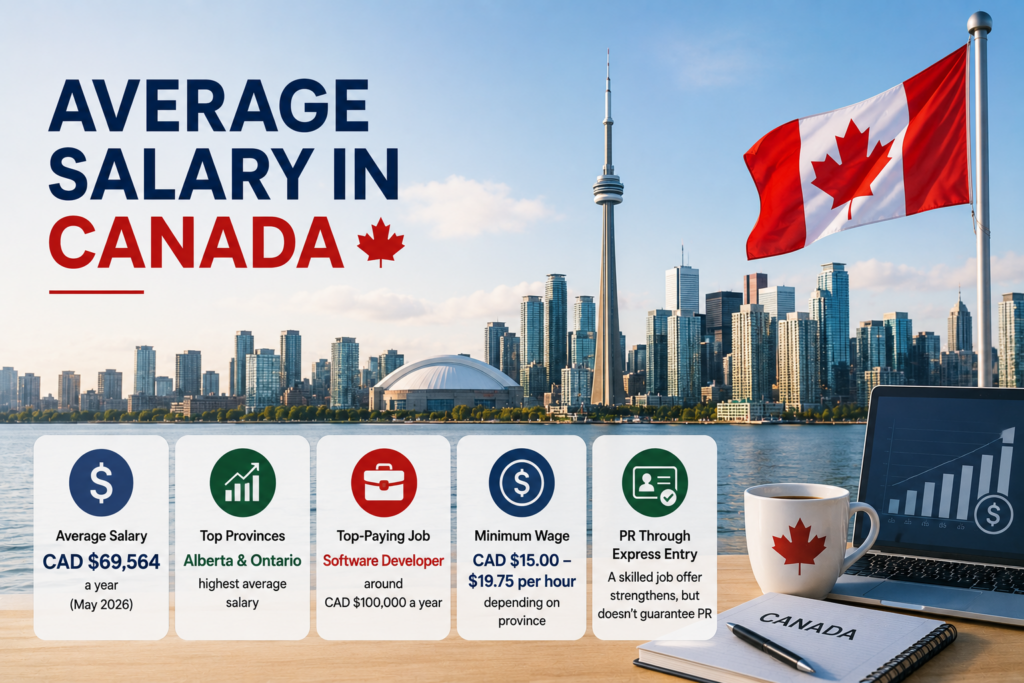
- The average salary in Canada is CAD $69,564 a year (about CAD $5,797 a month) as of May 2026.
- Alberta and Ontario post the highest average salary in Canada among the ten provinces.
- Software Developer tops the highest-paying jobs list at roughly CAD $100,000 a year.
- Minimum wage ranges from CAD $15.00 to $19.75 an hour depending on province.
- A skilled job offer strengthens, but doesn’t guarantee, PR through Express Entry.
Average Salary in Canada Per Month and Per Year (2026)
This number comes from Statistics Canada‘s Survey of Employment, Payrolls, and Hours, a monthly survey that tracks what people actually earn across every industry in the country. The most recent release puts average weekly earnings at CAD $1,337.77, up 3.4% year over year.
Break that down and the average salary in Canada per month works out to roughly CAD $5,797, or about CAD $69,564 a year. If you’re comparing Canada’s salary-per-month figures across sources, this figure is the government number, not a crowdsourced estimate from a job listing site.

Choose your dream country
 UK
UK
 USA
USA
 Germany
 Australia
 Ireland
 Canada
 UAE
UAE
 France
 Sweden
 Italy
Italy
 Other
Other
When do you want to study abroad?
What's your highest level of education?
Have you completed Class 12th?
What was your Class 12 CGPA/percentage?
Are you a student or a parent/guardian?
What do you want to study?
Select your current city
How Leap will help you

Personalised University Shortlist

Express Applications with Quicker Admits

End-to-End Application Support
| Timeframe | Amount (CAD) | INR Equivalent |
|---|---|---|
| Per week | $1,337.77 | Rs.92,112 |
| Per month | $5,797 | Rs.3.99 lakh |
| Per year | $69,564 | Rs.47.90 lakh |
Data: Statistics Canada, Payroll Employment, Earnings and Hours, May 2026.
This is an average across every industry and experience level combined, so a fresh graduate's actual salary in Canada per month will sit below this figure initially and climb as they gain Canadian work experience.
Average Salary in Canada by Province
Where you land in Canada changes this number significantly. Resource-heavy provinces and the northern territories sit well above the national average, while several Atlantic provinces sit below it.
| Province/Territory | Avg. Weekly Earnings (CAD) | Annualized (CAD) | INR Equivalent |
|---|---|---|---|
| Alberta | $1,378.85 | $71,700 | Rs.49.36 lakh |
| Ontario | $1,377.49 | $71,629 | Rs.49.31 lakh |
| British Columbia | $1,354.67 | $70,443 | Rs.48.51 lakh |
| Saskatchewan | $1,298.13 | $67,503 | Rs.46.47 lakh |
| Quebec | $1,293.11 | $67,242 | Rs.46.29 lakh |
| Manitoba | $1,218.31 | $63,352 | Rs.43.63 lakh |
| Nova Scotia | $1,217.66 | $63,318 | Rs.43.60 lakh |
| New Brunswick | $1,228.55 | $63,885 | Rs.43.99 lakh |
| Newfoundland and Labrador | $1,266.10 | $65,837 | Rs.45.34 lakh |
| Prince Edward Island | $1,189.61 | $61,860 | Rs.42.58 lakh |
| Yukon | $1,505.43 | $78,282 | Rs.53.90 lakh |
| Northwest Territories | $1,765.69 | $91,816 | Rs.63.21 lakh |
| Nunavut | $1,862.20 | $96,834 | Rs.66.68 lakh |
Data: Statistics Canada Table 14-10-0223-01, Average Weekly Earnings.
The territories post the highest raw numbers, but that reflects a genuine remote-location premium rather than a stronger job market for newcomers. Among the ten provinces, Alberta and Ontario are the two consistently ahead of the national average, driven respectively by energy and by finance and technology.
My insight: Students comparing the average salary in Canada across provinces often stop at the headline number. What actually matters for an MS graduate is which province has employers hiring in your specific field, since a strong average salary in a province with few tech or engineering employers won't translate into a job offer.
Highest-Paying Jobs in Canada for MS Graduates
Whether an MS in Canada pays for itself depends heavily on which occupation you land in. Technology, data, and engineering roles, the fields most Indian MS graduates actually enter, sit well above the national average salary in Canada, which is what makes the ROI work for this course bucket.
| Job Title | Median Hourly Wage (CAD) | Estimated Annual Salary (CAD) | INR Equivalent |
|---|---|---|---|
| Software Developer | $48.08 | $100,006 | Rs.68.84 lakh |
| Data Scientist | $46.15 | $95,992 | Rs.66.09 lakh |
| Mechanical Engineer | $45.67 | $94,994 | Rs.65.41 lakh |
| Financial Analyst | $43.27 | $90,002 | Rs.61.96 lakh |
| Registered Nurse | $43.27 | $90,002 | Rs.61.96 lakh |
Data: Job Bank Canada, wages by occupation, updated November 2025.
These are median wages, not entry-level offers, so expect your first job to land below the median and climb as you build Canadian work experience.
My insight: Job Bank's median wage beats self-reported job-site averages for salary negotiations, since it's pulled directly from Statistics Canada's Labour Force Survey rather than crowd-sourced data that skews toward whoever bothers to submit it.
Minimum Wage in Canada for Students and Part-Time Jobs
International students on a study permit can typically work up to 20 hours a week during academic sessions. Minimum wage is set provincially, not federally, so what you actually take home depends heavily on where you study.
| Province/Territory | Minimum Wage (CAD/hour) |
|---|---|
| Nunavut | $19.75 (Rs.1,360) |
| British Columbia | $18.25 (Rs.1,257) |
| Yukon | $18.51 (Rs.1,274) |
| Ontario | $17.60 (Rs.1,212) |
| Prince Edward Island | $17.00 (Rs.1,171) |
| Nova Scotia | $16.75 (Rs.1,153) |
| Quebec | $16.60 (Rs.1,143) |
| Northwest Territories | $16.95 (Rs.1,167) |
| Newfoundland and Labrador | $16.35 (Rs.1,126) |
| Manitoba | $16.00 (Rs.1,102) |
| New Brunswick | $15.90 (Rs.1,095) |
| Saskatchewan | $15.35 (Rs.1,057) |
| Alberta | $15.00 (Rs.1,033) |
Sources: Littler and Workforce.com
At 20 hours a week, that translates to roughly CAD $1,200 to $1,580 a month before tax, depending on province.
That's rarely enough to cover rent alone in Toronto or Vancouver. Most students treat part-time income as a top-up to savings or family support, not as their primary funding source.
Cost of Living vs Salary in Canada’s Major Cities
A high salary in an expensive city can leave you with less disposable income than a modest salary somewhere cheaper, even when the average salary in Canada for your role looks identical on paper. Here's how the three cities Indian students most often target actually compare once rent is taken into account.
| City | Monthly Cost Excl. Rent | 1BR Rent (Outside Centre) | Estimated Total | INR Equivalent |
|---|---|---|---|---|
| Vancouver | CAD $1,508 | CAD $2,220 | CAD $3,728 | Rs.2.57 lakh |
| Toronto | CAD $1,488 | CAD $2,009 | CAD $3,497 | Rs.2.41 lakh |
| Calgary | CAD $1,557 | CAD $1,550 | CAD $3,107 | Rs.2.14 lakh |
Sources: Rent and living-cost data from Numbeo, updated August 2026 for Toronto, Vancouver, and Calgary.
My insight: Calgary consistently gets overlooked by Indian students fixated on Toronto or Vancouver, but it combines Alberta's above-average salaries with meaningfully lower rent. For a software developer or engineer specifically, that combination often beats a nominally higher Toronto salary once rent is accounted for.
How a Job Offer Helps You Get Canada PR
A high salary matters for your finances, but for most Indian students the bigger prize is what a skilled job offer does for a Permanent Residency application. The average salary in Canada alone doesn't decide your PR outcome; how your job is classified does.
- The NOC TEER category matters most: Express Entry programs like the Federal Skilled Worker Program and Canadian Experience Class require your work experience to fall under NOC TEER 0 through 3, covering management, professional, technical, and skilled trade roles.
- The CRS no longer rewards a job offer directly: The Comprehensive Ranking System removed the automatic bonus points a job offer used to carry.
- A valid offer still keeps you eligible: Some programs require one as a baseline qualifying condition, separate from any points boost.
- PGWP usually comes first: Most Indian students secure a skilled offer only after finishing studies and starting a Post-Graduation Work Permit.
- Don't treat the offer as a shortcut: Read through the full PR requirements first, because a good salary alone won't carry your application on its own.
My insight: Here's what trips people up: a bigger salary doesn't automatically mean better PR odds. Express Entry cares about the NOC TEER category and whether your job is documented correctly under it, not the figure on your offer letter. A $65,000 offer filed under the right code can beat a $90,000 one that isn't.
What to Do If Your Salary or Job Offer Falls Short
Your offer is below the median wage for your role
Check the Job Bank wage report for your occupation before accepting or countering. Employers sponsoring a work permit or LMIA must generally meet the prevailing wage for the role, so a low offer is worth questioning, not just accepting.
You're graduating soon with no job offer yet
Don't panic; the Post-Graduation Work Permit gives you room to job hunt after you finish studying, no offer required beforehand. Spend that time going after roles that fall under your NOC TEER category instead of grabbing whatever pays, because that classification is what actually helps you later with PR, not just the paycheck.
Part-time income isn't covering your living costs:
Welcome to Toronto or Vancouver, basically. Even a full run of minimum-wage part-time hours barely dents rent in those cities. Think of that income as a top-up to savings or help from home, and when you can, pick roles that build NOC-relevant experience over ones paying you an extra dollar an hour.
Your salary looks good on paper, but taxes are eating into it more than expected:
Expect 20% to 30% of gross income to go toward federal and provincial tax, CPP, and EI combined, and more in higher tax brackets or in Quebec specifically. The average salary in Canada figures quoted anywhere, including in this guide, are always pre-tax, so run your expected take-home pay before committing to a city's cost of living, not after your first paycheck arrives.
3 Key Takeaways on Average Salary in Canada
First, treat the national average salary in Canada as a starting point, not a target, since your actual number will move significantly based on province, industry, and whether you're comparing gross or take-home pay.
Second, run the cost-of-living math before the salary math, since a lower salary in Calgary or a similar city frequently beats a higher one in Toronto or Vancouver once rent is factored in.
Third, if Permanent Residency is the end goal, prioritize a job offer's NOC TEER classification over its headline salary, since that classification, not the paycheck, is what Express Entry actually scores.
Verified by: LeapScholar's Canada counseling team, with hands-on experience helping Indian students plan finances, part-time work, and post-study career pathways in Canada.
Have questions about what you could realistically earn in Canada? Book a free session with a LeapScholar counselor to map your target province and role against these numbers.
Frequently Asked Questions About Average Salary in Canada
-
What is a good salary in Canada in 2026?
Above CAD $65,000 a year, you're comfortable as a single person outside the biggest cities. Toronto or Vancouver? Push that up to CAD $80,000-$90,000, because rent there eats a much bigger chunk of your paycheck than it would almost anywhere else in the country.
-
What is the average salary in Canada per month?
Roughly CAD $5,797 before tax, going by Statistics Canada's May 2026 numbers. That's a blended figure across every industry and experience level, though, so don't expect to hit it in your first job. A fresh graduate's Canadian salary per month usually starts lower and climbs as local work experience builds up.
-
How much can an Indian student earn part-time in Canada?
If you cap your hours at the legal limit of 20 hours a week, you can expect to earn between CAD $1,200 and $1,580 a month before tax, depending on your province's minimum wage. Nunavut and BC sit at the top of that range, Alberta and Saskatchewan at the bottom. None of it covers rent in a major city on its own, so treat it as pocket money, not a housing budget.
-
Which province in Canada pays the highest average salary?
On paper, the Northwest Territories and Nunavut. In practice, that's a remote-location premium, not proof of a stronger job market for someone relocating there. Among the ten provinces, Alberta and Ontario lead, with energy in one and finance plus tech in the other.
-
Is a salary of CAD $55,000 good for a single person in Canada?
Depends entirely on the city you're in. It's tight in Toronto or Vancouver, where you'll be budgeting every rupee just to get by, but the same number stretches noticeably further in Calgary, Edmonton, or most of Atlantic Canada, where rent doesn't swallow half your monthly paycheck.
-
How much tax gets deducted from salary in Canada?
Somewhere between 20% and 30% of your gross pay, once you add up federal tax, provincial tax, CPP, and EI. Where you fall in that range depends on your income bracket and which province you're in, since Quebec in particular has its own separate contribution structure.
-
What is the software developer salary in Canada in Indian Rupees?
CAD $48.08 an hour is the national median, which annualizes to around CAD $100,000, or about Rs.68.84 lakh at today's rate. If you're specifically eyeing tech roles, aim for British Columbia or Ontario since both pay a notch above that national median.
-
Does pursuing an MS in Canada actually pay off financially?
For software development, data science, and engineering, generally yes. Median pay in those fields sits comfortably above the CAD $69,564 national average. But if you land in a saturated field or a province with few relevant employers, that ROI math falls apart fast. The occupation and the location decide the outcome far more than the degree itself does.
-
Does a higher salary improve my chances of getting Canadian PR?
Not really, and this information catches many applicants off guard. Express Entry doesn't score a salary at all. It scores whether your job sits under an eligible NOC TEER category, so a correctly classified $65,000 offer can genuinely outperform a $90,000 one that's harder to slot into the right occupational code.








Have Questions? Get Guidance to reach your Dream University
Connect with India's finest counsellors and biggest study abroad community.
Get Guidance