
Quick Read
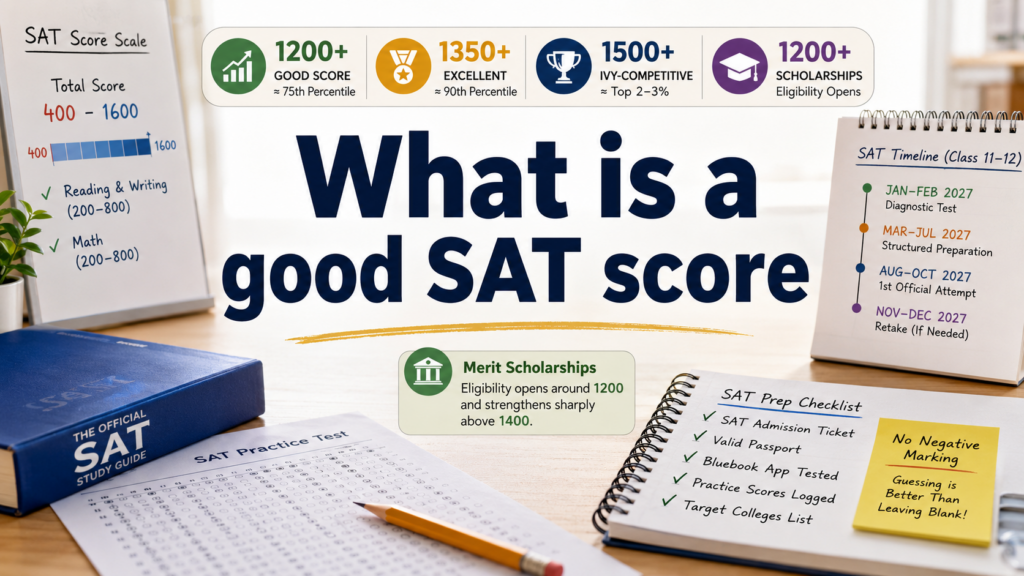
- A good SAT score is 1200 or higher, which places you at roughly the 75th percentile nationally.
- A 1350+ score is excellent, and a 1500+ is Ivy-competitive.
- Merit scholarship eligibility typically opens around 1200 and strengthens sharply above 1400.
- What counts as “good” depends on your target university’s middle 50% range, not a fixed number.

What Is a Good SAT Score in 2026?
The SAT is scored on a scale of 400 to 1600. The national average sits at approximately 1024-1050, so any score above that is technically above average. But “good” only becomes meaningful once you attach it to a percentile and a target college.
| Score band | Approx. percentile | What it signals |
| Below 1000 | Below 50th | Below the national average |
| 1000-1200 | 50th-75th | Average to slightly above average |
| 1200-1350 | 75th-90th | Good; competitive for most reputable public universities and many private Indian institutions |
| 1350-1450 | 90th-97th | Excellent; strong for selective universities |
| 1450-1600 | 97th-99th+ | Outstanding; Ivy and elite-tier competitive |
For Indian applicants specifically, a score of 1200+ is generally the entry point for mid-tier US universities and competitive private Indian universities such as Ashoka University and Shiv Nadar University, while elite international programs typically expect 1400-1500+.
Source: College Board, SAT Suite of Assessments national percentile data.
Counselor insight: We tell students not to chase a “universal good score.” A 1350 that clears your target university’s 75th percentile is more useful than a 1500 aimed at a school that doesn’t need it. Build your target score backward from your college list, not the other way around.
Understanding the SAT Score Scale (400-1600)
Your total score is the sum of two section scores, each ranging from 200 to 800:
- Reading and Writing (RW): 54 questions across two 32-minute modules.
- Mathematics: 44 questions across two 35-minute modules.
The Digital SAT uses multi-stage adaptive testing. Each section has two modules:
- Module 1 (Baseline): A mix of easy, medium, and hard questions that sets your starting performance level.
- Module 2 (Adaptive): Difficulty adjusts based on your Module 1 result. A strong Module 1 unlocks harder, higher-value questions in Module 2.
- The “score cap”: A weak Module 1 routes you to an easier Module 2, which can cap your maximum possible section score below 700 regardless of how well you do in that second module.
There is no negative marking on the Digital SAT, so leaving a question blank is always worse than a guess. See more on how digital SAT scoring and negative marking work.
Is 1200 a Good SAT Score for Colleges?
Yes. A 1200 sits around the 75th percentile, meaning you scored higher than roughly three in four test-takers. It’s competitive for many reputable US public universities and a wide range of private Indian institutions, though elite schools typically expect 1400 or higher.
If 1200 is your target range, this list of US colleges that accept a 1200 SAT score is a useful starting shortlist.
Good SAT Scores for Ivy League and Elite Schools
Ivy League testing policy has shifted significantly through 2026. For the 2026-27 admissions cycle, six of the eight Ivies require the SAT or ACT; Princeton and Columbia remain test-optional for this cycle only, with both moving to required testing from 2027-28.
| University | SAT middle 50% (25th-75th percentile) | 2026-27 testing requirement |
| Harvard University | 1500-1580 | Required |
| Princeton University | 1500-1570 | Test-optional (required from 2027-28) |
| Yale University | 1480-1580 | Required |
| Columbia University | 1510-1560 | Test-optional (required from 2027-28) |
| Brown University | 1500-1570 | Required |
| University of Pennsylvania | 1500-1560 | Required |
| Dartmouth College | 1490-1570 | Required |
| Cornell University | 1470-1560 | Required |
Sources: Individual university Common Data Sets (2024-25 cycle); current testing-requirement status compiled from each university’s official admissions office announcements as of mid-2026.
A score at the 75th percentile of your target Ivy meets the academic bar but does not set you apart on its own, since these schools evaluate the full application holistically. Our detailed guide to SAT scores for Ivy League admissions breaks the information down school by school.
Students specifically targeting Harvard or MIT can also see how our counseling team maps a full applicant profile for Harvard and MIT.
Counselor insight: For Indian applicants, an Ivy-range score is necessary but rarely sufficient. We see 1550+ strong profiles rejected every cycle because the rest of the application (essays, extracurricular depth, recommendations) didn’t match the score. Treat the score as a gate you need to clear, not a differentiator.
Good SAT Scores for Top Universities in the USA
Several non-Ivy universities have SAT expectations that overlap with or exceed Ivy League bands, particularly for STEM and pre-med tracks.
| University | Middle 50% SAT range | Detail |
| University of Chicago | 1510-1570 | Extremely high academic rigor |
| Johns Hopkins University | 1530-1560 | Highly competitive, especially for STEM/pre-med |
| Duke University | 1490-1560 | Scores in the 1500s are generally expected |
| Amherst College | 1480-1560 | Premier liberal arts college with elite standards |
At this level, the SAT mainly helps you avoid an outright academic rejection. Scores within or above these ranges help you remain competitive, but grades, coursework rigor, essays, and overall fit still matter significantly.
What Is the Average SAT Score for Scholarships?
Merit-based scholarships don’t have one universal SAT cutoff, but eligibility scales in fairly consistent bands across US colleges:
| SAT score band | Scholarship outlook |
| 1000-1200 | Minimum eligibility threshold at some public universities; smaller awards |
| 1200-1350 | Wider institutional merit-aid eligibility opens up |
| 1350-1450 | Competitive for stronger merit awards at most colleges |
| 1450-1600 | Eligible for the largest institutional and honors-college scholarships |
Many merit scholarships remain available even at colleges that are test-optional for admission, since they still use submitted scores to rank applicants for aid.
If you’re weighing SAT prep against your overall study-abroad scholarship strategy, it’s worth checking how your SAT score interacts with need-based aid rules for specific destinations, since not every country’s aid model rewards test scores the same way.
Source: Institutional merit-aid criteria as published by individual US universities’ financial aid offices.
SAT vs ACT: Which Score Works Better for You?
Colleges treat SAT and ACT scores equally. If you work well under intense time pressure and enjoy science-style reasoning, the ACT may suit you better; if you prefer more time per question and multi-step problem-solving, the SAT is the stronger fit.
| SAT score | ACT composite equivalent | Percentile rank |
| 1570-1600 | 36 | 99+ |
| 1490-1520 | 34 | 98 |
| 1350-1380 | 29-30 | 90 |
| 1200-1220 | 25 | 74-79 |
For a full breakdown of format, timing, and scoring differences, see our ACT vs SAT comparison guide, which can help you decide which test suits your strengths before you commit to a prep plan.
What Does Your SAT Score Mean for College Admission?
- Scenario 1: You’re targeting mid-tier public universities or competitive private Indian universities. A 1200-1350 range is a reasonable target. Focus your prep time on consistency across both sections rather than chasing a perfect score, since colleges in this band rarely require above the 75th percentile.
- Scenario 2: You’re targeting selective private US universities (top 50 non-Ivy). Aim for 1400-1500. At this tier, the SAT mainly filters out weaker academic profiles, so pair your prep with strong coursework rigor and a clear extracurricular narrative.
- Scenario 3: You’re targeting Ivy League or equivalent elite institutions. Target 1500+, ideally at or above the 75th percentile of your specific target school. Build in time for at least one retake, since a single sitting rarely produces your ceiling score.
SAT Documents and Preparation Checklist
| Item | Why it matters |
| SAT registration confirmation and admit card | Required for test-day entry |
| Valid passport (for India-based test centres) | Primary accepted ID for SAT in India |
| Bluebook app installed and tested | Digital SAT delivery platform |
| Practice test scores logged over time | Tracks whether you’re on pace for your target band |
| List of target universities with published middle-50% SAT ranges | Anchors your target score to real data, not a generic number |
Planning Calendar for Your Target Score
This calendar assumes you’re in Grade 11 now and targeting Fall 2028 admission (Early Decision/Action deadlines around November 2027, Regular Decision around January 2028). If you’re a year ahead or behind, shift every row by 12 months.
| Phase | Timing | Action |
| Diagnostic | January-February 2027 (Grade 11) | Take a full-length practice test on Bluebook to establish a baseline |
| Structured prep | March-July 2027 (Grade 11 finishing into Grade 12) | Focus on weak sections using official practice sets, ideally across the summer break |
| First official attempt | August-October 2027 (Grade 12) | Sit for your first official SAT, timed to leave room for a retake before Early Decision/Action deadlines |
| Score review | 2-3 weeks after your test date (September-November 2027) | Scores are released on the College Board portal roughly 2-3 weeks after test day |
| Retake (if needed) | November-December 2027 (Grade 12) | Your last safe window before Regular Decision deadlines in January 2028; use superscoring policies where available |
College Board typically releases exact test dates for a given cycle about a year in advance, so treat the August-October 2027 window as directional and confirm exact dates on satsuite.collegeboard.org once they’re published, likely by mid-2027.
Standard SAT registration in India costs approximately $130.98 (₹12,536), once the base fee, India regional fee, and GST are included. See the full SAT cost breakdown for Indian students before you plan multiple attempts, including fee-waiver eligibility if your family income is under ₹8 lakh.
Source: College Board fee schedule for India, current as of the 2026-27 testing cycle.
Exchange rate note: INR figures use $1 = ₹95.71. Rates fluctuate daily, so confirm the current rate before budgeting.
What Is the Lowest SAT Score to Get Into College?
There’s no single “minimum” SAT score, since thousands of US colleges accept a wide range of scores, and a growing number are test-optional altogether. That said, less selective public universities and colleges with rolling admissions often accept scores in the 950-1050 range. If your score lands below your target range:
- Check superscoring policies. Many colleges combine your highest section scores across different test dates into a new, higher composite.
- Retake strategically. A focused retake after 4-6 weeks of targeted prep, rather than a rushed second attempt, tends to produce bigger gains.
- Revise your college list. Our full list of SAT-accepting universities worldwide can help you find strong-fit options outside the ultra-selective tier.
- Weigh test-optional applications. At schools that don’t require the SAT, a weaker score can sometimes be withheld in favor of other application strengths, though this varies significantly by college and should be checked case by case.
Counselor insight: We rarely advise students to abandon a college list over one disappointing SAT sitting. A structured retake plan almost always closes a gap of 50-100 points. Where it doesn’t, adjusting the list to schools whose middle-50% range fits your actual score protects both time and money.
How to Improve Your SAT Score?
- Master the built-in calculator. The digital platform includes a DESMOS graphing calculator; practicing with it on the official Bluebook app saves time on complex Math questions.
- Prioritise Module 1 accuracy. Since the test is adaptive, an early careless error can be more damaging than one made later.
- Never leave a question blank. There’s no penalty for wrong answers, so a guess always beats a zero.
- Use official diagnostic practice. The Bluebook app gives the most accurate simulation of the adaptive interface available.
3 Takeaways on SAT Score for Indian Students
- A good SAT score starts at 1200 (75th percentile), with 1350+ considered excellent and 1500+ needed for Ivy-level competitiveness.
- Your actual target should be set against your specific college list’s middle-50% range, not a generic benchmark.
- A below-target score is manageable with superscoring, a focused retake, or a revised university shortlist.
Verified by: LeapScholar’s USA counseling team. Book a free session to get your SAT target mapped against your actual college shortlist.
Frequently Asked Questions About Good SAT Scores for Indian Students
-
What is a good SAT score overall?
A good SAT score is generally 1200 or higher, placing you around the 75th percentile nationally. Anything above the average of roughly 1050 is technically above average, but competitive applicants at reputable universities typically aim for 1200 as a baseline target.
-
Is 1200 a good SAT score?
A 1200 is a good, above-average score that sits around the 75th percentile, meaning you scored better than about three-quarters of test-takers. It works well for many public universities and private Indian institutions, though elite schools generally expect 1400 or higher.
-
Is 1500 a good SAT score?
A 1500 is an excellent score, placing you in roughly the top 2 to 3 percent of all test-takers. It sits near the lower end of the middle-50% range at Harvard and similar Ivies but remains highly competitive at nearly every other university globally.
-
What is a good SAT score for Ivy League admissions?
Ivy League-competitive scores generally fall between 1470 and 1580, based on each school’s published Common Data Set. Since most Ivies now require testing for the 2026-27 cycle, aiming for at least the 75th percentile of your target school gives you the strongest positioning.
-
What is the average SAT score needed for scholarships?
Merit scholarship eligibility typically opens around 1200, becomes meaningfully more competitive above 1350, and unlocks the largest institutional awards above 1450. Exact thresholds vary significantly by college, so always check individual scholarship criteria.
-
What are good ACT and SAT scores compared to each other?
Colleges treat SAT and ACT scores equally. A 1350-1380 SAT is roughly equivalent to a 29-30 ACT, while a 1490-1520 SAT lines up with a 34 ACT. Choosing between them usually comes down to test-taking style rather than which one “counts” more.
-
What is the lowest SAT score needed to get into college?
There’s no fixed minimum, since colleges vary widely in selectivity and many are test-optional. Less selective public universities and rolling-admission colleges often accept scores in the 950-1050 range, though a low score generally means widening your college list.
-
Is a 1200 SAT score enough for merit scholarships?
A 1200 can qualify you for entry-level merit aid at some public universities, but larger institutional scholarships typically require scores above 1350-1400. Always check a specific college’s published scholarship criteria rather than relying on a general benchmark.
-
Does a good SAT score matter at test-optional colleges?
Yes, in most cases. Even where a college doesn’t require the SAT for admission, many still use submitted scores to award merit-based scholarships, so a strong score can still work in your favor even at test-optional schools.
-
What are the best SAT scores for the world’s top universities?
The best SAT scores, in practical terms, are whatever meets or exceeds the 75th percentile of your specific target school. In absolute terms, scores of 1550 and above are considered the best SAT scores globally and are competitive at virtually every university, including the most selective Ivies.
-
What are considered good SAT scores by most Indian counselors?
Most study-abroad counsellors consider 1200+ a good baseline, 1350+ strong, and 1450+ excellent for Indian applicants, as these bands align with the score ranges accepted at the majority of US universities that Indian students target.










Have Questions? Get Guidance to reach your Dream University
Connect with India's finest counsellors and biggest study abroad community.
Get Guidance