
Quick Read
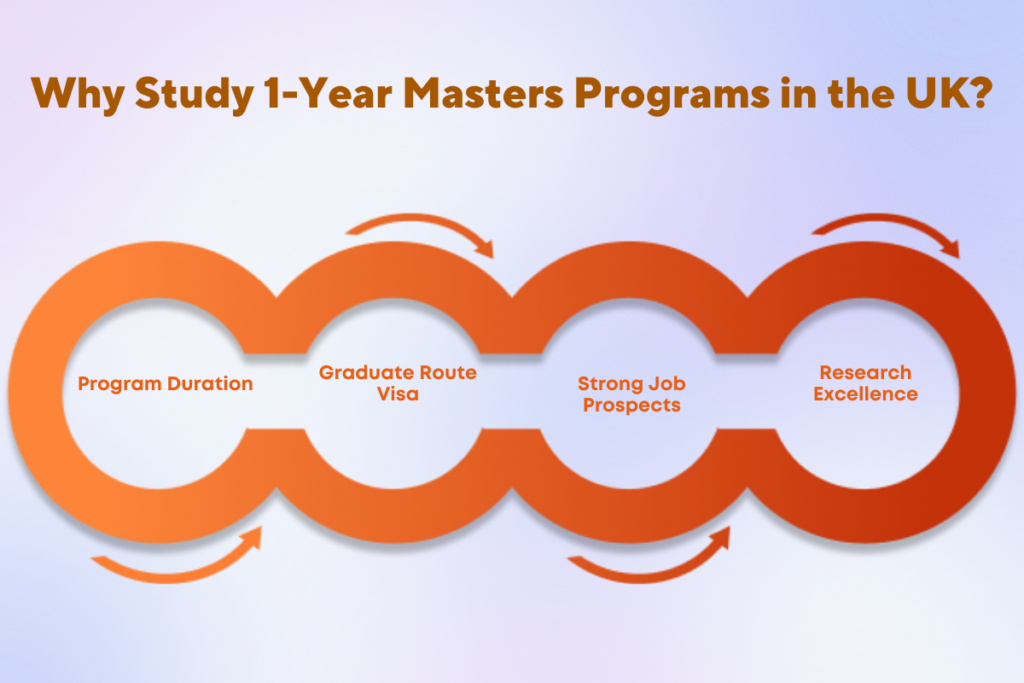
- UK Master’s programs are 1 year, saving Indian students Rs.20 lakh to Rs.40 lakh versus 2-year alternatives.
- Tuition for UK Master’s programs ranges from Rs.13 lakh to Rs.54 lakh depending on university and subject.
- Indian students need IELTS 6.5+ and a recognized bachelor’s degree with 55 to 70 percent marks.
- The Graduate Route visa lets graduates work in the UK for 18 months (for applications made on or after 1 January 2027).
- September is the main UK intake; January intake is available at mid-tier universities for most MSc programs.
Why UK Master’s Programs Are 1 Year (and What That Means for Indian Students)
UK Master’s programs are structured as 1-year, full-time degrees because the curriculum is built differently from what most Indian students have experienced. There are no general education modules, no elective padding, and no long summer breaks. You enter your specialization from day one. The UK uses the period from September through August for the dissertation or final research project, which other countries reserve for a second academic year. You study continuously for 12 months and complete a postgraduate qualification.
This design follows the UK’s qualification framework, which treats a 3-year Honours bachelor’s as sufficient academic grounding for direct entry into a specialist Master’s. Indian bachelor’s degrees are accepted on the same basis, whether you completed a 3-year BA or BCom or a 4-year BTech or BE.
The practical consequence for Indian families is financial. You pay tuition once, not twice. You cover living expenses for 12 months, not 24. The salary you would otherwise lose by spending a second year in coursework is recovered immediately after graduation.
Counselor insight: The pace surprises many Indian students. A student who has managed a 7.5 CGPA across four undergraduate years, with gaps between exams and projects, will find the UK pace genuinely intense. The dissertation runs simultaneously with final taught modules in most programs. Build in realistic academic preparation before you fly. IELTS alone is not enough.
For a detailed breakdown of why the 1-year structure is built the way it is, see our 1-year Master’s in UK guide.
What UK Master’s Programs Actually Cost Indian Students in 2026-27
The total cost of a UK Master’s program for Indian students in 2026-27 has four components: tuition, living expenses, the student visa fee, and the Immigration Health Surcharge (IHS). Each one must be budgeted separately.
Tuition fees
Tuition varies significantly by university tier and subject. Arts, humanities, and social science degrees sit at the lower end. STEM, finance, and business programs, especially at Russell Group universities, sit at the top.
| University Type | Typical Tuition Range | INR Equivalent (at Rs.129.87 per £) |
|---|---|---|
| Post-1992 / regional universities | £10,000 to £18,000 | Rs.13 lakh to Rs.23.4 lakh |
| Mid-ranked universities (Bristol, Bath, Warwick, etc.) | £18,000 to £27,000 | Rs.23.4 lakh to Rs.35.1 lakh |
| Russell Group flagship programs | £27,000 to £38,000 | Rs.35.1 lakh to Rs.49.4 lakh |
| MBA / specialist programs at top universities | £38,000 to £42,000 | Rs.49.4 lakh to Rs.54.6 lakh |
Living expenses
UKVI requires you to show maintenance funds of £1,171 per month if you will be living outside London, and £1,334 per month if you will be in London, for up to 9 months. These are the minimum proof-of-funds amounts; actual spending varies.
| City Tier | Monthly Living Cost (Estimated) | Annual (12 months) | INR Equivalent |
|---|---|---|---|
| London | £1,400 to £1,800 | £16,800 to £21,600 | Rs.21.8 lakh to Rs.28.1 lakh |
| Major regional cities (Manchester, Edinburgh, Birmingham) | £900 to £1,200 | £10,800 to £14,400 | Rs.14 lakh to Rs.18.7 lakh |
| Smaller cities (Leicester, Coventry, Hull) | £700 to £950 | £8,400 to £11,400 | Rs.10.9 lakh to Rs.14.8 lakh |
Visa and health surcharge
The fee for applying for a student visa is £490 (Rs.63,636). The Immigration Health Surcharge (IHS) is £776 per year of your visa. A standard 17-month student visa (1 month before the course + 12 months during + 4 months after) carries an IHS of approximately Rs. 1.07 lakh. Both fees must be paid in full at the time of application. They cannot be paid in installments.
Total budget estimate
| Destination | Tuition | Living (12 months) | Visa + IHS | Approximate Total |
|---|---|---|---|---|
| Regional UK city (mid-tier university) | Rs.20 lakh | Rs.16 lakh | Rs.1.7 lakh | Rs.37-38 lakh |
| London (mid-tier university) | Rs.27 lakh | Rs.25 lakh | Rs.1.7 lakh | Rs.53-55 lakh |
| Regional UK city (Russell Group) | Rs.35 lakh | Rs.16 lakh | Rs.1.7 lakh | Rs.52-53 lakh |
| London (Russell Group / MBA) | Rs.50 lakh | Rs.25 lakh | Rs.1.7 lakh | Rs.77 lakh |
UK vs US vs Canada: Total cost comparison for a Master’s degree
| Country | Program Length | Approximate Total Cost (INR) |
|---|---|---|
| UK | 1 year | Rs.38 lakh to Rs.77 lakh |
| USA | 1.5 to 2 years | Rs.65 lakh to Rs.1.2 crore |
| Canada | 2 years | Rs.55 lakh to Rs.95 lakh |
| Australia | 1.5 to 2 years | Rs.50 lakh to Rs.90 lakh |
Exchange rate used throughout this article: Rs.129.87 per £1 (based on Rs.1 = £0.0077). Verify the current rate before finalizing your budget, as exchange rates fluctuate.
Counselor insight: The most common budgeting mistake is starting with the university name and working backwards to cost. Start with a tuition cap: decide how much you are willing to spend on tuition alone before you open any ranking lists. Rs.20 lakh (£15,400) gets you into excellent programs at Bath, Surrey, or Exeter. Rs.35 lakh (£26,950) opens most Russell Group options except Oxford, Cambridge, and Imperial. Deciding this first saves weeks of confusion.
For a full breakdown of MS costs, including loan options and part-time work projections, see our guide on the cost of studying in UK for Indian students and MS in UK cost for Indian students.
Top UK Master’s Programs for Indian Students in 2026
UK Master’s programs are available across more than 50,000 postgraduate courses at over 160 universities. For Indian students, the high-ROI choices consistently fall into five subject areas.
MSc Computer Science / Data Science / Artificial Intelligence
These are the most applied-to programs by Indian students. Imperial College London, the University of Edinburgh, the University of Manchester, and the University of Southampton are the most popular. According to the QS World University Rankings 2026, Imperial College London ranks #2 globally, and Edinburgh ranks in the top 30 for Computer Science. Entry typically requires a BTech, BE, or BSc in a computing-related field with 60% or above. Starting salaries in UK tech roles for graduates from these universities range from £35,000 to £55,000 (Rs.45.5 lakh to Rs.71.5 lakh).
MSc Finance / Financial Technology / Accounting
The London School of Economics (LSE), Imperial, Warwick Business School, and University of Bristol are the leading choices. London-based finance programs carry higher tuition (£30,000 to £40,000 / Rs.39 lakh to Rs.52 lakh) but place heavily into UK banking and professional services roles. GMAT is sometimes required at LSE and Imperial for finance programs; check individual program pages. Indian students with a BCom, BBA, or CA qualification are generally competitive.
MBA (1-year, full-time)
The UK’s 1-year MBA is one of its most distinctive offerings globally. London Business School, Manchester Business School, Warwick, and Cranfield are the most prominent. Most require 3 to 5 years of post-graduation work experience. The QS Global MBA Rankings 2026 places several UK schools in the global top 20. MBA tuition ranges from £35,000 to £65,000 (Rs.45.5 lakh to Rs.84.4 lakh). Not suitable for fresh graduates.
MSc Management / Business Analytics
A good entry-level option for graduates from non-business backgrounds who want to pivot. Universities like Bath, Exeter, Birmingham, and Glasgow offer strong MSc Management programs that accept students from engineering, science, and arts backgrounds. Tuition is typically £18,000 to £27,000 (Rs.23.4 lakh to Rs.35.1 lakh).
LLM (Master of Laws)
Indian students with an LLB or LLM from an Indian university are eligible. The University of Oxford, UCL, King’s College London, and the University of Edinburgh are the top choices. The Bar Council of India recognizes UK LLMs for practice in India. Tuition ranges from £22,000 to £38,000 (Rs.28.6 lakh to Rs.49.4 lakh).
Counselor insight: Indian students often shortlist by ranking alone and then get surprised by specialization mismatch. A university that ranks #10 globally for Computer Science may have a weak program specifically in machine learning. That is the area most Indian students are targeting. Check the program-level rankings on QS by Subject, not just the overall university rank, before shortlisting.
For a ranked, field-by-field comparison of top universities in UK for Master’s, see our dedicated guide.
Eligibility and Documents for UK Master’s Programs: What Indian Students Actually Need
Academic eligibility
Most UK Master’s programs require a minimum of a 2:2 Honours equivalent, which maps approximately to 50 to 55 percent in your Indian undergraduate degree. Most competitive programs (Russell Group and above) require a 2:1 equivalent, which maps to 60 to 70 percent. A small number of programs at post-1992 universities accept 50 percent with a pre-Master’s pathway option.
| Program Tier | Minimum Indian Percentage Required | UK Equivalent |
|---|---|---|
| Post-1992 / regional universities | 50 to 55% | 2:2 (Lower Second) |
| Mid-ranked universities | 55 to 60% | Strong 2:2 |
| Russell Group (most programs) | 60 to 70% | 2:1 (Upper Second) |
| Oxford, Cambridge, Imperial (competitive programs) | 70%+ | First Class |
English language requirements
IELTS Academic is the standard test accepted by all UK universities. Most Master’s programs require an overall band of 6.5 to 7.0, with no individual band below 6.0. PTE Academic is accepted as an alternative at most universities, with equivalent score requirements. GRE is not required at most UK Master’s programs. This is a meaningful difference from US admissions.
Documents checklist
| Document | Requirement | India-Specific Note |
|---|---|---|
| Academic transcripts | All undergraduate semester/year marksheets | Must be original or officially attested; photocopy alone is not accepted |
| Degree certificate | Final degree certificate | If results are awaited, a provisional certificate is accepted at offer stage; the original is required for CAS conversion |
| Apostille of documents | Required by UKVI for visa stage | Issued by the Ministry of External Affairs (MEA), India; takes 2 to 8 weeks; apply at MEA Apostille Centre or via post |
| IELTS / PTE scorecard | Valid within 2 years of course start date | IELTS scores from British Council, IDP, and IELTS CBT are accepted |
| Statement of Purpose (SOP) | Compulsory for all programs | Should address your specific research/career interest, not a generic study-abroad narrative |
| Letters of Recommendation (LOR) | Usually 2 (academic or professional) | At least 1 academic LOR is preferred; professional LORs are accepted if there is 1+ year of work experience |
| Valid passport | Must be valid throughout your planned stay | Ensure at least 12 months of validity beyond your intended entry date |
| Proof of funds | Bank statements showing maintenance funds | The 28-day rule: funds must appear continuously in your account for 28 consecutive days ending no more than 31 days before your visa application date; any dip during this period can result in visa refusal |
| Tuberculosis (TB) test certificate | Required for Indian passport holders applying for a visa over 6 months | Must be done at an approved UK Visas and Immigration clinic; check the approved clinic list on gov.uk |
| CAS (Confirmation of Acceptance for Studies) | Issued by the university after offer acceptance and deposit payment | The CAS number is required to complete your student visa application; do not apply for the visa before your CAS is issued |
Counselor insight: The apostille requirement catches students every year. The MEA Apostille Centre processes applications in 2 to 8 weeks depending on the state and queue. Students from Tamil Nadu, Andhra Pradesh, and Kerala in particular should plan for the longer end of this range in peak seasons (June to August). Start your application the week your final results are published, not after you receive your university offer.
For help drafting your application documents, see our SOP for UK guidance.
The Graduate Route Visa and UK Master’s Programs: What Changes in January 2027
The Graduate Route is the post-study work visa that allows UK master’s graduates to stay and work in the UK after completing their degree without needing an employer sponsor. It is one of the most significant factors behind the UK’s appeal to Indian students.
The current position
Under the current rules, Master’s graduates who apply for the Graduate Route on or before 31 December 2026 will receive 2 years of unrestricted work permission. There is no minimum salary requirement and no restriction on the type of work you take during this period. You can switch jobs freely, work part-time, work full-time, or be self-employed. The Graduate Route does not lead directly to settlement. Time on it does not count toward the qualifying period for Indefinite Leave to Remain (ILR).
The January 2027 change
From 1 January 2027, the Graduate Route for bachelor’s and Master’s graduates is reduced to 18 months. This change was confirmed by the UK Home Office through a Statement of Changes to the Immigration Rules (HC 1333) laid before Parliament on 14 October 2025 and is reflected on the official GOV.UK Graduate visa page. PhD graduates are unaffected and continue to receive 3 years.
The change applies to the date of the Graduate Route application, not the date your course ends.
What this means if you start in September 2026
A student entering a 1-year Master’s in September 2026 will typically complete the program and graduate in September or October 2027. The Graduate Route application will be submitted after that point, in late 2027, which is after 1 January 2027. You will therefore receive 18 months, not 2 years. This rule applies to most Indian students planning to start in September 2026.
What this means if you start in January 2026 (already enrolled)
Students who began a 1-year Master’s in January 2026 typically complete it in December 2026 or January 2027. If you complete and apply for the Graduate Route before 31 December 2026, you will receive the full 2 years. If your course completion is confirmed by your university and your application is submitted on or before 31 December 2026, the 2-year period applies even if the visa is granted in early 2027.
Skilled Worker Visa pathway
The Graduate Route is a bridge, not a destination. The intended transition is from the Graduate Route to a Skilled Worker Visa, which requires an employer to sponsor you. Under the Skilled Worker route, as a new entrant, the salary threshold is lower than the standard going rate for the role. Graduates who actively pursue sponsored employment from the first month of the Graduate Route, not the final six months, are the ones who convert successfully. 18 months is workable in UK tech, finance, and consulting, but it requires starting your job search before you finish the dissertation.
Dependant visa note
Indian students on a taught Master’s (including all MSc, MA, and MBA programs) are not permitted to bring dependants to the UK under current rules. Only students on research-based programs or pursuing PhDs can apply for dependent visas. If you are married and your spouse plans to accompany you, your marital status is a material planning consideration.
What to Do When Things Go Wrong
Visa refused: Indian student visa refusal rates are approximately 4% (Home Office data). Refusals most commonly cite inconsistent financial documentation or failure to meet the 28-day maintenance rule. Address the specific reason stated in your refusal notice. Do not simply resubmit the same documents. Ensure your bank statements show 28 continuous days of the required balance ending within 31 days of your application date, with the source of funds clearly evidenced through salary slips, fixed deposit certificates, or an education loan sanction letter.
IELTS score below requirement: Popular IELTS test dates in India book up 4 to 6 weeks in advance. If your score is low, retest immediately. Some universities offer conditional admission through an English language pathway program while you retake it. Check with the admissions office before assuming a flat rejection. PTE Academic is also worth considering; some students find it faster to prepare for.
Missed the GREAT Scholarship deadline: Check the British Council India page for mid-cycle openings. Some universities release additional GREAT slots after the initial round. For Chevening, missed deadlines mean waiting for the next cycle (typically opening August 2026 for 2027-28 entry); use the intervening time to build the 2,800 hours of work experience required.
Missed the September intake deadline: If your target program is available in January, this route is a genuine option, not a demotion. If January is not available for your program, begin preparing your September 2027 application and use the gap year productively (work experience strengthens your profile for Chevening and MBA programs).
Scholarships for UK Master’s Programs: What Indian Students Can Actually Get
Scholarship availability for Indian Master’s students in the UK is narrower than most websites suggest. The options that exist are real and consistently underused.
The UK government’s flagship global scholarship. Covers full tuition at any eligible UK university (MBA capped at £22,000 / Rs.28.6 lakh), a monthly living stipend of £917 to £1,134 (Rs.1.19 lakh to Rs.1.47 lakh), return flights to India, visa fees, and the Immigration Health Surcharge. Highly competitive and prestigious.
Eligibility: Indian citizenship; a bachelor’s degree equivalent to UK upper second-class (2:1); a minimum of 2,800 hours of post-graduation work experience (approximately 2 full years of full-time work). You must apply to at least 3 UK universities simultaneously with your Chevening application.
Deadline: The 2027-28 cycle opens in August 2026 and closes in November 2026. Fresh graduates from May 2026 are not yet eligible. You need the work experience first.
A minimum £10,000 (Rs.13 lakh) deduction directly off your first-year tuition fee is available at participating UK universities in partnership with the British Council. No work experience required. Available for both September and January intakes at participating universities.
This is the most accessible scholarship for fresh Indian graduates, and it is consistently underused because students assume they need to secure it before applying to a university. You do not. Apply to your target university first; once you receive a conditional or unconditional offer, check whether that university participates in the GREAT scheme and apply. Scholarship funds are allocated to early applicants. Do not wait until your offer is unconditional.
Commonwealth Masters Scholarship
Full funding for students from Commonwealth countries, including India, pursuing a Master’s degree at a UK university. Targeted at students from lower-income backgrounds with a strong academic and development-focused profile. September intake only. Requires a dual application: through the Commonwealth Scholarship Commission (CSC) online system and through India’s Ministry of Education SAKSHAT portal.
University-specific awards for Indian students
Several UK universities offer India-specific scholarships that do not require a separate application beyond the main admissions form:
- Dr Manmohan Singh Scholarship at Cambridge (for exceptional Indian researchers, typically doctoral level)
- India GREAT at the University of Manchester: £5,000 to £10,000 (Rs.6.5 lakh to Rs.13 lakh) for eligible Indian applicants
- Progression Scholarships at the University of Surrey: awarded automatically to eligible Indian applicants based on academic merit, no separate application
- UCL Global Masters Scholarship: £15,000 (Rs.19.5 lakh) for students from lower-income backgrounds
Counselor insight: Students who apply for the GREAT Scholarship simultaneously with their university application, or within a week of receiving a conditional offer, have a noticeably better conversion rate than students who wait for an unconditional offer. Scholarship funds at most participating universities are allocated to the first wave of applicants. The application itself takes under an hour.
For a complete list with deadlines and eligibility criteria, see our guides on scholarships for Master’s in UK for Indian students and top UK scholarships for Indian students.
Decision Framework: Which UK Master’s Program Is Right for You in 2026-27?
Scenario A: You are a final-year BTech, BCom, or BA student graduating in May or June 2026, with zero work experience and a budget of Rs.35 lakh to Rs.50 lakh.
Target the September 2026 intake. Your results will arrive in June, board attestation will run June through August, and your CAS conversion should be complete by August or September. You are not eligible for Chevening. Apply for the GREAT Scholarship alongside your university applications in October to December 2025. Manchester, Warwick, Bath, and Bristol are realistic fits for this profile. Once you graduate, you will be on the 18-month Graduate Route. That is enough time to land a sponsored role in UK tech or finance, but only if you treat the job search as something that starts in month one of your program. Do not leave it until after your dissertation is submitted.
Scenario B: You are a working professional with 2 or more years of IT, finance, or management experience, with a budget of Rs.45 lakh to Rs.70 lakh.
You have two strong options. For September 2026: apply now, pursue the GREAT Scholarship, and consider MSc Management, MSc Finance, or a 1-year MBA. If you have reached 2,800 hours of post-graduation work experience by August 2026, apply for the Chevening 2027-28 cycle and target September 2027. This is worth the extra year if full funding resolves your ROI concern. For January 2027: if you have already missed September 2026 deadlines at your target university and your program is offered in January, This is a legitimate plan, not a fallback. Competition is genuinely lower, and MBA and MSc Management programs at Birmingham, Glasgow, and Coventry are available in January.
Scenario C: Your IELTS score is currently below 6.5, or you have an academic backlog on your transcript.
Do not apply in the current cycle without addressing these first. An IELTS score below 6.5 will result in rejections from most MSc programs, though some post-1992 universities accept 6.0 with no band below 5.5. Rebook your IELTS immediately: test dates fill 4 to 6 weeks in advance. If your backlog was cleared and the grade appears on your transcript, it generally does not block admission but must be explained in your SOP. Try Targeting January 2027 with an improved IELTS score and use the additional months to strengthen your application.
3 Key Takeaways
Three key points from this guide:
Fix your tuition cap before you shortlist universities. The right budget range determines which programs are realistic, whether September or January is your intake, and whether GREAT scholarship access applies. Rs.20 lakh buys you a strong program outside London. Rs.35 lakh opens most Russell Group options. Start here, not with a rankings table.
If you start in September 2026, plan your UK job search from week one of your program. Do not wait until after graduation. You will receive 18 months on the Graduate Route, not 2 years. That is a workable window in UK tech, finance, and consulting, but only if you use your university’s career services actively, apply to graduate schemes before your dissertation period, and do not treat job hunting as a post-degree activity.
Start board attestation the week your final results are published. MEA apostille of your degree certificate and mark sheets takes 2 to 8 weeks in India. Delaying the process until after your university offer arrives is the most common cause of CAS conversion delays among Indian students. Do not wait.
Verified by: LeapScholar’s UK counseling team, with hands-on experience guiding Indian students through UK university applications, UKVI documentation, and Graduate Route visa processes.
Have questions about UK Master’s programs? Book a free session with a LeapScholar UK counselor.
Frequently Asked Questions About UK Master’s Programs for Indian Students
-
What if my UK student visa is refused?
Around 4% of Indian student visa applications are refused, and it is almost always a documentation issue. The 28-day rule is the most common cause: your bank balance dipped during the required window, or the source of funds was not clearly evidenced. Read your refusal notice carefully. The exact reason is stated in it. Fix that specific issue, get clean statements covering a fresh 28-day period, and resubmit with salary slips, FD certificates, or a loan sanction letter. Sending the same documents again will get the same result.
-
What happens to the Graduate Route for students starting in September 2026?
A September 2026 starter finishes in late 2027 and applies for the Graduate Route at that point, which is after 1 January 2027. They receive 18 months, not 2 years. The cutoff is based on when you apply for the visa, not when your course starts. Only students who complete and apply before 31 December 2026 get the 2-year route. That is mainly January 2026 intake students finishing on schedule. PhD graduates are unaffected and continue to get 3 years.
-
Which UK Master’s programs are best for Indian students in 2026?
It depends on your background and target career. Programs with consistently strong outcomes for Indian students include MSc Computer Science and AI (Imperial, Edinburgh, Manchester), MSc Data Science (UCL, Warwick, Bristol), MSc Finance or FinTech (LSE, Imperial, KCL), MSc Management (Bath, Exeter, Birmingham), and 1-year MBA (Manchester, Warwick, Cranfield). Honest note: the employment gap between mid-ranked Russell Group and non-Russell Group is smaller than most students expect. City and industry access matter more than rank position.
-
What IELTS score do I need for UK Master’s programs?
Most programs require 6.5 overall with no band below 6.0. Oxford, Cambridge, LSE, and Imperial typically ask for 7.0. Some post-1992 universities accept 6.0 with no band below 5.5. PTE 62 is broadly equivalent to IELTS 6.5 and accepted at most institutions. If your score falls short, rebook immediately. IELTS test dates in India fill up 4 to 6 weeks in advance, and some universities cancel conditional offers if scores are not submitted by their stated deadline.
-
Can I work in the UK after completing my Master’s degree?
Through the Graduate Route visa, yes, without needing a job offer upfront. Apply before 31 December 2026 and you get 2 years. Apply on or after 1 January 2027 and you get 18 months. This is confirmed on the official GOV.UK Graduate visa page. Students starting September 2026 graduate in late 2027, so they fall into the 18-month category. PhD graduates are unaffected and continue to receive 3 years. During studies, your student visa allows up to 20 hours of paid work per week.
-
Is a 1-year UK Master’s degree recognised in India and globally?
UK postgraduate degrees are recognised by the Association of Indian Universities (AIU). UK LLMs are recognised by the Bar Council of India for legal practice. Globally, recognition is strong across the US, Canada, Australia, and Europe. The recognition question usually comes from parents, not employers. In practice, the employer conversation rarely goes the direction families fear. For a country-by-country breakdown, see our guide on whether a 1-year UK Master’s is recognised globally.
-
Do I need a GRE for UK Master’s programs?
For most programs, no. British universities evaluate applicants through undergraduate grades, your SOP, and references. GRE is not a standard requirement. A few programs at Oxford, Cambridge, and some business schools list it as optional, and some research pathways ask for it. If you are applying to a standard taught MSc, you almost certainly will not need it. Confirm on the individual program page before assuming.
-
What is the total cost of a UK Master’s degree for Indian students in 2026-27?
Budget Rs.38 lakh minimum for a regional university outside London, and Rs.53 to Rs.77 lakh for a London-based or Russell Group program. That covers tuition, 12 months of living costs, the visa fee of £490 (Rs.63,636), and the Immigration Health Surcharge. London costs roughly Rs.7 to Rs.10 lakh more per year than cities like Manchester or Edinburgh. All figures use Rs.129.87 per £1. Check the live rate before finalising your budget.
-
How long are UK Master’s programs for Indian students?
One year, full-time. The UK does not pad postgraduate programs with electives or a light second semester. You enter your specialisation from day one, and the dissertation fills the period other countries use for a second academic year. A handful of research or integrated engineering programs run 18 to 24 months, but for the vast majority of taught MSc, MA, and MBA programs, 12 months is the complete degree.







Have Questions? Get Guidance to reach your Dream University
Connect with India's finest counsellors and biggest study abroad community.
Get Guidance