
Quick Read
- Non-EU students can work up to 20 hours a week and 1,040 hours a year on a study visa.
- Part-time pay in Italy ranges Rs.780-1,665/hour (EUR 7-15), set by sector agreements, not a fixed minimum wage.
- You need both a Permesso di Soggiorno and a separate Codice Fiscale before starting any paid job.
- Milan and Rome offer the most openings; Bologna, Turin, and Padua balance pay with lower living costs.
Can Indian Students Work Part Time in Italy?
Yes. If you hold a Type D (long-term) student visa and have converted it into a Permesso di Soggiorno per Motivi di Studio (study residence permit) after arrival, you are legally permitted to take up part-time work. No separate work permit is required. The authorization to work is built into your residence permit itself, as long as you stay within the hour limits below.
EU/EEA students face no such restriction and can work like Italian citizens. This guide focuses on the non-EU rules that apply to most Indian students.

Choose your dream country
 UK
UK
 USA
USA
 Germany
 Australia
 Ireland
 Canada
 UAE
UAE
 France
 Sweden
 Italy
Italy
 Other
Other
When do you want to study abroad?
What's your highest level of education?
Have you completed Class 12th?
What was your Class 12 CGPA/percentage?
Are you a student or a parent/guardian?
What do you want to study?
Select your current city
How Leap will help you

Personalised University Shortlist

Express Applications with Quicker Admits

End-to-End Application Support
Legal Work-Hour Limits for Non-EU Students
- 20 hours per week during term time. This is a hard weekly ceiling, not an average. You cannot work 25 hours one week and 15 the next to balance it out.
- 1,040 hours per year total, across all jobs combined. If you hold two part-time roles, your combined weekly hours still cannot exceed 20.
- The cap does not expand automatically during semester breaks or summer holidays. Some employers offer separate full-time contracts during official university breaks, but the decision depends on the employer, not an automatic visa allowance.
- Exceeding the limit can put your residence permit at risk, so track your hours weekly, not monthly.
Explore Italy's complete student visa requirements to understand how your work rights fit into your overall permit conditions.
Paperwork You Need Before Your First Job
Step 1: Permesso di Soggiorno per Motivi di Studio Apply within 8 working days of arriving in Italy, at the Questura (police headquarters) or via the post-office kit system. This permit is what legally allows part-time work; without it, any paid job is illegal, regardless of your visa.
Step 2: Codice Fiscale This is Italy's tax identification number, separate from your residence permit. You need it to sign an employment contract, open a bank account, or get a phone connection. You can obtain it free from any Agenzia delle Entrate office; some Italian consulates may issue it before you leave India. The process typically takes about 15 minutes once you're at the counter.
Step 3: A registered contract Always insist on a written employment contract, even for casual hospitality or retail shifts. An unregistered "cash-in-hand" arrangement offers no legal protection and can complicate your permit renewal if questioned.
How Much Do Part Time Jobs in Italy Pay?
Italy has no national minimum wage. Instead, pay is set sector-by-sector through CCNL (collective bargaining) agreements between unions and employers. For typical student roles, the average pay works out to:
| Job type | Hourly pay (INR, 1 EUR = INR 111) | Hourly pay (EUR) |
| Hospitality, retail (general) | Rs.780-1,000 | EUR 7-9 |
| Food delivery (Glovo, Just Eat) | Rs.780-1,110 | EUR 7-10 |
| Private tutoring, language teaching | Rs.1,330-1,665 | EUR 12-15 |
| On-campus roles (library, research assistant) | Rs.890-1,330 | EUR 8-12 |
At 20 hours a week, this works out to roughly Rs.62,160-1,33,200 (EUR 560-1,200) a month, before tax.
Tax note: Your first Rs.9,43,500 (EUR 8,500) of annual income falls under Italy's IRPEF no-tax threshold, so most part-time student earners owe little to no income tax. Social security contributions of roughly 9-10% still apply and are non-refundable.
Where the Jobs Actually Are
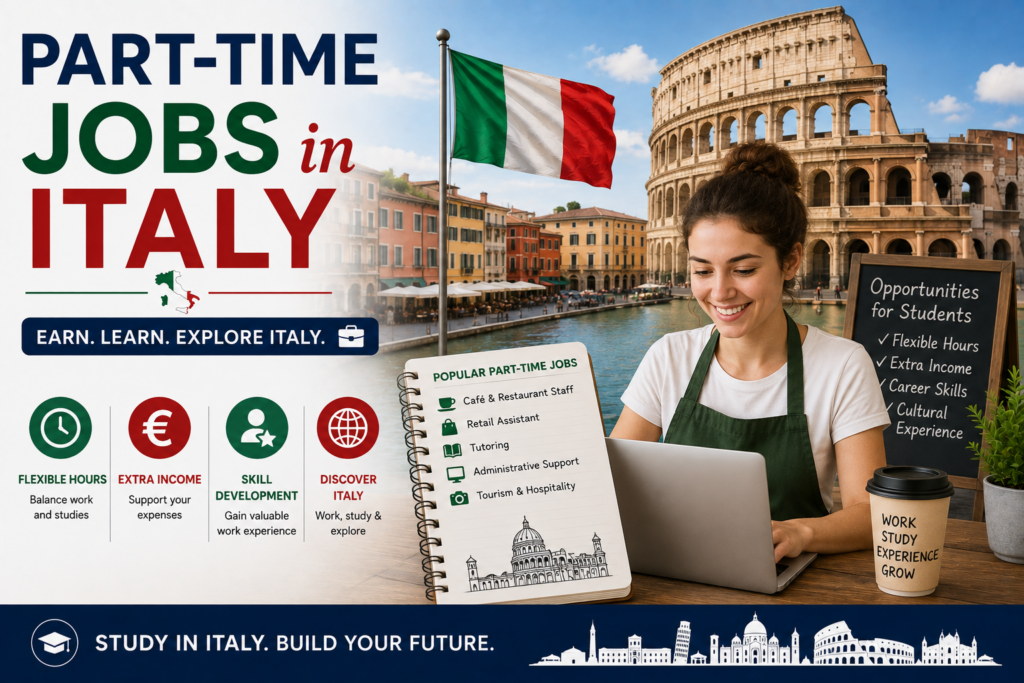
- Hospitality: Cafes, trattorias, restaurants, and hotels are the most common entry point, especially if you're still building your Italian.
- Retail: Clothing stores, supermarkets, and souvenir shops in tourist-heavy areas often hire seasonally.
- Tutoring: English or subject tutoring for local school students pays well and needs no Italian fluency.
- Food delivery: Glovo and Just Eat offer flexible, app-based shifts that fit around lectures.
- On-campus roles: Library assistant, research assistant, and administrative support positions are convenient and often don't require Italian at all.
- Tour guiding: English-speaking guide roles are common in cities with heavy tourist footfall.
Best Cities for Student Part Time Work
- Milan and Rome: The most vacancies and the highest wages, but also the highest cost of living. Check Italy's cost of living by city before deciding how much part-time income you'll actually need.
- Bologna and Florence: Large student populations and strong tourism keep hospitality and retail hiring active year-round.
- Turin and Padua: Industrial and academic hubs with steady demand, especially useful if your course is STEM-related.
Is a Part Time Job in Italy Worth It for You?
A part-time job in Italy will not cover your tuition. It's realistic for day-to-day costs like accommodation, food, and local transport, not for funding your education from scratch.
Counselor insight: Students on tighter timetables, particularly those in lab-heavy or clinical courses, often overestimate how many of their 20 weekly hours they can realistically use. If you're on the MBBS route into Italy, check whether IMAT is compulsory for MBBS in Italy as part of your planning, since medical programs typically leave far less room for part-time work than most other degrees.
Weigh a part-time job against your course load if you are
- In a research-heavy Master's with unpredictable lab hours.
- If you are still building basic Italian, you may need extra time for language classes.
- You are on a tight semester with back-to-back exams in your first year.
Can You Convert Your Study Visa Into a Work Visa?
Yes, after graduation. You'll need to register with the Centro per l'Impiego (employment centre) before your student permit expires and apply for a Permesso di Soggiorno per Attesa Occupazione (job-seeker permit).
See the full post-study work permit process for Italy for duration and eligibility details.
3 Takeaways on Part Time Jobs in Italy
- Non-EU students in Italy can legally work up to 20 hours a week and 1,040 hours a year, but this cap is fixed weekly and cannot be banked or averaged out.
- Expect Rs.780-1,665/hour (EUR 7-15) depending on the sector, enough to cover living costs like rent and food, but not tuition.
- Complete your Permesso di Soggiorno and Codice Fiscale before accepting any paid work; skipping either step makes the job illegal regardless of your visa status.
Talk to a LeapScholar counselor to find verified part time jobs in Italy that fit your visa and study schedule.
Frequently Asked Questions About Part Time Jobs in Italy
-
Can Indian citizens get a job in Italy?
Indian citizens can work in Italy, though the route depends on your status. Students on a Permesso di Soggiorno per Motivi di Studio can work part-time up to 20 hours a week. Full-time roles usually need an employer-sponsored work visa under Italy's annual "decreto flussi" quota.
-
Which jobs are in high demand in Italy?
Hospitality, food delivery, and tourism-linked roles see the steadiest student demand, especially in cities like Milan, Rome, and Florence. Private tutoring also stays in demand year-round since it needs no Italian fluency.
-
What is the average part time jobs in Italy salary per month?
At 20 hours a week, most students earn roughly Rs.62,160-1,33,200 (EUR 560-1,200) a month before tax, depending on sector and city. Confirm the current EUR-INR rate before budgeting.
-
How many hours can international students work in Italy?
Non-EU students can work up to 20 hours per week during term and up to 1,040 hours per year in total. This limit applies across all jobs combined and cannot be redistributed across weeks.
-
Do I need a separate work permit for a part-time job in Italy?
No. Your Permesso di Soggiorno per Motivi di Studio already authorizes part-time work within the legal hour limits. You do need a Codice Fiscale to sign a contract.
-
What is a Codice Fiscale and why do I need one?
It's Italy's tax identification number, required to sign an employment contract, open a bank account, or get a phone plan. It's issued free by the Agenzia delle Entrate, often within 15 minutes.
-
Can I convert my student visa into a work visa after graduating?
Yes. Register with the Centro per l'Impiego before your student permit expires and apply for a job-seeker residence permit, which lets you stay in Italy while searching for full-time work.
-
Which cities offer the best part-time job opportunities for Indian students?
Milan and Rome have the most openings and highest pay but higher living costs. Bologna, Florence, Turin, and Padua offer a better balance between earnings and cost of living.
-
Are there part-time jobs in Italy for students who don't speak Italian?
Yes, though options are narrower than in France or Germany. The most accessible jobs for students without fluent Italian include English-speaking tutoring, food delivery apps, tour guiding in tourist cities, and on-campus university roles.
-
What happens if I accidentally work more than 20 hours in a week?
This counts as a violation of your residence permit conditions and can affect its renewal. If it happens, stop immediately, inform your employer to adjust your schedule, and consult your university's international office or a licensed immigration advisor before your next permit renewal.








Have Questions? Get Guidance to reach your Dream University
Connect with India's finest counsellors and biggest study abroad community.
Get Guidance