
Quick Read
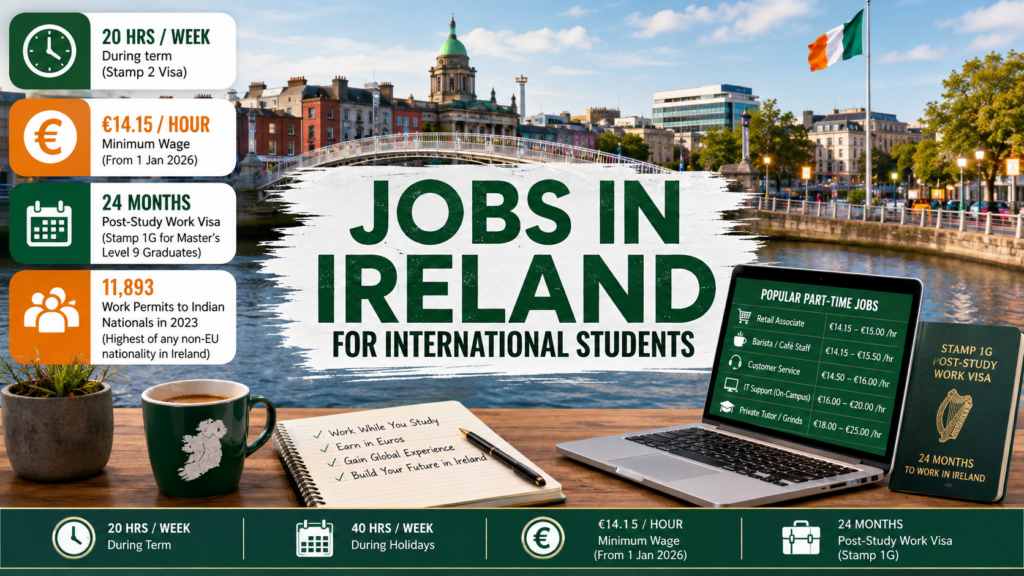
- International students in Ireland can work 20 hours/week during term and 40 hours/week during holidays on a Stamp 2 visa.
- Ireland’s minimum wage is €14.15/hour (Rs. 1,560) as of January 2026, higher than the UK, Australia and Canada.
- After graduation, a Stamp 1G post-study work visa gives Level 9 Master’s graduates 24 months to find and start full-time work in Ireland.
- Indian nationals received 11,893 work permits in 2023, the highest of any non-EU nationality in Ireland.
Work Rights for Jobs in Ireland for International Students 2026
Your right to work in Ireland depends entirely on your visa stamp and course type. Understanding these rules is the first step to finding jobs in Ireland for international students successfully.
Stamp 2 holders (students enrolled in a full-time course on the Interim List of Eligible Programmes / ILEP maintained by the Department of Justice) can work:

Choose your dream country
 UK
UK
 USA
USA
 Germany
 Australia
 Ireland
 Canada
 UAE
UAE
 France
 Sweden
 Italy
Italy
 Other
Other
When do you want to study abroad?
What's your highest level of education?
Have you completed Class 12th?
What was your Class 12 CGPA/percentage?
Are you a student or a parent/guardian?
What do you want to study?
Select your current city
How Leap will help you

Personalised University Shortlist

Express Applications with Quicker Admits

End-to-End Application Support
| Period | Working Hours Allowed |
|---|---|
| Term time | Up to 20 hours per week |
| Holiday period: 15 Dec to 15 Jan | Up to 40 hours per week |
| Holiday period: 1 June to 30 September | Up to 40 hours per week |
Stamp 2A holders (students on courses NOT listed on the ILEP) cannot work at all.
Before you accept an offer from any Irish institution, confirm your course is on the ILEP. This is the single most important work-rights check, and most students miss it until after they arrive.
To work legally, you also need a Personal Public Service (PPS) number. You cannot receive a salary in Ireland without one. Apply at your nearest Intreo Centre with your IRP card, a job offer letter, and proof of address. Processing takes 1-2 weeks. Start this process in Week 2 of your first semester, not after you find a job.
Counselor insight: Most Indian students arrive in September and begin job-hunting in October. By then, the best retail and hospitality roles for the Christmas period are already filled. Start your job search in Weeks 4-5, before you even have a PPS number. Get the offer first, then apply for the PPSN simultaneously.
Part-Time Jobs in Ireland for International Students: 2026 Wages
Part-time jobs in Ireland for international students are the primary income source during your degree. The national minimum wage in Ireland is €14.15/hour (Rs.1,560/hour) from 1 January 2026, confirmed by the Department of Enterprise. This is the floor. Most roles in Dublin pay 10-15% above minimum wage for experienced candidates.
Exchange rate used: €1 = Rs.110.24. Verify the current rate before finalizing your budget.
Part-time jobs for international students in Dublin and other Irish cities are concentrated in retail, hospitality, campus roles, and admin. IT support and tutoring pay above minimum wage and are worth targeting if you have a technical background.
| Job Title | Avg. Hourly Rate | INR Equivalent | Best Platforms to Find Work |
|---|---|---|---|
| Retail Associate | €14.15-€15.00 | Rs.1,560-Rs.1,654 | Jobs.ie, LinkedIn |
| Barista / Café Staff | €14.15-€15.50 | Rs.1,560-Rs.1,709 | Walk-in + Indeed |
| Customer Service (call centre) | €14.50-€16.00 | Rs.1,598-Rs.1,764 | LinkedIn, Indeed |
| Campus Library / Admin | €14.15-€15.50 | Rs.1,560-Rs.1,709 | University careers portal |
| IT Support (on-campus) | €16.00-€20.00 | Rs.1,764-Rs.2,205 | University IT department |
| Grinds / Private Tutoring | €20.00-€30.00 | Rs.2,205-Rs.3,307 | Carers.ie, Facebook groups |
| Delivery Driver | €14.15-€16.00 | Rs.1,560-Rs.1,764 | Deliveroo, Just Eat |
How much can an international student earn in Ireland per month? Working 20 hours/week at €14.15/hour, your gross monthly income is approximately €1,132 (Rs.1.25 lakh). During the June-September holiday period at 40 hours/week, that rises to roughly €2,264 (Rs.2.50 lakh) per month before tax. This covers a significant portion of living costs in cities outside Dublin, where monthly expenses typically run €1,000-€1,400 (Rs.1.10 lakh-Rs.1.54 lakh).
What You Actually Take Home After Tax
Ireland uses PAYE (Pay As You Earn). Most students working 20 hours/week at minimum wage pay very little tax:
- USC: 0.5% on income up to €12,012/year (Rs.1.32 lakh). Most student earnings fall in this band.
- PRSI: 4% only on earnings above €352/week (Rs.38,804). Working 20 hours at minimum wage puts you at roughly €283/week (Rs.31,198), so most term-time students pay zero PRSI.
- Income Tax: Combined personal and employee tax credits of €3,750/year (Rs.41,340) mean students earning under €18,750/year (Rs.20.67 lakh) pay no income tax. Working 20 hrs/week at minimum wage earns roughly €14,716/year (Rs.16.22 lakh), so you are well under this threshold.
Register your tax credits on Revenue's myAccount portal right after getting your PPS Number. Skip this and your employer deducts emergency tax at 40%. It is refundable but takes weeks to recover.
Where to Find Part-Time Jobs in Ireland
- IrishJobs.ie: Ireland's largest job board. Filter by "part-time" and city.
- Indeed Ireland: Best for hospitality and retail.
- Jobs.ie: Strong for admin and customer service roles.
- University careers portal: Employers here already understand Stamp 2 hour limits.
- Walk-in method: Print your CV and walk into supermarkets (Lidl, Aldi, Dunnes Stores, Tesco) and cafés directly. Irish hospitality managers hire this way regularly and prefer it.
Irish CV format: 1-2 pages, no photo, no date of birth. Both are standard on Indian CVs but flag you as unfamiliar with Irish hiring norms. Remove them before applying.
Counselor insight: Part-time jobs in Dublin for international students are highly competitive in Term 1 of every academic year. Students from 40,400+ international enrollments are all job hunting at the same time. Those who used the university careers center before arriving, not after, find jobs in the first 6 weeks.
Post-Study Work Visa Ireland: The Stamp 1G Explained
The Third Level Graduate Programme (Stamp 1G) is Ireland's official post-study work permit for non-EEA graduates. It gives you the right to work full-time in any sector without needing a separate employment permit while you search for a sponsored role.
| Degree Level | Stamp 1G Duration |
|---|---|
| Level 8 (Honours Bachelor's / Higher Diploma) | 12 months |
| Level 9 (Master's degree) | 24 months (12 months initial + 12 months renewal) |
| Level 10 (PhD) | 24 months |
Key rules confirmed by the Irish Immigration Service:
- You must apply within 6 months of your official degree award letter (not your last exam date)
- You must still hold a valid Stamp 2 at the time of application
- Application fee: €300 (Rs.33,072) per person
- Processing time: 6-8 weeks
- You must not have exceeded the 7-year limit on student permission in Ireland
The Level 9 / 24-month route is what most Indian students are selecting, and for good reason: the extra 12 months to transition to a Critical Skills or General Employment Permit makes a material difference to your outcome.
Counselor insight: The clock on your Stamp 1G application starts from the date of your official award letter from the university, not from when you finished your last module or submitted your thesis. Students routinely miss the 6-month window because they confuse exam completion with award confirmation. Chase your award letter within 2 weeks of results day.
For the full Stamp 1G application steps, post-study work visa Ireland covers the complete process.
Jobs in Ireland for International Students by Sector
Job opportunities in Ireland for international students span four main sectors. Technology, pharmaceuticals, financial services, and healthcare anchor Ireland's economy. These four sectors collectively employ the majority of international graduates who successfully transition to full-time work. Here is an honest sector-by-sector picture for 2026.
1. Technology and ICT
Ireland hosts the European headquarters of Google, Meta, Microsoft, Apple, and LinkedIn, making it one of the strongest technology job markets in Europe. International students in ICT can find well-paid graduate jobs in Ireland, but the competition is fierce. Over 40,000 international students now study in Ireland annually, many from tech-heavy programs.
The job market in Ireland for international students in technology is open to both EU and non-EU graduates, making it one of the most accessible routes for jobs in Ireland for foreigners.
The Critical Skills Occupation List includes software developers, data scientists, cybersecurity engineers, and cloud architects. Roles on this list at a salary of €40,904+ (Rs.45.08 lakh+) qualify for a Critical Skills Employment Permit. Recent graduates from Irish institutions who secure roles in listed occupations within 12 months of graduation qualify at a lower threshold: €36,848 (Rs.40.62 lakh) minimum.
2. Pharmaceuticals and Life Sciences
Cork and Dublin host 7 of the world's top 10 pharmaceutical companies. For graduates in chemistry, biochemistry, pharmacy, and biomedical engineering, Ireland's pharma sector offers consistently strong hiring rates. Graduate roles start at €35,000-€45,000 (Rs.38.58 lakh-Rs.49.61 lakh) annually. Many roles qualify for Critical Skills permits.
3. Financial Services
Dublin is the European base for Citibank, JP Morgan, Bank of America, and over 500 other financial institutions. Finance graduates with CFA progression, data analytics skills, or accounting qualifications find strong demand. Entry-level financial analyst roles start at €32,000-€40,000 (Rs.35.28 lakh-Rs.44.10 lakh).
4. Healthcare
Ireland has a documented nursing shortage, with the HSE actively recruiting internationally. Registered nurses, physiotherapists, occupational therapists, and pharmacists are all on the Critical Skills list. This is the one sector in Ireland where international graduates face the least competition relative to available roles. Starting salaries for staff nurses are approximately €35,000 (Rs.38.58 lakh) under the HSE pay scale.
Teaching jobs in Ireland for international applicants are also worth noting. The Department of Education runs international recruitment drives, particularly for STEM subjects and English language teaching at primary and secondary levels. Teaching jobs in Ireland for international applicants' salaries typically start at approximately €40,000 (Rs. 44.10 lakh) on the standard teacher pay scale.
Counselor insight: Indian students often pick the most popular MSc programs (Data Science, Computer Science) without checking how many other international students are graduating from the same course at the same time. For jobs in Ireland for international students, sector saturation matters more than university rank. A less popular specialization with genuine employer demand gives you better odds than a prestigious course with 200 competing graduates.
Work Permits in Ireland for International Students: Critical Skills vs General Employment
Once your Stamp 1G is running, your goal is to transition to a sponsored employment permit before it expires. These are the two main routes.
| Feature | Critical Skills Employment Permit | General Employment Permit |
|---|---|---|
| Minimum annual salary (from March 2026) | €40,904 (Rs. 45.10 lakh) with relevant degree | €36,605 (Rs.40.36 lakh) |
| Salary for recent Irish graduates | €36,848 (Rs.40.62 lakh) | The same rate applies |
| Labour Market Needs Test | Not required | Required (employer must prove no EEA candidate available) |
| Permit duration | 2 years | 2 years |
| Path to Stamp 4 | After 21 months | After 2 years (with application) |
| Who applies | Employer or employee | Employer |
| Family reunification | From day one | After 12 months |
Note: Recent graduate rate applies to non-EEA graduates of Irish institutions who apply for a CSEP within 12 months of graduation.
Source: DETE employment permit salary thresholds, effective 1 March 2026
The Critical Skills route is faster and less bureaucratic. If your role qualifies (check the Critical Skills Occupations List on the DETE website), push your employer toward it. The absence of a Labour Market Needs Test removes a significant step that can delay the General Employment Permit by 4-6 weeks.
How to apply for a Critical Skills Employment Permit:
This is the most common work permit route taken by jobs in Ireland for international students who secure graduate-level roles in tech, pharma, or finance.
- Confirm your occupation is on the DETE Critical Skills Occupations List
- Secure a full-time job offer for a role paying at least €40,904 per year
- Your employer registers on the Employment Permits Online portal
- Submit the application with your degree certificate, job offer letter, and passport
- Processing time: 4-8 weeks (as of 2026)
- Once approved, register your IRP card at your local Garda station or online
Which Indian Students Get Jobs in Ireland: 3 Real Scenarios
The job market in Ireland for international students is not uniform. Outcomes differ sharply by degree level, subject area, and how proactively students approach their job search. Here are three realistic profiles.
- Scenario 1: If you are completing a BTech in Computer Science graduating May 2026 and planning an MSc in Data Science at UCD or DCU
The MSc in Data Science is one of the most popular courses in Ireland for Indian students, which means you will graduate into a competitive market. You can still succeed, but your Stamp 1G period will be about securing a role that qualifies for a Critical Skills permit, not just any tech job. Target companies with established CSEP processes: Google, Accenture, Deloitte. Start applying before your results are out. Do not wait for graduation. - Scenario 2: If you are a BBA or B.Com graduate planning an MSc Finance or MBA in Dublin for September 2026
Financial services hiring in Dublin is steady. Roles in risk, compliance, operations, and fund administration hire Indian graduates consistently. These roles often fall under the General Employment Permit rather than Critical Skills, so your employer will need to run a Labour Market Needs Test. Target the MNC banks rather than boutique firms. They have established immigration teams and process permits regularly. - Scenario 3: If you are a BSc Nursing or BPharm graduate planning a postgraduate clinical programme in Ireland
This is currently the strongest hiring environment for any Indian graduate category in Ireland. The HSE's nursing shortage means hospital employers will often initiate the permit process on your behalf. Confirm your Indian nursing registration is recognised by the Nursing and Midwifery Board of Ireland (NMBI) before you apply to any programme. Recognition processing takes 3-6 months and must happen before you apply for any nursing role.
Documents Checklist: Jobs in Ireland for International Students
Having the right documents in order is essential before you can legally start any work in Ireland. Here is what you need at each stage.
| Document | What It Is | India-Specific Note | When You Need It |
|---|---|---|---|
| IRP Card (Stamp 2) | Irish Residence Permit confirming your student status | Issued at Garda station after arrival; carry it at all times | Before starting any job |
| PPS Number | Irish tax and social welfare ID | Apply at Intreo Centre with IRP card, a job offer letter, and proof of address | Before receiving your first salary |
| ILEP confirmation | Proof your course qualifies for work rights | Check at irishimmigration.ie before enrolling | At the enrollment stage |
| Award letter (for Stamp 1G) | Official degree confirmation from university | Different from your exam results or transcript, request from Registry Office | Within 6 months of graduation |
| Medical insurance | Required for Stamp 1G renewal | Annual policy; student plans from €160/year | At Stamp 1G application |
| CSEP/GEP application docs | For work permit after Stamp 1G | Includes employment contract, degree certificate, passport, employer EPOS registration | When transitioning to work permit |
| Indian degree certificates | For work permit applications | Get notarised copies of your BE/BTech/BSc marksheets; apostille may be required | For permit applications |
Month-by-Month Planning Calendar for Jobs in Ireland for International Students
Finding jobs in Ireland for international students is easier when you plan for arrival, not graduation. This calendar maps the Irish academic year to the actions Indian students need to take to maximize their job outcomes.
| Month | Action |
|---|---|
| August 2026 | Research part-time job options; update Irish-style CV (1-2 pages, no photo); register on LinkedIn and Jobs.ie before arrival |
| September 2026 | Arrive; register IRP card within 90 days; apply for PPS Number by Week 2 |
| October 2026 | Begin part-time job search (max 20 hrs/week); attend university careers fair; attend on-campus employer presentations |
| November-December 2026 | Intensify job search before Christmas holiday period (40 hrs/week work allowed from 15 Dec) |
| January 2027 | Return to 20-hr limit from 15 January; review your course placement options if applicable |
| March-April 2027 | Apply for summer internships (June-September period); target companies on Critical Skills list |
| June 2027 | 40-hour work period begins (1 June); prioritise paid internship over part-time retail if available |
| September 2027 | Return to term-time rules; begin Stamp 1G research if in final year; prepare job applications |
| January-April 2028 | Submit final assignments; apply for graduate roles; request award letter from Registry |
| Within 6 months of award letter | Apply for Stamp 1G (€300 / Rs.33,072 fee); continue working under Stamp 2 hours during processing |
What to Do If Jobs in Ireland for International Students Don’t Go as Planned
The path to jobs in Ireland for international students is not always smooth. Here are the four most common problems Indian students face and what to do about each.
- Can't find a part-time job in Semester 1? Most Indian students take 6-10 weeks. Walk into supermarkets (Lidl, Aldi, Dunnes, Tesco) with your CV directly. Many managers hire on the spot. Your university careers centre holds a list of employers already familiar with Stamp 2 limits.
- Stamp 1G delayed past Stamp 2 expiry? Apply 8-10 weeks before expiry. You can keep working under Stamp 2 conditions while your application is pending, provided you applied before expiry and have proof of the pending application.
- Employer withdraws the offer before your work permit is issued? The permit lapses with the offer. Time already spent counts against your Stamp 1G, so restart your job search immediately. Level 9 graduates can apply for a 12-month renewal by showing active job-seeking evidence.
- Graduated in IT and still no tech role after 6 months? A consistent pattern among MSc CS and MSc Data Science graduates from smaller Irish institutions in 2025-26. Broaden to adjacent roles: IT support, business analysis, and project coordination can qualify for a Critical Skills permit. Target MNCs in pharma and financial services with internal IT teams. Do not spend all 24 Stamp 1G months on ideal roles only.
3 Takeaways on Jobs in Ireland for International Students
Jobs in Ireland for international students are genuinely available, but securing them requires early action, the right course selection, and a clear understanding of the visa rules.
- Check the ILEP list before you enroll. Your registration must be on it for your Stamp 2 to carry work rights. This is non-negotiable and cannot be fixed after you arrive.
- Apply for your PPS number in Week 2 of your first semester. Job hunt from Week 4. The Christmas retail window closes fast, and part-time jobs in Dublin for international students go to students who start early.
- Apply for your Stamp 1G within 6 months of your official award letter, not your exam completion date. Build your work permit application timeline into your final-year plan, not as an afterthought after graduation.
Verified by: LeapScholar's Ireland counseling team, with hands-on experience guiding Indian students through the Stamp 2, Stamp 1G, and Critical Skills Employment Permit processes.
Have questions about jobs in Ireland for international students? Book a free session with a LeapScholar counselor.
Frequently Asked Questions About Jobs in Ireland for International Students
-
Can international students work in Ireland while studying?
International students on a Stamp 2 visa can work up to 20 hours per week during term time and 40 hours per week during the two official holiday periods: 15 December to 15 January and 1 June to 30 September. Students on a Stamp 2A (courses not on the ILEP list) cannot work at all. You must have a valid IRP card and a PPS number before starting any paid employment.
-
What is the minimum wage for international students in Ireland in 2026?
Ireland's national minimum wage from 1 January 2026 is €14.15/hour (Rs.1,560/hour), applicable to all workers aged 20 and over. This applies equally to international students. Most part-time jobs in Ireland for international students pay at or just above this rate. Specialist roles like IT support and tutoring pay €18-€30/hour.
-
How many hours can international students work in Ireland?
On a Stamp 2 visa, the limit is 20 hours per week during academic terms and 40 hours per week during official holiday periods (15 Dec-15 Jan and 1 Jun-30 Sep). There is no provision for additional hours, even during exam revision weeks.
-
What is the Stamp 1G post-study work visa in Ireland?
The Stamp 1G is the immigration permission granted under Ireland's Third Level Graduate Programme. It allows non-EEA graduates from Irish institutions to remain in Ireland after graduation to seek employment. Level 8 graduates receive 12 months; Level 9 (Master's) and Level 10 (PhD) students receive 24 months. It costs €300 (Rs.33,072) and must be applied for within 6 months of receiving your official award letter.
-
Do I need a PPS number to work part-time in Ireland?
A PPS number is mandatory before you can receive a salary in Ireland. Apply at an Intreo center with your IRP card, a letter confirming your job offer, and proof of your Irish address. You cannot get a PPS number before you have a job offer, so find work first, then apply. Processing takes approximately 7-10 working days.
-
What are the best part-time jobs in Ireland for Indian students?
The most accessible part-time jobs for international students in Dublin and other Irish cities are retail assistant, café/barista, customer service representative, and campus-based roles. IT support and private tutoring pay significantly above minimum wage and are worth targeting if you have relevant skills. University careers offices keep updated listings of employers who regularly hire international students.
-
Is the job market in Ireland good for international students in 2026?
It depends heavily on your field. Healthcare, pharma, and financial services offer strong graduate hiring for international students. The technology sector is competitive: Ireland saw a hiring slowdown in tech in 2024-2025, and Indian graduates from general CS programs report higher rejection rates than in previous years. Students in niche specializations with demonstrated skills (data engineering, cybersecurity, cloud architecture) continue to find roles. The job market in Ireland for international students remains more accessible than Canada or the UK for graduates who choose their course strategically.
-
What happens if I cannot find a job in Ireland after graduation?
If you are a Level 9 graduate, your Stamp 1G gives you 24 months. If you do not secure a sponsored role within the first 12 months, you can renew for another 12 months by demonstrating you are actively seeking graduate employment (proof of job applications, interviews, and agency registrations). If you still cannot secure a sponsored role after 24 months, you will need to leave Ireland or qualify for a different visa category. Do not wait until month 20 to start the permit application process.
-
Which sectors in Ireland sponsor work visas for international graduates?
Technology, pharmaceuticals, financial services, and healthcare are the four sectors that account for the majority of employment permits issued to international graduates in Ireland. Within these, the largest sponsors are Google, Meta, Accenture, Pfizer, KPMG, Deloitte, Citibank, and the HSE. For jobs in Ireland for international students seeking visa sponsorship, targeting these named employers is more efficient than applying broadly.
-
Do international students get jobs in Ireland?
Yes, international students do get jobs in Ireland, both during their studies and after graduation. During your degree, part-time jobs in Ireland for international students are available in retail, hospitality, IT support, and campus roles, with work rights of up to 20 hours per week on a Stamp 2 visa. After graduation, the Stamp 1G post-study work visa gives Level 9 graduates 24 months to secure full-time employment. Outcomes vary by sector: healthcare, pharma, and finance graduates find roles more consistently than general IT graduates in the current market.
-
How do Indians get jobs in Ireland?
Indians get jobs in Ireland through two main routes. During studies, part-time work on a Stamp 2 visa requires a course on the ILEP list and a PPS number. After graduation, the Stamp 1G post-study visa allows full-time work while you apply for a sponsored employment permit. The most direct path to full-time jobs in Ireland for Indian students is targeting MNC employers such as Google, Accenture, Pfizer, and Deloitte, which have established processes for Critical Skills and General Employment Permits, and applying before graduation rather than after.
-
Which jobs are easily available in Ireland?
The most easily available jobs in Ireland for international students during their studies are retail assistant, barista, customer service representative, and campus support roles. These roles hire in high volumes across Dublin, Cork, Galway, and Limerick, and most do not require prior Irish work experience. After graduation, healthcare roles (nursing, pharmacy, and physiotherapy) and finance operations roles have the strongest hiring rates for international graduates in Ireland. Technology roles are available but competitive, and students with niche specializations in data engineering, cybersecurity, or cloud architecture have significantly better placement rates than those from general CS programs.










Have Questions? Get Guidance to reach your Dream University
Connect with India's finest counsellors and biggest study abroad community.
Get Guidance