
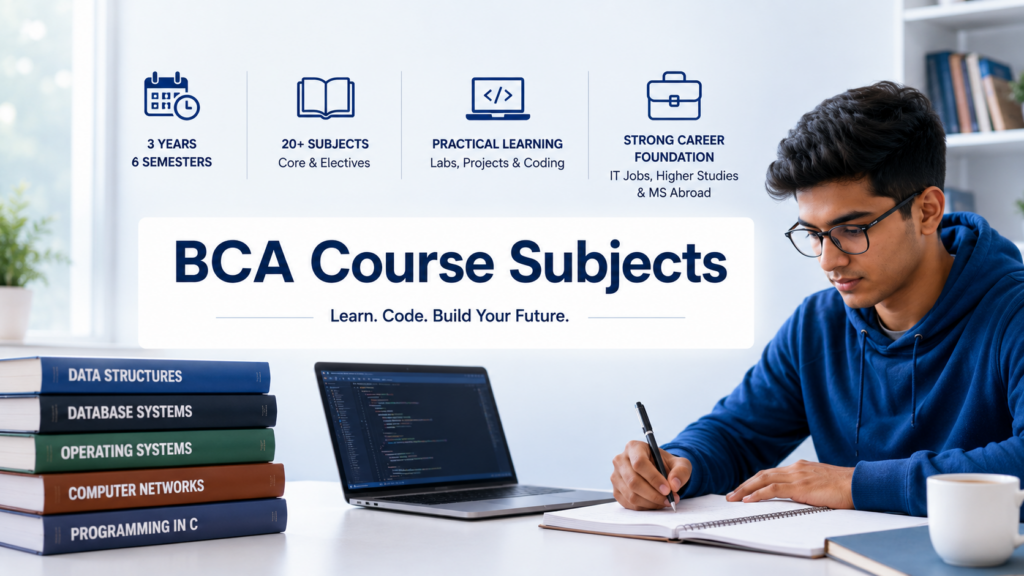
Quick Read
- BCA course subjects span 3 years and 6 semesters, covering 20+ core and electives.
- Most AICTE-approved colleges still require Class 12 Mathematics for admission.
- India’s BCA runs 3 years, versus 4 years for a US Computer Science bachelor’s.
- BCA graduates are exempt from Germany’s dMAT unless officially classified as engineering.
BCA at a Glance
| Duration | 3 years, 6 semesters |
| Eligibility | Class 12 (any stream), 45-50% aggregate; Math required at most AICTE colleges |
| Total subjects | 20-23 core and elective papers |
| Average fees (India) | Rs.30,000-1,50,000 per year |
| Average starting salary | Rs.2.5-4.5 LPA (Data Science track: Rs.3.5-6 LPA) |
| Common entrance exams | CUET UG, IPU CET, SET |
| Top recruiters | TCS, Infosys, Wipro, Accenture, Capgemini |
| Common next steps | MCA, MBA-IT, MS abroad (Canada, UK, Germany) |
BCA Course: What the Program Actually Covers

Choose your dream country
 UK
UK
 USA
USA
 Germany
 Australia
 Ireland
 Canada
 UAE
UAE
 France
 Sweden
 Italy
Italy
 Other
Other
When do you want to study abroad?
What's your highest level of education?
Have you completed Class 12th?
What was your Class 12 CGPA/percentage?
Are you a student or a parent/guardian?
What do you want to study?
Select your current city
How Leap will help you

Personalised University Shortlist

Express Applications with Quicker Admits

End-to-End Application Support
BCA (Bachelor of Computer Applications) is a three-year, six-semester undergraduate degree approved and regulated by AICTE, India's technical education regulator. Each semester carries four to six theory and lab papers, with a project component in the final year. The core BCA course subjects (Programming Fundamentals, Data Structures, DBMS, Computer Networks, Operating Systems, and Software Engineering) repeat across nearly every affiliated college in India, though the exact syllabus and paper names shift depending on which university a college is affiliated with.
Counselor insight: The single biggest confusion students walk in with is assuming "BCA" means one fixed syllabus nationwide. It doesn't. A university-affiliated college follows that university's syllabus; an autonomous college sets its own. Always ask for the exact syllabus document, not a general BCA course subjects list, before you pay any fee.
BCA Course Subjects List: Full Semester-Wise Syllabus
This BCA course subjects list is based on the Guru Nanak Dev University BCA syllabus 2025-26 and the AICTE model curriculum. If you're looking for BCA course subjects semester wise rather than a general overview, the table below is exactly that: subject names vary by college, but the sequence is consistent across most Indian universities.
Note: The syllabus has been verified against the latest GNDU 2025-26 curriculum available as of July 2026. At the time of writing, the 2026-27 syllabus edition had not been released. Since GNDU restricts automated access to its PDF documents, students should refer to the official university website for the latest updates before finalising their academic plan.
| Sem | BCA Course Subjects | Type | Why It Matters |
| 1 | IT Fundamentals / Intro to Computers | Core | Foundation for every IT role |
| 1 | C Programming | Core + Lab | First language; builds logic |
| 1 | Mathematics (Discrete/Applied) | Core | Needed for algorithms and data science later |
| 1 | Digital Electronics | Core | Hardware and logic basics |
| 1 | Communication Skills | Core | Documentation, client calls |
| 2 | Data Structures | Core + Lab | Decides your coding-round performance |
| 2 | DBMS | Core + Lab | SQL appears in almost every IT interview |
| 2 | Mathematics II (Calculus/Stats) | Core | Foundation for later AI/ML electives |
| 3 | OOP (C++ or Java) | Core + Lab | Core software development skill |
| 3 | Operating Systems | Core | System admin, cloud roles |
| 3 | Web Technologies (HTML/CSS/JS) | Core + Lab | Front-end and full-stack roles |
| 3 | Software Engineering | Core | SDLC, Agile used across IT |
| 4 | Design and Analysis of Algorithms | Core | Critical for top-firm coding interviews |
| 4 | Computer Networks | Core | Networking, cloud, cybersecurity roles |
| 4 | Web Programming (PHP/JS frameworks) | Core + Lab | Back-end and full-stack |
| 5 | Mobile App Development | Core + Lab | App development, freelancing |
| 5 | Data Science / Big Data | Core/Elective | Data analyst and data engineer roles |
| 5 | Cloud Computing | Core/Elective | AWS, Azure roles; high 2027 demand |
| 5 | Elective I | Elective | Deepens chosen career track |
| 6 | Cybersecurity | Core | High-salary, fast-growing field |
| 6 | Machine Learning Basics | Core/Elective | Entry AI/ML roles; MS abroad prep |
| 6 | Elective II + Major Project | Elective + Project | Final placement portfolio piece |
Counselor insight: Semester 3, where OOP and Operating Systems land together, is where most students hit their first real wall. Students coding daily from Semester 1 manage it fine. Students relying only on theory notes struggle here every single year.
BCA Course Subjects 1st Year: What You Actually Study First
The BCA course subjects in the 1st year build the base before things get technical. Semester 1 covers C Programming (a universal starting point regardless of stream), Mathematics (set theory, logic, and basic stats), IT Fundamentals (the most approachable paper for most students), and Digital Electronics (new territory for arts/commerce students, lighter than an engineering syllabus).
Semester 2 introduces Data Structures, arguably the single most important paper across all six semesters, since arrays, linked lists, stacks, and queues directly shape your coding-interview performance two years later.
Counselor insight: Students consistently underrate Data Structures in Semester 2 because the early topics look simple. By the time trees and graphs show up in Semester 3, students who skipped building real fundamentals are already behind. Take it seriously from week one.
Looking for BCA course subject books for the 1st-year? Programming in ANSI C by E. Balagurusamy (C Programming), Discrete Mathematics and Its Applications by Kenneth Rosen (Mathematics), and Digital Logic and Computer Design by M. Morris Mano (Digital Electronics) are the most commonly prescribed BCA 1st-year books across AICTE-affiliated colleges.
Buy the edition your specific college prescribes: syllabi shift year to year, and a mismatched edition wastes money. Avoid third-party "free PDF download" sites for these; most infringe copyright and often carry outdated or incorrect editions.
Can You Do BCA Course Subjects Without Math?
The answer depends entirely on the college, not on a national rule.
- Most AICTE-approved and central universities still require Class 12 Mathematics.
- Several private and autonomous colleges have dropped this requirement under NEP 2020.
- Programming subjects (C, Data Structures, OOP) start at zero for everyone, math background or not; nobody is ahead here.
If you're specifically searching for BCA course subjects without math, the honest answer is that it's possible at many institutions, but confirm directly on the specific college's admissions page rather than assuming a blanket rule applies.
BCA Course Subjects vs Computer Science Abroad: How India Compares
Since a real share of BCA students eventually consider a Master's abroad, it helps to see how India's BCA course subjects stack up against an undergraduate Computer Science degree in the countries Indian students actually apply to.
| Country | Degree & Duration | Structure vs BCA |
| India | BCA, 3 years (6 semesters) | Application-focused curriculum with programming, IT, management, and communication subjects. |
| USA | BS in Computer Science, 4 years | Includes a broader general education curriculum alongside computer science core subjects, with a stronger emphasis on theory. |
| UK | BSc in Computer Science, 3 years | Students specialize in computer science from the first year, making the structure more similar to BCA than the US model. |
| Canada | BSc/BCS in Computer Science, 3-4 years | Program structure varies by province, with many universities offering an optional fourth-year Honours program. |
| Australia | BSc in Computer Science, 3 years (+1 Honours year optional) | Covers core computer science subjects from the first year, following a progression similar to UK universities. |
The practical takeaway: a UK or Australian BSc CS runs the same length as an Indian BCA, while a US BS CS runs a year longer with heavier general-education content. This discrepancy is exactly why some US MS programs ask BCA graduates for bridging credits or a stronger CGPA to offset that gap.
Counselor insight: Students often assume BCA and BSc CS abroad are interchangeable because both cover programming and DBMS. The real gap isn't subject overlap; it's the extra year of depth a 4-year US or Indian BTech builds in. A strong BCA CGPA and a portfolio close that gap far more than the subject list itself does.
BCA Course Subjects vs BTech vs BSc CS: Which Fits You
| Factor | BCA | BTech CS | BSc CS |
| Duration | 3 years | 4 years | 3 years |
| Maths intensity | Moderate | High (Calculus, Physics) | Moderate-High |
| Streams accepted | Science, Commerce, Arts | Science (PCM) | Science |
| Annual fees | Rs.30,000–1,50,000 | Rs.1,00,000–5,00,000 | Rs.20,000–1,00,000 |
| Post-grad options | MCA, MBA-IT, MS abroad | MS, MTech, MBA | MSc CS, MCA, MS abroad |
Under NEP 2020, some universities offer a 4-year BCA (Honors with Research) exit, useful if your target MS abroad program specifically requires a 4-year undergraduate degree.
Counselor insight: Every year, TCS, Infosys, and Wipro hire BCA graduates from Christ University Bangalore, Symbiosis SICSR Pune, and VIT. What decides the outcome isn't the degree name. It's the college's placement record, a CGPA above 6.5, and real projects. A BTech from a Tier 3 college often has weaker placements than a strong BCA program.
BCA Elective Subjects: Choosing Your Specialisation
| Elective Track | Key Subjects | Best For |
| Data Science | Python, ML basics, Big Data | Data analyst, MS CS abroad prep |
| AI and ML | Neural Networks, NLP | AI/ML roles are strong for MS admits |
| Web Development | Advanced JS, PHP, React | Full-stack developer, freelancing |
| Cybersecurity | Ethical Hacking, Cryptography | Security analyst; high 2027 demand |
| Cloud Computing | AWS, Azure, Docker | Cloud engineer; certification value |
| Mobile App Development | Android Studio, Flutter | App developer, freelancing |
Elective availability varies by college: confirm which tracks are actually taught and by whom before finalizing admission.
BCA Course Subjects That Matter Most for Placements
Of every BCA course subject, five consistently decide entry-level hiring outcomes: Data Structures (the basis of nearly every coding round), DBMS (SQL comes up in almost every developer or analyst interview), OOP (inheritance, polymorphism, and encapsulation are directly tested in Java/C++ rounds), Computer Networks (essential for cloud/DevOps roles), and Web Technologies (a working project beats a high theory score in interviews).
BCA fresher salaries in India typically range from Rs.2.5 LPA to Rs.4.5 LPA at the entry level, based on aggregated data from Glassdoor. Figures shift often, so check current listings before benchmarking an offer. Students choosing the Data Science elective track can expect Rs.3.5 LPA to Rs.6 LPA at the entry level.
For a US-specific breakdown, see BCA salary in the USA.
Counselor insight: Build two portfolio projects before Semester 5, one using DBMS and one using OOP, and host them on GitHub. In campus drives, that beats a 9 CGPA with nothing practical to show.
Career Paths After BCA: MCA, MBA, and MS Abroad
- MCA: The most direct route. NIMCET and state-level entrance exams apply. Minimum BCA CGPA 6.0/10 at most universities. Starting salaries: Rs.5-10 LPA.
- MBA (IT/Business Analytics): A fit if you enjoyed managerial BCA subjects (HR, Business Organization). CAT, XAT, or CMAT are standard routes.
- MS in Computer Science abroad: BCA is three years; some MS programs need four. Canada accepts three-year Indian degrees at several universities.
See top BCA colleges in Canada. The UK's equivalent isn't literally called "MCA." It's an MSc Computer Science or MSc IT.
- MS in Germany (Summer 2027 intake): BCA graduates are exempt from Germany's dMAT unless APS India classifies the degree as engineering.
Check via APS India's official rules and see dMAT exemption categories for the full breakdown.
Before applying anywhere abroad, convert your CGPA to a percentage using this calculator.
Counselor insight: A three-year BCA does complicate MS abroad applications, but it's not an automatic rejection. Admitted BCA graduates typically show a CGPA above 7.0, a Data Science or AI/ML elective, at least one internship, and a project portfolio admissions teams can actually review. Applying to top-20 US universities straight after BCA with no experience rarely works. Be realistic about fit.
BCA Planning Calendar: Indian Academic Year 2027-30
| Period | Milestones |
| Jun-Jul 2027 | Year 1 begins. Semester 1: C Programming, Maths, IT Fundamentals |
| Nov-Dec 2027 | Semester 1 exams |
| Jan-May 2028 | Semester 2: Data Structures, DBMS begin |
| Jun-Jul 2028 | Year 2 begins. Semester 3: OOP, OS, Web Technologies (hardest stretch) |
| Nov-Dec 2028 | Semester 3 exams. IT internship applications typically open |
| Jan-May 2029 | Semester 4: Computer Networks, Algorithms |
| Jun-Jul 2029 | Year 3 begins. Choose elective now (Data Science track for MS abroad plans) |
| Sep-Oct 2029 | Are you targeting September 2030 for an MS abroad? Start shortlisting and IELTS prep now |
| Nov-Dec 2029 | Semester 5 exams, Project Phase 1. Begin NIMCET prep if MCA is the plan |
| Jan-Mar 2030 | MS Canada application window for September 2030 intake |
| Apr-May 2030 | Semester 6 finals, Major Project, campus placements |
| Jun-Jul 2030 | Graduation. Collect marksheet and provisional certificate; apply for post-grad immediately |
Is BCA Right for You? 3 Student Scenarios
- Commerce student, basic math only: Achievable. Programming subjects start at zero for everyone. Your real challenge is the math paper in Semester 1. Spend two to three months beforehand on algebra and number systems. Request the exact BCA 1st semester syllabus before paying any fee.
- Science student avoiding BTech: BCA course subjects give you a three-year IT pathway without four years of engineering-level physics and calculus. Choose a college with a documented placement record and real elective tracks.
- Planning MS abroad after BCA: Target CGPA 7.0+. Choose the Data Science or AI/ML elective. Complete one internship. Start IELTS or Duolingo prep by Year 2. Begin study-abroad counseling no later than the start of Year 3.
BCA Admission Requirements: Eligibility and Documents
General eligibility: Class 12 from a recognized board, with an aggregate of 45-50% (varies by college). Math is required at most AICTE-approved universities. Minimum age 17.
| Document | India-Specific Notes |
| Class 10 & 12 Marksheets | CBSE/ICSE/state board; attested copies required |
| Class 12 Passing Certificate | Separate from marksheet at most boards |
| Entrance Scorecard | CUET, IPU CET, or SET, if applicable |
| Character Certificate | From Class 12 school, signed by principal |
| Migration/Transfer Certificate | Needed if changing state board or university |
| Aadhaar/ID Proof | For enrollment and scholarship records |
Counselor insight: The most common delay we see is students not having a Migration/Transfer Certificate ready if they've changed state boards. Order it from your old board at least three weeks before the admission deadline; it's the one document that can't be expedited.
Entrance Exams for BCA Admission 2027
| Exam | Conducting Body | Status for 2027 |
| CUET UG | National Testing Agency | Registrations tentatively open in January 2027; the exam is tentatively in May-June 2027. Official notification has not yet been released. Confirm on the NTA site before planning around these dates. |
| IPU CET BCA | GGSIPU | 2027 dates not yet announced as of this writing; 2026 cycle ran April-June. Check the official CET portal directly. |
| SET | Symbiosis International University | For SICSR Pune, 2027 dates not yet released |
What to Do When BCA Goes Wrong
- Fail a BCA course subject (ATKT): You're promoted but must clear the backlog in the next supplementary exam. Backlogs compound and can delay graduation by a year.
- CGPA drops below 6.0 by Year 2: Most campus drives and MCA entrance cutoffs sit at 6.0-6.5. Restructure your study plan around high-credit subjects immediately.
- College loses AICTE approval: Verify AICTE status before admission; if it happens mid-program, approach the affiliating university for a transfer.
- Miss a post-BCA deadline: Missing NIMCET or CUET PG means waiting a year. For MS abroad, Round 2 still works at most Canadian universities, with a smaller scholarship pool.
3 Takeaways on BCA Course Subjects
- If you're a commerce student, verify the Class 12 math requirement at each target college directly, since it determines whether you need a BCA-without-maths college search.
- If you're focused on placements, treat Data Structures, DBMS, and OOP as your three priority BCA course subjects from Day 1, and build two GitHub-hosted projects before Year 3.
- If you're planning MS abroad, start research no later than Year 3. A CGPA of 6.5+, a Data Science or AI/ML elective, and confirmed IELTS/Duolingo scores are the baseline for most international admits.
Verified by: LeapScholar's India and Canada counseling team, with hands-on experience guiding BCA and BTech graduates through postgraduate and study-abroad applications.
Have questions about BCA career paths or study-abroad options? Book a free session with a LeapScholar counselor.
Frequently Asked Questions About BCA Course Subjects
-
What BCA course subjects are taught in the 1st year?
Semester 1 opens with Introduction to Computers, C Programming, Discrete or Applied Math, Digital Electronics, and Communication Skills, then Semester 2 adds Data Structures, DBMS, Mathematics Part 2, and Computer Architecture on top of that. Every semester pairs lab sessions with the theory. The core subject list barely changes across AICTE-approved colleges, even when individual paper names get renamed from campus to campus.
-
Is BCA difficult for commerce students without maths?
It's doable if you prepare before Semester 1. The BCA syllabus 1st year includes Applied Math and Discrete Math from the start. If your Class 12 was mostly accounts and economics, spend a month or two beforehand on basic algebra. Programming papers start fresh for everyone regardless of stream, so that part isn't a disadvantage for commerce students.
-
Is maths compulsory for BCA admission?
At most AICTE-approved universities, yes, Class 12 Math is part of the eligibility bar. That said, a number of private colleges have quietly dropped the requirement under NEP 2020, so it's no longer a universal rule the way it used to be. If BCA colleges without maths is what you're actually trying to find, skip the general assumptions and check each college's official admissions page directly.
-
What's the difference between BCA and BSc Computer Science subjects?
BCA course subjects are built around job-ready skills: programming, software development, web technologies, plus a few management papers. BSc CS goes deeper into the academic and mathematical side of computing, with less immediate job focus. If your goal is working in IT fast, BCA gets you there sooner. If you want research or higher studies in computer science, BSc CS builds a stronger base.
-
Is a BCA equivalent to a Computer Science degree abroad?
Not exactly. A BCA is closest in length and pacing to a UK BSc Computer Science or an Australian BSc CS, both of which also run three years. A US BS in Computer Science runs four years with a heavier general-education load, so BCA graduates sometimes need extra bridging credits or a stronger CGPA to be considered equivalent for a US Master's.
-
Which study-abroad country is most flexible for BCA graduates applying for a Master's?
Canada is generally the most accessible, since several Canadian universities accept a three-year Indian BCA directly for a Master's or postgraduate diploma. The UK evaluates an Indian BCA case-by-case through UK ENIC, and the US often expects a four-year undergraduate degree, so BCA graduates there may need a stronger academic profile to offset the one-year gap.
-
Which BCA subject is most useful for getting a software job?
Data Structures, followed by DBMS and OOP. Most companies build their coding rounds around Data Structures, ask SQL questions tied to DBMS almost universally, and test OOP concepts directly in Java/C++ interview rounds. These three BCA course subjects consistently decide shortlisting outcomes.
-
Which BCA specialization has the highest salary potential?
Data Science and AI/ML tracks currently lead on starting salaries among BCA graduates, with Cloud Computing close behind due to AWS/Azure certification value. Cybersecurity is also growing fast. Your elective choice in Years 2 and 3 measurably affects your first salary offer.
-
Does a BCA degree require the dMAT for Germany Master's applications?
Only if APS India classifies your specific degree title as engineering. Standalone Computer Science and BCA degrees are not automatically on Germany's dMAT-affected list, which currently covers only engineering, commerce/finance/economics, and business/management fields for Summer 2027 intake onward. Confirm your exact classification against the official APS India affected-fields list before assuming either way, since interdisciplinary titles are the most common source of error.
-
Can I study abroad after completing BCA in India?
Yes, but check eligibility carefully at each university. BCA is a three-year degree, and some MS programs abroad require four years. Canada is the most practical option since several universities accept three-year Indian degrees for MS or postgraduate diplomas. A CGPA of 7.0+ improves your chances meaningfully.
-
What happens if I fail a subject in BCA?
You get an ATKT, meaning you move to the next semester but must clear the failed paper in the next supplementary exam, typically held twice a year. Failing the same subject twice can hold back your graduation. Carrying two or three pending BCA subjects into Year 3 usually extends graduation by a full year, so clear backlogs immediately.
-
Which BCA subjects have the highest marks weightage?
Across most universities, Data Structures, DBMS, OOP, Computer Networks, and Software Engineering carry the highest credit weightage, since each combines a theory paper with a practical component. The final-year Major Project also carries substantial marks. Check your specific university's official credit distribution for the exact split.
-
Is Python taught in BCA?
Yes, usually from Semester 3 or 4 onward, since the BCA 1st semester syllabus starts with C Programming. Python typically appears as part of the Data Science elective track in Year 3, though some private colleges introduce it earlier. Check your specific college's semester-wise syllabus.
-
What is the BCA final year project about?
The final-year project spans Semester 5 (Phase 1) and Semester 6 (Phase 2). You identify a real-world problem, build a software solution using skills from your core BCA course subjects, and present it to a panel. Most students build web applications, inventory systems, or basic ML projects. This carries significant marks and is your strongest placement portfolio piece.








Have Questions? Get Guidance to reach your Dream University
Connect with India's finest counsellors and biggest study abroad community.
Get Guidance