
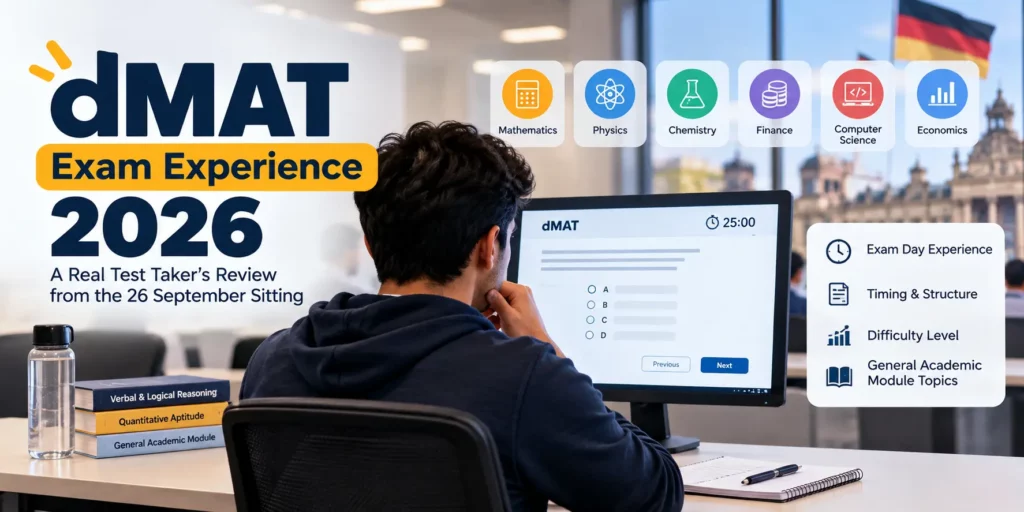
The dMAT (Digital Master Test) is g.a.s.t.’s aptitude exam for Indian Master’s applicants to Germany, introduced as part of the APS documentation process from the Summer Semester 2027 intake onward. This article covers what one candidate actually experienced while sitting the exam on 26 September 2026, alongside the official rules in our dMAT exam pattern guide.
Quick Read
- Reporting time was 7:30 to 8:00 AM for a 9:00 AM exam; check-in was a smooth ID and QR code scan on the admit card
- Core Module ran as three back-to-back 25-minute subtests with a 2-minute optional break between each, then a mandatory 30-minute break before the General Academic Module
- The General Academic Module does not start automatically; the examiner has to activate it after the break
- General Academic Module content ranged across math, physics, chemistry, finance, computer science theory, and economics, far wider than the sample questions suggest
- No negative marking; guessing is encouraged except on Mathematical Equations and Figure Sequences where a blind guess rarely pays off
What Exam Day Actually Looked Like
Quick Answer
arrive 60 to 90 minutes early, expect a smooth ID and QR code check, and pack a transparent water bottle since bags may need to stay outside the exam hall.
Reporting time was 7:30 to 8:00 AM for a 9:00 AM exam slot. Check in was smooth: ID proof verification followed by a QR code scan on the admit card, and both a digital copy and a printout of the admit card were accepted.
There were no safety lockers at the test centre, so bags had to be left outside the exam hall at the candidate’s own risk. A transparent water bottle was allowed inside. Scratch paper and a digital notepad were both explicitly not allowed; everything had to be solved mentally, in line with the no aids rule covered in the dMAT exam pattern guide.
Test centres vary, so treat the reporting time and locker situation as one candidate’s experience rather than a guarantee for your own centre. Still, arriving with time to spare and packing snacks for the break is worth planning around either way.
The Real Timing Structure
Quick Answer
the Core Module runs as three 25-minute subtests with short optional breaks, followed by a mandatory 30-minute break before a 90-minute General Academic Module that the examiner has to manually start.
The official material describes two 90-minute modules with a break in between. What that 90 minutes actually looks like inside the Core Module is more granular than most guides show:
| Segment | Content | Duration | Break after |
|---|---|---|---|
| Core Module, Part 1 | Figure Sequences, 20 questions | 25 minutes | 2 minutes, optional |
| Core Module, Part 2 | Mathematical Equations, 20 questions | 25 minutes | 2 minutes, optional |
| Core Module, Part 3 | Latin Squares, 20 questions | 25 minutes | 30 minutes, mandatory |
| General Academic Module | General Academic Module, around 55 questions | 90 minutes | Exam ends |
Two details worth flagging that aren’t in the official candidate notes:
- The General Academic Module is not an auto start; the examiner has to manually activate it once the 30-minute break ends, and candidates could move freely between questions within a section, check answers, and flag questions for review rather than answering in strict sequence.
- Leaving the room was allowed only during the mandatory 30-minute break, and during that window candidates could access their bags, eat snacks, and even use their phones, with invigilators present throughout.
How Hard the Core Module Really Was
Quick Answer
medium to hard overall, matching the official sample questions, with a few plug-in style Mathematical Equations not seen in any published samples.
Overall, the difficulty was close to that of the official sample questions, mostly medium to hard, with very few easy items. A few specifics from the sitting:
- Mathematical Equations: several questions needed a plug-in technique (testing values rather than solving directly) that doesn’t show up in the official samples
- Figure Sequences: one question had what felt like an irregular jump and may have been a flawed item; the rest matched the rotation, missing number, and grid logic patterns from the samples
- Latin Squares: consistent with the sample format, no surprises
On pacing, the candidate skipped 4 to 5 questions in each subtest to protect time for pattern recognition and review and estimated that 3 to 5 full-length mocks of representative content would make the time pressure manageable for most students.
What Came Up in the General Academic Module
Quick Answer
a wide mix of math, physics, chemistry, finance, computer science theory, and economics passages, testing reasoning from the data given rather than prior subject knowledge.
This is the part with the least public information anywhere, official or otherwise. The General Academic Module ran around 55 questions across roughly 10 tasks in 90 minutes (about 9 minutes per task), on a global timer, heavy on graphs, charts, periodic tables, and diagrams rather than plain text.
Topics recalled from the sitting:
| Subject area | Specific topics |
|---|---|
| Mathematics | Complex numbers, probability, linear equations (3 passages) |
| Physics | Centripetal force, angular velocity, angular acceleration, centrifugal force |
| Inorganic chemistry | Periodic table, atomic size, isotopes |
| Finance and markets | Call and put options, European vs American options |
| Computer science theory | Deterministic finite automata (DFA) |
| Economics and history | Industrial revolution, economic growth, per capita income comparisons |
| Social science | Qualitative research and the interview process |
| Macroeconomics | Differing views on societal inequality, including Karl Marx’s theory |
These exact questions won’t repeat; the General Academic Module draws from a large item bank, but the spread shows this module tests whether you can reason through unfamiliar academic material using the data given in the passage, not whether you already studied the subject. Candidates without a strong math background may find these three passages genuinely difficult, even though most of the information needed is given in the passage itself; those with some prior exposure to the math and physics content will move noticeably faster.
Interface, Navigation, and a Few Surprises
Quick Answer
the interface matched the official demo videos exactly and included an on-screen zoom tool, with no technical issues reported.
The on-screen toolset included a zoom function, and the interface matched the official demo videos exactly. Candidates could navigate freely between questions and flag items for review within each section.
The one friction point wasn’t technical: invigilators made announcements about consent forms and other admin during the test itself, rather than collecting them during the 30-minute break as planned. It was distracting enough to be worth a reminder to staff that the clock was still running.
Scoring and Guessing: What the Exam Signals
Quick Answer
there is no negative marking, and guessing is encouraged, but blind guesses rarely help on Mathematical Equations or Figure Sequences.
Test takers are actively encouraged to guess since there is no negative marking. That said, guessing pays off differently by subtest: on Mathematical Equations and Figure Sequences, a blind guess is close to useless given how the answer options are constructed, so it’s better to spend the time narrowing down the pattern than to guess cold. No on-screen information about scoring or results appeared during the test itself.
Top Tips From Someone Who’s Sat the dMAT
Quick Answer
plan logistics the night before, manage the clock so no single question eats your time, and scan the General Academic Module’s topics before choosing which passages to answer first.
- Plan test day well in advance: pack your bag with a water bottle, ID proof, and a printed admit card the night before
- Sleep on schedule the night before, and plan your travel and venue location ahead of time, some candidates travelled 1 to 2 hours to reach their centre
- On arrival, locate the exam hall first, then the registration counter, then move to your exam hall
- Plan your meals and break snacks in advance
- Every question carries equal weight; don’t get stuck on one question, keep moving, and watch the clock
- Sequence for accuracy: solve the easy and medium questions first to lock in accuracy, take educated guesses on hard questions, and pick one letter of the day ahead of time for any blind guesses
- In the General Academic Module, spend the first 1 to 2 minutes scanning all the topics on offer, answer the passages you’re comfortable with first (this candidate went math questions first, then chemistry, then theory-based passages, saving unfamiliar topics like options trading and DFA for last), and save anything unfamiliar for the end
For a structured run-up to test day, pair this account with our 6-week study plan or a guided dMAT prep course.
A note on sourcing: this account is based on one candidate’s real experience at the 26 September 2026 sitting and should be read alongside, not instead of, the official dMAT exam pattern and g.a.s.t.’s own terms at d-mat.de. Details like reporting time, locker availability, and break protocol can vary by test centre.
Frequently Asked Questions About the dMAT Exam
Does the dMAT General Academic Module start automatically after the break?
No. Based on one candidate’s account, the General Academic Module only begins once the examiner manually activates it after the 30-minute break ends; it isn’t a timed auto start.
Can I leave the room during the dMAT exam?
Only during the mandatory 30-minute break between the Core Module and the General Academic Module. You cannot leave during the timed sections.
Is there negative marking in the dMAT?
No confirmed negative marking exists, and candidates are encouraged to guess rather than leave answers blank, though guessing is far less useful on Mathematical Equations and Figure Sequences than on the General Academic Module. See the full scoring system for how raw answers convert to a scaled score.
Is the dMAT General Academic Module only about your degree subject?
No. One candidate’s sitting included passages spanning math, physics, chemistry, finance, computer science theory, economics, and social science, regardless of their own academic background. The General Academic Module tests reasoning based on the data provided, rather than on recalled subject knowledge.
Are lockers available at dMAT test centres?
Not necessarily. At least one test centre had no safety lockers, and candidates had to leave bags outside the exam hall at their own risk. Confirm locker availability with your specific test centre ahead of time if this matters to you.
Does the dMAT certificate affect my APS application?
Yes. The dMAT is layered on top of APS document verification, not instead of it. See our APS dMAT guide for how the certificate feeds into your APS file, and our dMAT registration walkthrough if you haven’t booked your slot yet.









Have Questions? Get Guidance to reach your Dream University
Connect with India's finest counsellors and biggest study abroad community.
Get Guidance