
Quick Read
- The dMAT Core Module has three fixed subtests for every applicant.
- Each core module subtest runs 20 to 25 minutes.
- The dMAT fee is Rs.16,515 (€150), separate from APS fees.
- There is no negative marking, so guessing pays off.
- Registration for the first India test closes 15 September 2026.
What Is the dMAT Exam Core Module?
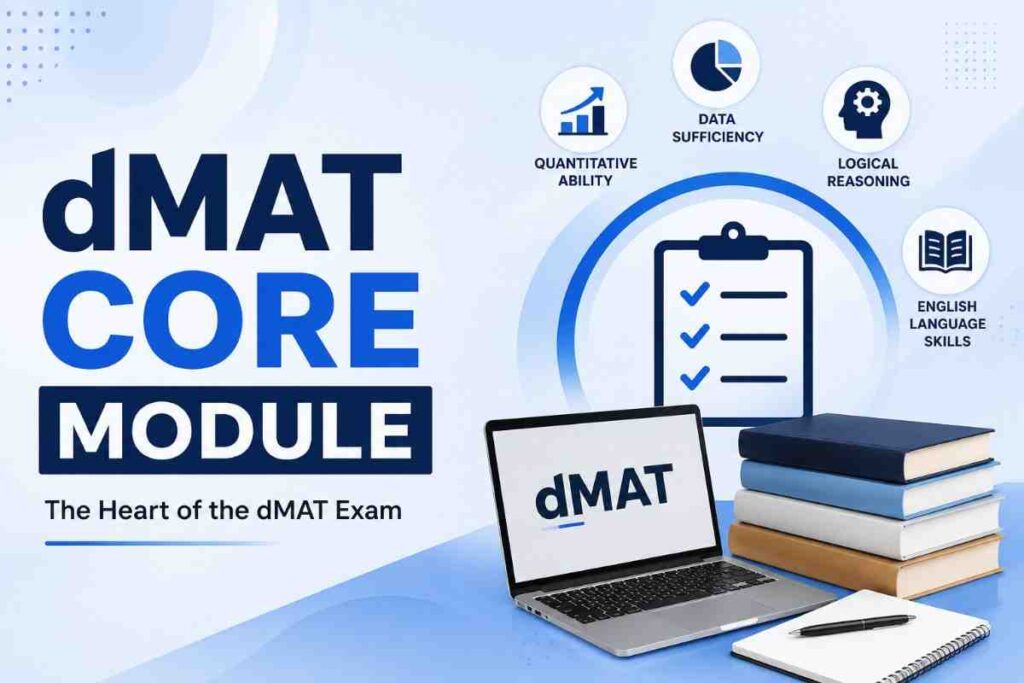
The dMAT is offered by g.a.s.t. (Gesellschaft für Akademische Studienvorbereitung und Testentwicklung) and consists of two modules: a core module and a subject module. The core module measures general study aptitude through three subtests of general cognitive skills, while the subject module tests subject-specific knowledge and application ability. Think of it as a cognitive test layer sitting on top of your academic verification, not a replacement for it.
For Indian applicants, the dMAT was introduced from 2026 as a new additional element inside the APS documentation and verification process for Master’s applicants. It does not replace APS. It sits alongside it.
| Fact | Detail |
|---|---|
| Administered by | g.a.s.t. (also runs TestDaF and TestAS) |
| Developed with | Universities of Ulm and Kassel, originally DAAD-supported |
| Total test duration | Three and a half hours, with a break between modules |
| Applies to | Engineering, Commerce/Accounting/Finance/Economics, Business/Management graduates |
| Applies from | Summer Semester 2027 Master’s intake onward |
| First India test | 26 September 2026 |
Related read: See the full dMAT syllabus for both modules if you also need the Subject/General Academic Module breakdown.
Once your dMAT prep is sorted, zoom back out, our full guide to studying in Germany covers everything else: universities, costs, visas, and scholarships.
dMAT Core Module vs Subject Module
This is the question most students actually search for. Here’s the side-by-side:
| Aspect | Core Module | Subject Module (General Academic Module) |
|---|---|---|
| What it tests | General cognitive and analytical skills | Ability to apply cognitive and analytical skills to academic problem solving |
| Varies by degree field? | No, identical for everyone | No (for APS India, it’s the General Academic Module for all affected fields) |
| Number of subtests | 3: Figure Sequences, Mathematical Equations, Latin Squares | 1 combined module using academic scenario passages |
| Uses memorised facts? | No, it’s a dMAT cognitive test, not a knowledge test | No, it tests transfer and application skill |
| Required for APS India? | Yes, for all affected applicants | Yes, alongside the Core Module |
Counselor insight: Students often assume the Core Module is the “hard, technical” half and the Subject Module is the “easy, general knowledge” half. It’s the opposite framing that trips people up. The Core Module is a dMAT cognitive test built on abstract reasoning speed. The Subject Module is where your actual academic background gives you an edge. Don’t over-prepare for one and walk in cold on the other.
The Three dMAT Core Module Subtests
The Core Module has three subtests: Figure Sequences, Mathematical Equations, and Latin Squares. Here’s exactly what each one demands:
| Subtest | Items | Time | What it actually tests |
|---|---|---|---|
| Figure Sequences | 20 | 25 minutes | Predict how a matrix of figures changes across a series, based on position, colour or orientation rules |
| Mathematical Equations | 20 | 25 minutes | Solve a small system of equations where letters stand for integers between 1 and 20 |
| Latin Squares | 20 | 20 minutes | Complete a 5×5 grid using letters A to E, each appearing once per row and column |
That works out to roughly 75 seconds per item across all three subtests. No calculators, scratch paper, or notes are allowed for any subtest, and guessing costs you nothing since there’s no negative marking.
1. Figure Sequences dMAT: What to Expect
Figure sequences dMAT items show a series of matrices where a shape shifts by a fixed rule (for example, a square moving one step diagonally, then two, then three). You extend the same rule to predict the next matrix in the series. This is pure pattern recognition, not memorised geometry.
2. Latin Squares dMAT: What to Expect
Latin squares dMAT items are 5×5 logic grids, similar to a simplified Sudoku. Most items are solved through elimination: if a row or column is missing only two letters and one already appears elsewhere in that row, the remaining cell has only one possible answer.
3. Mathematical Equations: What to Expect
You’re given a small system where each letter represents a whole number from 1 to 20, and exactly one solution exists. The skill tested is fast mental substitution, not advanced algebra or calculus.
One candidate who sat the 26 September 2026 exam confirmed the real pacing: each subtest runs as its own timed 25 minute block (Figure Sequences, then Mathematical Equations, then Latin Squares), with a short 2 minute break offered between each, optional rather than mandatory.
Counselor insight: The subtest most Indian engineering students underestimate is Latin Squares, not Mathematical Equations. Engineering graduates tend to over-trust their algebra speed and under-practice grid-based elimination logic, since it rarely shows up in Indian engineering coursework the way it does in aptitude tests like TestAS or GMAT.
Related read: For the full timing breakdown across both modules, see the dMAT exam pattern guide, and for practice material, see free dMAT sample questions.
How the Core Module Is Scored
Your core module answers aren’t marked pass or fail. Raw correct answers convert to a scaled score between 0 and 200, with 100 representing the average test-taker. This score is calculated separately for the Core Module and the Subject Module, then combined into a total on your certificate.
Alongside the score, you get a percentile rank: the share of all test-takers, across every centre and test date, who scored at or below you. A percentile rank of 70 means you outperformed 70% of everyone who has sat the test.
There’s no fixed passing score. Each German university decides independently how much weight to give your result, and some may set an informal cut-off, such as considering only the top 10% by percentile.
Counselor insight: Most Indian students expect a percentage-style result, the way board exams work, and the 0-to-200 scale confuses them at first. Treat 100 as “average performance across every test-taker,” not a passing mark, and you’ll read your certificate correctly the first time.
dMAT Exam Core Module Fees, Dates and Registration (2026 Cycle)
| Cost item | Amount |
|---|---|
| dMAT fee | Rs.16,515 (€150) |
| APS certificate fee (separate, existing requirement) | Rs.18,000 |
| Total certification cost | Rs.34,515 |
Exchange rate used: 1 EUR = Rs.110.10. Verify the current rate before finalising your budget, since it moves daily.
This is on top of your actual tuition and living cost planning. See what our counselors say on Master’s course fees and payment structure in Germany for the full semester contribution and blocked account numbers.
| Milestone | Date |
|---|---|
| Registration starts | 29 June 2026 |
| Registration deadline | 15 September 2026 |
| Test date | 26 September 2026 |
| Certificate available | 12 October 2026 |
Test centres are planned in Ahmedabad, Bengaluru, Bhopal, Chandigarh, Chennai, Kolkata, Mananthavady, Mumbai, New Delhi and Pune, with the final list confirmed during registration.
Counselor insight: According to DAAD’s 2025 enrolment data, Indian student numbers in Germany rose to 59,419, a 20% year-over-year increase so test centre seats are likely to fill fast. With this volume of growth, don’t assume a seat at your preferred city will be open if you register close to the 15 September deadline.
How to Plan Your dMAT Exam Core Module Prep
You have roughly 8 to 10 weeks between now and the 26 September 2026 test date. Here’s how to use them:
| Weeks | Focus |
|---|---|
| Weeks 1 to 2 | Take one untimed practice set per subtest. Identify your weakest of the three (Figure Sequences, Mathematical Equations, Latin Squares) |
| Weeks 3 to 5 | Daily 20 to 30 minute drills on your weakest subtest, using official g.a.s.t. and d-mat.de sample materials first |
| Week 6 | Add timed practice, matching the real 20 to 25 minute per-subtest window |
| Weeks 7 to 8 | Two to three full-length timed mock runs of all three subtests back to back, with no notes or calculator |
| Week before test day | Light review only. Confirm your test centre, ID document, and g.a.s.t. portal login |
This calendar also lines up with the Indian academic year: if you’re a final-year student, weeks 1 to 5 typically fall during your last semester’s coursework, so keep sessions short and consistent rather than cramming in one weekend.
Related read: For a full week-by-week study plan, see how to prepare for the dMAT.
What to Do When the dMAT Core Module Goes Wrong
If you score low on the Core Module: A low score does not automatically block your APS certificate. APS India verifies document authenticity separately, and the dMAT result is reported alongside it, not used as a pass or fail gate.
If you miss the 15 September 2026 registration deadline: You cannot sit the 26 September test. This pushes you to the next available cycle, which risks your Summer 2027 intake timeline entirely. If your degree is in an affected field, don’t wait for a university offer before registering.
If there’s a technical problem on test day: Follow the test centre’s on-site instructions and contact g.a.s.t. support directly. Missed time within a module cannot be made up.
If you’re not sure whether your interdisciplinary degree counts: Programs like business analytics, industrial engineering, data science, or financial technology sit between categories. Check your classification against APS India’s official affected-fields list before assuming either way.
3 Takeaways on dMAT Core Module
Three things to act on:
- Confirm whether your specific degree field and intake actually put you inside the dMAT Core Module requirement, and check the exemption list before assuming either way.
- Budget Rs.34,515 total (Rs.16,515 dMAT plus Rs.18,000 APS) and register before 15 September 2026, not after.
- Build subtest-specific timed practice, especially for Latin Squares dMAT items, rather than general aptitude revision.
Verified by: LeapScholar’s Germany counseling team, with hands-on experience guiding Indian engineering, commerce and business graduates through the APS and dMAT process.
Have questions about the dMAT Core Module or your Germany application timeline? Book a free session with a LeapScholar counselor.
Frequently Asked Questions About dMAT Exam Core Module
-
What is the dMAT core module?
The dMAT Core Module is the general aptitude section of Germany’s Digital Master Test. It has three subtests: Figure Sequences, Mathematical Equations and Latin Squares, and it’s identical for every applicant regardless of degree field.
-
Who needs to take the dmat core module?
Indian Master’s applicants whose undergraduate degree is in engineering, commerce/accounting/finance/economics, or business/management applying for the summer semester of 2027 or later, unless they qualify for a transitional or program-based exemption.
-
What is the difference between the dmat core module and subject module?
The Core Module tests general cognitive skills like pattern recognition and logic, the same for every applicant. The Subject Module tests your ability to apply academic knowledge from your own field to a short scenario, which for APS India applicants is the General Academic Module. Note that the dMAT is separate from any university-level test your program might ask for.
-
Can I use a calculator in the dmat core module?
No. Calculators, scratch paper, notes and electronic devices of any kind are not allowed in any Core Module subtest. Only your identity document is permitted on the desk.
-
Is there negative marking in the dmat core module?
No. There is no penalty for a wrong answer, but an unanswered question earns nothing either. Always attempt every item rather than leaving it blank.
-
How long is the dmat core module?
The three subtests run 25 minutes each, 75 minutes of active testing time in total, with a short optional 2 minute break offered between subtests. g.a.s.t. schedules the Core Module as a 90-minute block to allow for instructions and these transitions.
-
Is the dmat core module hard?
It’s designed to test reasoning speed, not subject knowledge, so difficulty depends on your comfort with timed abstract puzzles rather than your degree background. Most students find Latin Squares dMAT items the least familiar, since Indian coursework rarely includes grid-based logic puzzles.
-
How many questions are in the dMAT core module?
There are 60 items total across the three subtests: 20 Figure Sequences, 20 Mathematical Equations, and 20 Latin Squares, adding up to 75 minutes of testing time for the Core Module alone.
-
What are the three sections of the dMAT core module?
Figure Sequences (20 items, 25 minutes), Mathematical Equations (20 items, 25 minutes), and Latin Squares (16 items, 20 minutes). All three are single-choice, computer-based, and run without a calculator or notes.











Have Questions? Get Guidance to reach your Dream University
Connect with India's finest counsellors and biggest study abroad community.
Get Guidance