
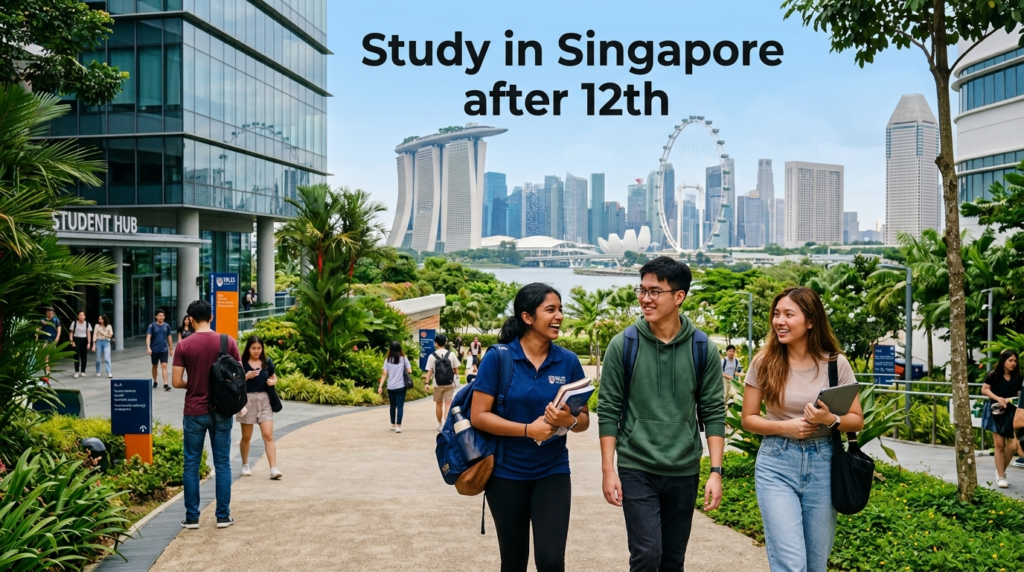
Quick Read
- NUS and NTU are ranked #8 and #12 in the world. Both sit in the QS 2026 global top 15.
- If you’re aiming for NUS or NTU, you’ll need 90%+ in both Class 10 and Class 12 to be competitive.
- Private universities like SIM and JCU Singapore accept 65–75% scores.
- Tuition at NUS or NTU for Indian students runs SGD 17,000–SGD 32,550 (Rs. 12.6 lakh–Rs. 24.1 lakh) per year.
- Budget is roughly SGD 1,500–SGD 2,000 (Rs. 1.1 lakh–Rs. 1.5 lakh) per month for living expenses.
- January 2027 applications open September–October 2026 with a compressed 6–8 week window.
Top Universities to Study in Singapore After 12th
| University | QS 2026 Rank | Type | Annual Tuition Fee | Min. Class 12 Requirement | Strong For |
|---|---|---|---|---|---|
| National University of Singapore (NUS) | #8 | Public | SGD 17,000–SGD 32,550 (Rs. 12.6 L–Rs. 24.1 L) | 90%+ aggregate | Engineering, Computing, Business, Life Sciences |
| Nanyang Technological University (NTU) | #12 | Public | SGD 17,000–SGD 30,000 (Rs. 12.6 L–Rs. 22.2 L) | 90%+ aggregate | Engineering, Materials Science, Business, Media |
| Singapore Management University (SMU) | #511 | Public (Specialised) | SGD 20,000–SGD 28,000 (Rs. 14.8 L–Rs. 20.7 L) | 80%+ aggregate | Business, Finance, Law, Accountancy |
| Singapore University of Technology and Design (SUTD) | #519 | Public (Autonomous) | SGD 33,250 (Rs. 24.6 L) | 85%+ aggregate; strong Physics and Maths | Engineering, Architecture, Computing, AI and Design |
| Singapore Institute of Management (SIM) | Unranked globally | Private (affiliated degrees) | SGD 15,000–SGD 25,000 (Rs. 11.1 L–Rs. 18.5 L) | 65–70% | Business, IT, Media, Psychology |
| James Cook University Singapore (JCU Singapore) | Unranked globally | Private (branch campus) | SGD 18,000–SGD 28,000 (Rs. 13.3 L–Rs. 20.7 L) | 60%+ | Psychology, Marine Biology, Business |
Sources: All university admission pages, QS World University Rankings 2026.
For a full university-wise fee breakdown, see the cost of studying in Singapore for Indian students.
Counselor insight: SMU is the world’s most improved university in QS Subject Rankings 2026, with Business & Management Studies at #39 globally and Accounting & Finance at #50 worldwide, both now in the global top 50. For a specialized business university, these numbers matter more than its overall QS position.

Choose your dream country
 UK
UK
 USA
USA
 Germany
 Australia
 Ireland
 Canada
 UAE
UAE
 France
 Sweden
 Italy
Italy
 Other
Other
When do you want to study abroad?
What's your highest level of education?
Have you completed Class 12th?
What was your Class 12 CGPA/percentage?
Are you a student or a parent/guardian?
What do you want to study?
Select your current city
How Leap will help you

Personalised University Shortlist

Express Applications with Quicker Admits

End-to-End Application Support
Courses to Study in Singapore After 12th: Your Options by Stream
Science (Non-Medical)
NUS and NTU both offer strong undergraduate programs in Computer Science, Electrical Engineering, Mechanical Engineering, Data Science, Chemistry, and Biomedical Sciences. If you had Physics and Maths in Class 12, these are your core options. Computer Science and Data Science are the most competitive programs at both universities for international students.
Private universities like SIM and JCU offer IT, Software Engineering, and related programs with lower entry requirements, often through partnerships with universities in the UK and Australia.
Commerce
SMU is the standout here. Its undergraduate programs in Business Management, Finance, Economics, and Accountancy are genuinely career-focused : mandatory internships, industry partnerships with firms like JPMorgan and Grab, and a case-study learning model similar to US business schools. SIM also offers Business Administration, Marketing, and Logistics programs through UK university affiliations.
Arts and Humanities
NUS has programs in English Literature, Philosophy, Political Science, Communications, and Social Sciences. NTU's Wee Kim Wee School of Communication and Information is one of the best in the region for media students. For students with a pure Arts background, private universities like SIM offer Media Studies, Design, and Psychology programs that are accessible with standard Class 12 marks.
Most In-Demand Courses in Singapore After 12th (2026)
Picking a course isn't just about what you enjoy. It's also about what Singapore's job market will actually pay you for when you graduate. Here's what's genuinely hiring right now, based on 2026 employer demand:
| Course | Where to study? | What is the scope? |
|---|---|---|
| Computer Science / Software Engineering | NUS, NTU, SIM | Tech hiring in Singapore grew over 30% between 2022 and 2024. AI and software roles are among the best-paid entry-level positions in the country right now. |
| Data Science and Business Analytics | NUS, NTU, SMU | Data scientists earn SGD6,200–SGD11,700 (Rs. 4.6 lakh–Rs. 8.7 lakh) per month. Finance, healthcare, and logistics are all hiring hard in this space. |
| Cybersecurity | NUS, NTU, SIM | The field is a national priority in Singapore, not just a tech niche. Government agencies, banks, and MNCs are all hiring consistently, and the supply of trained graduates is still short. |
| Business Administration / Finance | SMU, SIM, NUS | Singapore is Asia's financial center. JPMorgan, DBS, McKinsey, and Accenture recruit directly from NUS, NTU, and SMU campuses. SMU has mandatory internships built into the degree. |
| Biomedical Sciences | NUS, NTU | Singapore's healthcare sector is projected to grow 30% by 2030. Research labs, medical technology firms, and pharma companies are the main employers for graduates. |
| Sustainable Engineering / Green Technology | NTU, SUTD | The Singapore Green Plan 2030 is creating real jobs in clean energy, green infrastructure, and sustainability consulting. This is early-stage demand, which means less competition right now. |
One thing worth knowing: A degree from NUS or NTU in tech or finance puts you at an average starting salary of SGD 5,600 (Rs. 4.1 lakh) per month. Senior roles in AI and cybersecurity go well above SGD10,000 (Rs. 7.4 lakh) per month. That's the return on what you're investing in tuition.
Sources: SMU Academy 2026, Ministry of Manpower Singapore
Counselor insight: Indian students frequently prioritize Computer Science at NUS or NTU without considering alternative options. The acceptance rate for international students in CS at NUS is extremely low. If CS is your goal, have Data Science or Information Systems as a serious backup, not an afterthought. The employment outcomes are nearly identical.
Eligibility Criteria to Study in Singapore After 12th
Your eligibility depends entirely on which university you're targeting. Public universities are selective; private ones are more accessible. Here's everything in one place:
| University | Min. Class 12 % | English Requirement | SAT / Other | Notes |
|---|---|---|---|---|
| NUS | 90%+ | IELTS 6.5 or TOEFL 90+ | SAT may be needed for STEM programs | Class 10 marks also reviewed |
| NTU | 90%+ | IELTS 6.5 or TOEFL 90+ | SAT may be needed for Engineering | Subject scores reviewed individually |
| SMU | 80%+ | IELTS 6.0 or TOEFL 85+ | Not required | Interview shortlisting for some programs |
| SIM | 65–70% | Not required for CBSE/ICSE | Not required | Rolling intake; flexible entry |
| JCU Singapore | 60%+ | Not required for CBSE/ICSE | Not required | Direct application; year-round intake |
A note for the students: SOP and two academic LORs are required at all five universities. For NUS and NTU, your individual subject scores matter as much as your overall aggregate. A strong Maths score carries more weight for Computer Science than a high overall percentage with average Maths.
Decision Framework: Which Path Fits You?
- If you are a CBSE student with 92%+ in PCM (Physics, Chemistry, Maths) and aiming for an engineering or computing program . NUS or NTU are realistic targets. Start your application by October and have your SAT or IELTS ready.
- If you are a Commerce student from any board with 75–82% and a strong interest in Business or Finance, SMU is your best bet in Singapore. Its case-study model suits students who are confident in class participation. Apply between November and March.
- If you are an Arts or Humanities student with 60–72% from any board and want to study Psychology, Media, or Business . Private universities like SIM or JCU Singapore are the practical entry points. They offer rolling intakes and lower entry bars.
Study in Singapore after 12th: Documents Checklist for Indian Students
| Document | India-Specific Details |
|---|---|
| Class 10 marksheet | Attested copy of CBSE/ICSE/State Board marksheet |
| Class 12 marksheet | Attested copy; if results aren't out yet, predicted scores letter from school |
| Provisional / passing certificate | Required once results are declared |
| Passport (valid for at least 18 months) | Standard requirement; photocopy of biodata page |
| Statement of Purpose (SOP) | 500–800 words; program-specific, not generic |
| Letters of Recommendation (LOR) | 2 academic LORs from teachers who taught you recently |
| English proficiency score | IELTS / TOEFL scorecard (if required by program) |
| Bank statement / financial proof | Typically 3–6 months of family bank statements showing sufficient funds |
| Passport-size photographs | Recent, white background, colour |
| Medical examination report | Required for Student's Pass via ICA (specific format on ICA website) |
Tuition Fees and Cost of Living in Singapore for Indian Students
Tuition Fees
The numbers below are annual costs for international students.
| University Type | Annual Tuition | In INR |
|---|---|---|
| NUS / NTU (public, non-subsidised) | SGD17,000–SGD32,550 | Rs. 12.6 lakh–Rs. 24.1 lakh |
| SMU (public, non-subsidised) | SGD20,000–SGD28,000 | Rs. 14.8 lakh–Rs. 20.7 lakh |
| SIM / Private (international affiliations) | SGD15,000–SGD25,000 | Rs. 11.1 lakh–Rs. 18.5 lakh |
Sources: NUS Registrar Office, NTU Tuition Fees 2026
Monthly Cost of Living
| Expense | Monthly Cost (SGD) | Monthly Cost (INR) |
|---|---|---|
| Accommodation (shared HDB room) | SGD700–SGD1,200 | Rs. 51,786–Rs. 88,776 |
| Food (hawker + occasional cooking) | SGD300–SGD500 | Rs. 22,194–Rs. 36,990 |
| Transport (MRT/bus) | SGD80–SGD150 | Rs. 5,918–Rs. 11,097 |
| Utilities (if not included in rent) | SGD80–SGD120 | Rs. 5,918–Rs. 8,878 |
| Personal and miscellaneous | SGD150–SGD250 | Rs. 11,097–Rs. 18,495 |
| Total (estimated) | SGD1,310–SGD2,220 | Rs. 96,955–Rs. 1,64,240 |
Source: Numbeo, April 2026
Counselor insight: On-campus hostel rooms at NUS and NTU are significantly cheaper than private housing: typically SGD400–SGD700/month (Rs. 29,592–Rs. 51,786). The problem is they fill fast. Apply for hostel accommodation the moment you receive your admission offer. Waiting even two weeks can mean you're looking at private rentals, which easily cost SGD800–SGD1,200/month.
For a complete breakdown of university-wise costs, see the cost of living in Singapore.
Scholarships for Indian Students to study in Singapore After 12th
An important note to the students: The ASEAN Undergraduate Scholarship at NUS and NTU is not available to Indian students. India is not a member of ASEAN. The scholarship covers nationals of Brunei, Cambodia, Indonesia, Laos, Malaysia, Myanmar, the Philippines, Thailand, and Vietnam only. If you've been reading about it and assuming it applies to you, it doesn't.
That said, there are real options for Indian students. Here's what actually applies to you:
| Scholarship | Who can apply? | What it covers? | Bond / Condition | Apply via |
|---|---|---|---|---|
| MOE Tuition Grant | All international students at public universities, including Indians | Reduces tuition by 30–50% per year | 3-year work bond: must work for a Singapore-registered company after graduation | Applied through your university at the time of admission |
| NUS Science and Technology Undergraduate Scholarship | Citizens of Asian countries excluding Singapore (India qualifies) | Full subsidised tuition after MOE Tuition Grant, plus a living allowance | Highly competitive; academic record must be exceptional | No separate application needed; considered automatically through NUS admission process |
| NTU Nanyang Scholarship | All international students, including Indians | Full tuition plus SGD 6,500 (Rs. 4.8 lakh) per year for living | Merit-based; very competitive | Apply via NTU admissions portal alongside your program application |
Before you apply, keep these in mind:
- The MOE Tuition Grant comes with a 3-year work bond. You must work in Singapore after graduation. If you plan to return to India immediately or pursue a US master's right after, factor that in before signing.
- NUS and NTU scholarships are highly competitive. Strong Class 12 marks are necessary but not enough. Co-curricular record, leadership, and your personal essay all count.
- Apply for scholarships through the admission portal. No separate application is needed for the NUS Science and Technology Scholarship. The NTU Nanyang Scholarship is applied alongside your program application.
Counselor insight: Don't accept the MOE Tuition Grant without thinking through your post-graduation plan first. If you intend to pursue a career in Singapore, feel free to accept it. If you're unsure, understand what the bond actually means before you commit.
For more details on the scholarships and the eligibility criteria for Indian students, see scholarships to study abroad after 12th.
Student’s Pass: How to Get Your Singapore Study Visa After 12th
The student visa is officially called a Student's Pass (STP) in Singapore. It's issued by the Immigration and Checkpoints Authority (ICA). You cannot attend classes without it.
Step-by-step process:
- Receive your official letter of acceptance from your Singapore institution.
- Your institution registers you on ICA's SOLAR system and sends you a Registration Acknowledgement Letter.
- Log in to the ICA e-Service (SOLAR) and complete eForm 16 using your reference number.
- Pay the non-refundable SGD 45 (Rs. 3,329) application processing fee.
- ICA reviews your application: standard processing takes 1 to 4 weeks. During June to August (peak intake season), expect 4 to 6 weeks.
- If your request is accepted, you will get an In-Principle Approval (IPA) letter. You can also use this letter to get into Singapore.
- When you arrive in Singapore, go to the ICA Building or the location your school has designated for paperwork (biometrics, medical report submission).
- Pay the SGD 60 (Rs. 4,439) issuance fee. Your digital Student's Pass is emailed within 24 hours of completing formalities.
Part-time work rules: Under your Student's Pass, you can work up to 16 hours per week during term time. You can work full-time during official breaks between semesters, and you don't need a separate work permit. Source: Ministry of Manpower Singapore.
What to do if things go wrong?
In case your STP application is rejected:
The most common reasons are incomplete documents, missing financial proof, or an institution that isn't EduTrust-certified (for private universities). Don't apply again right away. First, contact your school's admissions team. They deal with ICA regularly and can identify exactly what's missing before you submit again.
Your 12th marksheets aren’t published
If your 12th marksheet isn't available because results aren't declared, get a predicted scores letter from your school on official letterhead. Most institutions accept this as a provisional document.
For full visa costs and a step-by-step guide, see Singapore study visa for Indian students and Singapore Student Visa fees.
Month-by-Month Application Timeline for Indian Students to Study in Singapore After 12th (2026–27)
If you're finishing Class 12 in 2026 and planning to start in Singapore in August 2027, here's when to do what:
| Month | Action |
|---|---|
| June–July 2026 | Class 12 results declared (CBSE/ICSE). Collect attested marksheets. Begin university research. |
| August–September 2026 | Shortlist universities. Draft SOP. Request LORs from teachers. Check IELTS requirements per program. |
| October 2026 | NUS and NTU application windows open (typically from October onward). Begin applications. |
| November–December 2026 | Submit NUS and NTU applications. Apply for SMU. Take the IELTS if required. |
| January–February 2027 | NUS and NTU application deadlines typically fall in February. Final submission. |
| March–April 2027 | Scholarship interviews at NTU (March to May). Watch your email closely. |
| May–June 2027 | Admission offers are typically released. Accept offer. Apply for Student's Pass immediately via SOLAR. |
| June–July 2027 | Apply for the Student's Pass at least 2 months before the course starts. Arrange accommodation. |
| August 2027 | Arrive in Singapore. Complete ICA formalities. Begin classes. |
Why Study in Singapore After 12th?
Here's what actually makes Singapore worth considering:
- World-recognized ranked universities: The National University of Singapore ranks 8th in the QS World University Rankings 2026, where it's also the only Asian university in the world’s top 10.
- A degree with genuine market value: NUS and NTU degrees hold significant value for recruiters in Singapore, Southeast Asia, and India. For students targeting MNCs or tech careers, this matters more than many realize.
- English throughout, from day one: All programs, across all universities, are taught in English. No language transition, no adjustment period.
- One of the safest places in Asia: Singapore ranked 11th on the Global Peace Index 2025, one of the highest safety rankings in Asia. For Indian families evaluating whether to send their child abroad, this is not a small thing..
- The job market is built around you: Google, JPMorgan, Facebook, and hundreds of other global companies have their Asia-Pacific headquarters in Singapore. When you graduate from NUS, NTU, or SMU, you are entering a job market where Google, JPMorgan, and McKinsey run their Asia-Pacific operations. The hiring ecosystem is built around these campuses.
- Shorter programs, faster career entry: Most bachelor's programs in Singapore run three to four years. That's often a year shorter than equivalent programs in the UK or US, which means lower total cost and an earlier start to your career.
A note for the students: NUS and NTU are genuinely competitive for international students. If your Class 12 aggregate is below 85–90%, private universities like SIM and JCU Singapore are real and solid options. Just know it's a different path, with different outcomes. Plan with that in mind from the start.
Wondering what careers look like after graduating? See job opportunities in Singapore for Indians and average salary in Singapore for Indian students.
Counselor insight: Students who plan to study in Singapore after 12th assume that getting into any Singapore university gives them the same outcome. It doesn't. NUS and NTU graduates and SIM graduates have genuinely different hiring trajectories in Singapore. Know which path you're on before you apply.
Key Takeaways
- Check your eligibility honestly. If your Class 12 percentage is above 90%, NUS and NTU are worth targeting. Below that, SMU, SIM, or JCU Singapore are real, viable options. Not fallbacks.
- Build your budget in INR using the April 2026 rate (1 SGD = Rs. 73.98). Total annual cost at a public university, including tuition and living, can run Rs. 24 lakh–Rs. 39 lakh. At a private university, expect Rs. 22 lakh–Rs. 32 lakh. Know this number before you apply, not after.
- Act on timelines. NUS and NTU application windows typically open in October and close by February. Missing that window means waiting another year. Private universities offer more flexibility with rolling intakes, but don't use that as a reason to delay.
Frequently Asked Questions About Studying in Singapore After 12th
-
Can Indian students study in Singapore after 12th?
Absolutely. Whether you've done CBSE, ICSE, or a state board, you're eligible to apply directly to undergraduate programs in Singapore after Class 12. NUS and NTU will look at your academic performance, English proficiency, and in some cases SAT scores. Private universities like SIM and JCU are more flexible and take applications on a rolling basis, so there's no single fixed window to worry about.
-
How much does it cost to study in Singapore after 12th?
Tuition at NUS or NTU runs between SGD 17,000 and SGD 32,550 (Rs. 12.6 lakh to Rs. 24.1 lakh) per year for international students. On top of that, budget roughly SGD 1,500–SGD 2,000 (Rs. 1.1 lakh–Rs. 1.5 lakh) per month for living expenses. When you add it all up, the total for a year at a public university, tuition plus living, comes to roughly Rs. 24 lakh–Rs. 39 lakh. Private universities are a bit lower. These aren't small numbers, so plan your budget before you apply, not after.
-
What percentage is required in Class 12 to get into Singapore universities?
It depends on where you're applying. NUS and NTU are genuinely competitive for international students. Most students who are admitted have a score of 90% or above. SMU sits around 80% and above. If you're at 60–75%, private universities like SIM and JCU are the realistic entry points, and they cover good programs too. Stream also matters. A 90% in Commerce won't automatically qualify you for an Engineering program at NTU.
-
Which courses can Indian students study in Singapore after 12th?
Quite a few, actually. Engineering, Computer Science, Data Science, Business Administration, Finance, Accountancy, Law, Communications, Psychology, Life Sciences, Architecture, and Design are all available across public and private universities. What's open to you depends on your Class 12 stream and the specific university. Science students have the widest range; Arts and Commerce students have strong options too, especially at SMU and SIM.
-
Is IELTS compulsory to study in Singapore after 12th?
Not always. If you went to a CBSE or ICSE English-medium school, private universities will generally accept that without asking for IELTS or TOEFL. For NUS and NTU, it's safer to have your IELTS (6.5 overall) or TOEFL (90+ iBT) ready, even if your board was English medium. Some programs waive it; others don't. Don't assume either way. Check the specific program admission page before you decide to skip the test.
-
Do Indian students qualify for the ASEAN Undergraduate Scholarship?
No, and this is a common misunderstanding worth clearing up early. The ASEAN scholarship at NUS and NTU is for nationals of ASEAN member countries: Brunei, Cambodia, Indonesia, Laos, Malaysia, Myanmar, the Philippines, Thailand, and Vietnam. India isn't part of ASEAN. What Indian students can actually apply for are the MOE Tuition Grant, the NUS Science and Technology Undergraduate Scholarship, and the NTU Nanyang Scholarship. Those are the real options worth researching.
-
How does the Student's Pass work for Indian students going to Singapore?
Once you have your Letter of Acceptance, your institution registers you on ICA's SOLAR system. You fill out eForm 16 online and pay a non-refundable SGD 45 (Rs. 3,329) processing fee, and ICA typically takes one to four weeks to process it. Peak season (June to August) can extend the processing time to six weeks, so it's advisable to avoid any last-minute submissions. If approved, you get an in-principle approval letter, which also works as your entry visa. The actual Student's Pass costs SGD 60 (Rs. 4,439) and is issued digitally now.
-
Can Indian students work part-time while studying in Singapore?
Yes, and many do. With a Student's Pass at an MOE or CPE-registered institution, you can work up to 16 hours a week during term. When semester breaks arrive, you can work full-time. You don't need a separate work permit for any of these activities. The one condition: you must be enrolled in a full-time diploma or degree program. Language schools and short courses don't qualify.
-
Is Singapore too expensive for Indian students?
Compared to India, yes. Compared to the UK, US, or Australia, it's often more manageable than people expect, especially when you consider that most programs here are three to four years, not four or five. Monthly costs for a student living in shared accommodation and eating at hawker stalls typically run SGD 1,310–SGD 2,220 (Rs. 96,955–Rs. 1,64,240). That's real money, but it's not unmanageable with some planning. Part-time work, on-campus housing, and home cooking can significantly reduce that figure.








Have Questions? Get Guidance to reach your Dream University
Connect with India's finest counsellors and biggest study abroad community.
Get Guidance