
Quick Read
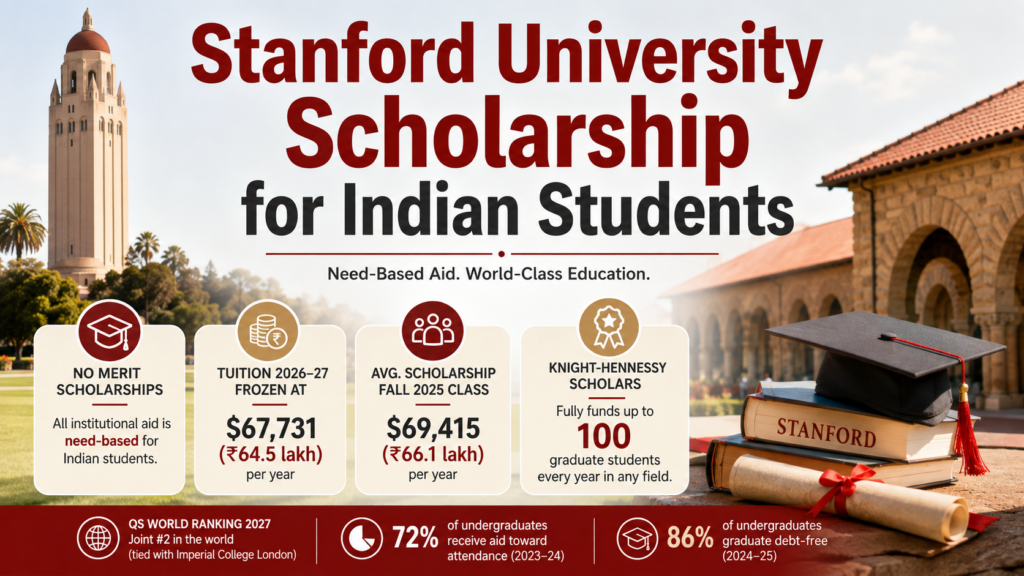
- Stanford has no merit scholarships; all institutional aid is need-based.
- International applicants must request aid at the time of application, not later.
- Tuition for 2026-27 is frozen at $67,731 (₹64.5 lakh).
- Knight-Hennessy Scholars fully funds up to 100 graduate students yearly, in any field.
Stanford University at a Glance: Before You Plan Your Scholarship Strategy
| Fact | Data |
| Global ranking | Joint #2 in the QS World University Rankings 2027 (tied with Imperial College London), behind MIT |
| Undergraduate aid policy | Need-blind for all applicants, but need-aware for international citizens who request aid |
| Total scholarship aid awarded, 2023-24 | $314.2 million (~₹2,992 crore) |
| Undergraduates receiving aid toward attendance, 2023-24 | 72% |
| Average scholarship, Fall 2025 incoming class | $69,415 (₹66.1 lakh) |
Exchange rate used: ₹95.22 per USD as of August 2026. Verify the current rate before finalizing your budget.
Sources: QS World University Rankings 2027 | Aid statistics from Stanford’s Undergraduate Education Facts page and Stanford’s 2026-27 tuition announcement.
Note: If you are researching a Stanford University scholarship, unlearn one thing most guides get wrong: beyond a handful of athletic awards, Stanford offers no merit scholarships at all. It offers need-based aid, with one Stanford-specific twist: the policy is need-aware, not need-blind, once an international citizen requests aid.
Does Stanford Give Scholarships to Indian Students? Need-Based, Not Merit
Stanford’s admissions office is explicit: financial aid is awarded strictly on demonstrated need. There is no merit-based Stanford University scholarship for academic performance or leadership, however strong the profile.
For domestic applicants, Stanford is fully need-blind. For international citizens, requesting financial aid becomes a factor in admission evaluation. This is the biggest distinction between Stanford and a school like MIT, which is need-blind for international applicants too.
Counselor insight: This one-time decision, made before you know your outcome, is more final than most applicants realize. If you don’t request aid at the time of application and later get admitted, you generally can’t request it afterward unless your citizenship status changes.
Stanford University Scholarship Cost of Attendance 2026-27: What It Covers and What Indian Families Actually Pay
The Stanford University scholarship isn’t a fixed cash amount tied to one expense. It’s gift aid, applied against your total cost of attendance, scaled to close the gap between your family’s calculated contribution and the full cost. It never has to be repaid.
What Does the Stanford University Scholarship Cover?
| Expense | Covered by Stanford University Scholarship? | Notes |
| Tuition | Yes, up to 100% depending on need | Fully covered for families with annual income under $150,000 (≈₹1.43 crore) |
| Room and board | Yes, up to 100% depending on need | Fully covered for families with annual income under $100,000 (≈₹95.22 lakh) |
| Books and personal expenses | Partially, via an allowance | Estimated, not billed directly |
| Health insurance | Sometimes included | Varies by circumstance |
| Travel to/from Stanford | Not covered by the undergraduate scholarship | Budget separately |
Stanford University Cost of Attendance (2026–27)
For 2026-27, Stanford held undergraduate tuition steady at $67,731 (₹64.5 lakh), the same as 2025-26. Room and board rose 3.5% to $22,944 (₹21.85 lakh), for a combined $90,675 (₹86.3 lakh) in fees before books and personal expenses.
| Cost Component | Who It Applies To | Amount |
| Tuition, 2026–27 (frozen from 2025–26) | Students without aid | $67,731/year (₹64.5 lakh/year) |
| Room and board, 2026–27 | Students living on campus | $22,944/year (₹21.85 lakh/year) |
| Family income threshold for free tuition | Families with typical assets | Under $150,000 (₹1.43 crore) |
| Family income threshold for free tuition, room, and board | Families with typical assets | Under $100,000 (₹95.2 lakh) |
| Average scholarship, Fall 2025 incoming class | Aided undergraduates | $69,415/year (₹66.1 lakh/year) |
| Undergraduates graduating debt-free, 2024–25 | Graduating class | 86% |
Exchange rate used: ₹95.22 per USD as of August 2026. Verify the current rate before finalizing your budget.
Note: Stanford hasn’t published one consolidated 2026-27 total cost figure at writing time; tuition and room/board above are confirmed via Stanford’s official tuition announcement. Check the official Stanford Financial Aid cost pages before finalizing your budget.
Counselor insight: Don’t anchor on the $90,675 sticker figure. Almost 72% of undergraduates receive some aid, and the number that matters is your net price after aid, not the headline fees.
Stanford University Scholarship Eligibility and Application for Indian Undergraduates
Who Is Eligible for a Stanford University Scholarship?
- Admission to Stanford as an undergraduate, for any nationality, including Indian citizens.
- Demonstrated financial need, calculated from family income and assets, not academic performance.
- No minimum GPA or test score to qualify for the scholarship itself; academics affect admission, not the aid amount once admitted.
- International citizens must indicate their need for aid on the application form itself; such requests can’t generally be added after admission unless citizenship status changes.
- There is no age limit and no restriction by intended major, including bachelor’s and dual-degree programs.
Stanford also awards a small number of athletic scholarships, requiring recruitment by a Stanford coach and NCAA Division I eligibility; this process is a separate track from financial aid.
There is no separate scholarship application form beyond the standard admission and financial aid process. Financial aid is assessed through the same documents for every applicant, domestic or international.
Documents Required for Stanford University Scholarship
| Document | Purpose | India-Specific Detail |
| CSS Profile | The primary financial aid application, assesses family income and assets | Indian bank statements and tax documents must be converted to English/USD |
| Financial aid request declaration | Factored into admission for international citizens | Submitted with your application form; can’t be added later except on a citizenship status change |
| Parent’s income tax statements | Confirms taxed and untaxed income | ITR-V or Form 16 for salaried parents; audited statements for self-employed parents |
| Proof of assets | Calculates expected family contribution | Property, fixed deposits, and investment statements, per standard CSS Profile documentation |
Key Stanford University Scholarship Deadlines
Financial aid priority filing dates differ by round: November 15 for Restrictive Early Action, February 15 for Regular Decision.
| Application Round | Deadline |
| Restrictive Early Action | November 15 |
| Regular Decision | February 15 |
Note: International students also need a Social Security Number or ITIN to actually receive scholarship funds once admitted, per Stanford’s International Students financial aid page. Plan for this step after admission, since it’s a common last-mile delay. This same need-based process applies regardless of home country, including for Pakistani and other international applicants.
Counselor insight: Since the aid request is factored into admission, don’t skip it hoping a strong profile carries you either way. If you have genuine need, declare it; looking “need-free” to boost odds usually backfires without helping your chances.
Knight-Hennessy Scholars: Stanford’s Flagship Graduate Scholarship for Indian Students
This is the single biggest funding opportunity most competing guides undersell. Knight-Hennessy Scholars is a fully funded graduate fellowship, open to citizens of all countries, and here’s exactly how it works:
| Detail | What You Need to Know |
| Who it’s for | 100 high-achieving students selected globally every year, any citizenship |
| Eligible degrees | JD, MA, MBA, MD, MFA, MPP, MS, and PhD, any of Stanford’s graduate programs |
| What it covers | Tuition and fees, plus a stipend for room, board, books, health insurance, one annual travel allowance, and personal expenses |
| Duration | Up to three years; longer programs like an MD or PhD have the remainder funded by the department |
| How to apply | Two separate online applications: one via the Knight-Hennessy portal, one to your Stanford graduate program, both targeting the same enrollment year |
| 2027-28 cohort deadline | October 6, 2026, well before most graduate program deadlines |
Confirmed on the official Knight-Hennessy eligibility page.
Counselor insight: Indian applicants often discover Knight-Hennessy after already applying to their Stanford program, missing the earlier deadline. Build that timeline first, then work backward.
MBA and Graduate Funding at Stanford GSB and Other Departments
Outside Knight-Hennessy, most Stanford graduate funding is need-based and department-specific, similar to MIT.
| Funding Route | How It Works | Key Detail |
| Stanford GSB need-based fellowships | Awarded directly by GSB, based on demonstrated need | Excludes loans by design; international students should research home-country loans first, often at better rates |
| Research and Teaching Assistantships | The dominant funding channel for Master’s and PhD programs outside GSB | Arranged directly through departments |
| Stanford MD program | Not an MBBS; a graduate-entry program funded through the same need-based model | Searches for “Stanford MBBS fees” should look here instead |
For the 2025-26 academic year, the Stanford MBA’s single-student cost of attendance was $135,771 (₹1.29 crore): $85,755 (₹81.6 lakh) tuition plus living expenses, housing, and mandatory medical insurance. GSB tuition rises roughly 3% for 2026-27; check the official GSB cost of attendance page for the current figure.
Counselor insight: Don’t let outdated posts set MBA funding expectations. Treat Reliance Dhirubhai as a bonus on GSB aid, not your primary plan.
External Scholarships Indian Students Can (and Can’t) Use for Stanford
The same problem that trips up MIT applicants hits Stanford applicants harder: the Inlaks Shivdasani Foundation, one of the most commonly recommended external scholarships, explicitly excludes Computer Science, Engineering, Business/Finance, and Management (MBA). Since CS is Stanford’s largest undergraduate major, this exclusion rules out a large share of its Indian applicant pool.
| Scholarship | What It Covers | Who Can Actually Use It for Stanford |
| Inlaks Shivdasani Foundation Scholarship | Up to $100,000 (₹95.2 lakh) for tuition, living, travel, and health cover | Only humanities, social sciences, fine arts, law, architecture, and pure sciences; not CS, engineering, business, or MBA |
| JN Tata Endowment Loan Scholarship | Interest-free loan up to ₹20 lakh, repayable over 7 years from year 3 | Open to all disciplines including engineering, for Master’s, PhD, or postdoctoral study |
| Narotam Sekhsaria Foundation PG Scholarship | Interest-free, repayable loan up to ₹20 lakh, merit-based | Postgraduate study only, across most fields; Indian citizens under 30 residing in India |
| Fulbright-Nehru Master’s Fellowship | Full tuition, living stipend, travel, and health insurance for up to two years | Applicants with at least 3 years of work experience and a bachelor’s degree at 55% or higher; not suited to fresh undergraduates |
Inlaks’ exclusions: Inlaks Foundation official eligibility page | JN Tata’s terms: JN Tata Endowment official FAQ | Narotam Sekhsaria: Foundation’s official PG Scholarship portal | Fulbright-Nehru: USIEF’s official Fulbright-Nehru Master’s Fellowships page.
Counselor insight: If you’re an engineering or CS applicant, cross Inlaks off immediately, and skip the Tata Scholarship or Rotary Ambassadorial Scholarship for Stanford, since neither applies here anymore.
Stanford University Scholarship Application Timeline for the 2027-28 Intake
| Milestone | Date | What Happens |
| Restrictive Early Action (REA) deadline | November 1, 2026 | Application components due |
| Financial aid priority deadline (REA) | November 15, 2026 | CSS Profile and aid materials due |
| REA decision release | Mid-December 2026 | Admission decision released |
| Knight-Hennessy Scholars deadline (2027-28 cohort) | October 6, 2026 | Separate application, before graduate deadlines |
| Regular Decision (RD) deadline | January 5, 2027 | Application components due |
| Financial aid priority deadline (RD) | February 15, 2027 | CSS Profile and aid materials due |
| RD decision release | Around April 1, 2027 | Admission decision released |
| Enrollment reply deadline | May 1, 2027 | Admitted students confirm enrollment |
Dates are confirmed on Stanford Admission’s Counselor Resources page and the Knight-Hennessy Scholars site, updated each cycle; recheck closer to your application season.
Counselor insight: Knight-Hennessy’s deadline falls three months before Regular Decision. If graduate funding matters, this date should anchor your entire calendar.
Planning your Stanford application? Read our guide, How to Get into Stanford University from India, for a step-by-step breakdown of the admissions process, application requirements, and timelines.
Which Stanford University Scholarship Path Fits Your Situation?
- Class 12 student, family under ₹95 lakh, applying for Fall 2027 undergraduate: File the CSS Profile by your round’s priority deadline and declare your need, expecting $0 tuition, room, and board if your numbers hold. Treat JN Tata or Narotam Sekhsaria as backup, not primary funding.
- Final-year BTech student applying for a Fall 2027 master’s in CS or Engineering: Knight-Hennessy is your best shot at full funding; its deadline lands months before most graduate deadlines, so start there first. Inlaks isn’t an option; JN Tata’s loan can help cover any shortfall.
- Working professional applying to the Stanford MBA: apply for GSB’s need-based fellowships as your primary plan, verify Reliance Dhirubhai’s status independently, and layer in Fulbright-Nehru with 3+ years of experience.
What to Do If You Don’t Get Aid or Miss the Deadline?
Missing a financial aid priority deadline doesn’t disqualify you outright, but since Stanford’s policy is need-aware for international citizens, missing your declared-aid window matters more than at a need-blind school like MIT. Submit what you have by the deadline and follow up immediately.
If your aid package is insufficient, you have three options:
- Contact Stanford’s Financial Aid Office directly if your family’s circumstances changed materially after filing the CSS Profile.
- Research loan options in India first, since Stanford GSB explicitly recommends this route for international students, often at better rates than US lenders.
- Layer in an external scholarship you’re actually eligible for, such as JN Tata or Narotam Sekhsaria, rather than defaulting to Inlaks without checking exclusions.
Counselor insight: Don’t assume a lower offer is final. Stanford’s aid office reviews changed circumstances, but only if raised proactively with documentation, not after enrollment.
3 Takeaways on Stanford University Scholarship
- Stanford scholarships for Indian students are available only through need-based aid, and international applicants must declare their need at application, not after.
- Knight-Hennessy Scholars is Stanford’s biggest graduate opportunity, but its October 2026 deadline falls months before most graduate deadlines, so plan around it first.
- Verify every external scholarship’s relevance before counting on it: Inlaks excludes CS and engineering; the Tata Scholarship is Cornell-only; and Rotary’s Ambassadorial Scholarship was discontinued in 2013.
Verified by: LeapScholar’s USA counseling team, with hands-on experience guiding Indian students through Stanford and Ivy League financial aid applications.
Have questions about Stanford scholarships or your own financial aid strategy? Book a free session with a LeapScholar counselor.
Frequently Asked Questions About Stanford University Scholarship
-
Does Stanford give scholarships to Indian students?
Stanford gives financial aid to Indian students through a need-based process, not merit scholarships, which it doesn’t offer outside a few athletic awards. Indian applicants use the same CSS Profile and aid request process as any international citizen, and Stanford meets 100% of demonstrated need for admitted students who request aid.
-
Is Stanford need-blind for international students?
Stanford is need-blind for domestic applicants, but for international citizens, requesting financial aid is a factor in the admission evaluation itself. This need-aware policy means Indian applicants should declare their need for aid carefully at the time of application, since it generally can’t be added later.
-
Can you get a full scholarship to Stanford?
A $0-cost outcome is realistic for undergraduates from families earning under $100,000 (₹95.2 lakh), since Stanford covers tuition, room, and board fully at that income level. For graduate study, Knight-Hennessy funds 100 students globally each year across any field.
-
What is the Knight-Hennessy Scholarship, and who is eligible?
Knight-Hennessy Scholars is Stanford’s flagship graduate fellowship, funding up to three years of any graduate degree for 100 students annually, with no restrictions based on citizenship, age, or field. Applicants must apply separately to Knight-Hennessy and to an eligible Stanford graduate program; the 2027-28 cohort deadline is October 6, 2026.
-
Is the Tata Scholarship available for Stanford applicants?
The Tata Scholarship, funded by the Tata Education and Development Trust, is exclusive to Cornell undergraduates and doesn’t apply to Stanford. Older study-abroad content listing it as a Stanford option is incorrect; look at JN Tata Endowment or Narotam Sekhsaria Foundation instead.
-
Is the Inlaks Shivdasani Scholarship valid for Stanford engineering or CS applicants?
Inlaks’ official eligibility list excludes Computer Science, Engineering, Business and Finance, and Management/MBA. Since CS is Stanford’s largest major, Inlaks isn’t usable for most of its Indian applicants; JN Tata or Narotam Sekhsaria are better alternatives.
-
What happens if I don’t request financial aid when I apply to Stanford?
International applicants who indicate they won’t apply for aid and are subsequently admitted generally aren’t eligible to request it later unless their citizenship status changes. This makes the decision at application time far more consequential for international citizens than for domestic applicants.
-
How much does a Stanford undergraduate actually pay after financial aid?
The average scholarship for Stanford’s Fall 2025 class was $69,415 (₹66.1 lakh), against a combined 2026-27 tuition and room-and-board cost of $90,675 (₹86.3 lakh). Amounts vary by income, with $0 tuition, room, and board under $100,000 (₹95.2 lakh).
-
Is the Stanford Reliance Dhirubhai Fellowship still active for Indian MBA applicants?
Its current status couldn’t be confirmed on an official GSB page at the time of writing, and recent sources suggest it may have been paused or discontinued since around 2024. Verify directly with Stanford GSB’s financial aid office before relying on it.






Have Questions? Get Guidance to reach your Dream University
Connect with India's finest counsellors and biggest study abroad community.
Get Guidance